Voters in Steinbach and Winkler are expecting to get the chance this October to decide whether to end a ban on cannabis retail stores in the southern Manitoba cities.
The issue was lit up again by petitioners, after councils in both cities decided not to back a plebiscite on ending the prohibition.
Jesse Lavoie, the president of Cannabis distributor TobaGrown, is leading the effort, saying attitudes in the fast-growing cities have changed since the last plebiscites were held, just days after federal legalization of cannabis in October 2018.
Selling cannabis “obviously goes against religious views … which are big in these cities,” he said.
But “if people look how busy their liquor stores are … the sky is not falling,” said Lavoie.
Steinbach and Winkler were among the last Manitoba municipalities to loosen their liquor laws. Winkler’s first liquor store opened in 2013, after a 2003 plebiscite approved alcohol sales. Steinbach voted to allow bars and cocktail lounges in 2011.
Organizers say so far, nearly 3,800 residents in Steinbach and 2,300 in Winkler have signed petitions approved by the Liquor, Gaming and Cannabis Authority of Manitoba calling for a plebiscite on cannabis stores in October’s civic elections. That surpasses the minimum required, according to the organizers.
Under provincial regulations, a plebiscite on cannabis stores can be launched either by a municipal council, or if a petition calling for one is signed by at least 20 per cent of registered voters.
When the federal government legalized cannabis sales in 2018, Manitoba gave municipalities the plebiscite option. An overwhelming 69 per cent of Steinbach voters and 70 per cent of Winkler voters voted in favour of bans in late October of that year.
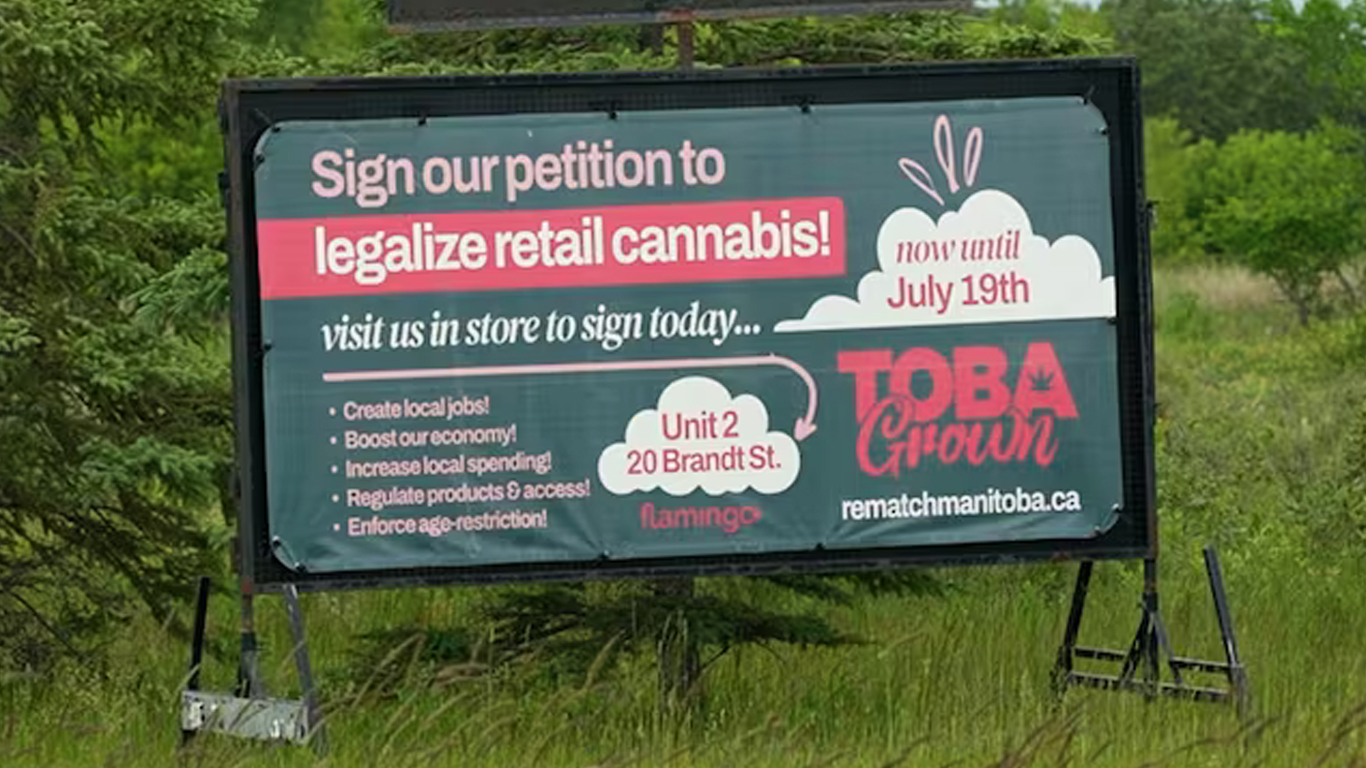
Manitoba-based cannabis retailer Flamingo Plus now has stores in Steinbach and Winkler — but they can’t sell cannabis.
They’re currently limited to selling nicotine vapes and pot paraphernalia, but are asking people to sign the petitions at the stores. The Steinbach store’s petition will be available until July 6, while the Winkler store’s is open until July 19. Identification is required to prove residency.
“Our team and Flamingo’s team, we worked out a schedule so that every single day, seven days a week, we’d have at least two people in the city literally going parking lot to parking lot, door to door,” said Lavoie.
Steinbach Flamingo store manager Cayla Pyziak is still taking to the city’s streets, trying to get as many signatures as possible before the petition is officially submitted.
She was surprised to see the wide variety of people putting their names down over the last three months, she said.
“I’ve had people that have lived here their whole lives, people that came from another country or another city, or have been here long enough to know that this isn’t really a realm of cannabis for a lot of people. It was a very big mix,” said Pyziak.
Non-users want vote
Not everyone who signed the petition is interested in buying cannabis, she said.
“I’ve noticed a big influx of people that just want to have their say, or have their right to choose,” said Pyziak.
Lavoie said even some retail cannabis opponents signed the petition as a matter of principle.
“This is more about democracy and allowing the people to choose. So we actually had a lot of people sign the petition who want to vote no in October,” he said.
He thinks many who do not use cannabis see a benefit to allowing sales, particularly around curbing illegal sales.
With legal sales prohibited, those looking for cannabis “just go down the street to their local illegal drug dealer, versus having to drive a 50-minute round trip” to a legal pot shop, he said.
Last August, Steinbach city council denied a request from Lavoie to approve a plebiscite on allowing retail cannabis sales in the city.
Steinbach Deputy Mayor Michael Zwaagstra told CBC at the time he didn’t support a plebiscite because he hadn’t heard any locals raising the issue.
The growing city has “a lot more important issues,” Zwaagstra said last year. “We don’t simply rush to have a plebiscite because someone who lives in Winnipeg asks us to hold one.”
Councils opposed
Jac Siemens was the only member of Steinbach’s seven-member city council to vote in favour of holding another plebiscite.
He argued a vote should be held for each new business that wishes to build in Steinbach. A similar tactic was used after Steinbach’s ban on alcohol establishments in 1972, which lasted until restaurants were allowed to serve booze in 2003. The city’s first liquor store opened in 2009.
“For me, it’s not a council decision. They gave that privilege away when they decided to hold a referendum [in 2018],” said Siemens.
Zwaagstra said allowing alcohol meant restaurants that wanted lounges came to Steinbach, but cannabis is different.
“There is no social benefit you get from having cannabis stores within the city,” Zwaagstra said last year.
Lavoie, who also lobbied for changes to provincial laws that now allow Manitobans to grow up to four of their own cannabis plants, says after the votes this October, he will turn his attention to pushing for rules to allow for public places where cannabis can be used, similar to lounges that serve alcohol.
Read the full article at CBC News