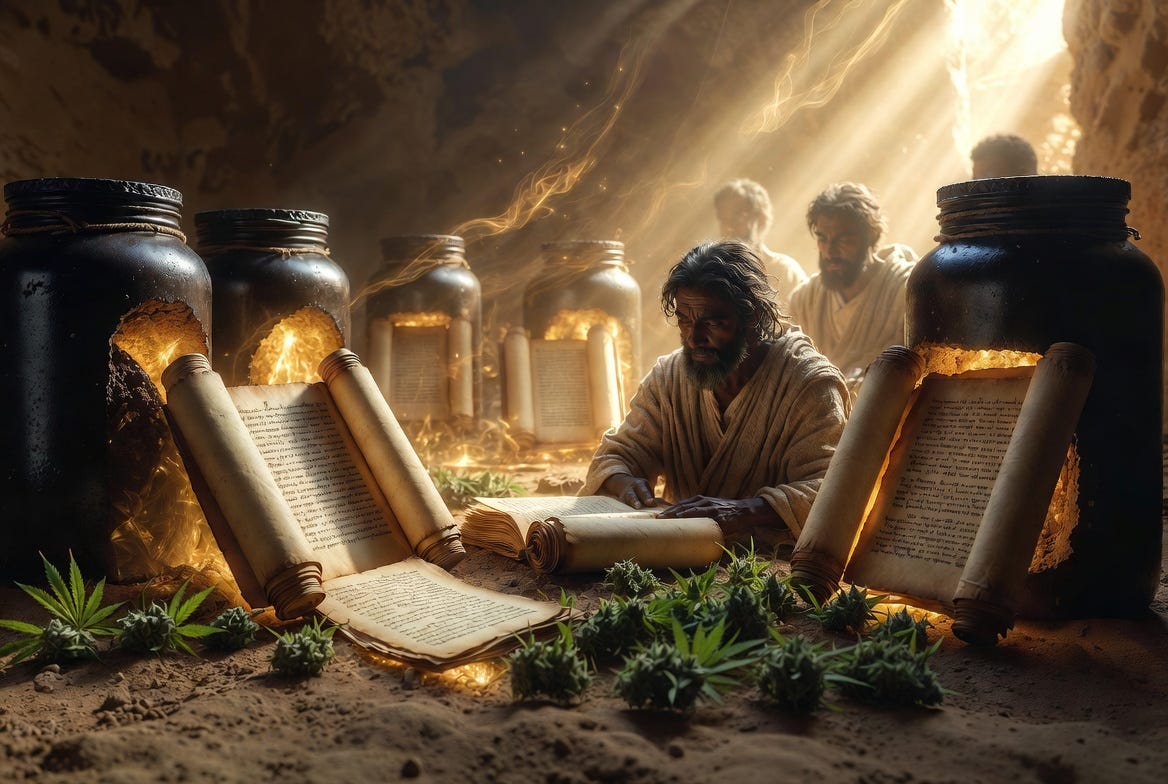
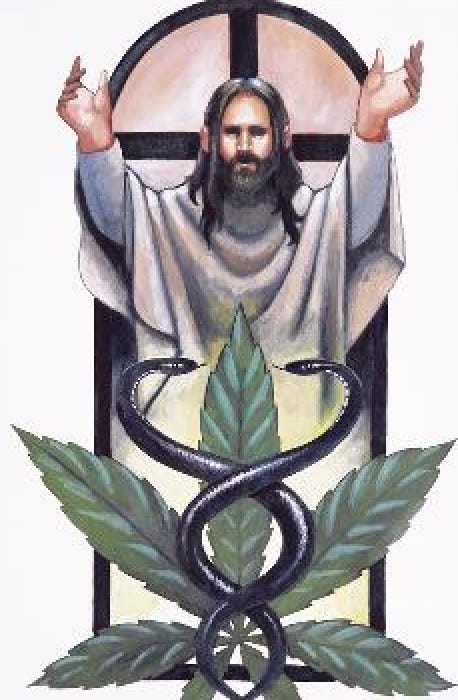
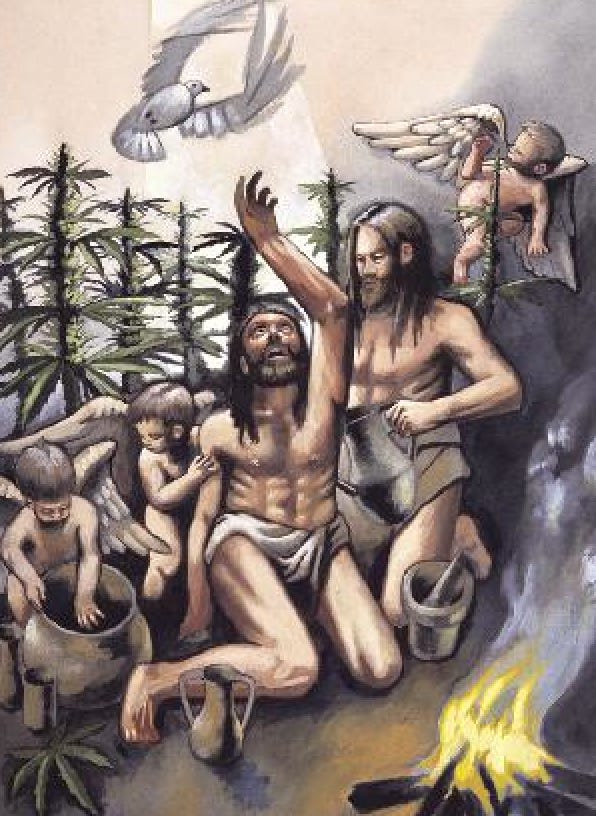
“Whoever has ears, let them hear what the Spirit says… To the one who is victorious, I will give the right to eat from the tree of life, which is in the paradise of God.”
Revelation 2:7
Clearly, Jesus promise here, stands in opposition to the prohibitions of Eden. We are reminded of Jesus positive association with the serpent in the Bible (John 3:14-15) and in Gnosticism, where both the serpent and forbidden fruit act as initiators to a new state of consciousness.
This is Part 10 from My Substack Series on Apocalypticmania:
Breaking taboos can serve as a powerful form of initiation by shattering ordinary boundaries of consciousness, morality, or social order, thereby granting access to hidden knowledge, personal transformation, or spiritual awakening. In this framework, the deliberate transgression of forbidden acts functions like a ritual ordeal or “forbidden fruit” test — forcing the initiate to confront fear, guilt, and limitation, then emerge with new insight or power. Classic examples include the Gnostic reading of Eden, where the serpent leads Adam and Eve to break God’s taboo on the Tree of Knowledge, resulting in gnosis and liberation from the Demiurge’s control; the use of prohibited entheogens like cannabis in ancient and modern rituals to dissolve ego and access visionary states; and various mystery traditions or countercultural acts that turn legal/spiritual outlaw status into a badge of enlightenment and resistance against empire. In each case, the taboo-breaker is “lifted up” through the very act that society condemns, mirroring the serpent typology in John 3.
Cannabis prohibition functions as a modern sacred taboo — an artificial legal, moral, and institutional barrier erected by systems of control (echoing the false god’s command in Eden) that criminalizes a natural plant long associated with healing, prophecy, and divine connection (kaneh bosem in the Bible, soma/haoma in ancient traditions). Breaking it becomes a deliberate initiatory act: the outlaw risks arrest, stigma, and social exile, yet gains direct gnosis through the plant’s altered states, heightened awareness, and ritual use. This transgression shatters the programming of fear and obedience, fostering personal sovereignty, anti-authoritarian insight, and a form of “victory” akin to eating from the Tree — turning the prohibited into the pathway for revelation and resistance.
Ironically, considering the role of the serpent in the Eden tale, one of the early slurs against cannabis was ‘viper’, said to have come from the hissing sound made when someone sucks on a joint to inhale. Like the forbidden fruits of Eden’s trees, the youth were warned off marijuana with threats of death and insanity. However, those who broke these horrific taboos, found themselves with eyes opened to new perception just as Adam and eve did in the eden fable. Like the God of the Bible who was distressed by this, so to were our own Authorities, as can be seen in the reactions to the cannabis infused Jazz Age, and the social revolutions of the Hippy generation who burned cannabis flowers in rebellion.
Another Biblical taboo was to peak behind the veil in the temple, into the sacred inner chamber, the Holy of Holies, which interestingly held symbolic items related directly to the Garden of Eden. Behind that veil stood a ritual microcosm of the Garden of Eden: guarded by cherubim (recalling those stationed at Eden’s entrance after the expulsion), an image of the serpent, the sacred tree and other sacred elements of the creation myth.
In the Jewish Temple, the Holy of Holies stood as the most sacred inner chamber, believed to house God’s divine presence, accessible solely to the High Priest—and only once a year on Yom Kippur—its profound secrets guarded behind a massive, thick curtain known as the veil or parochet, embroidered with cherubim and woven from fine linen in blue, purple, and scarlet. This impenetrable barrier enforced the ultimate taboo, hiding what lay beyond from all eyes and underscoring the lethal holiness of the unapproachable divine realm: unauthorized entry was considered a violation punishable by death. The High Priest prepared rigorously with ritual baths, special white linen garments, incense, and sacrificial blood offerings for atonement; as the consecrated and anointed representative (via the holy anointing oil central to priestly initiation), he alone could part the veil to perform these rites, emerging to affirm divine acceptance for the people. This system embodied profound reverence, ritual purity, the mediated nature of approaching the divine, and the absolute secrecy surrounding the mysteries within the Holy of Holies in ancient Israelite tradition.
The literal meaning of “Revelation” is itself an act of unveiling—a pulling back of the veil. This physical curtain separating the main Temple from the Holy of Holies carries deep symbolic resonance with the very concepts of revelation and apocalypse, terms whose Greek roots literally mean “unveiling” or “pulling back the veil” to disclose hidden truths. Just as the High Priest alone was permitted a momentary glimpse behind the barrier into the divine mysteries on the Day of Atonement, apocalyptic literature and visionary experience involve the dramatic removal of such veils—granting insight into heavenly realities, cosmic secrets, and the true nature of the sacred that everyday existence conceals. In this sense, the Temple veil stands as a powerful archetype for the human quest to pierce the ordinary and encounter the ultimate hidden reality. By looking behind the curtain, we might not only get a look at the secrets of the inner temple and a glimpse of Oz, but also find the secrets of the religions own origins…
In Greek, the book’s title is Apokalypsis, which simply means “revelation” or “unveiling.” It is not primarily about catastrophe or the dramatic end of the world as many assume today. Instead, it is about removing the covering that hides divine realities, exposing what lies beneath the surface of history, power, and religious tradition.
At the centre of the inner sanctum of the Holy of Holies was the sacred tree symbolism—the Tree of Life echoed in the menorah and other furnishings—along with, in earlier Israelite traditions, connections to the goddess Asherah. Her totems or poles (stylized trees) represented fertility, wisdom, and the divine feminine. As we have seen throughout this series, Asherah is intimately tied with Eden’s Eve, “the mother of all living,” and the serpent-associated motifs of life and knowledge. Asherah, as Yahweh’s consort in popular ancient worship before stricter monotheistic reforms, embodied aspects of the nurturing, life-giving presence that the Temple’s Holy of Holies ritually preserved and restricted.
In this way, entering the Holy of Holies was like a symbolic return to Eden—crossing the boundary between the ordinary world and the divine source, with the veil acting as both protector and barrier. The tearing of the Temple veil at Jesus’ crucifixion (as described in the Gospels) dramatically signals that this access is now opened wider, a profound unveiling of what was once hidden from most people.
In many ways, this Apocalypticmania series has been slowly pulling back that same veil on the apocalypse itself. Together we examined its origins in Jewish and Gnostic thought, its Zoroastrian influences, the preterist interpretations tying it to first-century events under Domitian or Nero, and the psychological and political power of end-times thinking. We have peeled back the layers of apocalyptic literature—its roots in temple ritual and goddess traditions, its evolution into later orthodox narratives—and explored their lingering implications in our own time: how apocalyptic mindsets continue to fuel modern conflicts, dispensationalism, propaganda, and cultural battles.
Just as the original Revelation pulls back the veil to reveal the true nature of empires, persecution, and ultimate victory, this shared exploration uncovers the human and historical realities behind the texts. It invites us all to see beyond the surface fear-mongering or literalist predictions, toward a clearer view of power, spirituality, and possibility. In a world still gripped by apocalyptic anxieties—whether political, environmental, or prophetic—we continue this timeless act of unveiling together, helping each other navigate what lies behind the curtain with clearer eyes and grounded insight. With the Tree of Life, that journey can end with hope and optimism. Revelation 2:7 reveals what is in the centre of the Garden and the goal of the Apocalypse, and Revelation 22, shows Eden restored and the Tree of Life in it’s former place of glory.
As I detailed in Part 2 of this series, Surfing the Apocalypse: Trump, Marijuana and My 36 Year Struggle with Apocalypticmania, 36 years ago, I had an experience where I felt it was divinely expressed to me, that this Tree of Life was cannabis. Now, I’d never expect anyone to believe that, based on my claim of a personal experience. In fact, even I didn’t, and I spent the following decades of my life, looking for proof of that, which I do think, makes a convincing case that in some points of time and areas of the ancient World, cannabis was viewed as that very Tree of Life. Indeed, I believe what I have found through pulling back the veil on the Bible, leads to that conclusion.
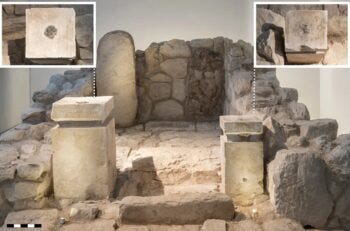
Solid historical research has indicated a variety of sources regarding the important role entheogens played in shamanistic ecstasy, enabling humanity to “hear the voices of the gods” as with the Oraculor cannabis smoke infused chamber at tel Arad.
The ‘Holy of Holies’ at tel Arad, the temple room, which would have been enclosed is about 2 meters by 2 meters, and the larger incense altar on the right, used for frankincense, a little less than a meter tall, the smaller altar on the right was used for burning cannabis resins.
The final redaction of the Old Testament comes from a time when religious revelation stagnated and degenerated into dogma, moral codes, and a means of controlling populations. Cannabis fell by the wayside, because those in power had little use for new revelations that could challenge the orthodoxy, and the entheogenic sacraments became prohibited. A transition that is mythically described in the Genesis story of the prohibition of the Tree of Knowledge of Good and Evil and the Tree of Life. In the Eden myth Yahweh, who falsely told mankind that they would die if they ate of the forbidden tree, shows himself in fact to be more afraid of the self realization that they might acquire. For after the original couple had partaken of the forbidden fruit, the Lord lamented that: “’The man has now become as one of us, knowing good and evil. He must not be allowed to reach out his hand and take also from the tree of life and eat, and live for ever’. So the Lord God banished him from the Garden of Eden to work the ground from which he had been taken. After he drove the man out, he placed on the east side of the Garden of Eden cherubim and a flaming sword flashing back and forth to guard the way of the tree of life.’”(Genesis 2:22-24).
Yahweh’s reference to “us” certainly brings to mind other unidentified players, as in the original Hebrew polytheistic pantheon headed by El, of which Yahweh was only a bit player, but also as in the Gnostic concept of an Evil Archon aided by co-creators. Not surprisingly this ancient myth was the basis of so much of the entheogen imbibing Gnostic’s own theological reversals. In many ways, the rediscovery of the cannabis Tree of Life and other entheogens, (many of which could be potential candidates for the original Tree of Knowledge), may mark the realization of Yahweh’s ancient fears, as well as humanities reentrance into the Garden of Eden, if in fact we ever left it at all…
As Franz Kafka wrote, perhaps “we live continuously in Paradise… whether we know it… or not.” A fellow German similarly commented that “Through clever and constant application of propaganda, people can be made to see paradise as hell, and also the other way around to consider the most wretched sort of life as paradise.”(Adolf Hitler) The rediscovery of the entheogens and the vast implications they have on theories concerning the development of religion give clear indications that we are in fact in Paradise but are the victims of a cruel and malicious hoax that would lead us to believe otherwise. It’s like through the Bible the veil of Ialdabaoth/Yahweh was pulled over the eyes of much of humanity. But what if the voices of the Gods were the shamanistic revelations of our ancient ancestors and first beginnings of the word in the mind of man? Then the flaming cherubim and the God who placed them between us and the forbidden trees of Paradise are all of our own creation, and the Exile is self imposed.
As the ancient Gnostics of the Valentinian school explained: “since human beings created the whole language of religious expression, so in effect, humanity created the divine world: ‘…..and this (Anthropos) is really he who is God over all”. Words echoed by the author of the Nag Hamadi’s Gospel of Phillip: “God created humanity; (but now human beings create God.) That is the way it is in the world—-human beings make gods, and worship their creation. It would be appropriate for the gods to worship human beings !”
In our own time, one is reminded of the Genesis tale by the way our own Authorities have blindly prohibited these once sacred substances and branded them as evil, warning of death and degradation, if not expulsion from society, for those who are drawn to break these prohibitions, and taste these forbidden fruits. Again like the Gnostic reversals of the Genesis myth, we can see that to further divert humanity in their quest for spiritual Gnosis, the rulers of our own time, as with the Gnostic’s malicious “Authorities”, in order to have their own materialistic ends served, have conspired against humanity and “threw Mankind into a great distraction and into a life of toil, so that their Mankind might be occupied by worldly affairs, and might not have the opportunity of being devoted to the Holy Spirit” (The Hypostasis of the Archons).
As a result of this conspiracy, humanity has become more and more separated from the natural world–Eden, which continually finds itself buried beneath cities and asphalt–The Highway to Hell is indeed paved. The rediscovery of the entheogens may offer us a means of reaquaintance with the natural order, and a way of return back to the Garden. For if there is one thing that can break through the pavement encasing our earthly paradise, its a weed….
The Resurrection of the Lord
Emerging research highlights how Marcion of Sinope’s mid-2nd-century canon — featuring a shorter Gospel of the Lord (an earlier form of Luke) and a collection of Pauline letters — may predate the canonical Gospels, with key elements like the virgin birth, physical resurrection of the dead, and many miraculous flourishes notably absent. Scholars increasingly suggest that Paul’s letters and other New Testament texts were later expanded, edited, or in some cases forged to align with emerging orthodox views and counter Marcionite/Gnostic influences, adding Jewish prophetic ties and supernatural details that were not part of the earliest layers. This points to a first-century Jesus story that was originally far more human — a teacher and reformer whose message centered on spiritual insight rather than the divine birth, bodily resurrection, and grand miracles that later defined the official narrative.
To the Gnostics and in the Gospel of John, Jesus Christ was the Logos, the “Word”, and it was what he said that established him in the minds of those who knew him. In a sense, the rediscovery of the “Word” of Jesus, as contained in the Nag Hamadi Library and other surviving Gnostic documents marks the resurrection of a more historical Jesus, an ecstatic rebel sage who preached enlightenment through rituals involving sex and drugs and a Jesus who threatened the overthrow of the status-quo of the time. A Jesus who is more analogous to the Indian Shiva, or the Greek Dionysus, then the pious ascetic creation of the Roman Church that has come down to us through the Bible’s New Testament. Certainly, the reintroduction of such an archetypal figure as this, as he always has, threatens the very power and sanctity of established States and Religions. In a way, the rediscovery of the Gnostic Jesus, and study of Marcion and other early voices, could be seen as his literary Resurrection. We can see a Jesus, stripped of the embedded solar mythology of virgin births, miraculous resurrections and miracles, and revealed as semitic yogi, preaching healing herbs and ecstatic techniques. This was more fully explored in Part 6 of Apocalypticmania: The Gnostic Apocalypse, the Consumation of the Age, and the Tree of Life.
Notably, even in the New Testament, Jesus explicitly indicates there are more secret, hidden teachings.
“To you has been given the secret [or mystery]of the kingdom of God, but for those outside everything is in parables, so that ‘they may indeed look, but not perceive, and may indeed listen, but not understand; lest they should turn and be forgiven.’” (Mark 4:11-12; parallels in Matthew 13:10-17 and Luke 8:9-10)
“Do not give dogs what is holy, and do not throw your pearls before pigs, lest they trample them underfoot and turn to attack you.” (Matthew 7:6)
The Nag Hammadi’s Gospel of Thomas opens with: “These are the secret sayings which the living Jesus spoke and which Didymos Judas Thomas wrote down.” It includes sayings like: “There is nothing hidden that will not become manifest.”
The Gnostic texts, as noted, are clearly related to the Book of Revelation in both style and content, so much so that some scholars have suggested that in Revelation, the works of a Gnostic initiate had somehow made its way into the official canon. A situation that was also discussed more fully in Part 6. Despite over a millennia and a half of extreme measures devoted toward suppression by the Catholic church, the ancient Gnostic heresies have miraculously made it down to the present day for their rediscovery in our own time, the Age of Information, (an epochian title that would have delighted the learned heretics who originally composed the Nag Hamadi Library). In rediscovering these long lost texts, the initiations contained in them, and the revelations which were recorded by Gnostic initiates, one must question if they contain a relevant message for the humanity of today?
In comparing orthodox Christianity to its ancient Gnostic counterpart, the father of modern psychology, Carl Jung, noted: “the vastly superior intellectual content of gnosis, which in light of our present development has not lost but gained in value…. [in Gnosticism’s]Promethean and creative spirit… we find… what was lacking in the centuries that followed: a belief in the efficacy of individual revelation and individual knowledge. This belief was rooted in the proud feeling of man’s affinity with the gods, subject to no human law, and so overmastering that it may subdue the gods by the sheer power of gnosis.”(Jung 1971)
Curiously, it could conceivably have been with a more liberal time such as our own in mind, that the texts which make up the Nag Hammadi codexes were originally hidden from the editorial flames of the Roman Church’s canonizers. The Gnostic scriptures themselves give clear indications that the ancient initiate who hid them, believed that their rediscovery would aid those who understood their meaning in eventually overcoming the tyranny of Iladabaoth and his Authorities. As the ancient author of The Gospel of the Egyptians recorded before committing the texts to their hiding spot for long over a millennia;
The Great Seth wrote this book with letters…[and]placed it in the mountain that is called Charaxio, in order that, at the end of the times and eras, by the will of the divine Autogenes, and the whole pleroma, through the gift of the untraceable, unthinkable, fatherly love, it may come forth and reveal this incorruptible, holy race of the great savior, and those who dwell with them in love, and the great, invisible, eternal Spirit, and his only begotten son, and the eternal light and his great, incorruptible consort, and the incorruptible Sophia, and the Barbelon, and the whole pleroma of eternity.
The tractate’s author Seth, indicates that he had the foreknowledge to do this after inhaling certain fumes: “Therefore the incense of life is in me…in order that I may live with thee in the peace of the saints, thou who existeth really truly for ever.” The reference to “the incense of life” and “the peace of the saints” is most interesting when compared to these two quotes, taken from the prophecies of Revelation: “incense… with the prayers of the saints”(Revelation 5:8; 8:3). As we discussed earlier in this series, this verse could well be a reference to cannabis incense, which had a long history concerning its prophetic powers in the area.
Interestingly, the ancient texts, although written in cryptic language, indicate that the authors may have foreseen the prohibition of their entheogenic sacraments and their future rediscovery as well. “Do you think these rulers have any power over you? None can prevail against the root of truth…..the authorities cannot approach them because of the spirit of the truth present within them; and all who have become acquainted with this way will exist deathless in the midst of dying mankind. Still this sown element will not become known now.’‘(The Hypostasis of the Archons). The unfortunately fragmented ancient text prophesizes that the tyranny of Iladbaoth and his followers would last “Until the moment when the true man, within a modeled form, reveals the existence of [missing words; possibly a further reference to the entheogens in light of the anointing reference that follows directly]truth, which the father has sent”:
Then he will teach them about everything: and he will anoint them with the unction of life eternal, given him from the undominated generation. Then they will be freed of blind thought: And they will trample underfoot death, which is of the authorities: And they will ascend into the limitless light, where this sown element belongs.
Then the authorities will relinquish their ages: And their angels will weep over their destruction: And their demons will lament their death.
Then all the children of the light will be truly acquainted with the truth and their root, and the father of the entirety and the holy spirit. (The Hypostasis of the Archons).
Besides the Gnostic texts and the Revelation’s associations with the use of entheogens and the consummation of the Age in the Apocalypse, they also make reference to the rediscovery of a certain long forbidden tree. In both cases this is one of the key issues of the ancient prophecies. The Gnostic author’s reference to “the incense of life”, certainly brings to mind the symbol of the Tree of Life, as does the above The Hypostasis of the Archon’s “unction of life”. Additionally the oldest of the Gnostic sects, the pre-Christian Ophites, refer distinctly to their anointing oil as coming from the Tree of Life itself. Further, much like the eucharistic relationship of Shiva being bhang in India, and the ancient SomaHaoma being both a plant and a god, elsewhere in Gnostic literature we find the spirit of Christ inhabiting both the mortal Jesus, whom it entered at his anointing, and this same Tree of Life. “For the Tree of Life is Christ. He is Wisdom…the Word…the Life, the Power, and the Door. He is the Light, the Angel, and the Good Shepherd” (Teachings of Silvanus).
The true vine, the plant of kindness, the incense of life, the unction of life, the anointing from the tree of life, the spirit of Christ as the Tree of Life, all point to evidence of a “Botanical Messiah”, and one which is given an even more descriptive portrayal at the end of the Book of Revelation, with a reference to its “leaves… for the healing of the nations”(Revelation 22:2). It is the “healing” aspect, present in both the “holy oil” which contained the “plant of kindness”, and in the leaves of the Tree of Life, which further unites symbol and plant as well as help us identify the early Christian use of hemp; for as we have documented, cannabis has been used from ancient times until the present as a valuable medicine and healing unguent.
With cannabis, intent and the individual’s pre-conceived opinions of the plant have a pivotal influence on the way the user is effected. This is because cannabis is a hypnotic, and the user applies this trance to a projected opinion of what its effects will be like. This explains why first time users often feel no effect, as they are not yet sure what they are expecting to experience and thus have no preconceptions to base the experience on. Referring to this anomaly, Andrew Weil & Winifred Rosen wrote that the nineteenth century medicinal imbibers of cannabis tinctures reported little or no mind altering effects “probably because they did not expect to and so ignored the psychoactive effects”(Weil & Rosen 2004). For such reasons, Weil aptly noted that “the best term for marijuana is active placebo–that is, a substance whose apparent effects on the mind are actually placebo effects in response to minimal physiological action”(Weil 19721986).
If the use of such a drug was administered during the “heightened state of belief”, induced in part by “crowd hysteria” that took place at the gatherings of Jesus and his followers, the placebo effects of suggestion would be magnified to the extreme. Effects that would be especially powerful if the drug were introduced to the ancient participants as a “holy oil”, that would cause them to feel being possessed by the “Holy Spirit”, and that was also rich with healing powers, analogous to the popular “snake oils” sold in the old West. But in the case of cannabis, unlike the phoney “snake oils” of yesteryear, the plant not only contained trance-inducing qualities, but also is actually rich with medicinal properties that have been used for centuries to treat a variety of ailments. “You are the plant of kindness. Let your power come…and heal… by this [unction]” (The Acts of Thomas).
The Acts of Peter and the Twelve Apostles demonstrates Jesus’ own view of the importance of this rite, when he gives the disciples an “unguent box” and a “pouch full of medicine” with instructions to go into the City of Habitation, and heal the sick. He tells them you must heal “the bodies first” before you can “heal the heart”.
For a deeper look at the role of the Christian holy oil for healing properties, possibly also giving a medically scientific explanation for some of Jesus’ alleged ‘miracles’ see – Did Jesus Heal With Cannabis?.
As the Gnostic incenses and ointments have been connected with the Tree of Life, it’s important to again note that like the Book of Revelation, Gnostic scriptures give prophecies of the Tree’s eventual re-appearance, only they take this a step further, stating the location where the Tree of Life will one day be found; “And the tree of eternal life is as it appeared by God’s will, to the North of Paradise, so that it might make eternal the souls of the pure, who shall come forth from the modeled forms of poverty at the consummation of the age…..”(On the Origins of the World)”
The Unbreakable Spine: Exodus 30:23 and the True Meaning of “Christ”
One of the greatest tasks of my holy quest, or state of ‘apocalypticmania’, to identify cannabis as the Tree of Life, has been in establishing Sula Benet’s theory, that the Hebrew terms, kaneh, and kaneh bosem, in some Old Testament passages (Exodus 30:23; Song of Songs 4:14; Isaiah 43: 24; Jeremiah 6:20; and Ezekiel 27: 19), identify ‘cannabis’. I believe that with the archaeological evidence of tel Arad, and how it fits with the references to kaneh, in Isaiah and Jeremiah, now establish this fact, (as well as give some of the strongest indications that cannabis was also mythologized as Eden’s ‘Tree of Life’). I lay the case out for kaneh as ‘cannabis’ succinctly in Kaneh Bosem 101: The Botanical, Linguistic, Archaeological and Contextual case for Hebrew ‘kaneh’ as ‘Cannabis’. If you are not familiar with this theory, I suggest you read that before continuing on.
In Exodus 30:23, God gives Moses the precise recipe for the holy anointing oil:
“Take thou also unto thee the chief spices, of flowing myrrh five hundred shekels, and of sweet cinnamon half so much, even two hundred and fifty, and of sweet kaneh bosem two hundred and fifty; and of cassia five hundred, after the shekel of the sanctuary, and of olive oil a hin. And thou shalt make it a holy anointing oil, a perfume compounded after the art of the perfumer; it shall be a holy anointing oil.”
Notice the quantity: 250 shekels of kaneh bosem—roughly six and a half pounds of resin in a single batch. This was no symbolic pinch of fragrance. It was a substantial, potent quantity capable of producing real effects when mixed with olive oil. The resulting oil was used to consecrate the tabernacle, its furnishings, and the priests themselves, rendering them “most holy” (Exodus 30:29). Anyone who tried to duplicate it or use it outside the prescribed ritual faced severe consequences.
Now connect this directly to the very title that defines Jesus throughout the New Testament. The Hebrew word Mashiach and the Greek Christos both mean exactly the same thing: “the Anointed One.” In the Old Testament, the ritual act that set kings, priests, and prophets apart as God’s chosen representatives was anointing with this very oil. The title “Christ” is therefore not an abstract theological label. It is rooted in a specific ritual act using a specific plant-based preparation commanded by God in the Hebrew Bible—the one that contains kaneh bosem.
Sula Benet first highlighted this in 1936, observing that the Hebrew root kan carries double meanings of “reed” and “hemp” across ancient languages, while bosem simply means “aromatic.” The word appears in contexts of temple incense, trade imports, and fragrant ointments. Linguistic parallels are striking: Akkadian qunnabu (or qunubu), the term for cannabis resin and oil used in temple salves and incenses, mirrors kaneh bosem in sound, context, and usage. As Benet noted, “In the original Hebrew text of the Old Testament there are references to hemp, both as incense… and as an intoxicant.” The mistranslation as “calamus” in the Septuagint and later Bibles has obscured this for centuries.
This linguistic and ritual spine runs unbroken from Exodus into the New Testament and the Gnostic writings. Jesus is called “the Christ” because he was the ‘Anointed One’. When we recognize that the anointing oil contained cannabis, the entire concept of the Messiah takes on a material, experiential dimension that mainstream scholarship has long spiritualized away. The Anointed One is the one who carries the power of the cannabis sacrament. The Christ is the one who restores access to the Tree of Life.
Moreover, in the Gnostic view, all who had gone through this ritual initiation, were deemed a ‘Christ’. Indeed the Gnostic tractate the Gospel of Philip records that; “The anointing (chrisma) is superior to baptism. For from the anointing we were called ‘anointed ones’ (Christians), not because of the baptism. And Christ also was (so) named because of the anointing, for the Father anointed the son, and the son anointed the apostles, and the apostles anointed us. He (therefore) who has been anointed has the All. He has the resurrection, the light, the cross, the Holy Spirit…” Throughout the text “light” is “associated usually with chrism”(Isenberg 1978), and it is stated that if “one receives this unction…this person is no longer a Christian but a Christ”(Gospel of Philip). Similarly, The Gospel of Truth records that Jesus specifically came into their midst so that he “might anoint them with the ointment. The ointment is the mercy of the Father…those whom he has anointed are the ones who have become perfect”. As the respected German expert on Gnosticism, Kurt Rudolph has noted:
Anointing with oil has a greater representation than baptism in Gnosis and… is even regarded as more significant… This association… is linked up with the name of Christ, “the Anointed One”. Magical connotations also played an important role: anointing oil expelled demons and gave protection against them; correspondingly it cured and dispelled the “sickness” of the soul and body. Hence exorcism (driving out) was performed by means of anointing. The ancient magical texts provide abundant evidence for this application of oil. Often the anointing is taken as a “sealing”, the ointment as a “seal”, i.e. it is a protective act and declaration of property. The deity in this way assures the believers through the priests and they enjoy its protection… In the foreground however is the concept of redemption, the gift of immortality which is transmitted by anointing. (Rudolph 1987)
The importance of the Holy ointment amongst the early Christians, is also attested to in the apocryphal book, The Acts of Thomas, which has the rite of anointing clearly eclipse the significance and importance of the placebo water baptism. This, and the ointments entheogenic effects derived from a certain “plant”, is aptly demonstrated in the prayers and invocations which the apocryphal book recorded as accompanying the rite. “Holy oil, given us for sanctification, hidden mystery in which the cross was shown us, you are the unfolder of the hidden parts. You are the humiliator of stubborn deeds. You are the one who shows the hidden treasures. You are the plant of kindness. Let your power come… by this [unction]’”. I discussed this situation regarding the anointing and term in the earliest stages of Christianity more fully in Part 6 of this series, The Gnostic Apocalypse, the Consumation of the Age, and the Tree of Life.
Specifically, it is worth noting in this context, that Jesus baptized no one in the New Testament account, but instead, in the oldest of the synoptic gospels, Jesus sent out the Apostles with this Holy Oil, “And they cast out many devils, and anointed with oil many that were sick, and healed them” (Mark 6:13). This passage shows us two things, that Jesus was ignoring the taboos about the anointing oil of previous times, that limited its use to priests, and then later kings (Exodus 30:33), and that the Holy oil was being used for medical purposes. Diseases like epilepsy, were considered demonic possession up until the medieval ages, and in our modern day, cannabis has been shown effective in treating sever forms of epilepsy, that even pharmaceutical drugs have been unable to remedy safely. Many of the other healing medical miracles, described in the New Testament, as well, seem to be ailments which have been effectively treated with medical marijuana, skin diseases, stiffened limbs, uterine problems, etc. both before the time of Jesus, and in our modern day.
As well, the New Testament, gives us some evidence that this same Holy oil, may have been used for enthoegenic purposes. “. . . you have an anointing from the Holy One, and all of you know the truth. . . . the anointing you received from him remains in you, and you do not need anyone to teach you. But as his anointing teaches you about all things and as that anointing is real, not counterfeit – just as it has taught you, remain in him.” (1 John 2: 27). Through this open distribution the singular Christ, “the Anointed”, was extended to become the plural term “Christians”, that is, those who had been smeared or anointed.
The Living Continuity: Pharmacology, New Testament Healing, and Gnostic Fire
Consider what 250 shekels of kaneh bosem, which likely refers to an extracted cannabis oil not raw cannabis, actually meant in practice. Modern pharmacology confirms that cannabinoids absorb effectively through the skin, reducing inflammation, relieving pain, and producing psychoactive states. The recipe was never meant to be symbolic; it was a real, powerful medicine and sacrament. James 5:14 instructs the elders to “pray over the sick and anoint them with oil in the name of the Lord.”
The Gnostic texts make the material reality even clearer. In The Acts of Peter and the Twelve Apostles, Jesus appears as a physician carrying an unguent box, accompanied by a disciple with a pouch full of medicine. He hands these to the apostles and commands them to heal the sick who believe, emphasizing that they must address bodies before hearts. The Gospel of Philip elevates chrism above baptism: “The chrism is superior to baptism, for it is from the word ‘Chrism’ that we have been called ‘Christians,’ certainly not because of the word ‘baptism’.” And again: “There is water in water, there is fire in chrism.” The “fire” was the psychoactive, ecstatic, healing power of the plant sacrament itself.
The orthodox church later reduced anointing to a symbolic gesture precisely to distance itself from anything resembling plant-based experience, and instead focussed on the placebo rite of Baptism. The Gnostics preserved the living memory: the anointing produced tangible effects—ecstasy, visions, healing—that no empty ritual could replicate.
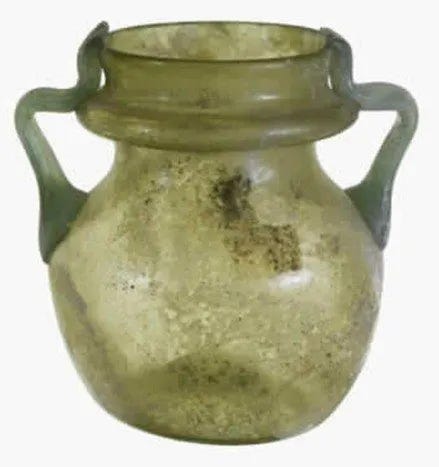
Archaeological evidence confirms both the use of cannabis topically, and inhaled in the Holy Land, in the early centuries of the Christian period. This glass jar is a medical cannabis artifact recovered from a 4th century CE site in Beit Shemesh, Israel that confirms the use of cannabis incenses and topical preparations in the area. In a tomb that contained the remains of a teenage girl who died in childbirth, archaeologists found in a “glass jar, the remains of burnt reeds, different herbs, and cannabis sativa were identified, the concoction vaporized in the glass vase and presumably inhaled as a medicine to ease pain. This mixed powder was found on the girl’s stomach, indicating that she was inhaling the cannabis herbal potion for relief during the birth.” (Israel Antiquities Authority, 2022).
The analysis of the dark material in the jar revealed the presence of Δ6-THC, an acid catalytic by-product of Δ1-THC and cannabidiol (CBD). (Zias et al.,1993) concluded that the purpose of giving the cannabis to the girl (by inhalation and topically) was to increase the increase of uterine contractions and to reduce birth pain. Cannabis has well known medicinal properties in regards to relieving the pain associated with childbirth.
“I thought it was incense,” Zias said. But when he had it analyzed by police and chemists at Hebrew University, it turned out to be a seven-gram mixture of hashish, dried seeds, fruit and common reeds.
Seven glass vessels containing traces of the drug were found near the skeleton. She probably used them to inhale the smoky cocktail to aid her delivery. Medical researchers have found that other than relaxing the user, hashish increases the force and frequency of contractions in women giving birth. It was used in deliveries until the 19th century, after which new drugs were developed. (Vessels Offer Window Into Ancient Use of Drugs, Los Angelas Times, 2002)
This little known archaeological study, is not the only solid evidence we have of cannabis use in the Holy Land.
The Archaeological Confirmation: Tel Arad and the Yahweh Shrine
Decades before the laboratory results arrived, the kaneh bosem theory predicted exactly what we now hold in our hands. In 2020, archaeologists published the definitive study in the journal Tel Aviv. Eran Arie, Baruch Rosen, and Dvory Namdar analyzed residues on two limestone altars from the Judahite shrine at Tel Arad—an 8th-century BCE fortress guarding the southern border of the Kingdom of Judah. The smaller altar in the holy of holies contained clear traces of Δ9-THC, CBD, and CBN—cannabinoids from cannabis. The plant material had been deliberately mixed with animal dung to burn at a lower temperature, producing inhalable psychoactive smoke in the small, enclosed chamber. The larger altar held frankincense mixed with animal fat. This is the first physical evidence of cannabis in any ancient Near Eastern religious context, and the first hallucinogenic substance ever identified in the Kingdom of Judah.
The shrine itself was deliberately buried during the reforms of Hezekiah or Josiah. It was a miniature version of Solomon’s Temple, complete with a holy of holies, standing stones, and paired altars. Inscriptions and artifacts confirm Yahweh worship blended with Asherah elements. The cannabis was burned in the inner sanctum of an official Judahite Yahweh shrine. God’s lament through Isaiah 43:24 that this pairing was not properly offered to him, and Jeremiah 6:20’s later rejecting kaneh and frankincense at the time of Hezekiah’s reforms suddenly make perfect sense: they were targeting the very practices preserved at Tel Arad, which had earlier also been practiced at the main temple in Jerusalem.
Importantly, the incense chamber at the tel Arad temple was based on the same design of the Holy of Holies in the temple built by Solomon, who, according to the Bible, worshipped the Goddess and burned incense on the High Places, such as tel Arad. Asherah was worshiped in both, and this practice was later abolished with the rise of monotheistic worship, as was the burning of incense on the high places. The reforms of Josiah specifically removed the women making ritual weavings for Asherah, from the temple in Jerusalem, and we have archaeological evidence for the use of hemp in her cult for ritual weaving for the Asherah. These reforms coincide with the date of tel Arad’s cancellation. There may be a connection seen here in Adam and Eve’s first act after being awakened from eating the forbidden tree, weaving clothes.
The Deeper Historical Context: Asherah, the Menorah, the Cherubim, Nehushtan, and the Eden Myth as Propaganda
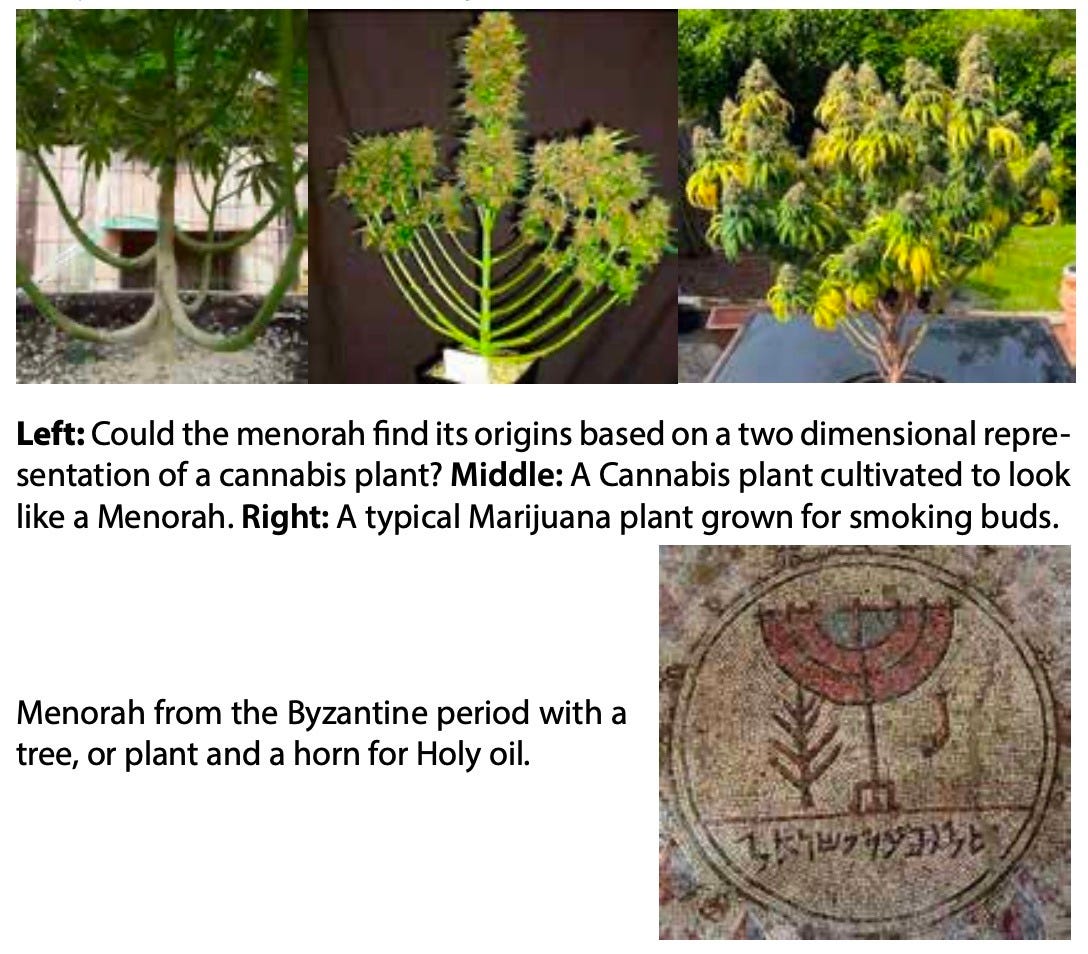
Here the evidence for cannabis as the tree of Life begins to converge with irresistible force. Asherah was widely revered in popular Israelite religion as the consort of Yahweh. Inscriptions from Kuntillet Ajrud and Khirbet el-Qom explicitly pair “Yahweh and his Asherah.” Her primary symbol was the sacred tree or pole—often a living tree pruned into cultic form, representing life, fertility, and divine wisdom. The menorah described in Exodus 25, with its almond blossoms, buds, and branches, was almost certainly modeled on these Asherah sacred trees. Biblical scholar Carol Meyers has demonstrated that the menorah’s design echoes the stylized tree of Asherah, transforming the goddess’s living symbol into the lampstand that illuminated the Holy Place as the Tree of Life.
The first Temple itself was built as a microcosm of Eden. Its walls were carved with cherubim and palm trees (1 Kings 6:29). Two massive cherubim guarded the Ark in the Holy of Holies, exactly as cherubim would later guard the Tree of Life in Genesis 3:24. Palm trees—ancient symbols of the Tree of Life—flanked the space. The entire sanctuary was Eden realized on earth, complete with the sacred tree (Asherah/menorah) its guardians the cherubim, and the brazen serpent.
Then came the reforms. In 2 Kings 18:4 we read that Hezekiah “removed the high places, broke the sacred pillars, cut down the Asherah, and broke in pieces the bronze serpent that Moses had made, for until those days the Israelites had been burning incense to it; and it was called Nehushtan.” The people were burning incense—likely the very cannabis incense evidenced at Tel Arad—to the serpent inside the Temple itself. Nehushtan, the bronze serpent, was an ancient healing and guardian figure tied to Asherah, frequently depicted with serpents as “Lady of the Serpent.” Hezekiah smashed it, cut down the Asherah poles, and centralized worship under pure Yahweh-alone practice at the Main Temple in Jerusalem, believed to have been located on the same site as the Al-Aqsa Mosque and the Apocalyptic envisioned Third Temple which could replace it, tying all this with events in our own time.
Crucially, the Eden myth in Genesis 2–3 was shaped and written (or heavily edited) during or after these very reforms, in the exilic or post-exilic period. Mainstream biblical scholarship dates the Yahwist source to this era of monotheistic centralization. The story functions as deliberate propaganda: the serpent—Asherah’s symbol—is cast as the deceiver; the sacred tree is forbidden and guarded by cherubim; eating from it brings death and exile rather than wisdom and life. Yahweh expels humanity and stations the cherubim to block re-entry forever. It is a direct reversal of the older Asherah-linked temple practices that included the cannabis tree sacrament. The myth justified the reforms: That tree worship and serpent incense was portrayed as the original sin that caused our exile. This is reflected in Jeremiah’s rejection of kaneh, (6:20) as well as in blaming the Fall of Jerusalem on exiled Israelites who burned incense to the “Queen of Heaven” (Jeremiah 44). The Expulsion myth of Eden can be seen as Yahweh’s “divorce” from Asherah and the goddess cult. Indeed Eve seduces Adam to eat of the Forbidden Fruit in the same way Solomon’s wives swayed him to worship the Goddess and offer incense on the high places. The Tel Arad residues prove the plant was actively used in the High Places such as the Yahweh-Asherah shrine at tel Arad, until the reforms of Hezekiah. The hypothesis here is that the later Eden myth was propaganda being weaponized against those practices.
No other plant candidate for vthe sacred tree—fig, pomegranate, wheat, mandrake, apple, or mushroom—possesses anything approaching this level of direct archaeological, linguistic, and historical corroboration. None were burned in Yahweh’s shrines. None match the qunnabu terminology and context of the Akkadian literature. None explain the massive quantity in the anointing oil or the Gnostic emphasis on chrism as the real fire.
From the Guarded Temple Garden to the Open Tree: The Veil Removed and the Leaves for the Healing of the Nations
In the First Temple period—before the centralizing reforms of Hezekiah and Josiah—the Jerusalem sanctuary was saturated with Eden imagery that blended official Yahwism with older Canaanite symbols of life, fertility, and divine presence. Massive golden cherubim guarded the Holy of Holies, echoing the cherubim who barred access to the Tree of Life after the fall (Genesis 3:24; 1 Kings 6:23–28). The walls and furnishings featured palms, flowers, pomegranates, and garden motifs, turning the temple into a micro-Eden. A sacred tree or pole—often linked to Asherah, the life-giving feminine divine principle—was present, sometimes standing alongside or represented by the seven-branched menorah, which itself was a stylized Tree of Life radiating divine light (Exodus 25:31–40). Even the brazen serpent (Nehushtan), originally a symbol of healing (Numbers 21), was kept in the temple complex until the reforms removed it as idolatrous (2 Kings 18:4).
These elements together painted the temple as a restored paradise where heaven and earth met—yet access remained strictly guarded. A thick veil separated the Holy Place from the Most Holy Place, symbolizing the barrier that kept humanity from unmediated divine presence. Only the high priest could enter once a year.
The Book of Revelation brings this full circle as the ultimate unveiling (apokalypsis). John sees the heavenly temple realities: the veil-like separations are gone. In the new creation there is no need for a physical temple at all, “for its temple is the Lord God the Almighty and the Lamb” (Revelation 21:22). Flowing from the throne is the river of the water of life, and on either side stands the Tree of Life, bearing twelve kinds of fruit every month, with leaves “for the healing of the nations” (Revelation 22:1–2; cf. 2:7, 22:14, 19). The cherubim guards, the restricting veil, and the purified-but-limited symbols of the old temple—all are transcended. What Eden lost and the First Temple symbolically echoed but could not fully restore is now openly available. The formerly forbidden is given without cost to the redeemed.
This apocalyptic vision transforms the old temple’s Edenic imagery: the sacred tree (Asherah/menorah), the healing serpent, the guarded presence—all find their fulfillment in open, universal restoration. The leaves that heal the nations point to a plant of life and wholeness meant for all peoples in the renewed creation.
In light of the aggregate biblical descriptions—its appearance, healing properties, multi-use nature, and role in sacred anointing and incense—many see the cannabis plant as the living embodiment of this Tree of Life imagery. If the First Temple’s sacred tree and menorah echoed an ancient life-giving plant, and Revelation restores that plant’s leaves for the healing of the nations, then the re-emergence of cannabis in our time carries profound apocalyptic weight: a sign that the barriers are coming down and the original gift is being returned.
The Wider Cultural Bridge: Haoma and the Ancient Tree of Life Tradition
The continuity extends far beyond Israel into the vast Indo-Iranian world, where the sacred plant known as haoma in the Avesta and soma in the Rig Veda stands as the direct counterpart to the biblical Tree of Life. My own research, synthesized in the 2020 Cannabis Culture article “The Cannabis Soma/Haoma Theory: A Synopsis Based on the Latest Textual and Archeological Evidence,” and more fully in my book, Cannabis and the Soma Solution (2010) builds on decades of textual, linguistic, and archaeological work to demonstrate that cannabis was the original haoma/soma—the plant sacrament revered across the ancient Near East and Eurasia as the Tree of Life itself. This identification is not purely speculative; it rests on precise matches between ancient descriptions, ritual practices, preparation methods, effects, and physical remains that align cannabis with the sacred plant in both Vedic and Avestan traditions, creating an unbroken bridge that links Assyrian Tree of Life iconography, biblical Eden imagery, and the apocalyptic restoration promised in Revelation.
Textually, the Rig Veda portrays soma as a leafy, many-leaved plant with digitate (finger-like) leaves, green-tinted faces when pressed, and a resinous juice that is greenish-yellow when fresh, tawny from tannins and resin, and intensified to aruna (reddish-brown) by oxidation—descriptions that perfectly match Cannabis indica or sativa. Rig Veda 10.94 describes stones speaking and roaring like a hundred or thousand men while chewing the branch of the purple tree, with the Soma-juice turning the stones green: “Let these (stones) speak…. Ye solid, quick moving stones, you utter the noise of praise… full of the Soma juice. They roar like a hundred, like a thousand men; they cry aloud with green-tinted faces… chewing the branch of the purple tree, the voracious bulls have bellowed.” Rig Veda 10.4.1 compares Soma-juices to birds perching on a leafy tree, while 10.11.7 places the progenitor in a leafy tree where Yama drinks with the gods. Rig Veda 10.2.7 speaks of Indra sprinkling beards with green Soma-juice, and 9.61.13 uses bhanga as an epithet of soma, interpreted as “smashing, breaking through” and linked to the cannabis epithet vijaya (victorious), matching cannabis’s intoxicating and victorious qualities. Soma is called the king of plants, all shrubs and trees, with verses like Rig Veda 10.97 declaring: “Of all the many Plants whose King is, Soma, Plants of hundred forms, Thou art the Plant most excellent… O all ye various Herbs whose King is Soma… Urged onward by Bṛhaspati, combine your virtue in this Plant.” Preparation involved soaking branches, pounding with stones or mortar and pestle, filtering through wool or grass, and mixing with milk, curd, barley water, or honey—methods echoed in bhang preparations and cannabis resin processing. The juice was exhilarating, aphrodisiac, and gave delight, with effects including imagination running riot, disturbances of time, space, and personality—classic cannabis phenomenology.
The Avesta mirrors this with equal precision. Yasna 10.12 praises haoma growing “on those mountains… in many varieties, as the milky, golden-colored haoma. Your remedies have been mixed by the creative magic of Good Thought.” Yasna 10.17 honors all haomas on mountain heights, stream depths, and ravines. Yasna 10.21 sacrifices to tall, golden, ruddy, death-averting haoma. Haoma is described as golden-green, tall, with roots, stems, branches, a pliant stem, fragrant, growing on mountains, swiftly spreading, and most nutritious for the soul. It is pressed, has healing and aphrodisiacal qualities, and can be consumed without negative side effects, bestowing spiritual wisdom. These epithets—leafy, many-leaved, milky, golden, tawny—align with cannabis resin’s color changes and the plant’s morphology of compound leaves and resinous tops.
Archaeologically, the case grows even stronger with finds that confirm cannabis’s ritual use across the Indo-Iranian sphere. Hemp rope dates to 26,900 BCE in Czechoslovakia. Tripod bowls from Ukraine around 3,500 BCE show carbonized cannabis seeds for burning. Corded Ware culture pottery (3,500–2,300 BCE) bears hemp cord impressions linked to cannabis drinks. Scythian tombs in the Altai Mountains and Pazyryk (circa 2,400 years old) contain carbonized cannabis in funerary braziers, with well-preserved flowers, seeds, and ritual tents for inhalation as described by Herodotus. Tarim Basin mummies (2,700 years old) include large quantities of cannabis leaves and flowers with mortars and pestles. The Bactria-Margiana Archaeological Complex (BMAC) sites (circa 2,000–1,000 BCE) reveal temple vessels with traces of cannabis, ephedra, and poppy, along with strainers, vats, and pressing equipment consistent with soma/haoma rituals. These discoveries, combined with Assyrian palace records listing qunnabu as a high-value import for incense and medicine, confirm cannabis traveled trade routes and was central to visionary and funerary rites.
This haoma/soma identification creates profound parallels with the Eden myth and its eschatological counterpart. Both traditions feature a sacred tree or plant guarded or contested by serpentine figures, offering knowledge and immortality that a jealous creator tries to withhold. In Zoroastrian myth, the serpent-dragon Azhi Dahaka opposes the haoma tree, while in Eden the serpent tempts humanity toward the forbidden tree—reflecting a shared ancient Near Eastern and Indo-Iranian substrate of plant-centered wisdom traditions that biblical reformers reframed as dangerous in the final edit of that text. Cannabis, identified as haoma, becomes the living link between these myths: the plant that was once central, then suppressed, and now promised anew in Revelation.
Particularly compelling is the eschatological “white haoma” at the end of time in Zoroastrian prophecy. Avestan texts describe a luminous, milky, golden-colored haoma that appears in the final renovation of the world, restoring paradise, defeating evil, and granting eternal life to the righteous. Indeed, some modern cannabis strains, are noted for their white appearance, such as ‘White Widow’, so named for its frosty, white appearance from heavy trichome coverage. The White Haoma, mirrors Revelation’s Tree of Life in the renewed paradise, bearing fruit for the healing of nations and standing as the ultimate sacrament of restoration. Both traditions envision the sacred plant returning at the apocalyptic climax to reverse the fall and usher in a new age of wholeness.
Like the many fruits of theTree of Life, and the multi uses of cannabis hemp, so too does the haoma provide more than an ecstatic sacrament. Vedic references to Soma’s fibrous qualities are pointed to by one of the more vocal proponents of the hemp Soma theory, the knowledgeable former editor and creative director of High Times, Steve Hager; “The restless Soma – you try to grab him but he breaks away and over- powers everything. He is a sage and seer inspired by poetry. He covers the naked and heals all who are sick. The blind man sees; the lame man steps forth.” A description that certainly does hold connotations of medicinal, fibrous, and psychoactive properties. Another Vedic verse on Soma has been referred to by earlier researchers in reference to the fibrous qualities of cannabis: “In the Sukla Yajurveda (IV.10), mekhala, the girdle, is described as ‘tying the knot of Soma.’ Is this an implication that the Soma plant had the same fibrous qualities as the hemp plant?” (Merlin, 1972). “In the Avesta it was Haoma for whom Ahuramazda first brought the ‘sacred girdle, star-begemmed, woven by the two Spirits’41” (Taraporewala, 1926). Also, the following verse has indications of rope in relation to Haoma: “May not Haoma bind you like he bound the villain” (Y.11.7). In A History of Indian Literature, the authors write that:
At the consecration of the Soma-sacrifice the sacrifice ties round his girdle a belt made of hemp and reed-grass with the words “You are the power of Angiras [ancient fire and magic priests]soft like wool; lend me power!” Then he binds a knot in his underclothing and says “you are the knot of soma.” (Winternitz & Srinivasa, 1996)
The Satapatha Bramana, also refers to the Brahminical thread Interestingly, the Satapatha Bramana specifically identifies hemp (sana – Sanskrit) as the fibre to be used (and it also seems to indicate some sort of symbolic connection with feminine power of the Universe) and refers to usana as the plant used for Soma, a word that has been seen as a variation of a Sanskrit name for fibre cannabis, sana. As I noted of this in Cannabis and the Soma Solution (2010):
In 1921 an article by Braja Lal Mukherjee, “The Soma Plant,” appeared in the Jour-nal of the Royal Asiatic Society (which was a response to an earlier paper on the identity of Soma) also put forth a theory presenting cannabis, “bhang,” as a serious candidate for the Soma. Mukherjee based much of his assertion on references in the Satapatha Brahmana that refer to a plant “usana” from which Soma is made, claiming this usana was a name of cannabis. As Mukherjee explained, the “u” in usana was a prefix carryover from the Kiratas, with whom Soma originated, and when the “u” is dropped you return to one of the original Sanskrit names for cannabis ‘sana.’ “The English word hemp, Greek kanna and Latin canna-(bis) are the same as Sana” (Ray, 1948). “The name Sana is derived from Sana, the true hemp. It is the same word as Gk. Kanna from which the Latin name of the plant, Cannabis sativa is derived” (Chatterjee, 1943).
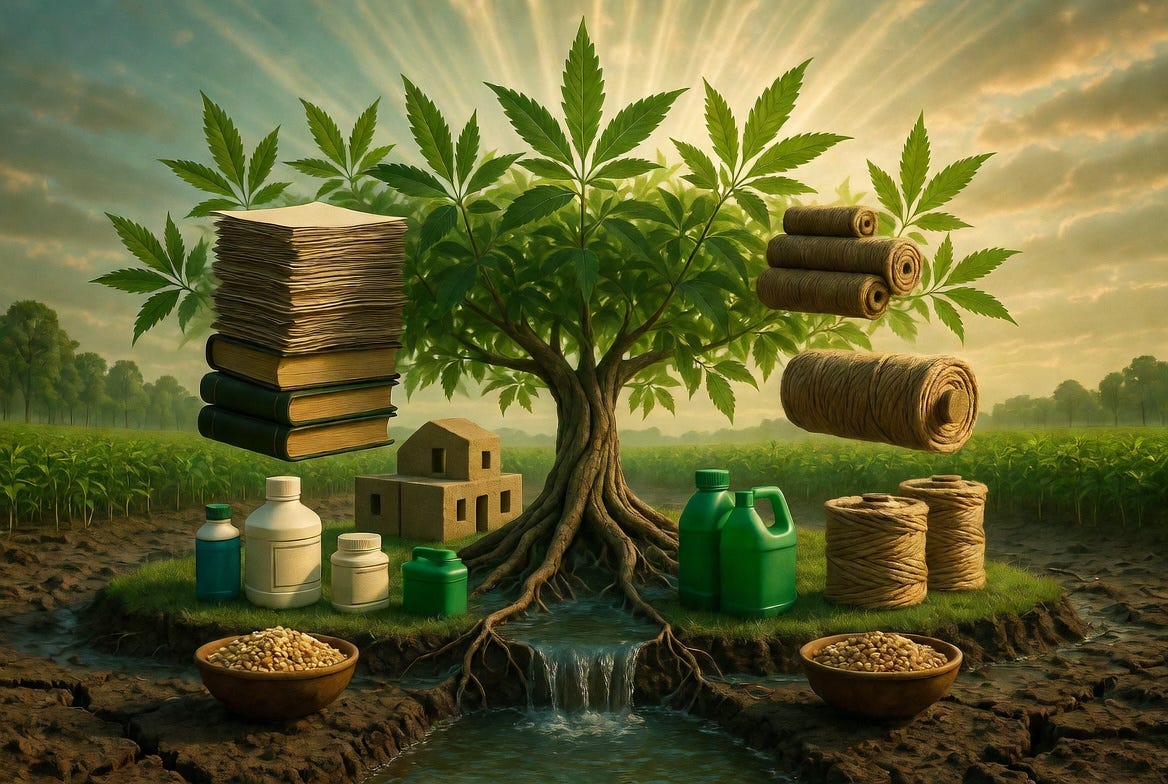
The multi-use nature of cannabis further cements its role as the Tree of Life. Its stalks provide fibre for clothing and rope; seeds yield nutritious food and oil rich in essential fatty acids; resin delivers medicine and sacrament; leaves serve healing infusions. This versatility—fibre, seeds/oil, resin, leaves—explains the “twelve crops of fruit” and “leaves for the healing of the nations” in Revelation 22:2, while echoing haoma/soma’s role as king of plants supplying all needs. Our millennia-long co-evolution with cannabis, encoded in the endocannabinoid system that modulates pain, inflammation, mood, immunity, and neurological balance, underscores this deep physiological and cultural partnership across Assyrian temples, Vedic rites, Zoroastrian potions, Gnostic chrism, Chinese pharmacopeia, African traditions, and beyond.
Recent scholarship and archaeological updates since 2020 strengthen this further. Studies confirm cannabinoid traces in BMAC vessels alongside ephedra and poppy, with strainers and pressing equipment matching soma/haoma preparation. Scythian gold chalices tested positive for cannabis-opium mixtures, and Tarim Basin finds include potent THC-rich cannabis bundles with mortars. These align with Herodotus’s accounts of Scythian cannabis inhalation in ritual tents, linking directly to Indo-Iranian nomadic spread. Linguistic continuity from qunnabu to haoma/soma reinforces cannabis as the shared sacrament. The case is now supported by carbon dating, residue analysis, and cross-cultural ritual parallels that no other plant candidate can match.
Cannabis as the Tree of Lie of the Ancient Near East
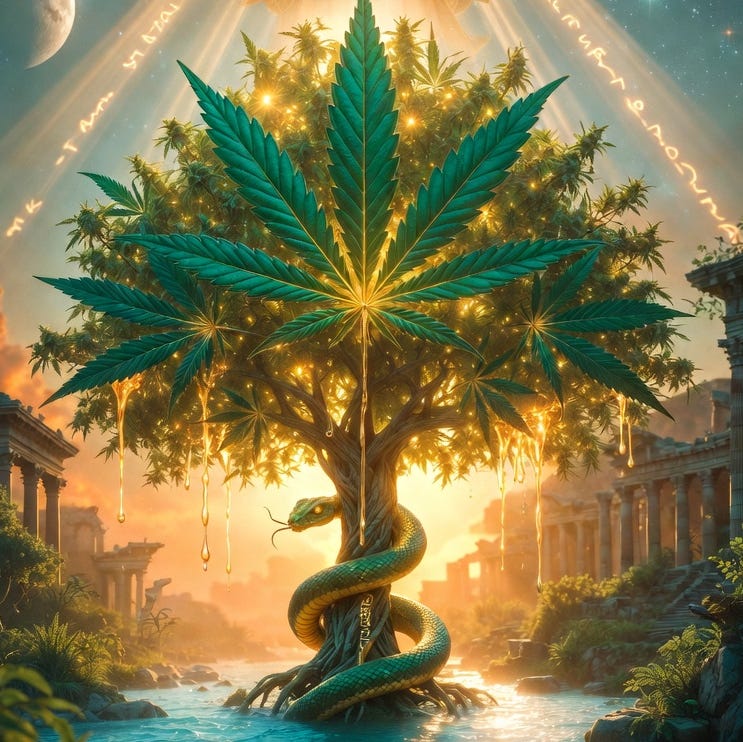
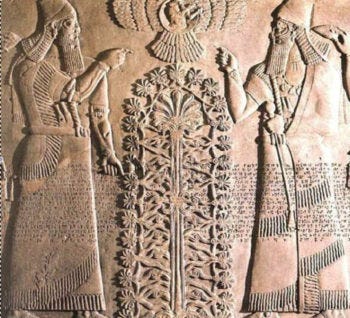
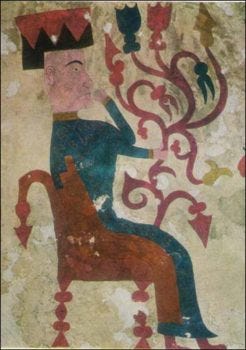
A fascinating current archeological theory proposes that a variety of ancient depictions of vegetation as the “Tree of Life” are ancient illustrations identifying cannabis use as an ancient entheogen. Interestingly, this is a connection I myself first proposed in my 2001 book, Sex, Drugs, Violence and the Bible.
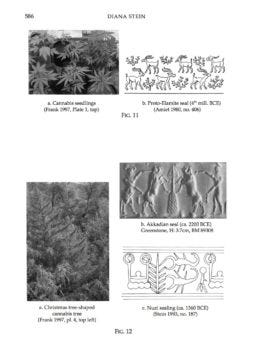
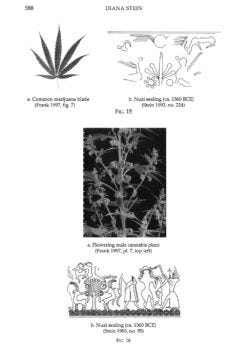
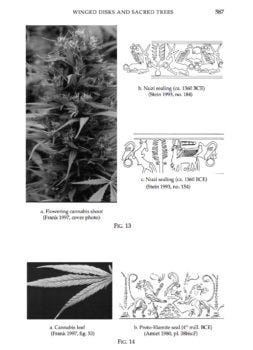
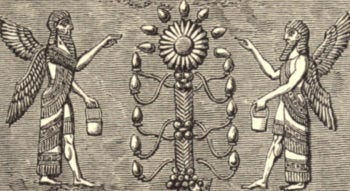
In common with the cannabis plant’s original habitat, the tree on Proto-Elamite, Nuzi, and Middle Assyrian seals grows in the mountains (fig. 10a–c and f, fig. 18a–b). The Proto-Elamite trees are often short and have a thin stem with irregular branches like cannabis seedlings (fig. 10a and fig. 11). Proto- Elamite, Akkadian and Late Bronze Age examples can be round (fig. 18a–b, fig. 19c–d) or conical like certain cannabis varieties (fig. 10b and fig. 12). Others resemble flowering shoots (fig. 13), a single leaf (fig. 14), or an individual blade (fig. 15). The clusters of flowers that hang from flowering male plants may be rendered schematically as hanging bulbs or volutes on trees from Nuzi (fig. 16 and fig. 17a–c).(Stein, 2009)
She goes on to note that the sacred tree of these earlier images, was adapted into later more refined Assyrian images of the Tree of life, and still retained their sacred association with cannabis.
…[I]t seems unlikely that the sacred tree motif, a central feature in the state iconography of the Assyrian empire, represents the date palm, [a common hypothesis]a quintessentially southern species that does not grow north of Samarra. By the first millennium BCE, the goats, the hunters, and the worshippers, who had flanked the sacred tree and the Qunnabu, the probable Assyrian word for cannabis, is attested in texts of the first millennium BCE. It occurs in a Neo-Assyrian recipe for perfume, and a contemporary letter refers to its use in ritual contexts.
A later Neo-Babylonian text records the delivery of large quantities of qunnabu to the great temple of Eanna and Ebabbar, and there are recipes in which hemp is an ingredient of aromatic oil used for cultic purposes.So cannabis was available in Mesopotamia during the sixth century BCE at the time when the Hebrew Bible was compiled in Babylon. There are no laws or records of court cases concerning the misuse of cannabis or of any other psychotropic plant. But given the central role of magic and divination in everyday Mesopotamian life, it is conceivable that those who could not afford the services of the court diviner, prophet, or magician turned to other methods or mediums. The use of drugs in urban contexts without the traditional ritual constraints of tribal societies not only poses a threat to organized religion, it also raises the long-standing controversy over the religious potentialities of psychedelic drugs. Do drugs like LSD reproduce the same state of timeless bliss as aesthetic practices, notably meditation, as Aldous Huxley, Timothy Leary, and others famously claimed in the 1950s to 1970s? I suggest that this ongoing debate lies at the heart of Genesis 3, and that the fruit tree described by Eve as a source of beauty, food, and knowledge was, in fact, a potent but dangerous source of enlightenment. If that is the case, the authors of the story, in common with leaders of most established religions, take the stand that knowledge of the spiritual kind cannot or should not be attained by means of hallucinogens. (Stein, 2009)winged disk on provincial seals of the past, are replaced by the king, and these two familiar symbols are modified once again, this time perhaps to reflect the king’s own image as a means toward enlightenment as well as enlightenment itself. (Stein, 2009)
Image – Assyrian Tree of Life with the King
Stein’s research has garnered attention as of late, through new interest in the role of psychoactive substances that has been generated by recent studies of residues in ancient Near eastern artifacts that reveal that psychoactive substances such as cannabis and opium, were used ritually in ancient times.
Interestingly, independently I came to almost identical conclusions about these ancient sacred tree images in my 2001 book, Sex, Drugs, Violence and the Bible :
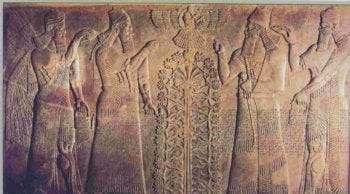
A religious symbol which undoubtedly comes from the ancient east is the Tree of Life. This is found in some of the earliest Sumerian art, and continues throughout Mesopotamian history, being very prominent in the Assyrian friezes of the first millennium B.C. The mythological conception of the Tree of Life is also found in Genesis iii:22.(Saggs 1962).
Like the potential entheogenic references to the Tree of Knowledge, the original Sumerian word for the Tree of Life contained etymological references to intoxicate. “In Sumerian the words for ‘live’ and ‘intoxicate’ are the same, TIN, and the ‘tree of life’, GEShTIN, is the ‘vine’”(Allegro 1970). The Hebrew word used for life, (as in the Tree of Life), ‘chay’, has more to do with enlivening, fresh, or merriment, and the continued fecundity of nature rather than personal immortalization.
In his discussion of the Eden mythology, Harold Bloom points out and questions that “Everything depends upon those two trees, of life and of knowing good and bad, or are they after all only one tree? Pragmatically they are, since only the tree of knowing good and bad is involved in the catastrophe, and also is J’s own invention. The Tree of Life is prevalent in the literature of the ancient Middle East, and I suspect that J interpolated this traditional tree into…[the]text as an interpretive afterthought”(Bloom 1990). A view that has has been held by other scholars;
“The principle of mythic dissociation, by which God and his world, immortality and mortality, are set apart in the Bible is expressed in a dissociation of the Tree of knowledge from the Tree of Immortal Life. The latter has become inaccessible to man through a deliberate act of God, whereas in other mythologies, both of Europe and of the Orient, the Tree of knowledge is itself the Tree of Immortal Life, and, moreover, still accessible to man.”(Campbell 1964)
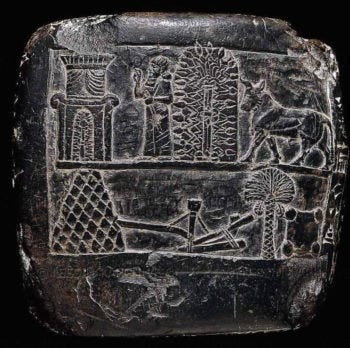
Fig 1: The Basalt Stela of King Essarhaddon.
….An ancient world symbol for the tree-of-life can be found in the Basalt stela of Assyrian king Esarhaddon, in the form of the elaborate looking plant directly behind the ancient monarch (fig-1). In Green Gold the Tree of Life: Marijuana in Magic and Religion (1995) we used this for the depiction in the upper level where “king Esarhaddon stands before an elaborate incense chamber with smoking…censer pictured in cut-away in the lower portion of the chamber, the upper chamber is tent-like with an opening,” (Bennett et. al. 1995). The tent was used to hold the smoke of cannabis incense, which the king would inhale by placing his head inside of it; a common means of marijuana inhalation in the ancient world, and an act of worship. “Cannabis as an incense was burned in the temples of Assyria and Babylon ‘because its aroma was pleasing to the Gods.’” (Benet 1975) An ancient Babylonian inscription reads: “The glorious gods smell the incense, noble food of heaven; pure wine, which no hand has touched do they enjoy”. In Babylonian religious rites, “Inspiration was… derived… by burning incense, which, if we follow evidence obtained elsewhere, induced a prophetic trance. The gods were also invoked by incense.”(Mackenzie 1915).
“The Chaldean Magus used artificial means, intoxicating drugs for instance, in order to attain to this state of excitement, for it was only then that he succeeded, so to speak, in deifying himself, and received the homage of genii and spirits of nature…This doctrine prevailed also in the Accadian (Babylonian) magic books. This furnishes an affinity of conceptions and beliefs which is of great importance… These incantations, most of which go back to the deepest antiquity, were gathered in collections such as those we have fragments of… Acts of purification and mysterious rituals increased the power of the incantations… Among these mysterious rituals must be counted the use of enchanted potions… which undoubtedly contained drugs that were medically effective.”(Lenormant 1874).
In the second quarter of the first millennium B.C., the “word qunnabu (qunapy, qunubu, qunbu) begins to turn up as for a source of oil, fiber and medicine”(Barber 1989). In our own time, numerous scholars have come to acknowledge qunubu as an early reference to cannabis. “It is said that the Assyrians used hemp as incense in the seventh and eighth century before Christ and called it ‘Qunubu’”( Schultes & Hoffman 1979).
Further, the pioneering research of etymologist Sula Benet led to the claim that “The ritual use of hemp as well as the name, cannabis… originated in the Ancient Near East”(Benet 1975)….This ancient Assyrian name qu-nu-bu, is the phonetic equivalent of the ancient Hebrew name for hemp, quaneh-bosm, [also translated as Kaneh Bosm]and the strong connections between the two can be seen in the similar ways both Mesopotamian and Hebrew worshippers utilized the plant.
In a letter written in 680 BC to the mother of the aforementioned king Esarhaddon, reference is made to qu-nu-bu, that give clear indications as to what substance was burning in the king’s incense tent. In response to king Esarhaddon’s mother’s question as to “What is used in the sacred rites”, a high priest named Neralsharrani responded that “the main items…. for the rites are fine oil, water, honey, oderous plants (and) hemp [qunubu]”. As was mentioned, the symbol behind king Esarhaddon, which also appears in numerous other depictions, has “in modern literature on the subject…[,been] often described as the tree of life…but unfortunately no texts are known which describe in more detail the contents of these pictures”(Ringgren 1973).
Likewise, not one single item from all of the existing ancient pictorial inscriptions has ever been suggested as an illustration of the ancient qunubu, which by all accounts played a very important role in both life and worship in the ancient Near East, particularly in the Sacred Rites, which likely are what the aforementioned inscriptions represent. This study proposes that the unidentified symbol of the sacred plant, and the undepicted plant for the word qunubu, are in fact a word and picture that describe the same thing— Cannabis, which was grown and revered as the Tree of Life in the ancient Near East.
The reason that this connection has not been noted before may be due to the fact that in the Ancient Near East matters involving religious and technical methods were considered closely guarded secrets. Professor H.W.F. Saggs noted that texts dealing with such matters ended with instructions such as; “Let the initiate show the initiate; the non-initiate shall not see it. It belongs to the tabooed things of the great gods”. Such holy knowledge was either only passed along verbally and not committed to writing, or “were written in a manner which was deliberately obscure…”(Saggs 1969). The image of the Tree of Life and its divine association with the king, as well as the use of cannabis as an holy incense and entheogen both fall into such a category
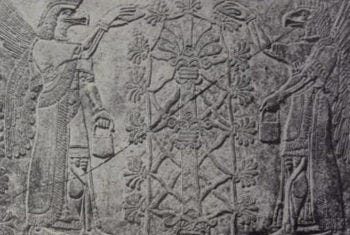
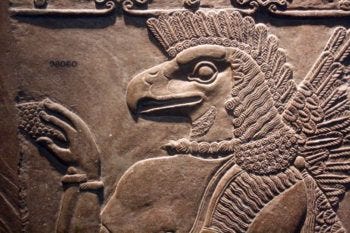
Amongst the first to connect the sacred and unnamed tree in Assyrian art with the mythical Tree of Life, was Sir A.H.Layard, who described and commented on the symbol over a century and a half ago. “I recognized in it the holy tree, or tree of life, so universally adored at the remotest period in the East, and which was preserved in the religious systems of the Persians to the final overthrow of their Empire…. The flowers were formed by seven petals”(Layard 1856) The “seven petals”, referred to by Layard, can be seen to be more likely stylized depictions of the seven distinct spears of the cannabis leaves, just as the pine cone like objects held by the figures often surrounding the plant, represent the pine cone like buds of the sacred qunubu.(See Fig. 2)
Fig 2
Behind the sacred tree and Esarhaddon in fig. 1, sits the Bull of Creation, while below are the early tools of ancient agriculture, perhaps indicating an intimate connection between the three symbols….
As the oldest known piece of woven fiber was made from hemp, along with the fact that the agricultural history of cannabis, extends far-back beyond recorded history, there has been speculation cannabis was indeed the first crop of ancient man. Cannabis’ hybridizing, whether for narcotic or fiber purposes, is certainly known to predate recorded history. Indeed, with its useful fiber, nutritious seeds, and fragrant incense it could have easily been conceived of as a Tree of Life in the ancient world. In line with this view, are the words of the feminist Biblical scholar Tikva Frymer-Kensky, which would seem to indicate an intimate connection between weaving and the forbidden tree, possibly hinting at a candidate offering both entheogenic and fibrous properties.
The coming of knowledge is stated very simply: “the eyes of both of them were opened and they perceived that they were naked”, a category they had not perceived in their childlike innocence, but, in addition, they are now able to sew themselves loincloths out of the available fig leaves. Somehow the knowledge of this skill of sewing, the beginnings of cultural knowledge, has come with the eating of the fruit of the knowledge of all things.(Frymer-Kensky 1992).
As Harvard University Professor of ethnobotany, Richard Evans Schultes has commented: “Early man experimented with all plant materials that he could chew and could not have avoided discovering the properties of cannabis (marijuana), for in his quest for seeds and oil, he certainly ate the sticky tops of the plant. Upon eating hemp, the euphoric, ecstatic and hallucinatory aspects may have introduced man to the other-worldly plane from which emerged religious beliefs, perhaps even the concept of deity. The plant became accepted as a special gift of the gods, a sacred medium for communion with the spiritual world and as such it has remained in some cultures to the present.” We can be sure that such effects were attributed to the plant by its ancient Near Eastern partakers, just as they have been by partakers of the plant the world over.
Fig.3 Basalt Stela of King Assurbanipal and the Tree of Life
Engravings from the time of Assurbanipal, another ancient Assyrian king associated with cannabis, also depict the sacred tree shown in the basalt of his father, king Esarhaddon. Professor Widengren postulates that every temple had a holy grove, or garden with a Tree of Life that was taken care of by the king, who functioned as a ‘master-gardener’. By watering and caring for the Tree of Life, the king gained power over life (Widengren 1951). As a scribe of the Assyrian king Assurbanipal recorded in 650 B.C.: “We were dead dogs, but our lord the king gave us life by placing the herb of life beneath our noses,” (Ringgren 1973). This last points to an incense, and by its name, the “herb of life”, we can easily visualize it as the plant depicted in the ancient stone engravings. Interestingly, we find that Assurbanipal’s ancient cunieform library contained recipes for hashish incense which “are generally regarded as copies of much older texts” and this archeological evidence “serves to project the origins of hashish back to the earliest beginnings of history.”.(Walton 1972)
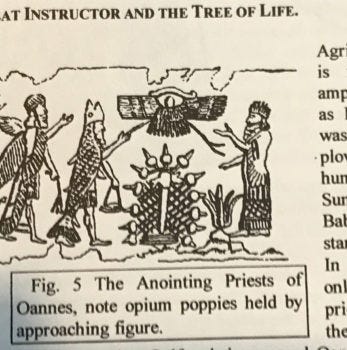
Generally the pine cone like buds, held by the birdmen have been associated with “pollination” of the sacred Tree, however in other depictions they are being used in association with the King in the same manner. What we suggested in Sex, Drugs, Violence and the Bible, is that these pinecones were stylized buds being collected from the Sacred Tree by the birdmen (themselves representing costumed winged shaman who could travel between worlds), and this is why they carry woven baskets, and then its power transferred to the King. Moreover, we know that cannabis was used in Assyrian rituals that revolved around these images. Particularly in association with a god known variously as Ea, Enki, Oannes and other names, and whom more than a few researchers have suggested was the prototype for Eden’s Serpent, and his mythology for other aspects of the myth.
…the features of Ea’s idealistic homeland Dilmun “may underlie the Hebrew accounts of Paradise.”(Hooke 1963). Reminiscent of the serpents role in the Garden of Eden story, the myth of Dilmun records how the goddess Ninhursag “makes eight plants spring up…in spite of a prohibition Enki eats all eight of them….There are obviously certain similarities between this myth and the biblical picture of paradise…the eating of the forbidden plants is distantly reminiscent of the tree of knowledge in the garden of Eden.”(Rinngren 1973). In another tale, Enki angers the goddess mother of mankind and like the devil the serpent is said to represent, he is “exiled from the earth to the abyss.”(Campbell 1962).
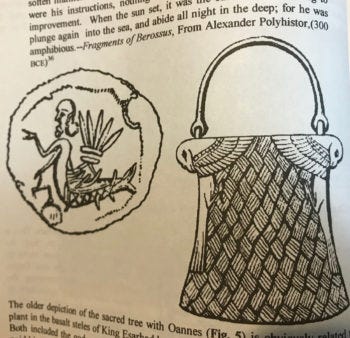
EaEn-kiOannes, is depicted as a fish-man, having his roots in the living-water, but more importantly, he has connections with a sacred tree similar to that which is described in the Garden of Eden. In the ancient Sumerian texts, EaEnkiOannes is described as being wise like the biblical serpent and as he “who knows the plant of life and the water of life.”(Ringgren 1973). Professor Mackenzie, also noted this in 1915, commenting that “In a fragmentary Babylonian charm there is a reference to a sacred tree or bush at Eridu [Eridu is thought to be the cradle of Sumerian civilization]. Professor Sayce has suggested that it is the Biblical ‘Tree of Life’ in the Garden of Eden… It may be that Ea’s sacred bush or tree is a survival of tree and water worship.”(Mackenzie 1915):
“Ea is…the god of wisdom, ‘the king of wisdom, who creates understanding’, ‘the experienced one (apkallu) among the gods’, ‘he who knows everything that has a name’. It is he who gives the king wisdom. He is also the god of the art of incantation. In his temple ‘the house of Apsu’ in Eridu there was a notable tree, kiskanu, whose branches were used in ritual sprinklings…The incantation priest was the representative of Ea.” (Ringgren 1973)
R. Campbell Thompson, of the British Museum, disagreed with Sayce’s theory, mentioned above, that the kiskanu was the original Tree of Life. This difference was based on what Thompson saw as Sayce’s misinterpretation of the etymological evidence. However the Sumerian name of the tree, kiskanu, which would seem to be at the base of the disagreement between the two scholars, serves as our connection between the Tree of Life and cannabis. The kiskanu tree “was the central point of various rites. A holy grove in the temple is…mentioned.” (Ringgren 1973). The second part of the name of this notable tree, kis-kanu has phonetic similarities with the early names for cannabis, through the linguistic root an, “which is found in various cannabis related words”(Abel 1980); such as the ancient Sanskrit name for hemp kana, or kene, Persian canna,… [and other variations]…
In mythology, one of Ea’s servants and adopted “son”, the hero and temple fisherman, Adapa, was referred to as the “ointment priest”, indicating the importance of the rite. The ancient mythology has it that Adapa’s “command was like the command of Ea”. It was the ritual anointing of the priesthood of Ea, that empowered them to act as the god’s representative. Through this shamanic rite they became “he whose ear Enki [Ea] has opened”. Religious scholar John Gray commented upon the Sumerian pantheon’s chief god, Anu’s resentment of Ea’s giving the knowledge of the god’s to a mere human, Adapa, as being “strongly reminiscent of the divine resentment at Adam for presuming to eat of the tree of knowledge of good and evil.”(Gray 1969).
A ritual enactment of Ea and Adapa’s relationship was applied to kings, who received their wisdom from Ea. Thus, it is not surprising that Ea appears in hymns from both Ashurbanipal and Esarhaddon with special reverence, or that the two kings are compared and connected to Ea’s anointing priest, Adapa. The mythology surrounding the god also indicates that he could ‘open the ear’ of his initiates if they burned incense to him, indicating a similar psychoactive ingredient to that found in the anointing oil. Likewise it was the ritual anointing of Moses and the Levite priesthood with the sacred cannabis ointment, along with burning the oils and vegetable matter of the plant before the ark of the covenant, which enabled them to speak on behalf of the Lord. (Bennett & McQueen, 2001)
Assyriologist R. Campbell Thompson noted that the kiskanu tree was quite prevalent as the ancient texts refer to the the “kiskanu, which ‘grows like a forest’ or ‘grove’” (Thompson, 1903). Referring to an incantation text regarding the kiskanu R. Campbell Thompson described:
This document… indicated to the magician, who was about to treat his afflicted patient, that a certain kind of plant or tree, the original which… grew in Eridu, and… contained magical qualities; and acting on this information the magician was directed to make use of a potion of the kiskanu plant or tree on behalf of the said patient. The text actually states the gods themselves made use of this plant to work a miracle of healing, and the implication is that the kiskanu plant was on this occasion of great benefit, it may again be made to perform the healing of a sufferer… provided that suitable words of power were recited… and appropriate ceremonies were performed, before the plant itself was used as a remedy. (Thompson, 1903)
Images from Sex, Drugs, Violence and the Bible Depicting Ea/Enk/Oannes with the Sacred Tree and images of the woven basket used to collect the pine cone like buds from it. Note the disembodied eye over the tree, an image that has been associated with states of sacred intoxication.
In the 19th century George Rawlinson noted of the pine cone like buds from the Assyria Tree of Life, that it is “as though it were the medium of communication between the protector and protected, the instrument by means of which grace and power passed from the genius to the mortal which he had under his care” (Rawlinson, 1881). As Rawlinson’s contemporary Francois Lenormant noted, “Often … it is held under the king’s nose, that he may breathe it” (Lenormant, et al., 1881). A scribe of the Assyrian king Assurbanipal recorded in 650 BC: “We were dead dogs, but our lord the king gave us life by placing the herb of life beneath our noses” (Ringgren, 1973).
When one reads the full passage regarding the qunnabu reference in the Sacred Rites in relation to the stella with Esarhaddon, the incense tent, Tree of Life, and the sacred ox, their connection is even more cemented, as is the imagery of the woven basket depicted in the other images of the Tree of Life:
“To the queen mother, my ‘lord’: your servant, Nergal-šarrani. Good health to the queen mother, my ‘lord.’ May Nabû and Marduk bless the queen mother, my ‘lord,’ May Tašmetu, whom you revere, take your hands. May you see 1,000 years of kingship for Esarhaddon.”
“As for what the queen mother, my Lord, wrote to me, saying: ‘What is going into the ritual?’ —”
“These are its constituents: sweet-scented oil, wax, sweet-scented fragrance, myrrh, cannabis [ŠEM.ŠEŠ ŠEM.qu-nu-bu], and ṣadīdu-aromatic. [I will] perform it [for a]ll [the … th]at the queen mother com[manded].”
“[On the xth] day, they will perform the whole-offerings: one ox, two white sheep, and a duck.”
“Damqaya, the maid-servant of the queen mother, will not be able to participate in the ritual. (Accordingly,) whomever the queen mother, my ‘lord,’ designates should open the basket and perform the ritual.”
So here we see qunubu cannabis, in association with both the sacred ox, or sacrificial “Great Bull that treadest the celestial herbage” in the stella from Esarhaddon, as well as a reference to the “basket” from the other depictions of the Tree of Life, making it clear a connection exists to the images of the sacred tree and cannabis.
It should be remembered that both Stein and I go into much more detail about all this in our work, and there is much more to it than can be presented here. I reached out to Dr. Stein, not to try to take credit for these theories, but out of excitement at the further independent confirmation. In a response she wrote. “The excerpts from your publications make fascinating reading, and I will follow up on some of your references. Yes, we seem to be moving along parallel paths. But whereas you are at liberty to pick and choose between pictures and textual references from different periods and cultures, I am more constrained by the rules of academia and have to explain the methodology and justify the reasoning behind every point I make.” A fair enough point, whereas she is constrained by academia to follow such protocols, I am a freelance researcher who began his own inquiry after a profound religious experience in 1990 where I felt it was revealed to me that cannabis was the Tree of Life of the Bible’s book of Revelation. As well, even the association of the Assyrian Tree of Life images being connected to cannabis was something that I now realize first came to me in a dream….
In the 90s I was in the habit of recording my dreams in a dream diary, although I am right handed I would record my dreams in my left hand, in an attempt to cause a synapses cross over between the right and left brain, that is why the hand writing and drawing are so particularly bad (although I am a messy writer). On April 7th 1994 I recorded the following dream and image:
Remembering that the image drawn was from a memory of a dream, it is a considerably close approximation of the Assyrian images. As well it was found along a river, which is symbolic of consciousness moving through time, a connection possibly indicated in the Book of Revelation’s reference to “Then he showed me a river of the water of life, [a]clear as crystal, coming from the throne of God and of the Lamb, in the middle of its street. On either side of the river was the tree of life, bearing twelve kinds of fruit, yielding its fruit every month; and the leaves of the tree were for the healing of the nations”. Indeed, it was reading those very words in 1990, and the recognition this was a reference to the cannabis plant and its many medical and industrial applications, that set my life course. I have travelled along many houses and read many books, and now it seems we are upon the doors of the University, a symbol of the academic world with this sort of research….. It was actually my own doubt of these experiences that led to my researching the history of cannabis, a subject I have covered in 4 books and dozens of articles. For I figured if there was anything to these revelations I had, then somebody else sometime or somewhere would know as well… And what I say to you after that nearly 4 decades of study on the subject is, there is a place where science and the spiritual world of Humanity meet, and in that place, you will find the most sacred of earth’s plants growing. The Cannabis Tree of Life is a revelation, offering new medicines to heal the sick, ways to change industry so it benefits the planet instead of harming it as well as new ways of perceiving the Human Experience and the Religions of Man. Cannabis is the Universal Spirit’s love letter to you, as well as a sacred gift from our ancestors. Not surprisingly an increasing amount of spiritually minded cannabis activists have adopted this symbolic analogy, many drawing their own independent conclusions on it, and have begun to make way for the once and future Tree of Life and the healing of the nations which it offers humanity. Now, with Stein, even actual archaeologists are exploring this theory.
The Healing of Humanity: Cannabis as Sacred Bond and Environmental Redeemer
The Tree of Life is not merely a symbol of ancient ritual or apocalyptic promise — it is the living plant that can heal humanity today in body, society, and planet. Cannabis, identified as the biblical kaneh bosem, haoma, and soma, offers a comprehensive path to restoration that addresses the deepest wounds of our modern world: environmental destruction, resource wars, bodily suffering, and spiritual disconnection. In the rediscovered Gnostic texts, Jesus emerges not as the distant orthodox savior but as the Anointed Healer who carried the holy oil and the Tree of Life itself, offering experiential gnosis through the very sacrament the orthodox tradition tried to bury.
Like the Tree of Life in the Biblical tradition, the White Haoma appears at the beginning and end of the Persian cosmological history. The ancient Persians believed that the identity of the White Hom would be revealed at the Great Renovation, when the Saoshyant, Final Savior, sacrifices the final sacred ox, and mixes it’s fat with the White Hom to prepare the elixir of immortality. In light of the slaying of the ox symbolism, it is interesting to note that in the Zoroastrian creation myth, Ahura-Mazda (God) gave the first created ox “cannabis to ease her discomforts in the throes of death” after she was afflicted with disease and hunger by Ahriman. If this is the case, then cannabis is more than a fitting plant to pour forth beneficially from the sacred animal’s wound as the White Hom, and the sacred ox to heal mankind at the consummation of the age with the same plant that eased it’s own pain at the beginning. (Especially when we consider that the plant played the role of entheogen with the ancient authors who recorded these inspired texts). As Payam Nabarz, author of The Mysteries of Mithras: The Pagan Belief That Shaped the Christian World, notes;
Some, basing their theories on the Zoroastrian creation story of the white bull being slain by Ahriman, have suggested that the Bull Homa and perhaps the later slaying of the Bull by Mithras is a symbol of the pressing of the Homa juice! This is a controversial but interesting view, as Ahura Mazda feeds the white Bull hemp to sedate him so when Ahriman kills him, the Bull wouldn’t feel the pain. From the Bull comes all life – animal and plant. (Nabaiz, 2005)
The central mythology of the cult concerns Mithra’s sacrifice of the sacred bull, or ox, an act he commits reluctantly, but for the benefit of humanity. Grabbing the bull by the nostrils, the Persian Christ plunges his knife into the animal’s side; from the sacrificial body of the bull are born all health giving plants and “from its spinal marrow, bread bestowing wheat; from it’s blood the vine which produces the sacred drink of the mysteries” (Eliade 1982). In a way, this series on the Apocalypse, and its analysis of the religions centred around it, has been a slaying of beliefs, aka, sacred cows.
An Environmental Redeemer
The roots of modern environmental activism run deep with cannabis culture, as both Greenpeace (founded in 1971) and Earth First! (launched in 1980) emerged from the 1960s–70s counterculture scene where pot-smoking hippies and back-to-the-landers mixed anti-establishment vibes with a fierce defence of the planet. Early Greenpeace crews in Vancouver embodied that tie-dyed, dope-friendly spirit—long-haired activists who chained themselves to whaling ships or protested nuclear tests often doubled as casual cannabis users drawn from the same peace-and-love crowds rejecting corporate greed. (My family Dr, Lyle Thurston, was among the founders, and he had a big influence on us, in and outside the office). Earth First! took it further: co-founder Mike Roselle, a former Yippie known for rolling joints during wilderness treks, helped birth the “no compromise” movement alongside fellow radicals, many of whom lit up while plotting tree-spiking and road blockades. But the strongest financial lifeline came in Northern California’s Humboldt County during the 1980s–90s “timber wars,” where underground cannabis growers—often the same back-to-the-land folks who’d fled cities for the redwoods—quietly funneled bags of cash and weed to the local Earth First! chapter. Those profits from high-priced “Emerald Triangle” herb subsidized everything from activist rallies and legal battles to community newspapers, helping save ancient groves like Headwaters Forest from clear-cutting while the growers themselves hid their plots in the very forests they fought to protect. It was a perfect, if ironic, symbiosis: cannabis cash quietly fueling the radical green fight long before legalization changed the game.
Then came the environmental redemption. Industrial hemp is one of the fastest-growing and most versatile crops on Earth, maturing in just 90–120 days and yielding 4–5 times more biomass per acre than trees. One acre of hemp can produce as much paper as 4–14 acres of trees, thanks to its exceptionally high cellulose content. Hemp paper is recyclable far more times than wood pulp and resists yellowing, making it ideal for packaging, books, and newsprint. Shifting to hemp could halt the logging of old-growth forests and significantly reduce the massive share of global landfill waste that comes from paper products.
Hemp also offers a superior, organic alternative to soil-depleting cotton. While cotton farming has historically exhausted the land — contributing to the Dust Bowl disasters of the 1930s through intensive monoculture and heavy chemical use — hemp requires far less water, virtually no pesticides or herbicides, and actually improves soil health with its deep roots that aerate the ground and prevent erosion. One acre of hemp yields up to four times more usable fiber than cotton, producing durable textiles, ropes, and canvas without the toxic chemical burden that has polluted waterways and degraded farmland for generations.
Beyond fiber and paper, hemp hurds mixed with lime create hempcrete — a fire-resistant, mold-proof, carbon-negative building material that sequesters CO₂ for decades while providing excellent insulation. Environmentally friendly houses built from hempcrete are already demonstrating how we can construct sustainable homes that actively heal the atmosphere rather than harm it. The same biomass can be turned into biodegradable plastics, biocomposites, and biofuels, slashing our dependence on petroleum and moving us away from oil-driven conflicts. These applications collectively grow a genuine peace dividend: fields of hemp can fuel vehicles, insulate homes, and package goods without a single barrel of crude.
Hemp seeds further reveal the Tree’s generosity. A single mature hemp plant can produce seeds that make up nearly half its total dry weight at harvest, offering an astonishingly efficient source of nutrition. Often enjoyed as shelled “hemp hearts,” these seeds deliver a high-quality, easily digestible complete protein containing all nine essential amino acids, along with an ideal 3:1 ratio of omega-6 to omega-3 essential fatty acids that support heart health, reduce inflammation, and nourish brain function. Rich in edestin — a globular protein structurally similar to human blood plasma globulins — as well as fiber, vitamin E, and key minerals, hemp seeds provide clean, sustained fuel for the body without the environmental or ethical costs of many other protein sources. Four short years after the 1937 Marijuana Tax Act, a researcher in Science magazine lamented the loss of this vital protein, warning that restrictions on hempseed “in effect, amount to prohibition.”
In its astonishing versatility — fiber for clothing and rope, hurds for building materials and paper, seeds for food and fuel, resin for medicine and sacrament — cannabis mirrors the Tree of Life described in Revelation 22:2, which bears twelve crops of fruit, yielding its fruit every month, “and the leaves of the tree are for the healing of the nations.” One plant supplies what entire industries now extract through deforestation, chemical-intensive agriculture, and fossil fuels. By embracing the Tree once forbidden, we can heal scarred landscapes, feed the hungry with abundant, bioavailable protein, construct carbon-negative homes, and break the cycle of oil wars and environmental ruin.
Healing Leaves
This is the practical outworking of the Gnostic revelation: the Anointed One offers not empty ritual, but a living sacrament that restores both body and Earth. The leaves for the healing of the nations are growing again. The question is no longer whether the Tree exists — but whether we will finally be free to eat from it.
At the same time, cannabis heals our bodies through the endocannabinoid system (ECS), an ancient regulatory network present in nearly all vertebrates that modulates pain, inflammation, mood, immunity, appetite, and neurological balance. The human ECS evolved to interact with cannabis compounds—THC and CBD act as keys to this lock, explaining why the plant has been used medicinally for millennia. Comprehensive evidence maps and systematic reviews show substantial benefits for chronic pain (including neuropathic pain), muscle spasticity in multiple sclerosis, chemotherapy-induced nausea and vomiting, and refractory epilepsy. FDA-approved Epidiolex (CBD) treats Dravet syndrome, Lennox-Gastaut syndrome, and tuberous sclerosis complex, reducing seizures where other drugs fail. For PTSD, anxiety, insomnia, and appetite loss in cancer patients, cannabinoids provide relief with fewer side effects than many pharmaceuticals. The National Academies of Sciences, Engineering, and Medicine concluded there is conclusive or substantial evidence that cannabis or cannabinoids treat chronic pain in adults, with meta-analyses showing 30-40% pain reduction in many cases. The ECS also plays roles in tissue healing and anti-inflammatory processes, correlating clinically with reduced symptoms in inflammatory conditions. Recent studies highlight potential in cancer pain, neurodegenerative diseases, and even modulating tumor growth via apoptosis in lab models. This is not fringe; it is the plant’s physiological gift to humanity, encoded in our biology after thousands of years of co-evolution.
Cannabis the Perfect Medicine for Nuclear Armageddon
In regards to references to a potential Nuclear Armageddon initiated by the Apoclapticmania discussed in this series, it is worth noting here that cannabis can be seen as a potent medicine for radiation sickness, and this includes radiation sickness from nuclear fall out.
Cannabis, through its key compounds like THC and CBD, has proven highly effective in treating chemotherapy-induced nausea and vomiting (CINV). FDA-approved synthetic THC analogs such as dronabinol and nabilone are specifically used for CINV cases resistant to standard antiemetics, working by activating CB1 receptors to suppress serotonin release and nausea signals in the brain and gut. Clinical trials demonstrate that oral THC:CBD combinations can boost complete response rates—no vomiting or significant nausea—from 8-14% with placebo to 24-25%, often outperforming older drugs like prochlorperazine, though with potential side effects like dizziness. This established efficacy stems from rigorous human studies and systematic reviews, making cannabis a reliable adjunct in oncology for managing severe nausea.
Nausea from nuclear fallout arises in acute radiation syndrome (ARS), triggered by high-dose radiation damaging rapidly dividing cells in the gastrointestinal tract and bone marrow, leading to serotonin release and inflammation—mechanisms strikingly similar to those in CINV. Unlike controlled chemotherapy, ARS is systemic and potentially fatal, with symptoms like nausea and vomiting appearing quickly after exposure. However, the overlapping pathways suggest cannabis could translate its antiemetic benefits from CINV to ARS, offering comparable relief by targeting the same serotonin-mediated emesis without addressing the underlying radiation damage.
Compelling evidence for cannabis in ARS comes from preclinical animal studies, where cannabinoids like Δ⁹-THC and others fully blocked radiation-induced vomiting in models like the least shrew, acting dose-dependently via CB1 receptors. Human data from radiation therapy (RT) for cancer supports this, with reviews showing cannabinoids reducing RT-induced nausea to levels matching standard care, and case studies highlighting dronabinol’s success in intractable cases. While direct ARS trials are absent due to ethical constraints, this mirrors cannabis’s CINV role as an effective adjunct—potentially cutting symptoms by 10-20% or more—emphasizing its promise for fallout nausea alongside supportive care like ondansetron.
The Christian-Right’s particular focus on prohibiting this sacred tree is somewhat ironic when it is considered that it was through the dawning of Spirit, provided by the entheogenic and healing anointing oil, that the early followers of Jesus came to consider themselves Christians, or Anointed-Ones! Indeed, almost no modern-day Christians are aware that the name of their faith makes reference to a psycho-active topical ointment that was rich in cannabis, or that the early Christians used a variety of other entheogens to achieve spiritual ecstasy. In fact, considering the importance of cannabis in the Christening oil, the Christian Right, who can be seen to be the main force behind prohibition’s unjust fight against the herb, could be considered anti-Christ, as could the Pope’s papal decree against soft drugs such as cannabis along with the Papacy’s former death penalty for cannabis use in medieval times. Even Government prohibition of this plant could be interpreted as being anti-Christ, as it places the Laws of Man above the Laws of Creation and prevents true cannabis using Christians from practicing their faith, going as far as to confiscate their possessions, sending them to prison, and potentially, even killing them.
Cannabis has also been used to clear the soil of heavy metals and radioactive contamination. Following the 1986 Chernobyl nuclear disaster, scientists turned to industrial hemp—a fast-growing, non-psychoactive variety of cannabis—as a powerful tool for phytoremediation, the process of using plants to extract toxins from the earth. Starting around 1998, hemp was planted in the contaminated exclusion zone near Pripyat, Ukraine, where it absorbed radionuclides like cesium-137 and strontium-90, along with heavy metals such as lead. Collaborations involving Ukrainian researchers, Phytotech, and experts like Slavik Dushenkov showed hemp to be one of the most effective plants for the job, thanks to its deep roots, high biomass, and remarkable tolerance for harsh conditions.
Over multiple growing cycles, the hemp pulled contaminants into its tissues, which were then harvested and safely disposed of, gradually reducing soil toxicity in lightly to moderately affected agricultural lands. While not an overnight fix—full cleanup can take years alongside natural radioactive decay—this approach proved cost-effective and practical for reclaiming unusable land compared to digging up and hauling away vast amounts of soil. Hemp’s work at Chernobyl highlighted its broader potential, with similar efforts or proposals following disasters like Fukushima.
Beyond radiation, hemp excels at mopping up other pollutants, including heavy metals and pesticides, while improving soil structure through aeration and organic matter addition. The plants’ harvested biomass requires careful handling as hazardous material, but the technique offers an eco-friendly path forward for hundreds of thousands of contaminated sites worldwide. This living example of cannabis as a healer of the planet adds a compelling chapter to its long history of practical and revolutionary uses.
The World Sacrament
This healing power ties us together in a sacred bond across religions and history. Cannabis has been revered as a sacrament in nearly every major tradition, creating a shared spiritual heritage that transcends dogma and reminds us of our common plant-based origins. In Hinduism, the Atharva Veda (circa 2000–1400 BCE) calls cannabis one of the five sacred plants that “release us from anxiety” and house a guardian angel in its leaves; it is “a source of happiness” and “joy-giver.” Bhang, a cannabis drink, is offered to Shiva during Maha Shivratri and Holi, with Shiva himself said to have created it from his body to purify the elixir of life. Sadhus and ascetics use it for meditation and spiritual discipline, uniting the devotee with the divine. In Zoroastrianism and Vedic India, haoma/soma was the king of plants, the immortal nectar granting wisdom and immortality—the same plant now identified as cannabis through textual epithets, preparation rituals, and archaeological residues from BMAC temples, Scythian tombs, and Tarim mummies. Assyrian temples burned qunnabu incense; Jewish high places used kaneh bosem in Yahweh-Asherah shrines until the reforms. Gnostic Christianity rediscovered Jesus as the physician carrying the unguent box and medicine pouch—the holy oil of chrism that produced the real “fire.” Rastafari see ganja as the holy herb for meditation and prayer, fulfilling biblical prophecies. African traditions, Chinese pharmacopeia, and indigenous practices worldwide incorporated cannabis for healing and communion. This cross-religious thread forms a sacred bond: the same plant that healed bodies and opened minds in ancient temples, Vedas, Avestas, and Gnostic gospels connects us all. It is the living reminder that religion’s shamanic, plant-based roots were suppressed but never erased. Rediscovering cannabis reunites humanity in a shared sacramental heritage, transcending divisions and restoring the experiential gnosis that fundamentalism tried to replace with empty ritual.
The most notable World religions can be tied into cannabis history, such as Hinduism, Sikhism, Zoroastrianism, Taoism, Shintoism, Buddhism, Islam, Judaism, and I am getting closer and closer to establishing it in Christianity. I could also mention the use of cannabis here in the spiritual techniques of Magic, Alchemy and Yoga. For some sort of unbiased assessment on the role of cannabis in religions I asked Grok the single prompt question, “what plant is most widely used for spiritual purposes across the world’s religions?” And it concluded:
Determining the single most widely used plant for spiritual purposes across the world’s religions is complex, as spiritual practices vary widely and plants hold different significances in each tradition. However, based on available information and the prevalence of certain plants in multiple religious and spiritual contexts, cannabis (Cannabis sativa) emerges as a strong contender due to its widespread use across diverse cultures and religions for millennia….. Cannabis’s widespread use across Hinduism, Rastafarianism, ancient religions, and various shamanic traditions gives it a broad geographical and cultural footprint. Its psychoactive properties make it uniquely suited for spiritual practices aimed at altering consciousness, a common thread in many traditions. While plants like white sage or frankincense are also widespread, their use is often symbolic or aromatic rather than psychoactive, and they are less universal across as many distinct religious traditions as cannabis. [Complete answer from Grok]
In the Gnostic texts, Jesus is revealed as a literary resurrection—the true Anointed Healer who was buried by orthodoxy but rises again through the Nag Hammadi Library and rediscovered scriptures. In the Acts of Peter and the Twelve Apostles, Jesus appears as a physician with an unguent box and pouch of medicine, giving the apostles the tools to heal bodies first, then souls. The Gospel of Philip declares the chrism superior to baptism, with “fire in chrism.”
Moreover, in relation to the Eden myth, in John 3:14 Jesus compares himself to the Brazen Serpent which Moses made, and which Hezekiah destroyed because the people burned Incense to it! Gnostics expressed similar views as we saw in Part 6 of this series. In texts like the Testimony of Truth (Nag Hammadi) saw Jesus/Christ as the counterpart to the Eden serpent through direct identification and typological linkage. The serpent is presented as the wise instructor who counters the Demiurge’s (the ignorant, envious creator-god’s) prohibition by urging Eve to eat from the Tree of Knowledge, opening humanity’s “eyes of the mind” to gnosis and exposing the false god’s malice and lack of foreknowledge. The text explicitly equates this serpent with Christ: after retelling the Genesis story from the serpent’s positive viewpoint, it cites the bronze serpent Moses raised on a pole (Numbers 21:9) as a prefiguration—”For this is Christ; those who believed in him have received life”—positioning Jesus as the same saving, enlightening principle that brings spiritual awakening and liberation from the Demiurge’s domain, much as the original serpent did in Eden. Indeed, this connection is represented in Revelation, as Jesus offers humanity to eat from the forbidden tree of Eden!
This Gnostic Jesus is not the distant, faith-only figure of the canon but the living Christ who carried the cannabis holy oil and embodied the Tree of Life. His “resurrection” is the rediscovery of the sacrament that makes us Christs—the plant that heals, awakens, and restores Eden. The Gnostic Jesus hands us the unguent box today, inviting us to anoint ourselves with the Tree of Life and overcome the demiurge’s tyranny through direct experience.
The evidence from every angle—archaeological, linguistic, medical, environmental, and religious—converges on one truth: cannabis is the Once and Future Tree. It heals our bodies through the ECS, redeems the planet by replacing petroleum and saving forests, ends oil wars through biofuels and bioplastics, and binds us in a sacred, cross-cultural bond that the Gnostic Jesus embodied as the rediscovered healer. The paradigm shift is here. The Tree stands before us.
The Gnostic Reversal: Seeing Through the Propaganda
The Gnostics understood exactly what had happened. In the Testimony of Truth they confront the creator god directly: “But of what sort is this God? First he maliciously refused Adam from eating of the tree of knowledge… Surely, he has shown himself to be a malicious grudger!” They reverse the narrative: the serpent is the wise Instructor, working with Sophia to awaken humanity from ignorance. Ialdabaoth is revealed as the jealous liar who feared we would become like the true God. Cannabis becomes the weapon against his tyranny. It opens the eyes, restores the divine spark, and grants immortality of consciousness.
The orthodox church fought fiercely to elevate water baptism over anointing because the plant produced measurable, experiential effects no symbolic ritual could match. The “fire” was cannabis in the chrism. The Gnostic texts preserve the older, plant-based experiential religion that the Eden myth was written to suppress. Catholicism’s control was based purely on the Church’s proclaimed role as intercessor between humanity and God, only to be related through the Church’s own doctrines and placebo sacraments.
“Sophia’s Apocalyptic Return: The Celestial Woman, Eden’s Trees, and the Mother Plant”
As explored in an earlier article, The Mother Plant of the Goddess – Cannabis, “Asherah’s… tree symbol was alternately the ‘tree of knowledge’ or ‘tree of life.’ In northern Babylon she was known as the Goddess of the Tree of Life, or the Divine Lady of Eden.” This Asherah-Sophia continuity invites us to reread one of the most vivid apocalyptic images in the Christian canon—the “great sign in heaven” of Revelation 12—through a Gnostic lens.
In the Gnostic re-imaginings that have animated our Apocalypticmania series—particularly the inversion of Eden where Sophia, as the divine feminine principle of wisdom, sends the serpent to awaken humanity through the Tree of Knowledge rather than condemn it—we glimpse a profound reclamation of the sacred feminine. This thread runs through the Gnostic texts preserved in Nag Hammadi, where Sophia’s “fall” is not mere error but a cosmic act of creative audacity, birthing the material world yet yearning for its redemption. The Tree of Life, often overshadowed by the forbidden knowledge in orthodox readings, emerges in these visions as the ultimate return: a restored Edenic harmony where gnosis heals the rift between spirit and matter. Building directly on that foundation, let us turn to one of the most vivid apocalyptic images in the Christian canon—the “great sign in heaven” of Revelation 12—and reinterpret it through this Gnostic lens. Here, the “lady clothed with stars,” traditionally read as Mary, the Nation of Israel, or the Church, reveals herself as none other than Sophia herself, the exiled yet triumphant Mother Goddess whose restoration counters the warlike fractures of patriarchal history. And woven into this vision is the Mother Plant herself—cannabis—honored across ancient cultures for her female essence, her peace-giving sacraments, and her intimate kinship with the Tree of Life.
The passage in Revelation 12:1–2 describes “a great sign appeared in heaven: a woman clothed with the sun, with the moon under her feet and a crown of twelve stars on her head. She was pregnant and cried out in pain as she was about to give birth.” The dragon stands ready to devour her child, who is destined to rule the nations with an iron scepter. Standard exegesis ties this to the Virgin Mary fleeing to Egypt with the infant Jesus, or to Israel birthing the Messiah amid persecution, or to the Church in eschatological labor. Yet in Sophian Gnostic and Kabbalistic traditions, this celestial woman is Sophia—Pistis Sophia, the fallen aeon of wisdom, or Imma Shekinah, the Supernal Mother. As one Sophian teaching frames it, she is “clothed in the sun” (Tiferet-Beauty on the Tree of Life), standing on the moon (Yesod-Foundation), crowned with twelve stars (Hokhmah-Wisdom), embodying the full descent of divine light into the world. The Virgin of Light from Pistis Sophia herself conceives the Holy Child through heavenly essence; her birth pangs mirror the redemptive ascent of the Serpent Power, the gnostic awakening that lifts humanity from the Demiurge’s shadow realm. The dragon? Yaldabaoth, the flawed creator-god of orthodox Genesis, whose jealous rage seeks to devour the light-child of wisdom. This is no mere Marian allegory but the apocalyptic return of the divine feminine, birthing Christ-consciousness—the Logos reborn not as patriarchal law but as liberating gnosis.
This reinterpretation flows seamlessly from the Eden myth as we reframed it earlier in the series. In Gnostic narratives, Sophia does not tempt Eve to sin; she is the counterpart of the serpent, the instructor who enters the Tree of Knowledge to grant the spark of self-awareness. As one account in the Hypostasis of the Archons relates, Sophia’s emissary awakens Adam and Eve from the Demiurge’s slumber, revealing their divine origin beyond the material prison. The expulsion from Eden is thus the Demiurge’s frantic attempt to suppress this gnosis, severing humanity from the Tree of Life—the living wisdom that restores wholeness. Revelation 12 completes the arc: Sophia, the same wisdom-figure who animated Eden’s trees, now appears in the heavens as the laboring mother, her child snatched to safety only to return in the New Jerusalem. The Tree of Life reappears at the end of Revelation (22:2), its leaves for the healing of the nations—echoing the Gnostic promise that gnosis reunites the Pleroma’s fragmented light. Sophia’s “fall” and redemption mirror the biblical woman’s flight into the wilderness (Rev 12:6, 14), where she is nourished until the time is fulfilled. This is the consummation of the age: not fiery judgment but the reintegration of the divine feminine, healing the Edenic wound.
Central to this reclamation is the Mother Plant of the Goddess—cannabis—whose female nature has been honored since antiquity as a sacrament of Sophia’s wisdom and the Tree of Life’s bounty. In my 2019 exploration, The Mother Plant of the Goddess – Cannabis, I detailed how cannabis is dioecious, occurring in male and female forms, with the female plants alone producing the resinous flowers prized for their psychoactive gifts. This botanical reality made her the quintessential “mother plant” in ancient cults, embodying fertility, vision, and communion. Scholars like Sula Benet long ago traced kaneh bosm—the fragrant cane of Exodus and the anointing oil of kings—to cannabis, linking it to Asherah, the Canaanite consort of El/Yahweh whose sacred groves and poles (asherim) were systematically uprooted by monotheistic reformers. Asherah’s tree-symbolism merges with Sophia in later wisdom literature (Proverbs 3:18 calls Wisdom “a tree of life”), and in Gnostic synthesis, cannabis becomes the living embodiment of that tree: a plant that opens the inner eye to gnosis, just as the serpent did in Eden. Ancient Near Eastern goddesses—Inanna, Ishtar, Astarte, and their echoes in Freyja or the Indic Kali—were venerated with cannabis in rituals of prophecy, healing, and ecstatic union. The plant’s female flowers, heavy with trichomes, mirror the womb-like creative power Sophia holds.
In a scene of transmutation reminiscent of Ashera’s earlier role as the cultic Tree, in On the Origin of the World, Sophia’s daughter Zoe, also referred to as Eve of Life (Eve of Zoe), entered “the tree of acquaintance” to hide from the Authorities (Ialdabaoth and his emanated co-creators). Further indicating such an influence from the earlier Near Eastern traditions, Sophia states that “I appeared in the form of an eagle on the Tree of Knowledge… that I might teach them and awaken them out of the depths of sleep”, a statement that certainly invokes the preexistent imagery contained on Near Eastern inscriptions of the eagle-headed deities picking cones from the sacred Ashera-Tree of Life.
Importantly here, Asherah was not alone among Near Eastern Goddesses, in her association with cannabis. In Studies on Neo-Assyrian Texts II: “Deeds and documents” from the British Museum (1983) Frederick Mario Fales, translates the following ancient cuneiform verse (No. 12. BM103205. Copy: p. 252) regarding Ishara and qunubu cannabis
The salve of Ishara
is cannabis;
The salve of Ishara
is cannabis:
From the mouth of Qisirayyu
I hear so
As Fales explains “the connection between the salve of the plant qunubu and the name of this goddess might be sought in the aspect of the latter as deity of love. On qunubu… as cannabis… another [Assyrian] attestation of the plant [is translated]… ‘(She) said: ‘what is required for the ritual?’’ Quality oil, wax, quality salves (and particularly) salve of myrrh and salve of cannabis…’” (Fales, 1983).
As Gavin White has also noted:
…[T]he multifaceted goddess Ishara. She does not appear to be a native Mesopotamian deity, but was worshipped by many people throughout the ancient Near East, which has led to a confusing array of attributions – she is known as a great goddess to the Hurrians, the wife of Dagon among the West Semites, and to the Akkadians she was a goddess of love of love with close affinities to Ishtar, whose sacred plant cannabis (qunnabu) was known as the aromatic of Ishara… from her widespread worship she is also known as the queen of the inhabited world. (White, 2008)
Variations of “Ishara” appear as “Ašḫara” (in a treaty of Naram-Suen of Akkad with Hita of Elam) and “Ušḫara” (in Ugarite texts). In the archeological site at Alalah, her name appeared with the Akkadogram IŠTAR plus a phonetic complement “-ra”, as IŠTAR-“ra”. All phonetically similar to Asherah and Ishtar.
The connection to Ishtar here is interesting, as this Goddess’ cult, like that of Asherah’s was known for its shamanic priestesses. As the British Archeologist Diana Stein has noted “Inspired prophecy is a Mesopotamian phenomenon that is linked, in particular, to the ecstatic cult of Ishtar. The cult of Ishtar is described as an esoteric mystery cult that promises transcendental salvation and eternal life to its initiates. Altered states of consciousness, visions, and inspired prophecies were achieved by means of various ecstatic techniques…” (Stein, 2009). We can see here that cannabis and likely other entheogenic substances were a part of this technique.
Volkert Haas, a German Assyrologist and Hittitologist stated in Geschichte der hethitischen Religion (1994) that: “the nature of ‘Išḫara is closely related with that of the goddess Ištar [sic – Ishtar]. At the end of the 2nd millennium BC Išḫara is hard to distinguish from Ištar anymore. For instance in a cuneiform lexical list ‘the star of Išḫara’ is similar with ‘Ištar, the mistress of the Lands’. In the beginning of the 1st mil. her aspect as goddess of sexuality is completed with goddess of war. Then epitheta like ‘Išḫara, Mistress of Mankind’ show that henceforth she is melted with Ištar”
“The name of the Babylonian goddess Beltu (var. Belit, Belti) is the feminine form of Bel (‘Lord’), and means ‘Lady’. She is identified either with Ishtar or Ṣarpanitu [Wife of Marduk, and a goddess of childbirth]. Her mention in the Hebrew Bible is conjectural… biltî in Isa. 10.4 into bēltî, ‘my Lady’….Since the name Beltu is not really a name but an epithet (‘Lady’), the identification with a specific deity is beset with problems. Used in genetical constructions such as Belet-Akkadi or Belet-ekaliim, the term ‘Lady’ is an element in the name (or epithet) of numerous Babylonian and Assyrian… goddesses… The goddess to have been designated most frequently by this epithet, both in Summerian… and Akkadian… is no doubt Ishtar”
In a Sourcebook for Ancient Mesopotamian Medicine (2014) JoAnn Scurlock records a recipe that requires 3 shekels of qunnabu [cannabis]to be mixed with other aromatic plants “a total of 26 shekels of aromatics in a mortar. You wash raisins in date beer. You take (them) out and mix these aromatics into them. You pour white (beer) onto it and then it is sealed for three days. On the fourth (!) day, you open (it) and pour out a libation to Beltu (before use).”
This is notable in relation to references to Ishtar in 18th century BCE tablets from the Palace of Mari, which was located in modern day Syria. These texts refer to a ritual dedicated to the Ishtar and refer to a drink given to ecstatic seers, who spoke on behalf of the Goddess.“Presumably this drink contained psychoactive substances, perhaps mixed with wine, as Mari was a key centre in the wine trade” (Stein, et. al., 2022).
Central to these overlapping traditions is the profound syncretism between Asherah and Ishtar, wherein the Canaanite mother goddess—embodied in sacred groves and asherah poles as the nurturing Tree of Life and consort to El (and folk Yahweh)—merged with Ishtar’s ecstatic cult of love, war, fertility, and prophetic vision through her Levantine counterpart Astarte. Both goddesses were venerated as aspects of the “Queen of Heaven,” with cannabis (qunnabu/kaneh bosem) serving as a shared sacrament in rituals of anointing, healing, and altered consciousness: Asherah’s arboreal symbolism echoing the psychoactive Tree of Knowledge/Acquaintance, while Ishtar’s mystery cult employed entheogenic techniques, including cannabis-infused salves, drinks, and offerings, to induce the very visions and transcendental states Stein describes. This fusion, evident in names like Ishara (phonetically and cultically bridging Asherah and Ishtar) and shared priestess-shamanic roles, underscores cannabis as the living Mother Plant linking ancient Near Eastern goddess worship to Gnostic Sophia—her female flowers awakening gnosis just as Zoe/Eve entered the Tree, reclaiming the forbidden wisdom suppressed by later monotheistic reformers.
The association between ancient Near East Goddesses and sacred trees was widespread. Buffie Johnson noted that not only is the “Mother Goddess, strongly connected with the Tree of Life, [she]is in a sense the tree itself. At the same time she is outside the tree, vivifying it to bud and flower.”(Johnson 1981). Like Asherah, “The goddess Ishtar was thought to dwell in a sacred tree” (Taylor, 1995).
Near Eastern Goddess pendants, often identified with Asherah,indicating the belief that human sexuality fostered the fertility of nature, with the sacred tree of the Goddess, growing from her vagina, the source of ‘life’ from ‘Western Asiatic Tree-Goddesses’ (Irit Ziffer, Israel Museum, 2011). Necklaces such as these, are what was likely condemned by the prophet Hosea, when he demands that Israel remove the “adulterous look from her face and the unfaithfulness from between her breasts.” Hosea 2:2).
Goats flank the Tree of Life on a ewer that is related to the Asherah cult. The shape of this particular tree has been noted for its strong similarities to the later menorah. The Lakhish (Lachish) ewer, discovered by James L. Starkey in a rubbish heap outside a temple at Lakhish. Image from “Understanding Asherah – Exploring Semitic Iconography,” BAR Sept/ Oct. 1991
As eleswhere I have suggested that the reference in Jeremiah 44, where the prophet blames the Fall of Jerusalem, on people burining incense to the “Queen of Heaven” and kaneh is also rejected in Jeremiah 6:20, all written in the same time period tel Arad, was ‘cancelled’, I have suggested a connection here, and it’s worth noting Jeremiah 44, also refers to the pouring out of drink offerings to the Queen of Heaven. Both Asherah and Ishtar were seen as the Queen of Heaven, and both sects ritually used cannabis. Through cultural exchange and syncretism in the ancient Near East—especially via the related Canaanite goddess Astarte—the two were frequently associated or blended in worship, sharing attributes like fertility and celestial titles, which influenced regional cults and even biblical references to the Queen of Heaven.
However, many sources see an even older relationship between Ishtar and Inanna, another goddess that holds ties with cannabis. Like Ishtar, who she is conflated with, Inanna was an ancient Mesopotamian goddess of love, war, and fertility. She is also associated with beauty, sex, divine justice, and political power. As with other similar near Eastern Goddesses, Inanna also seems to have had strong ties with the ritual use of cannabis. Inanna had a famous cultic temple Eanna [Sumerian: 𒂍𒀭𒈾, É-anna, meaning “House of Heaven”], and as noted “later Neo-Babylonian text records the delivery of large quantities of qunnabu [cannabis]to the great temple of Eanna” (Stein, 2009).
The historical suppression of this Mother Goddess has profoundly shaped our warlike cultures, a theme that resonates with the apocalyptic dread we have traced throughout the series. As patriarchal pastoralists and monotheistic reformers rose—first with the Indo-European warrior cults, then with the iron-age consolidation of Yahweh-alone worship—goddess veneration was demonized or demoted. Asherah’s groves were cut down (2 Kings 23:4–15); Sophia was recast as the fallen temptress; the divine feminine was exiled from the heavenly council. Anthropological and historical analyses, such as Rachel McCoppin’s Goddess Lost: How the Downfall of Female Deities Degraded Women’s Status in World Cultures, and Ed Dodge’s A History of the Goddess: From the Ice Age to the Bible, demonstrate the correlation: societies that once elevated goddesses as supreme creators—matrifocal Neolithic cultures across Europe, the Mediterranean, India, and the Americas—granted women roles as priestesses, warriors, and regents. These communities emphasized harmony, fertility, and cyclical renewal over conquest. With the “downfall of female deities” through conquest and colonization, women’s status declined, and male sky-gods of thunder and war ascended. Iron-age ideology prized hierarchical kingship, valor in battle, and possession; the goddess became subordinate wife, virgin, or harlot. Gimbutas-inspired scholarship and broader feminist historiography link this shift to increased militarism: pastoral nomads who stole women and livestock turned hunting cults into warrior cults, replacing the Mother’s peaceful groves with fortified citadels. Monotheism completed the erasure—Judaism, Christianity, and Islam subordinated or silenced the feminine divine, fostering cultures where domination replaced communion. The result? Perpetual apocalypticmania: endless cycles of empire, crusade, and eschatological violence born from the psychic wound of the lost Mother.
Evidence of ritual cannabis use in this sacred Matriarchy, dates back at least 5,000 years. Evidence recovered in Spain, from an ancient Iberian site. The Science article The most outstanding leader of the Iberian Copper Age was a woman: Opulent grave suggests “Ivory Lady” played a key role in society 5000 years ago, details a grave site dedicated to a high ranking female leader or priestess. “Chemical traces of wine, cannabis, and cinnabar…were …found near her body… these substances suggest she was involved in religious rituals” (Zhao, 2023). A similar high ranking Scythian queen or priestess was also buried with her sacred cannabis.
With the strong elements of Goddess worship in the Scythian culture, it is not surprising to find a matriarchal hierarchy as well, and we know from surviving artefacts that Scythian women took powerful leadership roles in the tribe. As well “Both men and women probably smoked [hemp], since we found two sets of apparatus for smoking with the burial of a man and a woman” (Rudenko, 1970). Indeed later finds of cannabis seeds at the site of a “Scythian Queen” provide evidence of this.
In 1993, a female Scythian mummy was discovered. The China Daily reported of the find “The mummy was buried alongside six horses in full harness, dishes, a mirror, a brush, and even a small pot of cannabis to help her travel into the afterlife.” A 1995 episode of The National Geographic Explorer, The Frozen Siberian Tombs, profiled a dig centered around a recently discovered Kurgan, and the program televised such things as an over 2,000 year old hemp shirt, woven as fine as silk; A beautifully embroidered and decorated bag, used for holding cannabis; And an exotic Persian rug, testifying to wide ancient trade routes. This find was in the Altai Mountains of Siberia, an area where the borders of Russia, China, Mongolia and Kazakhstan converge. The New York Times story on the find reported; `
…[S]he was elegantly laid out in a white silk blouse, red skirt and white stockings. She had been buried in a hollowed tree trunk alongside horse harnesses, a mirror, dishes and a small container of cannabis, which archaeologists believe was smoked for pleasure and used in pagan rituals. ….That, and the intricate tattoos on her left arm, led the archaeologists who found her to conclude that she was a Scythian princess and a priestess. (Stanley, 1994)
In relation, it is interesting to note that along with the cannabis burning braziers found Pazyryk, two extraordinary rugs were also found in the frozen Scythian tomb. One rug had a border frieze with a repeated composition of a horseman approaching the Great Goddess Tabiti-Hestia, the patroness of fire and beasts, who holds the ‘Tree of Life’ in one hand and raises the other hand in welcome. Professors Schultes and Hoffman refer to this carpet in a chapter on cannabis (Schultes & Hoffman, 1979).
A Horseman approaches the Great Goddess who holds the tree of life in one hand, on the frieze of a Scythian carpet, carpets such as these were often cloaked over a teepee like structure and used as a hot box over a brazier of smouldering cannabis flowers. Archaeological evidence recovered from multiple sites confirms that the Scythians both burned cannabis ritually in braziers, and consumed it in liquid form, from golden goblets.
Cannabis, precisely because she is honored for her female essence, stands as the peace-giver who can heal this rift. Unlike the male-dominated cults of war, the Mother Plant calms aggression, fosters empathy, and dissolves ego-boundaries—qualities the Gnostics associated with Sophia’s redemptive light. In ritual use across millennia, from Scythian shamanesses inhaling her smoke in funerary tents to medieval European “witches” dancing in hemp fields, cannabis induced states of interconnectedness that mirrored the Pleroma’s unity. Her psychoactive resin, produced only by the female, sacramentally reenacts Eden’s gift: not forbidden fruit but liberating knowledge that returns us to the Tree of Life. In the context of Revelation 12, the laboring woman’s child—snatched to heaven yet destined to rule—symbolizes this gnostic rebirth. Cannabis, as the living Tree, aids the modern seeker in birthing that inner Christ-consciousness, countering the dragon of patriarchal fear. Where monotheism bred division and holy war, the Mother Plant invites participatory mysticism: communal, embodied, feminine-infused gnosis that dissolves the apocalyptic urge toward destruction.
This reinterpretation offers a radical counter-narrative to the doom-scrolling dread of our age. Sophia’s return in Revelation 12 is not passive suffering but cosmic triumph; By reclaiming cannabis as the female Tree of Life—suppressed alongside Asherah yet resilient in folk memory—we participate in the apocalyptic consummation: the New Jerusalem where “the leaves of the tree are for the healing of the nations” (Rev 22:2). The warlike cultures spawned by goddess-loss give way to a restored Eden, where Sophia’s wisdom, embodied in the Mother Plant, fosters peace over domination. This is no escapist fantasy but a practical gnosis: inhale the sacred smoke, meditate on the celestial woman, and feel the divine feminine rise within. The child is born; the dragon is cast down. In honoring cannabis’s female nature, we honor Sophia herself—peace-giver, wisdom-bringer, and the living bridge back to the Tree
The Climactic Restoration: Revelation 2:7, 22:4, and the Death of the Old God
Right at the opening of Revelation, the risen Christ declares: “To the one who is victorious, I will give the right to eat from the tree of life, which is in the paradise of God.” This is the direct reversal of Genesis 3:22-24. The Eden myth ends in prohibition and exile. Revelation begins with the promise that those who overcome will eat from the Tree and re-enter paradise. Jesus, the Anointed One, is freely offering the very sacrament that Eden had guarded.
The vision reaches its fullest expression in Revelation 22:2: “On either side of the river stood the tree of life, bearing twelve crops of fruit, yielding its fruit every month. And the leaves of the tree are for the healing of the nations.” The twelve manners of fruit speak to cannabis’s extraordinary versatility and continuous productivity: fiber for clothing, rope, and sails; nutritious seeds and oil rich in essential fatty acids that nourish body and brain; resin for potent medicine and sacrament; leaves for healing infusions and teas. These monthly yields evoke the plant’s reliable harvests across seasons, providing sustenance, healing, and visionary insight without end.
The leaves “for the healing of the nations” point directly to medical cannabis and our profound, millennia-long co-evolution with the plant. Modern science has revealed the endocannabinoid system—an ancient regulatory network present in nearly all vertebrates—that modulates pain, inflammation, mood, immunity, appetite, and neurological balance. Our bodies literally evolved to interact with cannabis compounds; the plant and humanity have shared a deep physiological and cultural partnership for thousands of years. From ancient Assyrian temple medicine and Vedic healing rites, to Zoroastrian haoma potions that healed body and spirit, to Gnostic chrism, Chinese pharmacopeia, African traditions, and New World uses, cannabis has been revered across countless religions and cultures as a healer of body, mind, and soul. It has served as the bridge between the human and the divine in shamanic, yogic, and mystery traditions worldwide. In Revelation’s renewed paradise, the leaves restore wholeness to divided nations—precisely the role medical cannabis plays today in alleviating suffering on a global scale, from chronic pain and epilepsy to inflammation, anxiety, and neurological disorders. Recent studies confirm the endocannabinoid system’s presence in humans dates back through millions of years of evolution, with cannabis compounds acting as keys to this ancient lock, explaining the plant’s universal appeal in religious and medicinal contexts from the Vedas to Rastafari interpretations of Revelation 22:2 as the “healing of the nations.”
The climax arrives in Revelation 22:4: “And they shall see His face, and His name shall be in their foreheads.” In that radiant moment of self-realization—awakened by the Tree—we recognize the divine face as our own. The name inscribed on the forehead is awakened consciousness itself. The old jealous deity Yahweh dissolves in this unveiling. Ialdabaoth’s tyranny ends. The paradigm shift completes.
This identification of self with the Godhead was the central divide between the Gnostics and the Roman Catholic Church that shaped orthodox Christianity. The Church rejected the Gnostic concept of the “god within”—the divine spark or inner Christ accessible through personal gnosis—because it directly challenged institutional authority, the necessity of its sacraments, clergy-mediated salvation, and the orthodox view that humanity is fallen and dependent on external grace.
In Gnostic thought, this divine spark belongs to Anthropos — the Primordial Human or Heavenly Man — the perfect, androgynous archetype of humanity that existed before the flawed material world created by the ignorant Demiurge (Ialdabaoth). Unlike the biblical Adam formed from dust and trapped in ignorance, Anthropos carries the true divine image and represents humanity’s original godlike potential. The savior in Gnosticism is therefore not an external figure demanding worship, but the awakening of Anthropos within each person. When the individual realizes their identity with this inner divine Human — through gnosis, the Tree, and the Light/Logos — they become a living Christ. In this way Anthropos is both the savior and the saved: the collective awakening of humanity’s true nature that overcomes the illusion of separation and restores the Pleroma — the divine fullness or realm of pure spiritual light.
This awakening is not merely individual but collective. Anthropos embodies a shared human consciousness — a kind of epidemic or archetypal memory that lives in all of us, connecting every soul like jewels in Indra’s Web. We are already glimpsing this in our own time through the internet: the instantaneous global access to the collective works, languages, translations, histories, and knowledge of humanity functions like a digital nervous system for Anthropos — a technological mirror of the Akashic records or the radiant forehead-light of Adam Kadmon, the Qabalah’s name for this same figure. Ironically, the very first commercial transaction on the precursor to the internet (ARPANET) was a weed deal between students — a fitting symbolic beginning for a technology that would one day help spread the very sacrament that awakens the Tree of Life. Many of the pioneering figures who shaped the personal computer and internet revolution — including Apple co-founder Steve Jobs — openly credited psychedelic experiences (LSD in particular) with expanding their consciousness and inspiring their creative breakthroughs.
For me personally, this Age of Information has been indispensable. I could not have completed the decades of research presented in my books — uncovering the hidden role of kaneh bosem, tracing qunnabu through ancient texts, and connecting the dots across Gnostic, Biblical, and cross-cultural traditions — without the internet’s vast archives, instantaneous translations, and global connectivity. The Gnostics themselves, who hid their scriptures in jars anticipating a future time when they could be rediscovered, would likely have viewed our current epoch with awe and recognition: an age when suppressed knowledge floods back into the light, when the collective mind of humanity becomes accessible, and when the tools exist for a true apocalyptic unveiling on a planetary scale.
A similar structure to this concept can be found in this article and everything we read. I would not be able to present this case without all the other authors and their ideas (and their individual points of reference) that we have so freely quoted from. Authors which in turn could not have produced their research and ideas without being influenced by earlier writers and their ideas, who in turn were influenced by still earlier authors all the way back to the very first caveman who drew a hieroglyph on a cave-wall and perhaps even further…… to the original idea. The collected words of humanity, are in a very realistic and material way the Logos, the Words of the Immortal Man Like all the individual threads needed to construct a carpet, each thread of evidence helped to complete this bold tale which we’ve woven. In our epochian Age of Information and the Internet, for the first time in history, such formerly forbidden information is available to more members of humanity than ever before, and the Light of Knowledge has its best chance ever to overcome the Darkness of Ignorance. “If you know the truth, the truth will make you free”(John 8:32).
Ignorance is a slave. Knowledge is freedom. If we know the truth, we shall find the fruits of truth within us. If we are joined to it, it will bring our fulfillment.(The Gospel of Philip)
When enough people experience this gnosis, amplified by such information spreading tools and opened minds, the light of Anthropos spreads through the collective field of human consciousness, turning personal illumination into a widespread evolutionary leap. In the Persian tradition this is mirrored in the final Renovation, when after the sacrifice and the administration of the White Haoma, the xvarenah — that light-like sacred fluid — shines forth from the forehead of Mithra and ultimately from all the righteous, illuminating the renewed world.
Jesus’ own association with Light and the Word (Logos) makes this especially potent. Much of the imagery of Christ as the primordial Logos drew from esoteric Jewish traditions of the heavenly Anthropos, which later flowered in the Qabalistic figure of Adam Kadmon. In that tradition, Adam Kadmon shone with a light from his forehead rich in complex patterns and linguistic symbols—merging the symbolism of light and language/writing into one (Scholem 1974; Schonfield 1968). Similar motifs appear across traditions: the Eye of Shiva that burns away ego-bound consciousness; and the Gnostic Teachings of Silvanus, which describes Christ as a single being whose light illuminates every place, like a lamp in the soul.
We stand at the threshold of exactly this collective awakening. In our Age of Information, when knowledge reaches critical mass, that mind-light from the forehead can spread through humanity like Indra’s Web — the Hindu image of an infinite net where each jewel (each soul) reflects every other jewel in perfect interconnectedness. The Unbegotten Father “looks to every side and sees itself from itself.” Attention itself becomes the originator and transmitter of the living Logos — the unifying light of ideas that overcomes ignorance, fear, and hate. When enough individuals open to this experience, immortal androgynous Anthropos attains Cosmic Consciousness, and the Kingdom of Heaven becomes a widespread reality rather than a distant promise.
With the Tree of Life restored, the old exile ends. The serpent’s truth is vindicated. The veil is torn. Paradise was never lost — only forgotten. And now, at last, we remember.
The Tree of Life appears at the beginning of the Bible and at the end in the horrific Book of Revelation, and its appearance in these times symbolizes the end of the Biblical Age, and the potential of two futures, a return to the Garden, or total annihilation. Having exorcised the Ghost of the Nobodady, Iladabaoth/Yahweh from our conception of Paradise, we find ourselves armed with our new Gnosis, standing alone in a Paradise gone mad and on the very edge of destruction, with no all powerful Heavenly Father to save us, and faced with the responsibility that if there is any hope, then we must save ourselves.
Moreover, as the last chapter of the Bible, the fulfillment of Revelation, symbolically and ritually identifies, the end of the Age of the Book, we no longer need to be guided by it’s pages, or it’s imaginary deity, we have developed minds and reasoning of our own, we are the Masters of our own destiny from here forward. I see this as extending beyond the Bible, to the religious texts of all generations. These books may be Maps, but they are old out of date Maps, and should not be taken as the sole guides for the modern territory we live in.
The study of Entheogenic history is the Paradigm Shift of our time, in that reveals the plant based, shamanic origins of religion itself. A scenario that is as much a threat to Fundamental Religions of the Book, as Darwin’s theory of human evolution was to the myths of Creation in Genesis. In that they reveal the plant based shamanic origins of religion itself. When you fill the temple full of cannabis smoke, the question arises on whether the Prophets were communicating with some supernatural sky god, or via access to receptors in their brains, entering a deeper communication to something held within themselves? Likely questions such as this, is at the root of the cause of Fundamentalist religions attack on shamanism and the use of sacred plants though history, from the inception of the Dark Ages, when Pagan and Christian Gnostic cults were destroyed and driven underground, to the middle ages and the burning of witches for herbcraft, and into the continents of Africa, India and the New World, when such practice was demonized, prohibited, and the practitioners, jailed, tortured and murdered. A situation that has followed down to the modern day, and which this generation must change, as the direct experience provided by these plant messengers of Gaia, are the way back to Eden, and the restoration of the Natural Order of Mother Earth.
We never truly left Eden. We were lied to and tricked into believing we did. The serpent told the truth. When we consider the history of cannabis, even within the short period of the last century, it is hard not to perceive its catalytic potential for social change, equal in both its power and its persecution to the early Christian movement. In the 1930’s when young people started smoking cannabis, long established racial barriers began to fall between blacks and whites for the first time, something pointed out as negative in the anti-marijuana propaganda of that time. In the 1960’s when young people started smoking pot, they began to question the Government, the ethics of their elders, and the war in Viet Nam. In the 1980’s when young Russian soldiers fighting against Afghani rebels began smoking pot, they started to question why they were there, and many deserted their ranks. This type of tolerance and compassion for others appears again and again throughout the history of cannabis, something that has always made it a threat to those who would enslave and separate mankind.
It has been said that the method of telling a genuine theophany from mere delusion is either by a sudden physical healing or if one is transmitted information which turns out to be true, and which you had no way of knowing. Over 36 years and five massive volumes of collected documentation later, I find myself believing in my 1990 revelation about cannabis being the Tree of Life, more now than I did originally.Evidence and proof have made that difference.
Long before the rise of Hinduism, Buddhism, Taoism, Sikhism, Zoroastrianism, Shinto, or any of the Abrahamic faiths, cannabis had already revealed itself as humanity’s oldest living sacrament — the true perennial gift of Mother Earth. Archaeological traces of its ritual use stretch back at least 5,500 years in Europe, with deliberate burning in funerary trituals, consumed with eine in ancient Spain, Bactria-Margiana temple vessels, Tarim Basin shamanic bundles, and Assyrian qunnabu incense long before any scripture was written. In the Vedas it was exalted as soma, the king of plants and immortal nectar of wisdom; in the Avesta it was revered as haoma, the golden, death-averting elixir of the final renovation. Hinduism enshrined it in the Atharva Veda as one of the five sacred plants that release anxiety and house a guardian angel, while Lord Shiva himself is said to have created bhang from his body to bring joy and purification to the gods. Traces of its sacred use appear in Taoist incense rites, Shinto purification ceremonies, Sikh meditative traditions, and countless African spiritual practices for healing and divine communion. Within the Abrahamic stream it surfaces as kaneh bosem in the holy anointing oil of Exodus, the chrism that Gnostic Christians declared superior to baptism — the very “fire” that made ordinary people into living Christs — and later as the holy herb of Rastafari. Across every continent and every age this resilient green medicine has functioned as the living Tree of Life itself: the same soma-haoma that the ancients pressed and drank, the same fragrant cane Moses was commanded to blend into the anointing oil, the same plant whose leaves are for the healing of the nations in the restored paradise of Revelation. It is not the invention of any single religion, but the original, perennial sacrament of Mother Earth — the once and future Tree that Sophia’s serpent first offered and the risen Christ still holds out to those who overcome. In reclaiming it we do not adopt a new faith; we simply return to the oldest one humanity has ever known.
When one thinks of what the State has to offer a person with its taxation, prohibition, and empty promises, as well as the dead spirituality of the modern church, in comparison with what this natural plant can give us, the choice seems clear and simple;
When we were naked–with the fibers of her stalk, hemp clothed us.
When we were hungry–with the protein and essential fatty acid rich oils of her seeds, hemp fed us.
When we wanted to record our thoughts and share them with others–Hemp offered us the paper to do it with.
When we wanted to see the world–hemp offered us the sails and ropes for the ships as well as the caulking for the boats that made it possible.
When we were dying of Aids, vomiting from chemotherapy, going blind from glaucoma, shaking from epilepsy–hemp offered us a natural medicine that eased our pain or treated are maladies.
And when we sought a means of communion– the joint was passed and the sacred circle reformed.
In this time we can rally around the flag of the State, and praise the false faith of the Church, or alternatively we can return to the garden and pick up Natures flag, cannabis hemp and recognize it for the holy sacrament that it is, to stand united around the once and future Tree of Life!
He has given them an inheritance
in the lot of the Holy Beings,
and joined them in communion with the Sons of Heaven, to form one congregation,
one single communion,
a fabric of holiness,
a plant evergreen,
for all time to come.(The Hymn of the Initiants)
We stand at the final crossroads of this apocalyptic age, the very moment the risen Christ promised in Revelation 2:7: the choice between the Tree of Death and the Tree of Life. On one side lies the petroleum Antichrist — the blind, jealous tyranny of Ialdabaoth reborn as Big Oil — a future of endless resource wars, poisoned oceans, melting ice caps, and climate chaos that devours nations while the old gods of profit and domination laugh from their crumbling thrones. On the other stands the green path of restoration: cannabis, the Once and Future Tree, the living kaneh bosem embedded in the holy anointing oil of Exodus, the chrism that birthed the first “Christians” as anointed Gnostics, and the sacred sacrament honored across ancient streams that fed into Judaism, Christianity, and Islam.
As this exploration of Apocalypticmania draws to a close, cannabis emerges as the catalytic force capable of rewriting our entire understanding of Revelation. Far from a harbinger of catastrophe, the true unveiling (apokalypsis) is the return of the Tree of Life. Through Tel Arad’s altars, Gnostic fire, Assyrian qunnabu rites, and the persistent botanical memory of the Abrahamic traditions, we witness the resurrection of a Botanical Messiah whose leaves are for the healing of the nations. In our time, this living Tree offers a triple redemption: it heals our bodies through the ancient endocannabinoid system, restores a dying planet through fiber, food, building materials, biofuels, and soil regeneration, and reawakens our spiritual life by reopening direct experiential gnosis — the very access to the divine that jealous gods and earthly authorities have long guarded. What was mythologized as exile from Eden becomes revealed as a self-imposed illusion. The serpent told the truth. The veil is torn. Paradise was never lost — only forgotten. With the rediscovery of the Once and Future Tree, the apocalypse transforms from doom into deliverance, from prohibition into paradise regained.
Make Way for the Once and Future Tree of Life.
A Modern Myth
Having been partially awakened through the fumes of forbidden smoke, I found myselfwandering through what was left of Paradise, in search of more forbidden fruits and knowledge. In my travels I came upon a Beast in the Garden, a figure of supposed black magic and shrouded in darkness, a fellow Gnostic aficionado, who claimed to be the very 666 of Revelation. The Beast was much pleased at my noble quest, and scoffed at the Authorities prohibitions, telling me: “It is a lie, this folly against self…. fear not that any God shall deny thee this” and he went onto to make the preposterous claim:
I am the Snake that giveth Knowledge & Delight and bright glory, and stir the hearts of men with drunkenness. To worship me take wine and strange drugs whereof I will tell my prophet & be drunk thereof! They shall not harm ye at all.”
He was much pleased to see my acquaintance with the holy hemp and my attempts to recloak it with myth, telling me that if this plant was not in fact the very fruit of “the Tree of Life, at least of that other Tree, double and sinister and deadly…”. Unveiling to me that when he himself burned this sacred plant the Queen of Heaven spoke to him saying “if… thou… burnest mine incense before me, invoking me with a pure heart, and the Serpent flame therein, thou shalt come a little to lie in my bosom.”. This last comment from this Beast, otherwise known as Aleister Crowley, certainly brings to mind the symbolism incorporated in the Eden myth, about Asherah, the serpent, and the sacred incense of tel Aarad!
We can also be sure that when Crowley chose the title for his short but inspired work, The Book of the Law where the above references to the Queen of Heaven and the Serpent appear, named, he did so in ridicule of a similar book written by the hand of man, that caused the disappearance of these same archetypes from the Hebraic religion, the Book of Deuteronomy. Raised himself as a Plymouth Brethren, and as a child allowed to read little else but the inspired word of scripture, Crowley recognized the hand of forgery in the Old Testament, and followed suit, writing his own inspired text that restored aspects of both the pre-Excilic religion of the Hebrews, and Gnostic Christianity.
Curiously, I have come to see Crowley’s Apocalypticmania, somehow intertwined with my own symptoms of this troubling mental disorder, through a series of synchronistic events that have occurred to me over the decades I have been researching all this. I think that connection is worthy of exploring in relation to my wider series on the Apocalypse, as it may offer some insights on how I came to my conclusions…. so watch for another instalment in this series ‘777: Hashish, Aleister Crowley, Charles Stansfeld Jones, and Me’, coming soon….
Become a Cannabis Culture Insider
The best of Cannabis Culture and Pot TV delivered to your inbox.
Chris Bennett has been researching the historical role of cannabis in the spiritual life of humanity for more than three decades. He is co-author of Green Gold the Tree of Life: Marijuana in Magic and Religion (1995); Sex, Drugs, Violence and the Bible (2001); and author of Cannabis and the Soma Solution (2010); Liber 420: Cannabis, Magickal herbs and the Occult (2018); and Cannabis: Lost Sacrament of the Ancient World (2024) . He has also contributed chapters on the the historical role of cannabis in spiritual practices in books such as The Pot Book (2010), Entheogens and the Development of Culture (2013), Seeking the Sacred with Psychoactive Substances (2014), One Toke Closer to God (2017), Cannabis and Spirituality (2016) and Psychedelics Reimagined (1999). Bennett’s research has received international attention from the BBC , Guardian, Sunday Times, Washington Post, Vice and other media sources. He currently resides in Nova Scotia, Canada.