While Donald Trump positions himself as tough on hard drugs, his record tells a different story.
During his presidencies he has handed out pardons and clemency to some of the most notorious drug figures in recent history: former Honduran President Juan Orlando Hernández, convicted of flooding the United States with over 400 tons of cocaine; Ross Ulbricht, creator of the Silk Road dark-web empire that moved millions in anonymous narcotics; Michael “Harry-O” Harris, the violent trafficker who helped build Death Row Records; and Larry Hoover, the Gangster Disciples leader serving multiple life sentences for running a massive drug enterprise.
These selective acts of mercy, particularly the high-profile clemency granted to figures like Larry Hoover and Michael “Harry-O” Harris, helped Trump peel away support from traditional Democratic strongholds by signaling leniency toward certain urban and street-culture icons, contributing to his notable gains among Black men and some Hispanic voters in 2024—gains that were reinforced when Harry-O publicly endorsed Trump following his earlier clemency. These pardons, also stand in stark contrast to the aggressive new crusade his administration has launched against foreign leaders—raising uncomfortable questions about whose drug crimes actually matter.
Take Cuba. As of March 2026 there are no legitimate, active drug-trafficking charges or convictions against President Miguel Díaz-Canel or any current top Communist Party officials in any credible court. Old 1980s U.S. allegations—based largely on protected informants and never tested in open trial—have long been dismissed by Havana as politically motivated smears. Even the recent Miami task force set up by Trump’s Justice Department and the DEA looks less like serious law enforcement and more like a fishing expedition designed to justify pressure or regime change. Cuba has never been a major trafficking hub like some of its neighbors, yet the revived accusations conveniently fit a pattern of using drug rhetoric as cover for bigger geopolitical aims.
The Trump administration in 2025–2026 heavily promoted Venezuela as a production source and transit hub for fentanyl entering the United States, using this to justify Operation Southern Spear—a campaign of military strikes on suspected drug boats in the Caribbean and eastern Pacific. President Trump described targeted vessels as “stacked up with bags of white powder that’s mostly fentanyl” and claimed “those drugs mostly come from a place called Venezuela,” asserting each boat killed “on average, 25,000 people” and that the U.S. had “knocked out 97 percent of the drugs coming in by sea.” After Nicolás Maduro’s capture in early 2026, the White House posted: “Angel Families thank President Trump for saving lives & capturing Maduro – the kingpin flooding America with deadly fentanyl. Justice is being served.” Treasury and State Department actions in 2025 linked the Maduro regime’s alleged “Cartel de los Soles” to supporting fentanyl networks tied to Mexican cartels. These strikes provided no public evidence of fentanyl (or drug seizures in most cases), involved “double-tap” tactics to kill survivors, made no attempts at arrests or prosecutions of anyone involved, and were widely condemned as illegal under international maritime and human rights law—conducted in international waters against small craft that lacked the range or capability for direct voyages to the United States.
Yet evidence shows these fentanyl claims were false. The DEA’s 2025 National Drug Threat Assessment, the State Department’s International Narcotics Control Strategy Report, UNODC reports, and analyses from The New York Times, PolitiFact, and the Washington Office on Latin America confirm Venezuela had no significant role in fentanyl production or trafficking to the U.S. Fentanyl is manufactured by Mexican cartels (Sinaloa and CJNG) using precursors from China and India, then smuggled primarily across the southern land border. The targeted vessels—typically go-fast speedboats (like 12-meter Flipper-style motorboats with powerful outboard engines), pangas, or low-profile semi-submersibles—were high-speed for short dashes but regionally focused, often carrying cocaine or marijuana bound for Europe, Africa, or Central America/Mexico, not the U.S. mainland. The clearest example of the gap between rhetoric and reality is the Maduro case: indicted in 2020 on narco-terrorism and cocaine-conspiracy charges, Maduro and associates were seized in Caracas in early 2026 and now await trial in U.S. custody. The revised January 2026 superseding indictment dropped prior claims (pushed by Treasury and State in 2025) that the “Cartel de los Soles” was a formal, hierarchical organization, rebranding it as a loose “patronage system” or culture of corruption fueled by drug money. Critics viewed this as an admission the “kingpin” narrative rested on thin, circumstantial evidence from informants with no direct proof of Maduro ordering major shipments. Venezuela denounced the prosecution as fabricated to justify intervention, while its legitimacy remains debated amid geopolitical tensions over oil, migration, and regional influence. In essence, the fentanyl blame extended older cocaine allegations—strong in public messaging, but unsupported or revised under scrutiny.
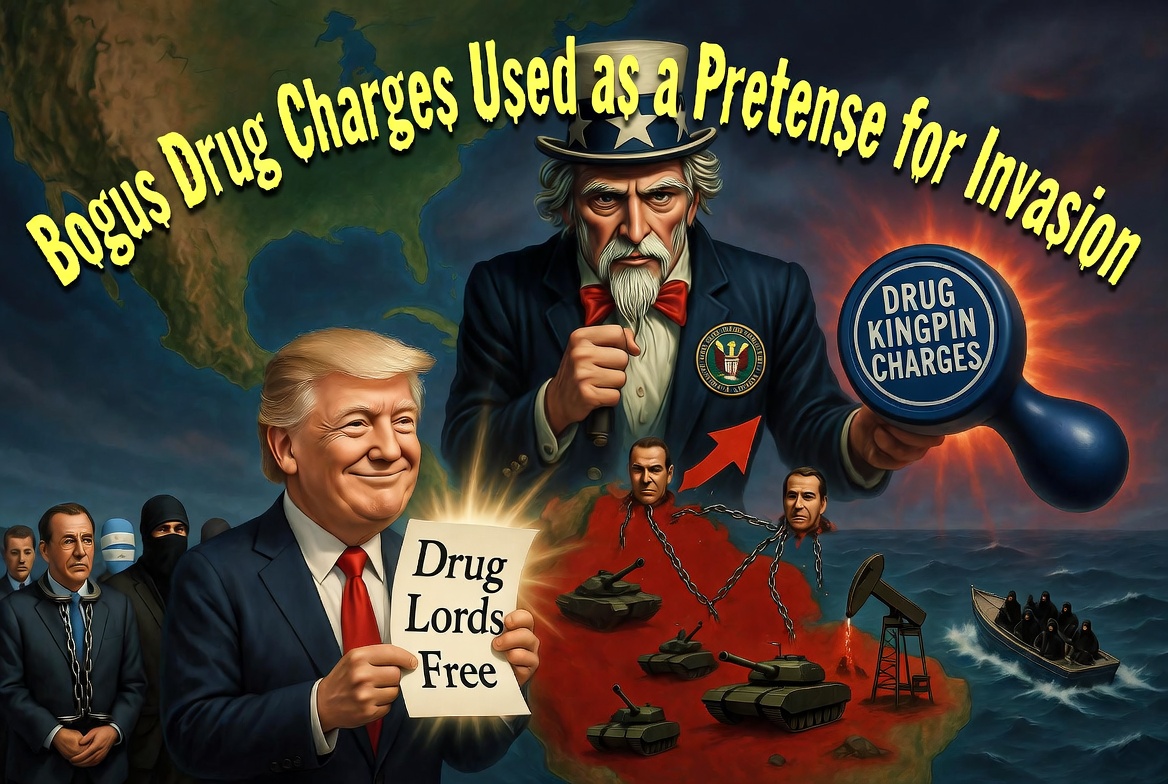
And that is where the real story begins. These shaky charges have served as the perfect pretext for full-scale invasion and occupation. The U.S. military raid that snatched Maduro and his wife has been condemned internationally as an extrajudicial operation that spilled beyond Venezuelan borders, with reports of actions—including lethal force—in international waters carried out without transparent evidence or due process. Once in control, American administrators moved swiftly to “stabilize” the country’s oil infrastructure, effectively seizing billions in resources under the banner of reconstruction. Critics around the world now label these moves textbook war crimes: unilateral regime decapitation, resource plunder, and the imposition of foreign control dressed up as anti-drug justice. What began as courtroom indictments has ended with boots on the ground and Venezuelan sovereignty erased, and oil resources under American control—all justified by drug allegations that even the prosecutors themselves quietly watered down.
The Trump administration has extended its pattern of unsubstantiated fentanyl accusations to Canada, with officials and the president repeatedly claiming “massive” amounts of the drug cross the northern border, justifying tariffs of up to 35% on Canadian imports and even provocative suggestions that Canada should become the 51st U.S. state to eliminate border issues and tariffs altogether. These assertions lack credible backing: U.S. Customs and Border Protection data show that in fiscal year 2024 and into 2025–2026, fentanyl seizures at the Canadian border amounted to mere dozens of pounds—less than 0.2% of total U.S. seizures—compared to over 21,000 pounds at the southern border with Mexico, where the DEA and multiple reports confirm Mexican cartels (Sinaloa and CJNG) dominate production using precursors from China and India. Similar hetoric has targeted Mexico, with threats of direct U.S. military strikes or invasions against cartels inside Mexican territory—rhetoric that escalated in 2025–2026 amid ongoing tariff pressures and operations like Southern Spear—despite Mexico’s cooperation in extraditions, seizures, and border deployments, and no public evidence supporting claims of unchecked cartel control necessitating unilateral American intervention. Such inflammatory claims, devoid of supporting seizures or intelligence, mirror the Venezuela playbook: inflating minor or nonexistent threats to pressure sovereign neighbors economically and militarily, all under the guise of combating a fentanyl crisis overwhelmingly sourced from the south, not the north.
In the end, the pattern is hard to ignore. Trump frees American-friendly drug figures at home while weaponizing the same accusations abroad to topple governments, grab resources, and redraw the map. Whether in Cuba’s ongoing probes or Venezuela’s completed “liberation,” the drug war has once again proven itself the perfect smokescreen for old-fashioned imperialism.
Excerpted from – Zeitgeist Apocalypse: Trump as the Antichrist, MAGA as Heresy, and America as Babylon: Apocalypticmania Part 9: The United States of Armageddon –