In Part One of this series, Apocalypticmania: The Psychological Disorder Driving Human History I laid out the definition of “apocalypticmania” — that weird anxiety inducing, persistent mental grip the end-times narrative holds over so many of us, whether we grew up Evangelical, watched too many dystopian flicks as kids, or just absorbed the ambient anguish of living in the late 20th and early 21st centuries Zeitgeist. We looked at how the Book of Revelation, combined with Cold War mushroom clouds, Reagan’s 666 numerology memes, Gulf Wars, climate dread, and now the whole Trump phenomenon, keeps triggering this obsessive loop in the collective psyche—and in my own head, more times than I care to count. I also admitted that the condition isn’t just abstract theory for me; it’s been the engine (and sometimes the curse) behind almost everything I’ve done since 1990.
Understanding my Apocalypticmania, its origins and where it has led me
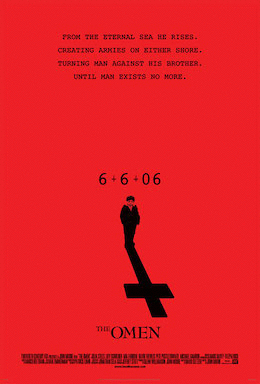
I think it was when I was a kid, in the 70s, that I first developed latent indications of apocalypticmania, after seeing or hearing about the movie The Omen (1976). The film, as i am sure most people are aware, centres around the birth of the Antichrist, born with the number 666 on his scalp, in the movie, the mark of the beast. Perhaps dystopian movies about the fall of mankind and the end of the world also influenced my condition. Born after the events of the atomic age, such fears were realistically inherited by my whole generation.
I can’t blame a religious upbringing for my apocalypticmania, like a Jehovah’s Witness or an American Evangelical Christian could, as they were literally indoctrinated into this trauma inducing psychological state from an early age. The amount of times my family went to church together could be counted on one hand. My mom, who mostly raised me, was into horoscopes, tea leaf reading, and automatic writing, not the beliefs of the Bible, and my dad flutters between atheism and agnostic. I went to Sunday school a handful of times, but it never really took and it was not something my parents encouraged much. None the less, just growing up in a Christian world, with its Christian specific holidays, and themes in movies, like vampires being afraid of the cross, caused the basics of the Christian mythos to develop in my mind, I knew the basc myths of the Bible and I accepted these ideas.
Compounding this, and I think this is true of anyone growing up in the last decades of the 20th century, end of the Worldand post-apocalyptic themes in movies and television, really primed us for apocalypticmania in so many ways. I was completely obsesses with movies like Planet of the Apes, Logan’s Run, Hardware, Mad Max a Boy and his Dog and other sci-fi classics which predicted the fall of civilization.
Another possible contributing factor from my childhood, was I had a couple of dreams that really stuck with me and I applied a lot of significance too. One of these was a dream where I was showing a sprout coming up out of the ground, and was told it was going to have healing power and other things. At the time I was sure it was a clover, it had little rounded leaves. However, later I learned that a cannabis sprout has similar leaves. Decades later in the early 2000s I saw an independent film about hemp, that had an opening of a cannabis time lapse from sprouting, and I was hit with a heavy deja vu of that childhood dream and felt like that is what I saw. Although here, I did not make any sort of Biblical connection about it when I was a kid.
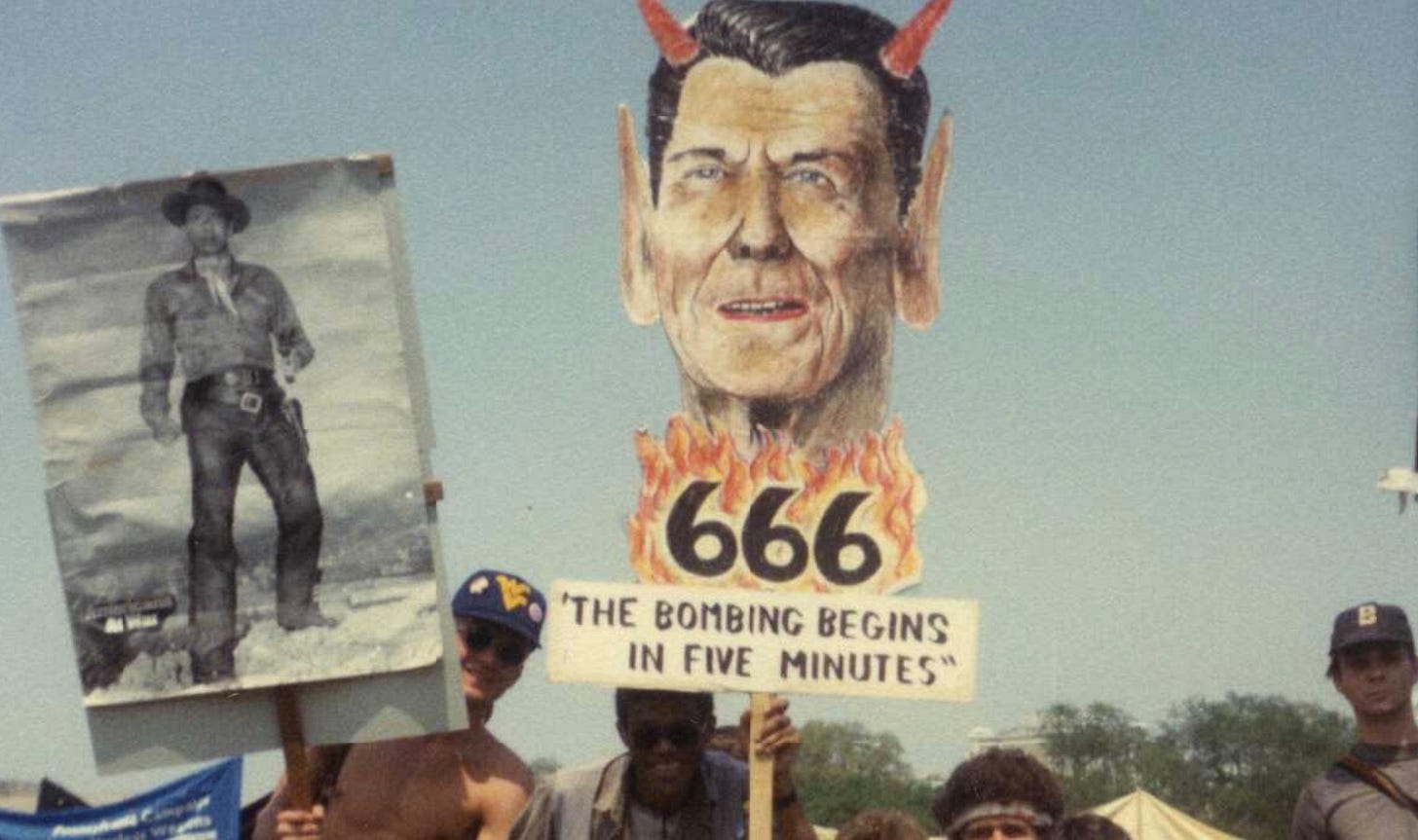
I think I had a little spike when the whole 666 thing coming up with Ronald Wilson Reagan’s presidency as well. With some other sufferers of apocalypticmania at the time, I took note that each of Reagan’s 3 names had 6 letters, Ronald Wilson Reagan, and with some bogus numerology this was identifying him with the ‘mark of the Beast’. I can’t recall why, but at some early point, I began to imagine myself playing some sort of role in the unfolding events, and when drunk or high enough revealing these hidden thoughts to others. But for the most part, it stayed in the background of my life, and did not explode into a full grown case of severe apocalypticmania, till the beginning of the 1990s.
Full Blown Apocalypticmania, 1990
In 1990, I experienced a synchronization of events that contributed to a religious experience or a psychotic break, depending on one’s perspective. Wether for better or worse, this event is undeniably at the core of my own research interests, and has led the direction of my life ever since. Since that time, symptoms of apocalypticmania, have repeatedly come to the forefront, and receded into the background of my consciousness, depending on the state of the world and my life at the time. (Current events, for instance, have triggered it, and in many ways this article is an attempt at self analysis.)
At that time, at the cusp of 1990, I was a surfer on the West Coast of British Columbia’s Vancouver Island. I was living a hedonistic life of many surfers, based around having a job that allowed for a lot of time to chase waves. I was working 3 nights a week at a union job as a night watchman in a local fish plant, cutting back on living expenses with a hobby cannabis garden in my back shed, and chasing the cold and then un-crowded Canadian Pacific waves. It should also be noted that at that point in my life, I had no background in either writing or religious studies, not even a high school diploma. I was on my own and working by the time I was 17. I graduated from the school of hard knocks.
[I tell the story of my 1990 religious experience in a 2004 video, for those who prefer that to reading this next section]
The first of these events occurred with the exposing of the rampant pedophilia problem within the Catholic Church. This issue was coming to light via the testimony of adults who had spent time as children in Newfoundland’s Mount Cashel Orphanage, and were molested by the Christian monks who ran the facility.
The news about widespread child molestations and physical abuse at Newfoundland’s Mount Cashel Orphanage, operated by the Christian Brothers, came to light in the late 1980s after a decade-long cover-up of earlier allegations. A 1975 police investigation into reports of abuse—triggered by boys escaping the orphanage and confiding in family—uncovered confessions from some Brothers and statements from dozens of residents, but it was abruptly shut down by senior Royal Newfoundland Constabulary officials and the Justice Department, with accused Brothers quietly transferred out of the province instead of facing charges. The scandal resurfaced publicly in February 1989 when a caller on a popular radio open-line show alleged a police cover-up of the 1975 probe, prompting the investigation to be reopened. This led former resident Shane Earle to speak out, and in March 1989, the independent newspaper The Sunday Express published explosive accounts of abuse dating back years, sparking outrage. The revelations quickly resulted in a provincial government-ordered public inquiry (the Hughes Inquiry) and criminal charges against several Brothers, exposing institutional failures by police, government, and church authorities.
Shocking Secrets of Mount Cashel: Canada’s Darkest Orphanage Scandal – https://www.youtube.com/watch?v=F59INSxzkww&t=2s
Around that time, I was asked to be my niece’s godfather, and went to her Catholic Christening, when it became time for me to repeat the priests word, I froze like an idiot and just had a stupid grin on my face, I could not do it. Not long after that priest as well, was exposed for child molestation.
Although I was not brought up within a religious family, these events drew my interests and in an effort to try to understand the problem at its roots, I decided to try and read the Bible. Having a job as a night watchman in a west Coast fish plant, I had plenty of time to read, so I went out and picked one up. I tried reading it, but found it very hard to read and extremely boring and did not make it far, so it got put away in the night watchman’s room and forgot about it for some months.
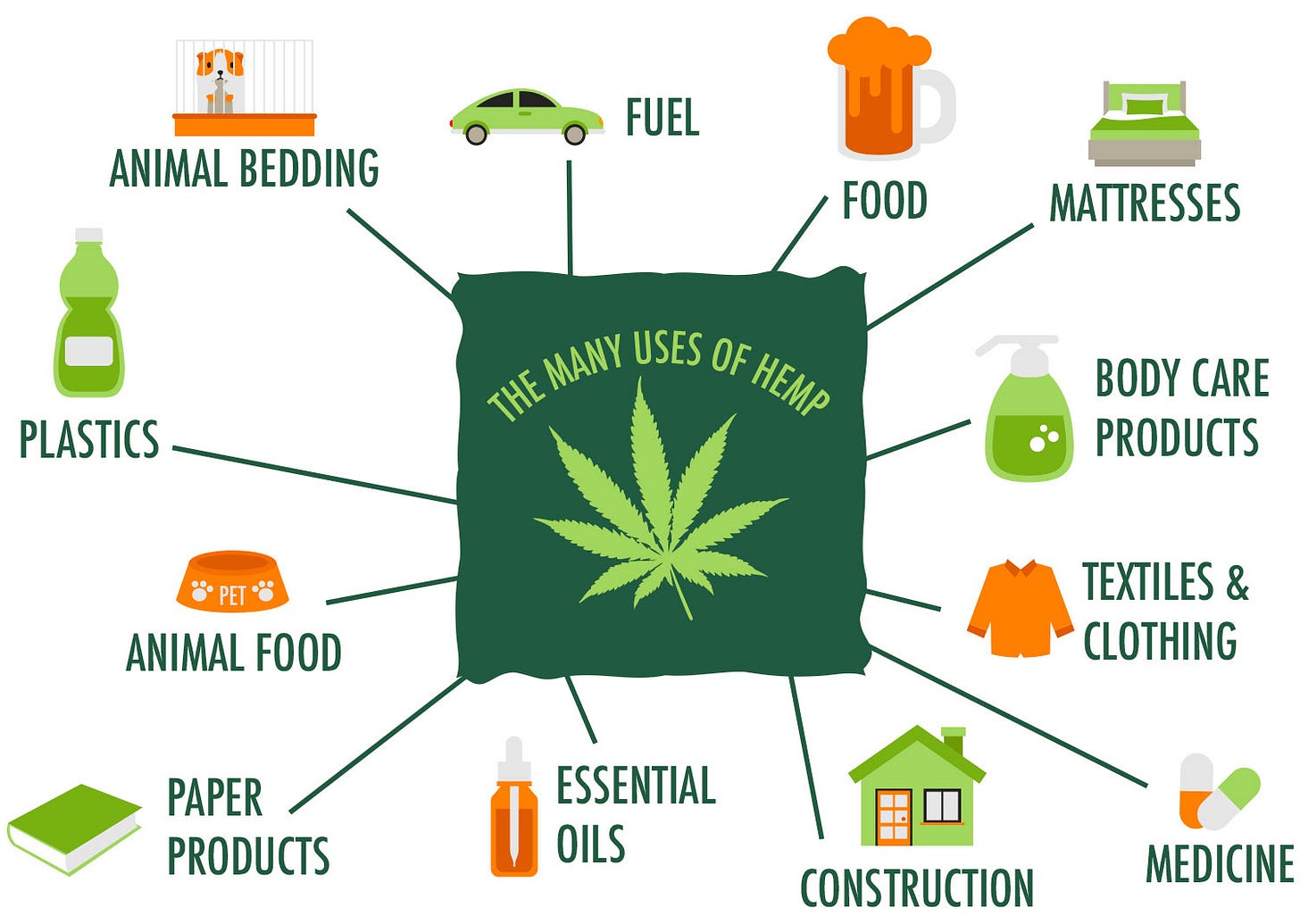
Another major factor was that I had also first learned of the many uses of cannabis besides smoking it, such as fibre for clothes, seed for food, oils for paints and fuels and the like. Up until the 90’s the term “Hemp” had fallen into such disuse that few even knew this was a reference to cannabis, and when a friend first told me about the industrial uses of Hemp, I was extremely skeptical. As well, it was a hard subject to research, as all literature that was pro cannabis had been virtually banned at that time in Canada, but upon looking through some encyclopedias at the library I began to learn that my friend’s claims had a basis of fact behind them. This was of particular interest to me at that time, as the area where I lived was caught up in a battle between loggers and environmentalist and I could see that cannabis (in the form of industrial hemp) may hold the answer in the equation of jobs vs. the environment. Fifty percent of trees harvested go to the pulp mill to become paper products and all of this could be replaced by renewable cannabis crops, which are thought to vastly out produce trees for paper when grown and harvested for those purposes.
Simultaneous with these events, the first Gulf War in Iraq began to unfold which initiated a fear in myself and many others that this war could escalate to a global scale. Accordingly, I came to the belief that not only did hemp for paper offer the solution to the over-logging of Canada’s old growth forests, but that it could also provide a viable bio-diesel alternative to the oil deposits that the first Gulf War seemed to really be about. But no one was promoting these ideas to any effect in 1989, in Canada.
One night, or rather in the very early morning hours, while working as a night watchman, I was sitting at the empty lunchroom table by myself, smoking a thumb sized joint of the potent Cannabis indica that I had grown in my shed and reading the newspaper. That newspaper contained an advertisement from a well known American Evangelist, about an upcoming stadium service. In the advertisement, the Preacher (I think it was Pat Robertson) was positioned at the pulpit, and behind him were military tanks and jests and the theme of the sermon tied the then-ongoing Gulf War with Revelations 18 (The Fall of Babylon).
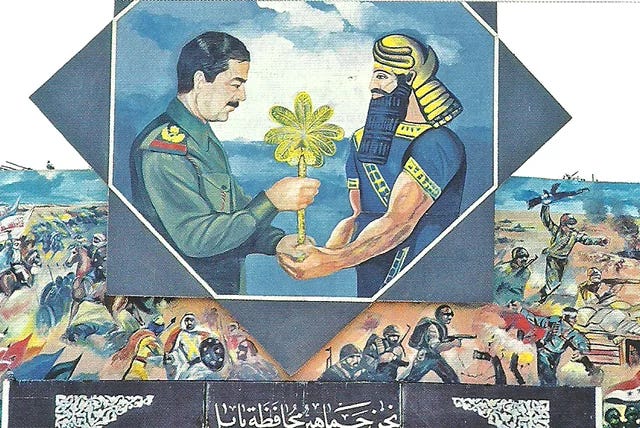
Babylon once sat in the place of modern Iraq, and having followed the developing story, I knew that people in the Mid-East and America, due to Saddam Hussein’s firing of a scud missile into Israel, were drawing analogies between Saddam and Nebuchadnezzar, the most famous king of Babylon, who conquered ancient Israel. Saddam did much to encourage this view, he had been restoring the ancient Gardens of Babylon, and had a laser image of Nebuchadnezzar shot into the Night sky, then his own image superimposed over it. He also produced murals, inscribed bricks, and other propaganda to this effect.
Thus, I became caught up in the apocalyptic ardor of the moment. Having seen apocalyptic movies like The Omen as a child, along with talking with the occasional Jehovah’s Witness, as well as being of the generation that approached the close of the millennia, I was already deeply influenced by societal imprinting that holds the scenario of Revelations as a deep core belief. I immediately retrieved the Bible I had left in the night watchman’s office and excitedly read through the Book of Revelations. I noted with interest how the Prophet John was given a scroll to eat before prophesying (Revelation 10:10). The scroll tasted sweet in his mouth and turned bitter in his stomach, which I understood from my personal experiences as a descriptive of the ingestion of a psychoactive substance in order to produce a visionary state. After drawing this analogy in my own mind, the references to the incense with the prayers of the Saint and their billowing clouds of smokes (Revelation 5:8, 8:3) along with accounts of God’s “witness’s” dressed in “sack cloth” (Revelation 11:3) caught my interest, all making me consider cannabis incense and cloth, and, finally, I reached the end revelation and read the account of the Tree of Life.
On either side of the River of Life stood the Tree of Life, bearing twelve manner of fruits, and yielded her fruit every month, and the leaves of the tree were for the healing of the nations.(Revelation 22:2).
At this point, I had what can either be described as a religious epiphany, or a psychotic break which led to a full blown case of apocalypticmania. My experience at the time was like a divine information-filled light entered my being leaving me with the strong intuitive knowledge that cannabis was that Tree of Life described at the end of the Book of Revelation. This was the pivotal moment of my entire life and the deciding factor in the path I would follow from then on. It also marks the moment my apocalypticmania, went from a latent case, to a full blown one…..
Cannabis has well known, numerous and historical industrial uses (i.e. fruits). Its’ leaves have historically been used for healing, it was a major medicine prior to being prohibited for everything from corns and bunions to coughs and consumption. Of course, since that time, cannabis’ medical qualities have become increasingly well known, and can be legally used in many parts of the world, but at that time, this was far from the case.
In my mind, the many fruits of the tree of life were seen as the cannabis plant’s many uses. Hemp based products also aid in the restoration of the environment and offer eco-friendly alternatives to environmentally damaging cotton production and the use of petroleum based products. The seed of the cannabis plant, and oil expressed from that seed, have many nutritional benefits. Cannabis fibres are made into cloth, paper made from hemp offer an alternative source to the harvesting of trees, and the whole plant can be used in the production of bio-mass fuels which could help to solve the world’s dependency on fossil fuels. Cannabis is also harvested every month of the year, as with the fruits of the tree of life. Knowing these facts and deeply under the influence of cannabis and the religious experience it provoked in me in the circumstance, I found it impossible to ignore these analogies with the Biblical Tree of Life. However, keep in mind, by that time I’d been smoking cannabis for 15 years (I started when I was 12) and never had any sort of psychotic break. So I emphasize here it was a combination of events and cannabis at the core of it.
When I awoke my wife at that time, with an early morning phone call relating this revelation, she became extremely upset, crying on the phone and telling me I was having a mental break down. The next day, no longer under the immediacy of the cannabis-induced religious experience, my analytical mind began to feel the stirrings of doubt about the whole experience. Had I just been really stoned? Interestingly, since then I have read numerous historical accounts of people who experienced their own revelations from cannabis, and pondered the legitimacy of them due to this same sort of situation.
I resolved to research my newfound understanding of cannabis’ place in my theology to determine whether there existed support for my revelation or whether it was simply the product of a “stoned” mind. I figured if there was anything to the experience I had, others would have acquired similar experiences from it. Also, I did not think my own experience was valid enough, and I wanted validation for it.
At that time I knew nothing about the vast history regarding the role of cannabis in religion, other than a vague awareness of Bob Marley and Rastafarianism. Nor much about religion or history itself. Digging into deep research based on some religious experience could easily be interpreted as a form of a delusion disorder, and it is a clear symptom of the sort of apocalyticmania we are discussing here. The person may function normally otherwise but becomes preoccupied with gathering “evidence” to support their idea, interpreting neutral events as confirmation. This is common in cases where someone obsessively researches to prove a personal theory (e.g., a hidden conspiracy affecting them or a grand discovery). In my case, this turned into 5 books and dozens of published articles in other books, journals and magazines, so in that respect it was rather ‘fruitful’.
As I pondered my experience, and looked out of my front window at clear cut mountain tops, I would think that one thing I did know was that hemp paper could save those trees and my conscience drove me to discuss and advocate for the use of cannabis to solve these environmental issues to all who would hear. I formed a group, ‘Patriotic Canadians for Hemp’, ‘patriotic’ because I saw how that schtick on patriotism was being played by George Sr. to sell a war. As well, I figured that if cannabis was the Tree of Life, then someone else somewhere will be aware of that fact, and in the background of all this I began to research deeper and deeper. I soon found there were historical references to the medicinal and spiritual use of cannabis in diverse cultures going back millennia which helped identify the “leaves for the healing of the nations”, a phrase often quoted in reference to cannabis by Rastafarians. I began to collect and compile this information. My goal was to prove for a fact that cannabis was the very ‘tree of life’ in reality, and I saw this as a divine mission, akin to Parsifal’s search for the Grail.
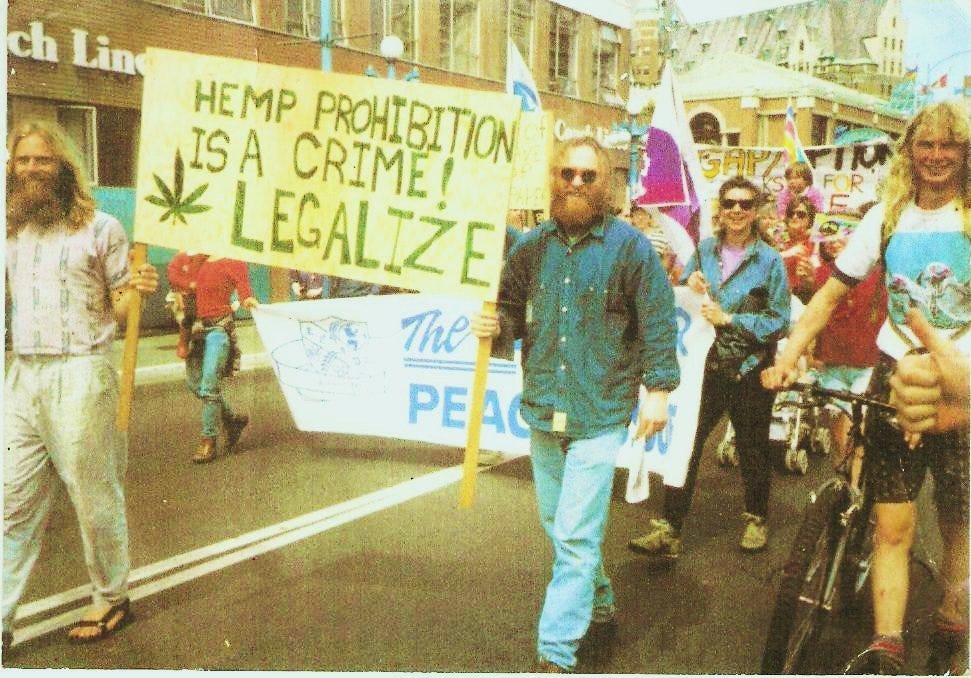
In a weird moment of synchronicity, and to the amazement of my concerned friends shortly after this, an article appeared in the Victoria, BC newspaper the Times Colonist, ‘Christ led me to marijuana court is told’ about the court case of James Dure, in 1990. I got a few of my surf buddies together, made some signs, and organized my first protest. The defendant James Dure claimed to have travelled the land with the incarnation of a modern Jesus, known by the name Lightning Amen, as i recall the holy spirit descended on him while high on LSD at Woodstock. Luckily I was skeptical enough then not to get pulled into that one. But James efforts in court, was worth supporting, and I went on to do the same as a expert witness and offering evidence in other cases and my own challenge to the law as well. I did make the acquaintance of Dure’s lawyer Donald Bohun then though, he was also an advocate of legalization and was pleased to see us protesting. Don really got into my research later and was writing about cannabis and the Bible himself under the name Gospel Writer up until his death a few years ago. He’s not the only lawyer who has taken such an interest either. (Apparently, some aspects of my apocalyopticmania can be contagious, be careful what you read.)
Shortly after this initial experience I noted that others had independently accepted and come to this same belief in cannabis being the Tree of Life. For example, references appear throughout Rastafarian texts and music. One day, on a business visit with a Chinese businessman who was importing hemp cloth into Canada, I noticed a picture on his wall of an old hippy gentle man poking his head out between cannabis plants, and the slogan on the image stated “Church of the Universe, Tree of Life Sacrament”. The Church of the Universe formed in 1969, when a group of hippies began noticing that whenever they smoked cannabis at their gathering the conversations often took on a tone of the philosophical and spiritual. I joined this Church in 1991 and remained a member till 2016, when one of the 2 surviving founders, Brother Michael began supporting Donald Trump. a sign of things to come for me over the next decade, as I watched more and more friends succumb to the Trump appeal.

The only real dogma of the church was that cannabis was the tree of life, and we were mandated o use and share its fruits (the many uses of hemp). Their many efforts to provide sacraments to their members resulted in multiple court cases over the years, and some of these used my research. I also got them Prof. Carl Ruck to testify as a expert witness, as he had by then become a supporter of my research. The Layer, Paul Lewin, wrote in regards to my written submissions to a 2008 Church case “Fantastic. Well written. Very compelling. By the end of this I’m probably going to have to convert”, as I recall, he later did join the Church before it disbanded. I myself, acting as a Church Reverend, took the Canadian government to court, over my right to use Cannabis as the ‘tree of life’, a court case that took years, and is a story in itself. Canada legalized cannabis while the case was in appeal.
An interview about my cannabis and religion court case.
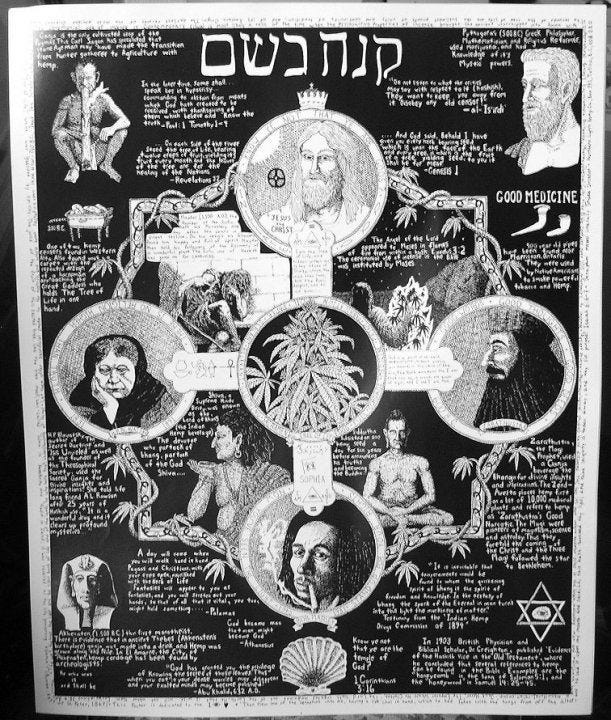
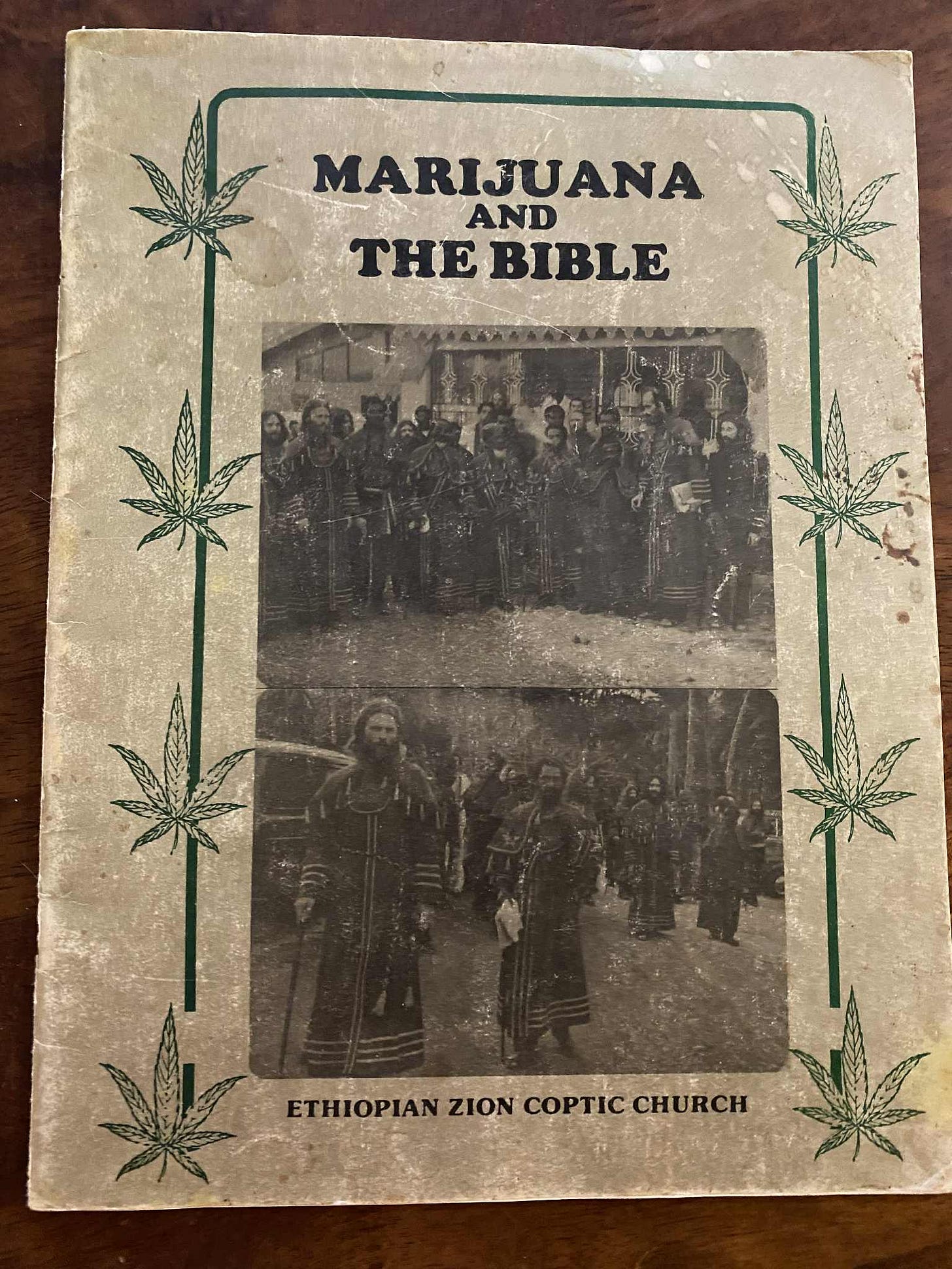
When I sent the Church of the Universe the research I had been putting together in the early 90s, they sent me a package in return, that contained a booklet Marijuana and the Bible, by Jeff Brown, who had been a member of the forcibly disbanded Ethiopian Zion Coptic Church. The Ethiopian Zion Coptic Church is a distinctive religious movement that emerged in Jamaica during the 1940s and 1950s, drawing heavily from the teachings of Marcus Garvey, biblical scripture, Afrocentric ideals, and Ethiopianism, while positioning itself as a “mansion” or branch within the broader Rastafari tradition. Unlike mainstream Rastafari groups that often revere Haile Selassie I as divine, the church emphasizes a structured Christian framework with communal living and views cannabis—referred to as ganja or the “holy herb”—as an essential sacrament, smoked continually throughout the day to foster spiritual communion, meditation, and closeness to God, interpreting it as referenced in the Bible from the burning bush to daily bread. The group expanded rapidly in the 1970s, establishing compounds in Jamaica and attracting white American converts in the United States, where it was formally incorporated in Florida in 1975; however, this growth led to high-profile legal battles, including convictions for large-scale marijuana smuggling and court rulings that recognized it as a legitimate religion but denied broad exemptions for cannabis use due to compelling state interests. Many Church members were arrested for smuggling cannabis from Jamaica to Florida, and the Church was for a time forcibly disbanded. Today, the church remains active though smaller, maintaining an online presence to advocate for religious exemptions and the therapeutic use of cannabis in compliance with federal law.
Jeff Brown, while serving time for marijuana smuggling on behalf of the Church, had also been come over with this drive to collect and document the historical role of cannabis in religion. The foundation provided by Jeff in his booklet Marijuana and the Bible was a very real affirmation to me that I was following the right path. I became friends with numbers of Coptic brethren, and they visited me in British Columbia, but they are basically fundamentalist Christians that use marijuana and I found their restrictions on sexuality were too much for me (“no hand sex, no oral sex” etc.). Comparatively, The Church of the Universe promoted nudity, and the Church rings worn by the brothers were a man and woman in the ‘69’ position, in commemoration of the year the Church was formed.
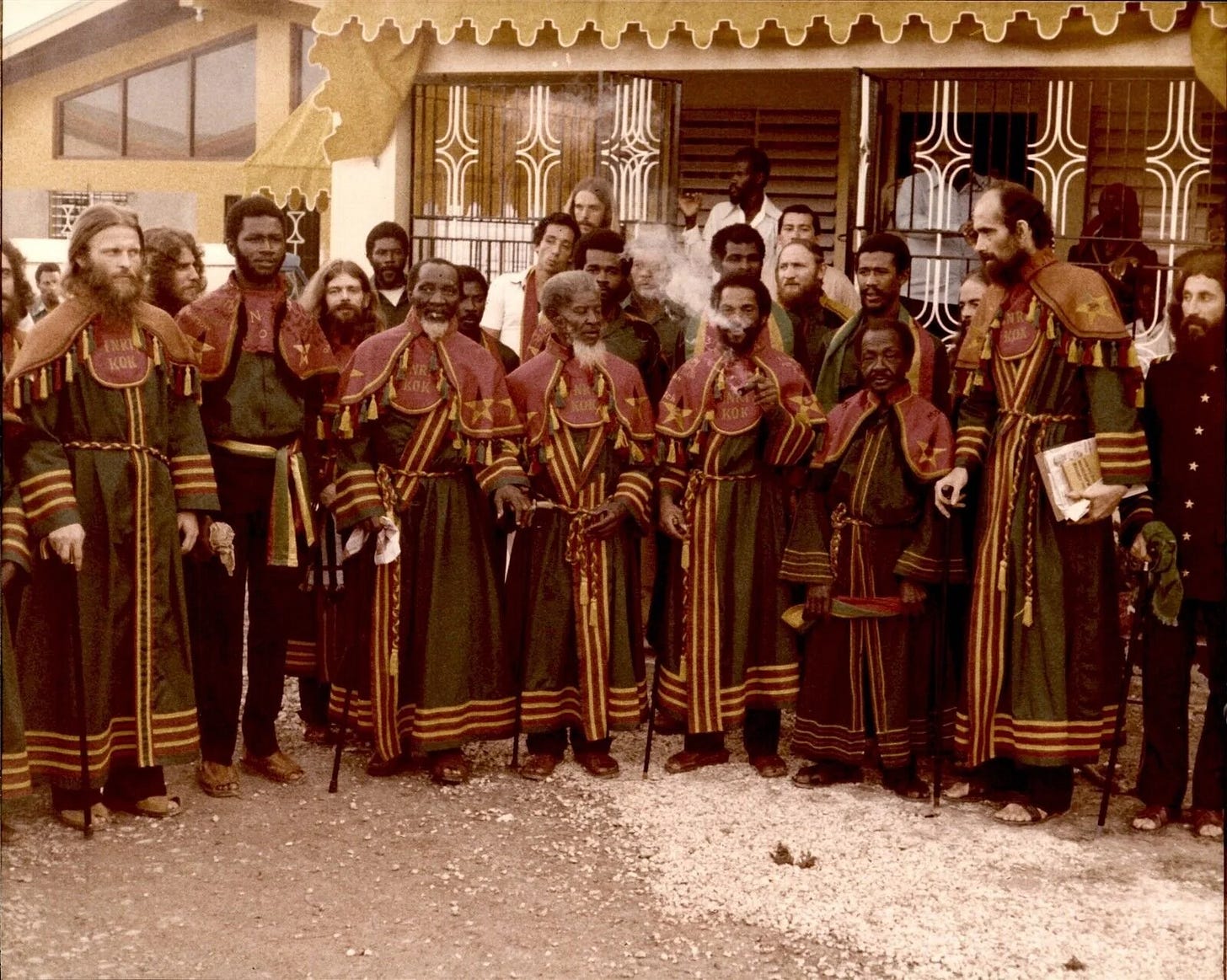
In regards to cannabis Churches, many of them could be seen as apocalypse inspired, particularly if they see cannabis as the ‘Tree of Life’. Even Rastafarianism emerged in 1930s Jamaica largely through a unique interpretation of the Book of Revelation. Early leaders like Leonard Howell saw the 1930 coronation of Haile Selassie I as Emperor of Ethiopia as the fulfillment of biblical prophecies, especially Revelation’s descriptions of the “Conquering Lion of the Tribe of Judah” (5:5) and “King of Kings, Lord of Lords” (19:16)—titles Selassie held. Influenced by Marcus Garvey’s prophecy to “look to Africa where a black king shall be crowned,” Rastas came to view Selassie as God incarnate (Jah) or the returned Christ, destined to liberate Black people from colonial oppression (”Babylon”) and lead them home to “Zion” (Ethiopia/Africa). Revelation remains central to Rastafari beliefs, framing the ongoing spiritual struggle and promise of ultimate redemption.
Coinciding with the research into the religious use of cannabis, I began to make products from hemp, like clothes, paper pads, and hemp seed food products. In fact, the company my first wife and I started, Mama Indica’s hemp Seed treats, opened the door to commercially produced hemp seed food products in Canada, where it is now a major industry. I would say all my cannabis based activism and efforts, have been tied up with my condition of apocalypticmania.
Throughout the early 90s, I would travel around and preach the wonders of the hemp plant at campuses and events, often setting up a table of my wares and information. I felt at the time, like something of a later day Ezekiel, dressed in sack cloth ie, my own home made hemp clothing, and seeing hemp as a way to save the World. I was sure at that time George Sr. was Antichrist, just like I suspected Reagan was before him.
To some extent, when doing public events, talking to the media and promoting hemp, I kept a lot of my thoughts about cannabis being the Tree of life in the background, and saved it for the people I thought might be ready for it. Family and friend concerns waned as I started appearing in the news, and they saw that there was reality to what myself and others were saying about hemp and the many products it produced. However, some older surfers I knew and looked up too, once showed up at my house for a sort of intervention. I’d sent some crazy esoteric letter into Surfer Magazine, in response to a negative article they had about cannabis, with cringey lines like “the new Rome will Fall”, and they were genuinely concerned, telling me how a joint now and then was fine, but I was going overboard.
My Apocalypticmania, peaked in the 1990s with George Sr’s presidency but then declined a little with Bill Clinton’s, who too me, seemed so much less sinister. (Be that as it may, Clinton kept the systemic evil of the American Empire rolling right along, with a slightly friendlier smile and disposition). None the less, my obsession with finding the deep secrets of esoteric cannabis history was firmly imprinted, and promoting hemp seemed like the best thing I could do to help the Environment, ensure jobs, heal the sick and lift the burden of oppression.
In 2000 I was offered a job at Pot TV, and left the small West Coast fishing town I lived in for Vancouver. This pulled me out of surfing for about 25 years, but got me heavily entrenched in activism. Before my ‘religious experience’ all i could think about was surfing, where I lived, worked and travelled to were all based on that. I’d always be checking the wind direction, and be eager to get off work to hit it. After my 1990 ‘tree of life’ episode in the fish plant though, I’d be out surfing, and thinking about the sad state of the World, and would feel like I was shirking off a higher responsibility, for hedonistic pleasures. I remember having a dream shortly before I left, where I was walking through the streets of my early childhood, and was finding my surfboards along the way broken in to pieces. I took it as a bad omen, and in a way it came to be.
In Vancouver, with the folks at Pot TV and Cannabis Culture and the funding of Marijuana Maverick and Libertarian, Marc Emery, we were able to take cannabis activism in Canada, up another level, and even began to have a strong effect on both sides of the border. Emery and I clashed like hell when he first showed up in the Vancouver scene. But he told me a story about a woman fainting in front of his bookstore before he got into cannabis legalization, and she later came to his shop and said she had a vision, of him with a plant leaf, dollar sign, and jail bars. It made me feel that somehow, for at least that time, our paths were aligned. Marc, is yet another person I know, who has been deeply drawn into the Trump sphere, and after sex scandals, racists exploits and other things, I eventually stopped being friends with him, even before MAGA. But I supported and enabled him for longer than I wish I had. We did some great work in the early 2000s, and helped to pave the way for legalization, but its all dead to me now, and I feel like Emery took a huge steaming shit on everything we did together.
Besides researching the role of cannabis, I had also acquired a deep interest in the book of Revelation, and tried to understand as much as I could about its origins and meaning. I put some of the material used in this series of articles together in the late 90s for the conclusion of Sex, Drugs, Violence and the Bible (2001) but I edited most of it out before publishing, as I thought it dated the work, and made the book a little crazier! (like a book suggesting figures from Moses to Jesus was getting ‘most high’ on cannabis could not get any crazier!!!). I’ve edited and re-adapted this material for this series of articles.
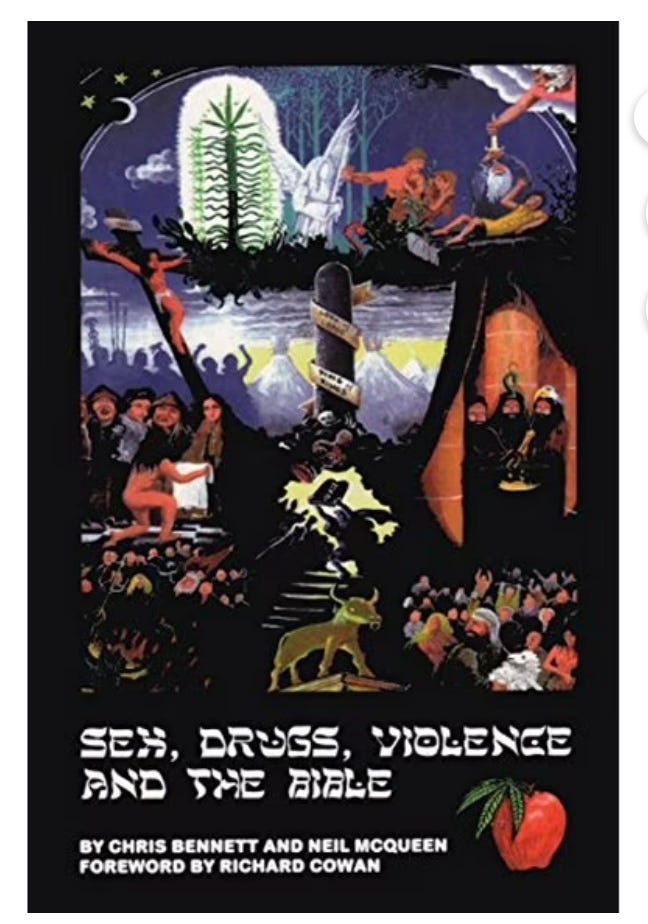
News stories about articles based on material from SDVB appeared in the International press in reputable news sources like the BBC, The Guardian, The Washington Post, Vice, and other media and the book was reviewed by Prof. Carl Ruck in the London, England, Sunday Times.
Initially, after my religious experience, I sort of thought the Bible held some great truth, but the more I read it, the more I doubted it. One factor in my rejection of the Bible and mainstream christian views was Medical cannabis was being brought to the forefront in the 90s, and this was largely due to it helping a lot of people with HIV and AIDS. This factor brought a lot of LGBQT people into the cannabis scene, such as advocates I admired like Dennis Peron and Brownie Mary. Also as a kid, my mom had gay friends, and our family Doctor was a gay man we greatly admired, one of the founders of Greenpeace in fact. This conflicted in a big way, with the more Christian based Ethiopian Zion Coptic Church, but not with the Church of the Universe, which was increasingly supportive of my work and research.
As well, I was clearly not a “Christian”, once I really started looking at things, I just could not buy the Virgin birth, Resurrection from the Dead, Forgiveness of Sin through the sacrifice of another and other elements. I suspect as I was aware of the scandals of the Catholic Church prior to my ‘religious experience’ in 1990, some of that carried over into skepticism and doubt, and that was a part of my Revelation. The big thing for me in regards to the Apocalypse, was establishing cannabis as the ‘tree of life’. Connecting it to the Bible was part of that, but that did not equate to promoting the Bible. I reasoned that appearing in the last paragraphs of the Bible’s last chapter, that the cannabis ‘Tree of Life’, somehow signalled the end of the ‘Age of the Book’, symbolically indicating in my mind, the Authority of Religious texts in general.
In order for you to understand the basis of my claims about cannabis being the ‘tree of life’, which developed from my apocalypticmania, I’ll need to give a bit of a rundown on my research. Anyone well familiar with my work can skim this part. But in order to understand how deep my apocalyopticmania goes, I think one needs to appreciate how deep a hole I have dug myself into with my research.
Kaneh Bosem and the Tree of Life
Another factor that caused me to reject a favourable belief in the bible, came though trying to understand the 5 Biblical references to kaneh and kaneh bosem that the anthropologist Sula Benet suggested originally identified cannabis. I could see a contradiction in the references, Exodus 30:23, Song of Songs 4:14, Isaiah 43:23-24, Jeremiah 6:20 and Ezekiel 27:19 which start out positive, identifying cannabis in a holy oil, but become more negative and kaneh is clearly rejected in Jeremiah 6:20. As I began to study these references in context, reading the Bible and books on the historical background of the Bible, it became clear that the references to kaneh, were wound up with the emergence of the ancient Israelites from a polytheistic culture, to a monotheistic one. This was particularly tied to Yahweh’s former spouse, the Levantine Goddess Asherah, the Queen of Heaven, who was worshipped alongside Yahweh and other deities for centuries before monotheistic reforms over took the region. Although a fringe theory in the 1990s the fact the Biblical God had a wife and this was suppressed by the authors of the Old Testament texts, this is now widely accepted by Biblical scholars.
Decades after I first suggested that the suppression of kaneh (cannabis) was tied with Asherah, an 8th century Hebrew BCE temple was discovered in tel Arad, Jerusalem, believed to be a site that indicated the combined worship of Yahweh and Asherah, and it provided archaeological proof, cannabis was being burnt for ritual purposes. Video: Religion for Breakfast: This Ancient Israelite Altar Burned Cannabis
In relation to the suggestion that Asherah’s worship was tied to cannabis, she would not be alone here in regards to Near Eastern goddesses. Ishtar may have also received a cannabis infused drink offering under the epithet Beltu, as noted in Dictionary of Deities and Demons in the Bible (1999). Inanna also seems to have had strong ties with the ritual use of cannabis. Inanna had a famous cultic temple in Eanna, and as noted “later Neo-Babylonian text records the delivery of large quantities of qunnabu [cannabis]to the great temple of Eanna” (Stein, 2009).
Elizabeth Wayland-Barber, a professor of archaeology and linguistics, notes that it was in the second quarter of the first millennium BCE that the “word qun-nabu (qunapy, qunubu, qunbu) begins to turn up as for a source of oil, fiber and medicine” (Barber 1989). This term has generally been identified with ‘cannabis’ by Assyriologists. See The Assyrian Dictionary, Volume 13 (1982)
Many have commented on its phonetic similarity to kaneh bosm and the Akkadian term qunnabu. Kaneh can also be phonetically rendered qaneh, and qunnabu, kunnabu. The contextual use here fits as well, qunnabu appears as an item in the ‘sacred rites’, and as an offering at temples, and in the forms of incense, anointing oils and infusions, in contemporary references to the Biblical era.
Importantly here, Frederick Mario Fales (1946-2024) was Professor of Ancient Near Eastern History at the University of Udine, he translated the following ancient cuneiform verse (No. 12. BM103205. Copy: p. 252) regarding the goddess Ishara and a ‘qunubu‘ cannabis salve:
The salve of Ishara
is cannabis;
The salve of Ishara
is cannabis:
From the
mouth of Qisirayyu
I hear so
As Fales explains “the connection between the salve of the plant qunubu and the name of this goddess might be sought in the aspect of the latter as deity of love. On qunubu… as cannabis… another [Assyrian] attestation of the plant [is translated]… ‘(She) said: ‘what is required for the ritual?’’ Quality oil, wax, quality salves (and particularly) salve of myrrh and salve of cannabis…’” (Fales, 1983).
This topical salve of course brings to mind the kaneh bosem anointing of Exodus 30:23, and these are not the only references to the Assyrian qunubu prepared as a topical, incense or ingestible used as a medicine or in sacred rites.
Asherah, was significantly associated with the sacred tree motif, which some scholars connect to the biblical Tree of Life in the Garden of Eden. This was seen as further validation of my apocalyptic views, as it provided a potential avenue of directly connecting the tree of life to cannabis.
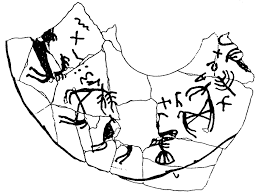
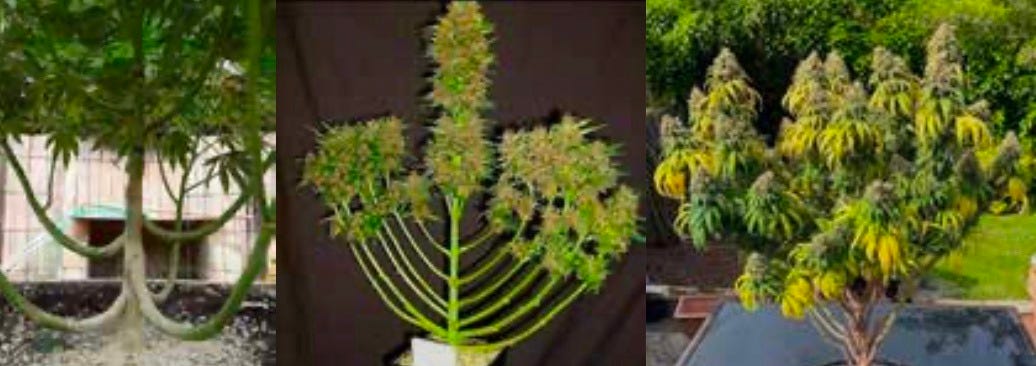
It is believed that the tel Arad temple was ‘cancelled’ during the reign of King Hezekiah, who was purging the worship of other deities in the region, besides Yahweh. This was particularly focussed on imagery of Asherah, and associations with her worship. 2 Kings 18:4 records how Hezekiah, “destroyed the high places. He broke the memorial stones and cut down the Asherah poles. He broke into pieces the bronze snake that Moses made, for until then the Israelites were burning incense to it. It was called Nehushtan.”
One of the titles of Asherah, was “the lady of the serpent.” Interestingly, the patriarchal monotheistic takeover, which saw her image and priestesses removed from the temple in Jerusalem by the same historical figures suggested to be behind the cancelation of the shrine in Arad, gives us some interesting insights into some potent Biblical mythology.
The Brazen Serpent brings to mind another serpent in the Bible, one that in the myth of Genesis, swayed the first woman with the fruits of a forbidden tree. These items were removed from the Main temple in Jerusalem, and one might be reminded of certain elements of the Garden of Eden at play here, so it’s worth noting other motifs present, such as the two cherubim over the altar, and the sacred trees, also appear in the Eden Myth. This has caused some speculation that the Eden myth, composed late in the Old Testament time period, and placed at the beginning by later editors, was concocted as a sort of propaganda against the earlier combined cult of Asherah. This is a theme that is explored more fully in my book Cannabis:Lost Sacrament of the Ancient World.
Interestingly, Asherah’s main symbol was a sacred tree, often described as “the tree of life”, which was later depicted as prohibited in the Garden of Eden. In his article ‘Yahweh’s Divorce from the Goddess Asherah in the Garden of Eden’ Arthur George notes:
As noted by numerous biblical scholars, the Goddess is also seen in the figure of Eve herself… In the Eden story she is given the epithet ‘the mother of all living,’ an epithet like those given to various ancient near Eastern goddesses, including… Asherah… Eve’s actual name in Hebrew (ḥawwâ), besides meaning life (for which goddesses were traditionally responsible), is also likely wordplay on an old Canaanite word for serpent (ḥeva). The name of the goddess Tannit (the Phoenician version of Asherah) means ‘serpent lady,’ and she had the epithet ‘Lady Ḥawat’ (meaning ‘Lady of Life’), which is derived from the same Canaanite word as Eve’s name (ḥawwâ). (George, 2014)
This connection to cannabis, Asherah and the tree of life imagery was a particularly important revelation for me when I was doing my research, as it was a means of tying the references to kaneh, and the tree of life to cannabis. Thus the archaeological connections between tel Arad, Asherah and cannabis, offering a more concrete connection, agitated my apocalypticmania further.
To be clear here, no current Biblical scholar ever suggested cannabis use by the Israelites in this context. But I did by following Sula Benet’s 5 references to kaneh and kaneh bosem and it I am stating now that tel Arad, confirms Sula Benet’s linguistic hypothesis. Briefly, a summary of these references in the context of tel Arad, and other linguistic evidence is as follows:
The Exodus 30:23 reference, gives us indications that this was a cannabis oil or resin product, as was the cannabis used at tel Arad. The Akkadian qunnabu is believed to have a cannabis oil or hashish, like the Hebrew anointing oil, we also know that cannabis was used topically in Assyria in religious rituals.
Song of Songs 4:14 identifies cannabis in a list of spices, which includes frankincense. It has been suggested by numerous scholars, that the Songs were a remnant of the Hieros Gamos, or Sacred Marriage. Archaeological evidence has confirmed the presence of a Hebrew Goddess, Asherah, in Israel during the Kingdom period. In the Bible Solomon was accused of burning incense on high and worshiping the Goddess. The temple of tel Arad sits high upon a hill, and is known for its evidence of the combined worship of Yahweh and Asherah, as well as its two altars for frankincense. Moreover the temple at tel Arad, is built upon the design of Solomon’s temple in Jerusalem. As well, references to qunnabu identify the use of cannabis in other regional representations of the Goddess, such as Ishtar, Inanna, Ishara and others.
Isaiah 43:24, gives us a direct combination of kaneh and frankincense as an offering to Yahweh, identifiable with the cannabis resins and frankincense found on the two altars at tel Arad. Yahweh burns with anger for being burdened with ‘sins’ and ‘iniquities’ with no offering of kaneh and frankincense. Connections with Isaiah 6, and the smoke filled inner chamber, indicates such ‘sins’ and ‘iniquities’ were lifted with incense offerings and this gave the prophet the power to speak for Yahweh. We see similar ritual use of qunnabu in Assyrian and Babylonian temples.
Jeremiah 6:20 again gives us kaneh in direct company of frankincense, as with the cannabis resins at tel Arad. Here it is rejected, and this happens in the same time period as tel Arad’s cancellation. In both cases, it seems this was connected with the suppression of the Goddess Asherah. Jeremiah 44 specifically blames the fall of Jerusalem as being caused by the Lord’s anger of ‘burning incense to the Queen of Heaven’.
As well Jeremiah identifies kaneh as coming from a foreign land, as was the case of the cannabis resins at tel Arad.
Ezekiel 27:19 identifies cannabis as coming in via trade routes, as with the cannabis at tel Arad.
For a more complete understanding of these references and the linguistic case, see my article Kaneh Bosem 101: The Botanical, Linguistic, Archaeological and Contextual case for Hebrew ‘kaneh’ as ‘Cannabis’.
In the first of Benet’s references to kaneh, (Exodus 30:23) it appears as an ingredient in the Holy anointing oil, that was used at first for the intalation of the High Priest, and later this was extended to the anointing of kings as well. The one who received the anointing, in Hebrew, was known as the Messiah, in later times, through Greek translations, this became Christ. Researching this, I came to hypothesize based on New Testament and Gnostic references, that early Christians used a Holy oil, for medical, and also spiritual purposes. Information that has garnered international interest and debate. This has been covered for decades by both mainstream sources like the BBC, the Guardian, Washington Post, and more sensationally by media like Vice, Big Think and other countless sources. Arguably, this hypothesis has escaped my hold. I see it continually turned into new memes and news stories, seldom giving me any credit, its just out there spreading like yeast in rising dough, leading its best life without me.
To briefly, give some idea about this, it should also be noted, that nowhere in the Bible does Jesus baptize his disciples, but in the oldest of the synoptic Gospels, he does send out the apostles with holy oil, “And they cast out many devils, and anointed with oil many that were sick, and healed them.” (Mark 6:13). Epilepsy was interpreted as demonic possession in the ancient world, and cannabis is an effective medicine against that, as well as a number of other diseases miraculously treated by Jesus.
As well, the Bible’s New Testament’s 1 John describes the spiritual knowledge contained in the anointing: “you have an anointing from the Holy One, and all of you know the truth … the anointing you received from him remains in you, and you do not need anyone to teach you. But as his anointing teaches you about all things and as that anointing is real, not counterfeit – just as it has taught you, remain in him” (1 John 2: 27).
A 1992 archaeological dig in Bet Shemesh near Jerusalem has confirmed that cannabis medicine was in use in the area up until the fourth century. In the case of the Bet Shemesh dig, the cannabis had been used as an aid in child bearing, both as a healing balm and an inhalant. This find garnered some attention, as can be seen from the Associated Press article, ‘Hashish evidence is 1,600 years old’, that appeared in Vancouver newspaper The Province, on June 2, 1992:
Archaeologists have found hard evidence that hashish was used as a medicine 1,600 years ago, the Israel Antiquities Authority said yesterday. Archaeologists uncovered organic remains of a substance containing hashish, grasses and fruit on the abdominal area of a teenage female’s skeleton that dates back to the fourth century, the antiquities authority said in a statement. Anthropologist Joel Zias said that although researchers knew hashish had been used as a medicine, this is the first archaeological evidence. (Associated Press 1992)
As Zias and his colleagues explained: “We assume that the ashes found in the tomb were cannabis, burned in a vessel and administered to the young girl as an inhalant to facilitate the birth process” (Zias, et al., 1993). This find of cannabis in a Judean cave was further supported by the later analysis of glass vessels from the site which also contained evidence of cannabinoid residues (Zias, 1995). This find provided evidence of both inhaled and topical use.
However, it is in the Gnostic Christian texts that we get the greatest indications of these uses, and here, anointing is counted as far superior to the water baptism of the Roman Catholic Church. By the time I wrote Sex, Drugs, Violence and the Bible (2001) I had become familiar with Gnostic Christianity, and ancient Gnostic texts, and this really influenced my beliefs at the time, and the direction of my research.
Christian Gnosticism was a diverse esoteric movement in the first few centuries CE that stressed gnosis (direct spiritual knowledge) as the key to salvation, over mere faith or church authority. Jesus is portrayed not as a suffering redeemer but as a spiritual guide revealing hidden truths. Women held leadership roles in Gnosticism, and Mary Magdalene was considered the premier apostle. Key texts, many previously known only through condemnations by Church Fathers like Irenaeus and Tertullian, include the Gospel of Thomas (a collection of Jesus’ sayings emphasizing self-knowledge and enlightenment), the Apocryphon of John (detailing Gnostic cosmology and creation myths), the Gospel of Philip (exploring sacraments and mystical unions, including Jesus’ close relationship with Mary Magdalene), and others from schools like Valentinianism and Sethianism. The most significant cache of these writings surfaced in 1945 when an Egyptian peasant, Muhammad Ali al-Samman, discovered the Nag Hammadi library—a sealed jar containing 13 ancient codices with over 50 Coptic texts (translations of Greek originals from the 2nd-4th centuries CE) buried near a monastery in Upper Egypt, likely hidden by monks to evade destruction amid rising orthodoxy; this trove revolutionized scholarly understanding of early Christian diversity, revealing Gnosticism’s rich, alternative interpretations of Jesus’ message and challenging the dominance of canonical scriptures.
In the first few centuries AD, Christian Gnostic groups such as the Archontics, Valentians and Sethians rejected water baptism as superfluous, referring to it as an “incomplete baptism”. In the Gnostic tractate, “the Testimony of Truth, water Baptism is rejected with a reference to the fact that Jesus baptized none of his disciples (Rudolph 1987). On the other hand, being “anointed with unutterable anointings” the so-called “sealings” recorded in Gnostic texts, can be seen as far more literal event, than the many metaphorical baptisms that are referred to. “There is water in water, there is fire in chrism.” (Gospel of Philip). “The anointing with oil was the introduction of the candidate into unfading bliss, thus becoming a Christ”(Mead 1900). “[T]he oil as a sign of the gift of the Spirit was quite natural within a Semitic framework, and therefore the ceremony is probably very early…. In time the biblical meaning became obscured: Ambrose explained it in his catechumens as like the anointing of an athlete before running a race”(Chadwick 1967). The surviving Gnostic descriptions of the effects of the anointing rite make it very clear that the holy oil had intense psycho-active properties that prepared the recipient for entrance into “unfading bliss”.
Indeed the Gnostic tractate the Gospel of Philip records that; “The anointing (chrisma) is superior to baptism. For from the anointing we were called ‘anointed ones’ (Christians), not because of the baptism. And Christ also was (so) named because of the anointing, for the Father anointed the son, and the son anointed the apostles, and the apostles anointed us. He (therefore) who has been anointed has the All. He has the resurrection, the light, the cross, the Holy Spirit…” Throughout the text “light” is “associated usually with chrism”(Isenberg 1978), and it is stated that if “one receives this unction…this person is no longer a Christian but a Christ”(Gospel of Philip). Similarly, The Gospel of Truth records that Jesus specifically came into their midst so that he “might anoint them with the ointment. The ointment is the mercy of the Father…those whom he has anointed are the ones who have become perfect”. As the respected German expert on Gnosticism, Kurt Rudolph has noted:
Anointing with oil has a greater representation than baptism in Gnosis and… is even regarded as more significant… This association… is linked up with the name of Christ, “the Anointed One”. Magical connotations also played an important role: anointing oil expelled demons and gave protection against them; correspondingly it cured and dispelled the “sickness” of the soul and body. Hence exorcism (driving out) was performed by means of anointing. The ancient magical texts provide abundant evidence for this application of oil. Often the anointing is taken as a “sealing”, the ointment as a “seal”, i.e. it is a protective act and declaration of property. The deity in this way assures the believers through the priests and they enjoy its protection… In the foreground however is the concept of redemption, the gift of immortality which is transmitted by anointing.(Rudolph 1987)
The importance of the Holy ointment amongst the early Christians, is also attested to in the apocryphal book, The Acts of Thomas, which has the rite of anointing clearly eclipse the significance and importance of the placebo water baptism. This, and the ointments entheogenic effects derived from a certain “plant”, is aptly demonstrated in the prayers and invocations which the apocryphal book recorded as accompanying the rite. “Holy oil, given us for sanctification, hidden mystery in which the cross was shown us, you are the unfolder of the hidden parts. You are the humiliator of stubborn deeds. You are the one who shows the hidden treasures. You are the plant of kindness. Let your power come… by this [unction]’”.
For a deeper understanding on this see my articles Did Jesus Heal With Cannabis? and Early Christianity’s Drug Fuelled Magic Rituals.
I was quoted by The Guardian in reference to these ideas stating that “If cannabis was one of the main ingredients of the ancient anointing oil _ and receiving this oil is what made Jesus the Christ and his followers Christians, then persecuting those who use cannabis could be considered anti-Christ.” this was back in 2003, when the American Empire was increasingly alarmed about the BC Bud coming from my home Province, calling it the “Crack of marijuana” and claiming it funded terrorism. In my apocalyptic mind, I saw this American infringement akin to the Roman Empire’s in Jesus own time.
I was increasingly attracted to the idea that entheogenic substances in the early stages of religion, indicated the plant based shamanic origins of religion. Not just the Biblical kind either, the Vedic Soma and Avestan Haoma, source of a sacred beverage became just as important as the ‘Tree of Life’ in my developing cannabis cosmology, and I have made considerable progress in establishing a connection there as well.
I suggested that the research about cannabis and other entheogens in the ancient world and particularly their role in the formative period of a number of the world’s major religions, is as much a threat to fundamental religions as Darwin’s theory of Evolution was to the myths of creation in Genesis. In that what the history of the entheogens provides, is the plant based shamanic origins of religion itself, and this follows the anthropological transition from shamanism to religion, that seems the standard throughout human cultures.
I worked as well to document a role for cannabis in articles and books in other existing world’s religions, such as Hinduism, Sikhism, Zoroastrianism, Taoism, Shintoism, Buddhism and Islam as well as in Magic, Alchemy and Yoga. I saw defining a role for cannabis in various religion, cultures and around the World, as documenting cannabis’ role as the tree of life whose “leaves are for the healing of the nations”, and expanding its role beyond just Christianity. Prophecies about Haoma in Zoroastrianism, and Gnostic accounts regarding the Tree of Life and the “Consummation of the Age”, were incorporated into my beliefs about the Apocalypse and sent me deeper into my state of apocalypticmania. (My book Cannabis and the Soma Solution came out of this research, and since then, the hypothesis that cannabis served in haoma and soma preparations has gained considerable academic support.)
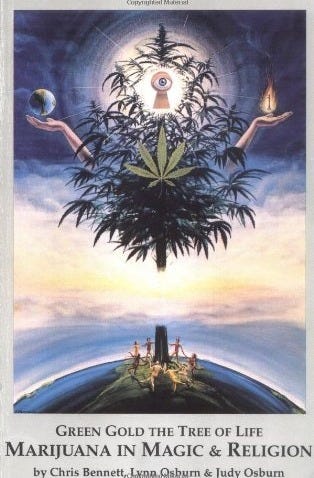
Also influencing my thoughts in the v1990s, were the words of other writers discussing psychoactive substances, such as Terrence Mckenna, who I corresponded with in the early 90s, and who was supportive of my first book, Green Gold the Tree of Life: Marijuana in Magic & Religion (1995). In Trialogues at the Edge of the West: Chaos, Creativity, and the Resacralization of the World (1992) a book composed from a conversation with McKenna, mathematician Ralph Abraham, and parapsychology researcher Rupert Sheldrake, I read “Either there is an inevitable apocalypse on the horizon or one might be created by a self-fulfilling mechanism of paranoid prophecy. To stop it, we must diffuse the time bomb of the Bible” and that idea really influenced me.
Eastern sages have taught that ‘we are our thoughts’. But what happens when we think collectively? I saw this as taking apocalypticmania further with the view that the collective belief in the Apocalypse, was the true danger in the Book of Revelation, in that they could literally manifest themselves through the fact that tens of millions of Moslems, Christians and Jews earnestly believe and have faith that they will. “For this reason, we have to do surgery on the self-fulfilling mythological mechanism working in history. One good start would be a reinterpretation of the Revelation of Saint John the Divine”(Abraham, McKenna & Sheldrake 1992). Interestingly, it has long been noted that indication in the book of revelation itself, presented evidence that some sort of substance was given to the prophet John, to induce a prophetic state:
So I went to the angel and asked him to give me the little scroll. He said to me, “Take it and eat it. It will turn your stomach sour, but ‘in your mouth it will be as sweet as honey.’” I took the little scroll from the angel’s hand and ate it. It tasted as sweet as honey in my mouth, but when I had eaten it, my stomach turned sour. Then I was told, “You must prophesy again about many peoples, nations, languages and kings.” (Revelation, 10:9-11)
With my ideas about the Tree of Life, and a cannabis using Jesus, I really believed then that I held the antidote for the gloomy apocalypse of Revelation, and was set out on a holy mission to disarm the time bomb of the Biblical armageddon with this information. In order to achieve this holy task, I needed to more fully understand the divine mechanisms behind the Book of Revelation, and dig into its origins.
As I stated in the title of this article, it’s been a ‘struggle’ with apocalypticmania, and its fallen into the background or risen to the foreground, for me largely based on world events. It’s also been a blessing and a curse. A blessing, in the sense, it created a focus that led me to write 5 books, chapters in other books and journals, dozens of articles, a lot of art, speaking engagements, organizing conferences, a career in providing plant medicines and more. (I seemed more destined for a life of hard labour before my 1990 event). A curse, in the sense I’m sure its caused many to not take me seriously or be hesitant to support my work. I hear it in old speeches and interviews, and it kind of makes me cringe a little now.
A lot of the material in this series was stuff I first put together in the 90s when I was working on Sex, Drugs, Violence and the Bible. I suspect when I was writing and editing in the late 1990s with Clinton in power, I was feeling slightly less concerned about the end of the world and the antichrist, and I decided not to go with a conclusion that predicted the apocalypse. I was trying to be honest enough with myself, to really look at the Book of Revelation, and try to understand it from various perspectives, and thus I put this outline together this outline looking at the various influences that saw its creation, and some different interpretations of its meaning. I’ve been keeping it on file ever since, occasionally updating it with new information, and interest based on the my oscillating symptoms of Apocalypticmania.
When GWB was elected President, and the Gulf War resumed, and drugs were tied in with it, I had another peak of apocalypticmania. In 2005 I put out the video Burning Shiva Hour – Pharmakeia: George W. Bush, The Apocalypse & the War on Weed, which covered Revelations references to sorcery, under its Greek name, Pharmakeia, and which Evangelicals see as referencing modern use of drugs, including cannabis.
Millenialist Hal Lindsey, who had a vdry severe case of Apocalypticmania, stated concerning comments made in Revelation 18:23 and the reference to the word “sorceries”.
. ..[T]he word ‘sorceries’…. comes from the Greek word pharmakeia, which is the word from which we get our English word, pharmacy. It means a kind of occult worship or black magic associated with the use of drugs. This word is mentioned several times in the Book of Revelation. It is said of the great religious systems that “all the nations were deceived by your sorcery”(Lindsey 1970).
Lindsey pointed at the revelation of the psychedelic ingesting youth of the time, noting that “these drugs reduce a man’s thinking and mentality to a point where he is easily demon- possessed” (Lindsey 1970). I’ve always thought this would become a key issue for Evangelicals. But my concerns there have not been made manifest, many MAGA, RFK for instance, seem to embrace psychedelics, and this is particularly true of the Techbro faction, as witnessed with Elon Musk’s ketamine induced antics as First Buddy. (The wider Drug War though, has now been used falsely as a proxy for invasion, as a weapon of mass destruction.)
Importantly in this video I also addressed the role of Evangelical, and Christian Zionist influence on the White House and World politics, particularly in regard to the Mid East and Israel. This is where apocalypticmania becomes a very real and concrete threat to the World. Something I will get into deeper later in this series.
Again as in the early 90s, I really thought all this was imminent, but as with George Sr before him, George Jr’s presidency passed, and Obama’s led to another drop in my symptoms of apocalypticmania. Now, saying that, I don’t want to pretend that Clinton, Obama, or Biden were great leaders. Just slightly less apocalyptic in my mind, largely because they suffered with less Evangelical influences. However, the systemic evil of the American Government, its foreign policy, its relationship with Israel, are an issue with both political fronts in the USA, and these factors led in many ways to the American public to gamble on Trump’s first presidency, which sadly has only exasperated the wider global situation with apocalypticmania, and my own symptoms have gone through the roof as well.

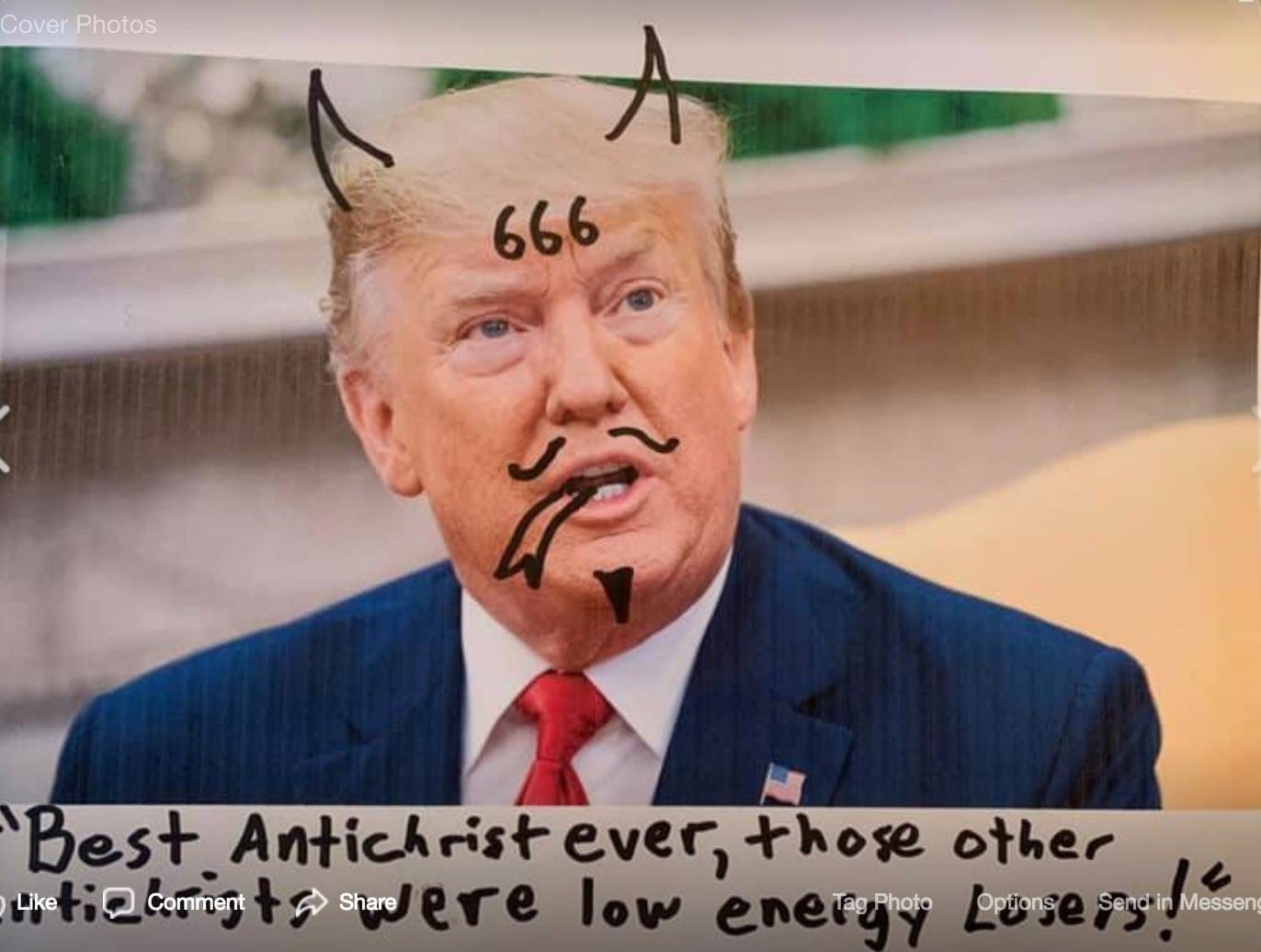
Trump was on my radar here almost immediately. I was jokingly referring to Trump as the antichrist, even before the 2016 election (and even more jokingly, Hillary as the Whore of Babylon!). But jest often hides deeper truths, and when my apocalypticmania flares up I increasingly would make that connection.
In regards to Revelation and the Beast or Antichrist, some historians see this as a reference to a specific Roman emperor, while others see it as more of a generic reference to office of the Emperor itself. In that respect, Jr. Sr., Reagan and all American Presidents could be seen as holders of that position, and America the modern counterpart of the Roman Empire, that was deemed Babylon in the Book of Revelation. But the thing about Trump is, he is the best antichrist ever, those other Antichrists were low energy losers!
The scariest thing for me about Trump, was the real world effect I was seeing in people I actually knew. Trump reaches people through shared hate, and has empowered racists and bigots around the globe, not just the USA. By the time Trump was running for the presidency a lot of us cannabis activists were connected around the world, and I knew a load of American activists. Watching some of them get drawn into the MAGA sphere was like living in a Stephen king novel, and watching people you knew getting swept up by some sort of super natural charismatic force. I lost a lot of friends to this. People like Andrew Struthers, who I was friends with going back to the 80s, and is known for classics like Spiders on Drugs which has 63 million views on Youtube. I appear in a couple of Struther’s books as well. Andrew, also a sufferer of Apocalypticmania, had been an environmentalist during the Clayquot Sound protests, now, living in his van, with little income, he is preaching Musk and Trump as solutions in videos like ‘Van Life Apocalypse Episode Two: The Secret Key To Everything’
And then there is the self titled ‘Psychedelic Historian’ Tom Hatsis, another close friend I did some podcasts and other things with. Just a few years ago, Tom was a gender fluid hipster, prancing around in skirts and leotards, and now he has gone so far MAGA, he puts many well known MAGA influencers to shame. Tom’s most recent book is a war on ‘woke’ culture and he claims diversity inclusion is ruining Psychedelic Culture in his new Fascist manifesto Psychedelic Injustice: How Identity Politics Poisons the Psychedelic Renaissance, and it has a page about me in it. This book grew out of Tom’s feeling of resentment of not getting speaking engagements at psychedelic conferences, as organizers sought a more diverse list of presenters, rather than all white panels. In some cases, Hatsis had been a previous presenter, and he is not always a popular one, which also may have played a role. I suspect meeting so many MAGA on Grindr really fucked with Tom’s head. I discussed some of this MAGA dandy’s bullshit in a recent blog entry TOM HATSIS: THE PSYCHEDELIC FASCIST. There have been many other friends I have seen drawn into a similar fate, my best surf buddy who I knew since i was 16 as well. I have never seen any of them come back from it, just dig in deeper. It’s broken my heart, literally.
Covid, as well caused another huge spike in my apocalypticmania. It felt like the end of the world competing with other masked grocery shoppers for the food and other good disappearing from the shelves, and even more so when I loaded up my truck with my partner, pets and essential goods, and left our Vancouver home for the rural entheogen retreat we were then building, Soma Institute. Although Covid killed our plans for a retreat centre, it did serve as a good apocalyptic retreat to sit out the pandemic for a couple of years. I made a video there about the apocalypse, but it seems to have mysteriously vanished from Facebook since.
Fun Fact, as I noted in a 2020 Facebook post, the first of the Four Horsemen of the Apocalypse is Plague. In John’s revelation, the first horseman is on a white horse, carrying a bow, shooting arrows, and given a crown, riding forward in Conquest and generally interpreted as Pestilence, or plague. Curiously, Corona means “crown” and an arrow could be seen as symbolic of the ‘novel spike’. Some interpreters say the first Horseman is called Pestilence, and is associated with infectious disease and plague. It appears at least as early as 1906, when it is mentioned in the Jewish Encyclopedia. This particular interpretation is common in popular culture references to the Four Horsemen.
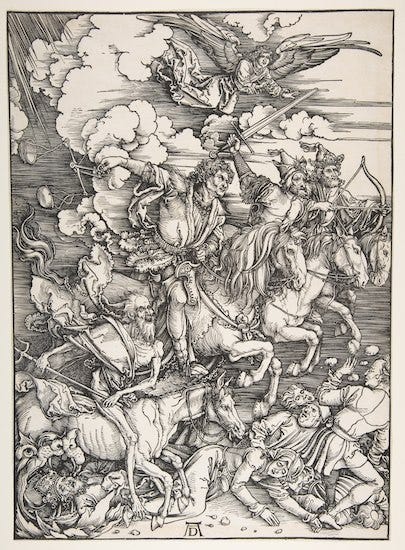
Albrecht Dürer 1498, The Four Horsemen, from “The Apocalypse” with the first rider having a crown and holding an arrow.
Covid, actually worked out good for me, even with the failure of Soma Institute, although at the time it did not seem like it. A number of factors brought that together, and none seemed positive at the time. One thing was, the area Soma Institute was at an increasing fire risk, as Global Warming took effect. We had to evacuate a number of times, and dealt with a lot of smoke, all contributing to my apocalyptic views. As well, Qanon, and MAGA thinking were an increasing presence in the plant medicine scene we were part of, and this led to me becoming increasingly disillusioned with the idea of running a entheogen retreat centre. I think the final factor was, when I hired a guy who contacted me that I had known a few decades before in my surfing days, and he was not the guy I remembered and caused a lot of grief for the Institute, drawing the sort of heat that prevented us from pursuing what we were doing under the radar. When I confronted him about some of his bullshit, he responded “you were a way cooler guy when you were just some surfer on the west coast”. And I realized then, that I had been a lot happier back then as well. I’d gotten into Electric Longboards in Vancouver before I left, as it appealed to my surfing roots, and was a great way to beat traffic and parking costs in the city, so surfing was already on my mind again.
Between, fires, covid preventing the official opening of our retreat, Qanon fuckheads infilitrating the plant medicine scene, Rat Bastards, and the hopeless state of the world and humanity, I fell into a sate of disillusion with what I had been doing over the previous decades. I decided to give up on everything I had been doing, sell of my Vancouver home and the retreat centre, move to Nova Scotia on the other side of the country, and get back into surfing. I had come to the hard conclusion, that my efforts were a hopeless delusion, that humanity was only going to get worse, and that there was not a Government in the World ready to deal with Global Warming and other environmental movements, end war, etc, and more importantly, there was not a population of a leading World Power that was ready to elect one that would. Why bang my head against the wall, when I could retire and get some waves.
Moving from Soma Institute was yet another apocalyptic adventure. After the fires of summer, as we were packing up and leaving, the worst floods in BC’s history hit the region, massive landslides, bridge collapses and flooding, had me cut off for a week during the move, and my partner was stuck there isolated with no way to leave. But in the end, I loaded up a high end Mercedes Van with my cat, bird, dog, and life partner, bought a SUP surfboard and headed off to chase the surf after over 20 years out of the Ocean.
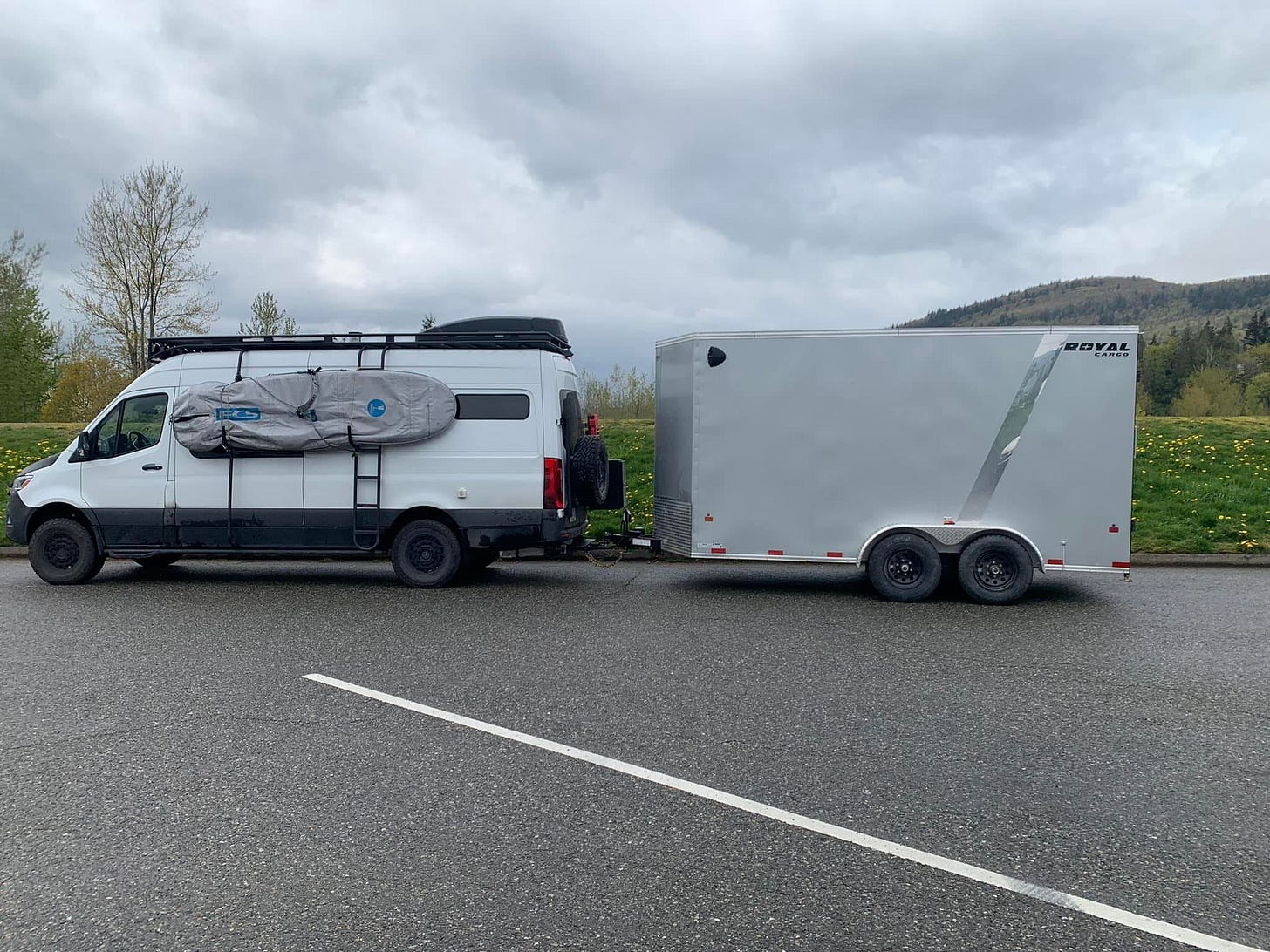
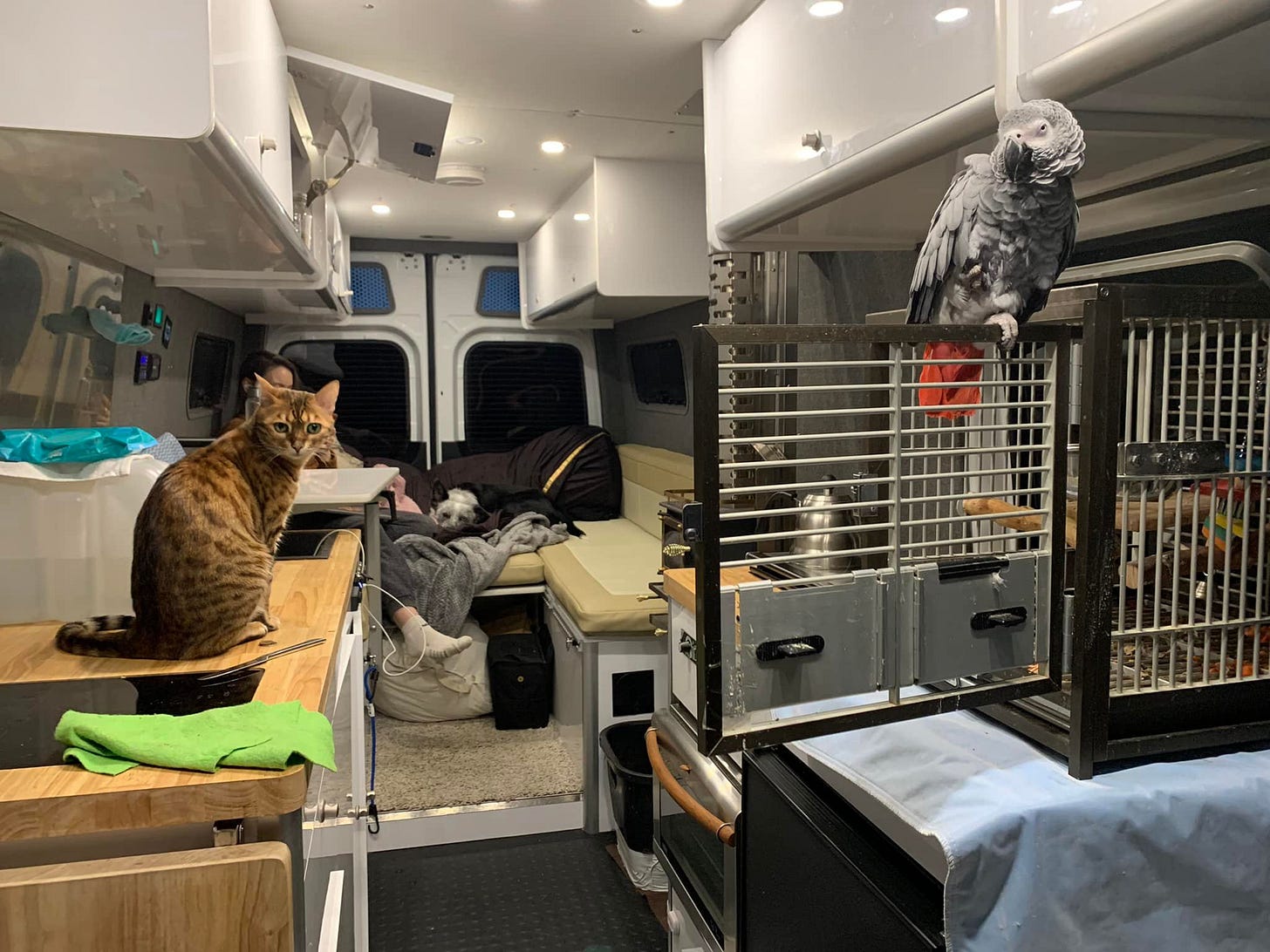
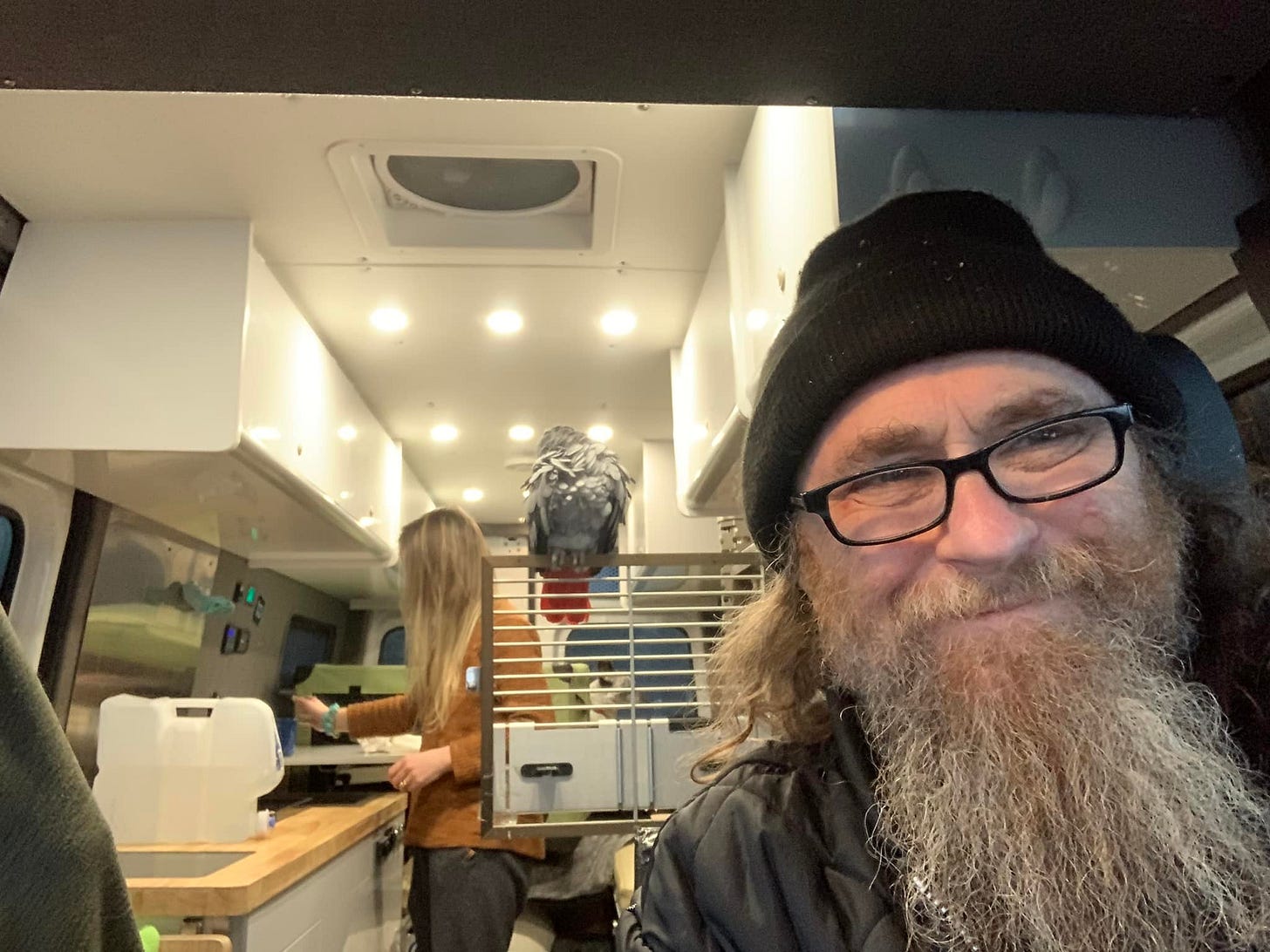
During the time of Soma Institute, in 2020, the Greatest archaeological find relating to my own research, happened. the archaeological study of an 8th century BCE Hebrew temple in tel Arad, Jerusalem, discussed earlier was released and it confirmed the ritual use of cannabis, something I had been suggested for over a quarter century prior. I agreed to write a book detailing this, and how it related to my earlier work, but I could not get going on it, as things fell apart at Soma, and I lost my inspiration completely, at one of the most pivotal times.
I really thought the tel Arad findings was going to legitimize my work, I’d been in a lot of news stories in previous years with my claims about Biblical cannabis, but sadly crickets, and the impact of the story was lost to the headlines about Covid, and Trump’s continual terror tweeting.
I had pretty much giving up on things, and was travelling around in the van for a while in BC, surfing and visiting friends, before the Drive to Nova Scotia, waiting for winter to pass, so we could leave in the Spring. Then my cat got out one night in the city, and I thought I lost him for good. Stress like that can exasperate magical thinking for me, and I made an agreement with god in my head, that if I got my cat back, I’d write the book. I’d given up after a night looking for him, with busy city streets all around, and I had to leave the next morning for an appointment, but I stuck his enclosed litter box out where he had jumped ship, and thought I’d come back later and see of he was around, but before I left he was in it, growling like a psycho, and I got him in the Van. So we can thank my cat Shankar, that Cannabis: Lost Sacrament of the Ancient World finally came to be finished, as I doubt it would have without that added pressure.
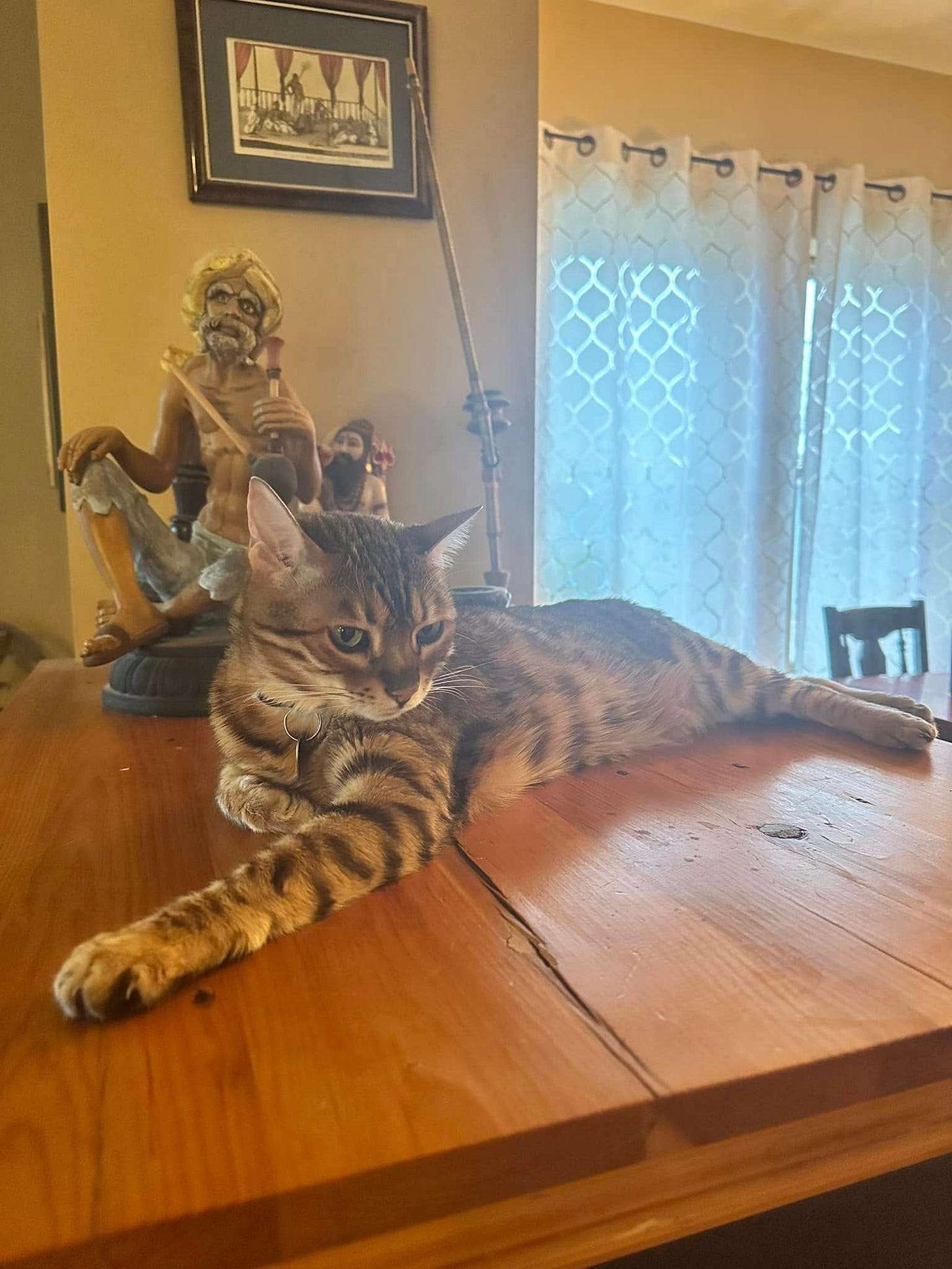
When Trump was replaced by Biden, my concerns quelled slightly, but I saw Genocide Joe and his support for Israel’s genocide as more of the same. I also never lost faith that this was not the end of Trump, despite most people saying he was going to jail, and would never run again. Intuitively I knew he would return. I still rallied against it, but I’d see these waves of conversion to MAGA among my Facebook friends. I had been blocking MAGA since 2016, but new conversions would happen all at once, spiked I suppose by events in the news cycle. I would watch this with horrid dread, and see it as the charisma of the Antichrist.
On the surreal day that the Trump assassination took place, and Trump stood up with fist raised and a bloody ear, the very first thing that popped into my mind was Revelation 13:3 which describes how the Antichrist will receive a fatal wound to the head but the whole world will be amazed he survived. “And I saw one of his heads that was wounded as if fatal, but it was healed and the world was amazed.” (Revelation 13:3). I’ll get more into how I think Trump fits the bill so well in the closing chapter of this series.
I put this together to reveal my own biases, so the reader is aware of where I am coming from, and as 35 year recap. At this point, I feel pretty disillusioned, although I did make some progress on my quest to bring to light the role of cannabis in the spiritual life of humanity, I think I also dropped the ball a few times on the road and missed some real opportunities by half assing things. What is worse, I have lost my faith in the masses of humanity. I know good individuals, but this time period has been a great lesson about how a Nation went Nazi almost a century prior. As it is, for now, I’m just trying to make the best of things, make a little noise, stay high, love my family, catch some waves at the end of the World and surf the Apocalypse as best I can.

Now that the definition of Apocalypticmania, and my own story are done, let’s delve into some of the background history of the Book Of revelation, through some of its prior influences. Next up is a look at the The Zoroastrian Influence: Many so called Christian themes, such as a final Day of Judgment and the Resurrection of the Dead, prevalent in Revelation, actually have their origins in Zoroastrian sources, interestingly here, cannabis may well have played some role of inspiration.
Coming articles include:
The Old Testament Influence on Revelation: The apocalyptic imagery and themes from the visionary accounts of Daniel and Ezekiel contributed greatly to the corresponding imagery and design of Revelation.
The Historical Situation of Revelation’s composition: As a seditious anti-Roman and anti-Jewish, Christian text written in code, describing events that were taking place at the time of its composition and strongly influenced by pre-existing Hebraic and Zoroastrian Apocalyptic material.
The Gnostic Apocalypse and the Book of Revelation. A number of scholars have pointed to Gnostic themes in Revelation. A minority of scholars see this as coming from a Gnostic influence, the majority see this as too early for Gnostic sects to have originated. However, these themes may have influenced cosmological developments in laterGnosticism, which has its own version of the Apocalypse and ‘Consummation of the Age”. These Gnostic references were deeply influential on my own apocalyptic mind set and developing cosmology.
The Book of Revelation as a Description of a Future Apocalypse: As a document describing the visions of a Christian seer of supposed future events that gave indications of the final conflict between Good and Evil that results in a global catastrophe of epic proportions.