Kali ma
The Fierce Black Goddess Kali, has been worshipped in India for over 3,000 years.
Kali represents the untamed power of nature’s cycles—annihilating ignorance, ego, and demonic forces to pave the way for renewal and spiritual enlightenment. Kali is both a terrifying warrior who dances wildly on battlefields and cremation grounds and a compassionate mother figure (Kali Ma) who empowers devotees to conquer inner fears and achieve moksha, or ultimate freedom from the cycle of rebirth. Revered especially in Tantric traditions, Shaktism, and regions like Bengal where her Kali Puja festival draws millions, she transcends her fearsome iconography to symbolize the triumph over death, the inevitability of change, and the nurturing aspect of the cosmos, reminding worshippers that true power lies in embracing the shadows for profound growth. Historically, Cannabis has appeared as an offering in Kali’s Puja festivals, and as a sacramental offering in Tantric rites.
The Goddess Kali is not primarily a Vedic deity. While she is now a prominent figure in Hinduism, her origins are believed to predate the Vedas and are strongly linked to Tantric traditions and pre-Aryan dark skinned tribal cultures that inhabited India before the arrival of the Vedic Aryans. Kali does not appear in the Rigveda, Yajurveda, or Samaveda. Kali’s emergence is strongly linked to Tantric practices and pre-Aryan tribal cultures. Kali was later integrated into the broader Hindu pantheon, particularly through texts like the Devi Mahatmya and Puranas, which elaborate on her various forms and powers. While integrated into Hinduism, Kali’s worship has also continued within the Tantric tradition, which is seen by some as more closely aligned with her original, non-Vedic character.
Although Shiva is the ‘Lord of Bhang,’ cannabis appears in offering to a number of other deities such as those dedicated to Shiva’s consort Kali, Goddess of Life and Death. Cannabis “is holy/consecrated to the most powerful Goddess ‘Kali ‘as well. “Kali… [is]worshipped with imbibing’s of cannabis” (Agrawal, Dhanasekaran & Kumar, 2022). At “Kali Puja festivals , a good deal of bhang , charas , and ganja is used” ( Evidence of witnesses: Indian Hemp Drugs Commission, 1893-1894).”Cannabis helps priests, ascetics, fakirs, yogis and sanyasis in their meditation and performance of religious rites . Devotees of … the goddess Kali and Durga… offer and partake of it after the puja ceremony” (Acta Ethnographica Hungarica, 1988).
Cannabis has played a significant role in the worship of Kali, particularly within certain Tantric and Shakta traditions of Hinduism, where it is revered as a sacred plant that facilitates spiritual connection, transcendence, and ritual purification. In these contexts, cannabis, often referred to as bhang, ganja, or vijaya (meaning “victory” in Sanskrit), is considered a gift from the gods, associated with both Kali and Shiva, her consort, who is famously linked to cannabis in Hindu mythology. The use of cannabis in Kali worship is rooted in Tantric practices, which emphasize transcending dualities (e.g., purity and impurity) to achieve spiritual liberation. Texts like the Mahanirvana Tantra and regional Tantric traditions from Bengal and Assam (c. 10th–12th centuries CE) describe cannabis as a tool to heighten meditation, induce ecstatic states, and connect with Kali’s fierce, transformative energy, particularly during rituals in cremation grounds or during festivals like Kali Puja. Devotees consume bhang (a cannabis-infused drink) or smoke ganja to loosen ego-boundaries, align with Kali’s chaotic yet liberating essence, and experience her as the destroyer of illusion (maya). In Bengal, where Kali worship is prominent, bhang is offered as prasad (sacred food) during certain rituals, symbolizing the goddess’s acceptance of all aspects of existence, including intoxicants. However, this practice is not universal; it is primarily associated with esoteric sects and is less common in mainstream or Vaishnava traditions, which may view cannabis use as impure. Historically, cannabis’s role in Kali worship reflects her association with the marginalized, the unconventional, and the transcendence of societal norms, aligning with her role as a goddess who embraces the totality of life and death.
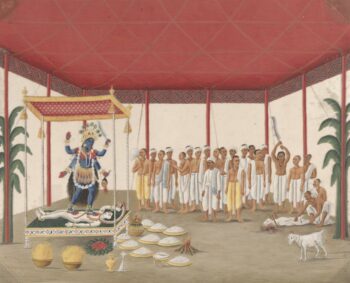
The Kali Puja as depicted in a 1860 image.
According to the Bulletin on Narcotics (Volumes 1-2, 1949), which cites no source, Brahman, the highest ranking group in India’s caste system, attempted to limit this practice
In Hindustan, in distant ages when the secret of the priests was revealed, the Brahmins appear to have attempted to control its use. They authorized it only on the occasion of certain important religious celebrations (Kali festivals, Durga puja etc). We cannot know wether the people readily accepted the restrictions of their consumption of Cannabis potions to the permitted dates; nor can we say wether it was not precisely in order to gratify the passion for the intoxicating drug, while at the same time respecting the laws promulgated by the ministers of the divinity, that the custom of smoking hemp arose. (Bulletin on Narcotics, 1949)
Ganja and bhang were not only offered too Kali at her puja, but also were offered in secretive tantric rites, with yoginis, who at times took on the Goddess form of Kali in rituals.
[The image of Kali smoking used in the title image, taken from a controversial Indian film, landed the Director in court, for religious disrespect]
In the Mahanirvana Tantra “Tantra of the Great Liberation” one of the most important texts dedicated to the cult of Tantra, Kali’s cannabis mantra is given as “Om, Hrim Ambrosia, that springeth forth from ambrosia, Thou shalt showerest ambrosia, draw ambrosia for me again and again. Bring Kalika within my control. Give success; Svaha” (Avalon, 1913). In Tantric rites, cannabis retained its ancient Vedic epithet of ‘Vijaya’ (Victory). As Arthur Avalon (aka, Sir John Woodroffe) explained: “Vijaya, (victory) used in ceremonies to Kali: That is the narcotic Bhang (hemp)… used in all ceremonies” (Avalon, 1913). Dr. Michael Aldrich, a pioneer of cannabis history, gives us some insights into this use:
In medieval India and Tibet, sorcerers in search of magic powers glorified the use of a marijuana drink (bhang)… in Tantric sex ceremonies derived from the ancient soma cult. A circle of naked men and women is conducting an experiment of the central nervous system. They consecrate a bowl of bhang to Kali, goddess of terror and delight. As the bhang begins to take effect, the worshippers mentally arouse the serpent at the base of the spine, sending waves of energy up to the cortex. (Aldrich, 1978)
The Kaulajñānanirṇaya is a significant Sanskrit Tantric text attributed to Nath Yogi Guru Matsyendranātha, and also refers to cannabis for ritual purposes. Georg Feuerstein the German Indologist specializing in the philosophy and practice of Yoga, in Tantra: The Path of Ecstasy noted that cannabis was shared with female initiates [yoginis] and the Kaula-Avali- Nimaya (2:110-2:111) in the sexual rite of maithuna.
Maithuna is preceded by a preliminary ritual in which the yoni is anointed with sandalwood paste. This makes it resemble a beautiful flower and also highlights the Tantric interest in menstrual blood (also called pushpa, or “flower”). The female initiate, or shakti, also is offered hemp (vijaya), a mildly narcotic substance…. The Kaula-Avali-Nirnaya (2.110 – 111) mentions hemp as an alternative to wine and also speaks of four classes of hemp and their respective purificatory mantras. (Feuerstein, 1998)
The Sarvollāsa Tantra, also known as Sarvānanda Tarangini. is a significant text within the Shakta tradition of Hinduism, specifically associated with Tantric practices and the worship of the Divine Feminine (Shakti). Authored by Sarvānandanātha (15th-16th Century CE). As a Tantric master, Sarvānandanātha is regarded as a siddha (perfected being) whose teachings continue to guide practitioners. His work is typically studied under the guidance of a guru due to its esoteric nature and the complexity of its rituals and philosophies. it is a rare manuscript that serves as a compendium or “Samgraha” of Tantric knowledge. These texts are part of the broader Tantric literature that emphasizes non-dualistic (Advaita) philosophy and the interplay of Shiva and Shakti, the masculine and feminine cosmic principles. In the Bhairava Tantras, Bhairava, the fierce form of Shiva, is often paired with Kali as his divine consort. This pairing symbolizes the unity of consciousness (Shiva) and energy (Shakti), a core principle of non-dual Tantra. Kali, as the dynamic and transformative aspect of Shakti, complements Bhairava’s fierce, transcendent nature.
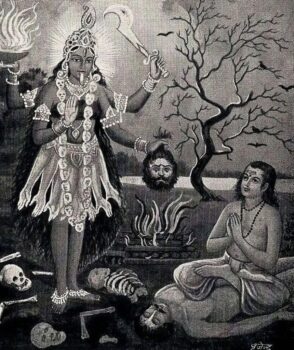
Goddess Kālī and Sarvānanda Ṭhākur. Hindu Print Kalyan (Hindi magazine) Gita Press, Gorakhpur.
Cannabis appears as an offering in the Sarvānanda Taraṅgiṇī, and is shared with the yogini
Smoking of hemp of 4 different sorts (samvidāpāna), prescribed with wine; its sanctification. (Sarvananda Tarangini 30)
Betel leaf, [water from]a copper pot, gāñjā , palm sap, snake venom, date palm, juice, thorn apple, and bhāṅg (cannabis) these eight are called alcohol and bestow bliss to the worshipper. (Sarvananda Tarangini 196)
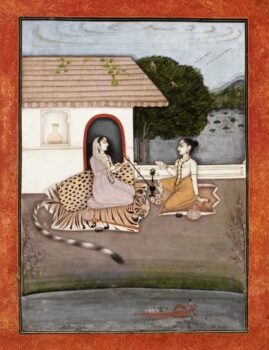
Two Yoginis (Victoria and Albert Museum)
The painting shows two female ascetics sharing a hookah, and seated on animal skins, the traditional seat of holy men and women. The dark shading and sombre colouring are typical of painting in the Mughal province of Murshidabad in the mid-18th century.
Bhagavati, often associated with the goddess Kali, is a term used in Hinduism, particularly in Kerala and Nepal, to refer to the divine feminine energy, or Shakti. Ganja was offered to the Goddess under this name in Tantric sex rites as well.
When the Tantric religion came into existence in India is not known ; but Tantric practices always invoked the ganja smoking god Siva and the goddess Bhagavati.…the Kulamava Tantra…Says… “By doing japa of mantra and by adoration of Bhagavati, the consort of Shiva, at times of sexual union, a man becomes, like Suka, free from all sin” (Dharmapala & Anagarika,1933)
The Sabar people, a dark skinned indigenous tribe in India, have a unique and complex relationship with the goddess Kali, often incorporating her into their animistic beliefs and practices, sometimes with tantric elements. While not exclusively tantric, their Kali worship is deeply intertwined with their animistic worldview and traditional rituals. Sabar women were often sought after by Tanrik adepts as or yoginis. In Masters of Mahamudra (2010) Keith Dowman explains discusses the roles of ganja and Sabara yoginis in the Charyapada songs (8th-12th century CE) composed by Saraha an Indian Buddhist Mahasiddha and poet, who lived in the 8th century.:
The Sabara women were most desirable as consorts to the tantrikas…”Sabari” became virtually synonymous with “tantric yogini” in the siddhas’ caryapada songs. Saraha sang an evocative love song, a tantric analogy, about Sabara and Sabari lovers. “The Sabara girl is sitting on a high hill. She has peacock feathers on her head and a garland of ganja around her neck. Her dear Sabara is mad, intoxicated by love for her.” … The jungle Sabaras wear peacock feathers as their emblem, and ganja (marijuana) has special significance for them. Associated with the Sabaras is the image of a yogin crazed with sexual passion for his Saban consort, intoxicated from smoking ganja, covered in ashes and drinking alcohol from a skull-cup. For Saraha this image is a metaphor for Buddhist tantric practice. (Dowman, 2010)
Durga Puja
Cannabis also played an important role in the Durga Puja, the annual Hindu six day festival that celebrates worship of the Hindu goddess Durga. In the 19th century, at the close of the Durga Puja, it was customary to drink bowls of bhang and to offer them to others. As the Indian Hemp Drugs Commission Report recorded:
The custom of offering an infusion of the leaves of the hemp plant to every guest and member of the family on the… last day of the Durga Puja, is common in Bengal, and may almost be said to be universal. It is alluded to by many of the witnesses who refer to its use on this occasion as well as on other days of the Durga Puja festival. But, while there can be no doubt as to the existence of the custom, there is considerable divergence of opinion as to the true nature of it. The custom itself is a simple one. On the last day of this great festival the male members of the family go forth to consign the image to the waters and on their return the whole family with their guests exchange greetings and embrace one another. During this rejoicing a cup containing an infusion of the leaves of the hemp plant is handed round, and all are expected to partake thereof, or at least to place it to the lips in token of acceptance. Sweetmeats containing hemp are also distributed. Opinion is almost equally divided as to whether the custom is a mere social observance, or whether it is an essential part of the religious ceremonial of the festival. There is difference whether there is any injunction in the opinion among the witnesses as to Shastras rendering obligatory the consumption of hemp; but Tantric religious works sanction the use, and the custom whatever be its origin may now be said from immemorial usage to be regarded by many people as part of their religious observances. From the evidence of the witnesses it would appear that there is no specific direction in the Shastras of the manner in which the drug should be used but from the references quoted it would appear that the use alluded to is authority that of bhang in the form of an infusion. (IHDCR, 1894)
Dr. William Dymock, Professor of Chemistery in the Calcutta medical College, recorded in the 19th century:
The use of Bhang on certain festive occasions such as the Durga puja especially in the N W Provinces and Behar is common among the better classes and the ordinary run of orthodox Hindus accustomed to have their little excitements may use it at such times without incurring any opprobrium such as would result from the use of wine or other spirituous liquors. In Bombay the hilarity of the Bania women returning from the temples on holidays can hardly be attributed to pure milk .There would appear to be no reason to suppose that the occasional use of bhang does much harm. (Dymock, 1890)
References to this practice were recorded well into the 20th century. “Bhang is taken on the day after the Durga Puja , because that is supposed to be a very auspicious day , and the name of the drug – siddhi – signifies success , which is supposed to be imbibed with the drug for the whole year” (Caṭṭopādhyāẏa,1940).
Indications are that this practice, unlike the use of cannabis at Holi, Shivaratri and the Kumbh Mela, fell into decline. Writing for the United Nations Office on Drugs and Crime in 1957, Dr I. C. Chopra and Col. Sir R. N. Chopra, Member of the Expert Advisory Panel on Addiction-producing Drugs of the World Health Organization, noted that: “In Bengal… the custom still persists among certain classes of offering a beverage prepared from the leaves of the cannabis plant to the various family members and to guests present on the last day of Durga Puja (Vijaya Dasmi) which is the biggest Hindu festival in that state…. where Durga Puja is observed in a manner similar to that in Bengal, the use of bhang is not so much in vogue” (Chopra & Chopra, 1957).
After Colonial times, disdain for this practice readily increased “bhang and wine , have made the name of Durga Puja or the worship of the ten – handed goddess of Bengal , otherwise so solemn and sacred in the popular mind , a thing to be dreaded by all lovers of true religion” (Sastri, 1912). More recently we can see strict restriction regarding cannabis at the Dussehra Cuttack, the grand celebration of Durga Puja, culminating in the immersion of the goddess’s idols on Vijayadashami, which commemorates the final day of the much celebrated festival. In the 2024 article ‘Strict rules imposed for idol immersion procession during Cuttack Dussehra‘ “People coming to the procession cannot consume or bring with them any kind of intoxicants such as cannabis, marijuana, Ganja, brown sugar, etc.If someone is suspected of consuming or possessing drugs he will be restrained from the procession” (Himanshu, 2024). Again this year, we similar bans:
No fairs will be allowed near Durga Puja mandaps this year in Bangladesh as these often see anti-social elements gathering for consuming cannabis and alcohol, said home affairs advisor Md Jahangir Alam Chodhury on Monday, ahead of the largest religious festival for minority Hindus in the country. (Times of India, 2025)
Thus the decline of this practice in Durga Puja, has readily declined through efforts to prohibit it. The situation with the Durga Puja, is a clear example of how the profanation of cannabis, can drive it’s religious use underground, and even its disappearance from rituals.
Is Kali the Coolie Duppy of Rasta Ganja?
Interestingly, considering the patriarchal bible based view of current Rastafarianism, a connection to the use of ganja, seems to have come through the worship of the Black Goddess Kali Ma, who is sometimes paired with Shiva. As noted in Rastafarianism re-examined – the impact of the Indian presence in the Caribbean (Dhakal, 2020):
Afro-Jamaicans observed and participated for example in the celebration of the Hinduist worship of goddess Kali (‘Kali puja’)… and incorporated traditions of the Indian community like the consumption of the weed-infused drink “bhang” as well as the ritual use of marijuana known as “ganja” – a term of Hindi/Urdu origin). (Dhakal, 2020)
In The First Rasta: Leonard Howell and the rise of Rastafarianism (2003) Hélène Lee writes “at regular intervals, a few individuals in every Indian community would perform a ‘secret’ Kali puja… After certain ceremonies that involved the smoking of ganja, the congregation would return to the home of the host, chanting and shouting ‘Jai Kali Mai!’. Drinking of bhang (marijuana), smoking ganja, hailing the goddess…. Curious Afro-Jamaicans would always evesdrop at a distance in hidden places. Some would join the festivities as guests”.
The use of ganja as an entheogen was introduced to Jamaica by Indian indenturers. They used ganja in Kali worship and tantrism. In some of these ganja sessions, some of the Afro- Jamaican population gathered to share in the Kali weed. One can also appreciate the linguistic borrowings of Rastas from Hindi to describe the sacred plant and its accompanying apparatus. The plant is often referred to as ganja or kali (collie) and is smoked in a chillum, or cutchie (also spelled kochi) and saapi. Ganja and kali are both from Hindi, with kali either coming from Kali (the popular Hindu goddess) or kalee (the ganja leaf bud) or a combination of both. The names of the smoking receptacles are also of Indian origin. Later words like chalice (for the chillum pipe) and Ishens (for ganja, I-word for incense) were added to Iyaric [Rasta language] to use Christian frameworks to validate their uses. (Stewart, 2021)
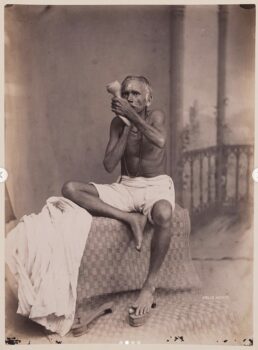
The Hindu Rastafarian connection continued into “the late 1950s, and Indian elders were shown the same respect as Africans. Exchanges (‘reasonings’) took place around the ‘chalice,’ the water-cooled coconut-shell ganja pipe. Dreadlocks, which some rasta elders remember as ‘zagavi’ (from the Hindu jatawi) were possibly inspired by Indian Saddhus, religious mendicants whose presence in Jamaica is confirmed by a 1910 photograph” (Lee, 2003). Ganja, Kali weed, chillums, dreadlocks, vegetarianism, even the exclamation ‘Jah Rastafari!’ from “Jai Kali Ma!” and more have been seen as an Indian influence on Rastafari.
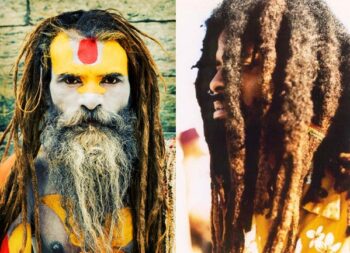
“Hindu Sadhu (Indian holy men) came into contact with Afro-Jamaicans who picked up on the Sadhu’s lifestyle of wearing matted hair (dreadlocks), vegetarianism (Ital food), and marijuana smoking (brought over by Indian coolies” Rastafarianism and Hinduism
Apparently Ganja smoking by Indian immigrants in Jamaica at the Kali Puja continued into the 20th century! As noted in The Legacy of Indian Indenture: 150 Years of Indians in Trinidad (1995):
Kali mai, the black Hindu goddess who averts sickness and death is… offered these oblation [cannabis]… Kali puja (ceremonial worship) was a regular feature of almost every Indian community in Jamaica until the 1950s which was witnessed by Africans. During these pujas… became possessed by smoking ganja… (Gosine, Mahabir & Malik, 1995)
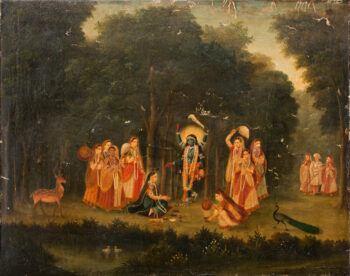
An old painted image of a Kali Puja being performed secretively in the forrest.
Jahlani Niaah, Chairman of the School of the Sacrament and the Rastafari Studies Global Coalition, and a lecturer at the University of the West Indies, specializing in African diaspora praxes, Rastafari cosmology, and Indigenous leadership, explains:
This involvement of Rastafari with ganja is a major part of its early formation, guided by its founding fathers. Leonard Howell, …was known to have cultivated ganja as a cash crop, exporting it to the United Kingdom as a marketplace for it before it was restricted as a contraband. It was Howell, this early prophet of Rastafari who anchored the herb in a ritualistic way through verbal suggestions as to how to prepare and invoke its appropriate usage.
Howell was known to have had strong connections with the East Asian community, and so we know that culturally, the connection of the Asian arrivals in the 1840s impacted the way Rastafari culture developed. This is demonstrated in the preference for the Hindu term “ganja,” used to refer to cannabis. In addition, the paraphernalia used to smoke the herb also have maintained those influences. For example, kutchie, and chillum are terms that are still used in India to refer to aspects of smoking vessels. Rastafari also used to talk about burning “collie herb” which is a reference to Kali, the Hindu deity. (Niaah, 2021)
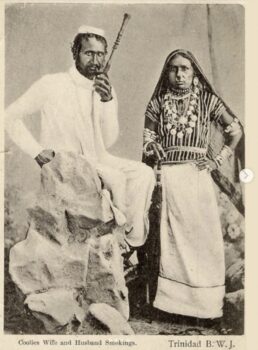
Trinidadian, East Indian man smoking a coconut shell water-pipe, adopted as the ‘chalice’ in Rastafarianism, circa 1889.
This history, has largely been lost on Rastafarianism, which is rather patriarchal, and generally prefers to focus on its connection to Africa. Clinton Hutton, a Rastafari scholar, has noted how Kali the Jamaican folkloric understanding of the Coolie Duppy, ie ‘the Indian Migrant ghost’, “fit[s] the description of ‘Kali, the black and terrifying earth mother of Indian mythology.’” Reminding, Rastafari of the Kali roots to Jamaican cannabis use, may be one of the way she haunts them.
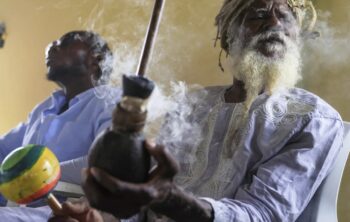
A Rasta elder passes the chalice. Image from AP news story – Why Rastafari smoke marijuana for sacramental reasons and the faith’s other beliefs (2023)
[For more on the Indian influence on Rastafarianism see: Indian Influences on Rastafarianism: Understanding the History of Rastafari and the Sacramental Use of Ganja with Jahlani Niaah; Dreadlocks, Ganja & Gods | The Hindu link between Bob Marley and Rastafari; The connection between Rasta and Hinduism. The story of the real origin of rasta; Rastafarianism re-examined – the impact of the Indian presence in the Caribbean; Early Encounters in Colonial Jamaica: Hindu and Rastafari Divine Metaphysics]
The Patriarchal religions which have dominated our world for millennia, seem to have now reached their peak, in a World at War with itself. Take solace in Kali’s ganja, and give a prayer for the return of Shakti energy into our troubled world. “Om, Hrim Ambrosia, that springeth forth from ambrosia, Thou shalt showerest ambrosia, draw ambrosia for me again and again. Bring Kalika within my control. Give success; Svaha!”