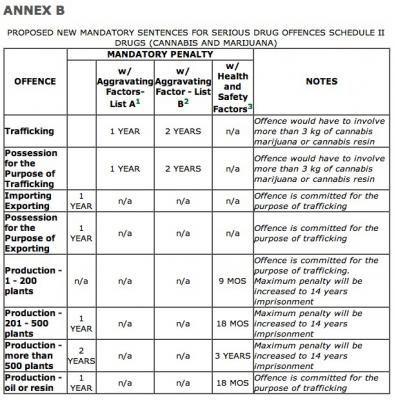
C-15 has been passed by the Senate Committee with minor amendments.
It now proceeds to the Senate for a final vote. After that, the bill only requires a signature by the Governor General to become law.
This unfortunately means we will be unable to delay C-15 any further, and short of rejection by the Senate (highly unlikely), we will face passage of this bill before, or shortly after, the Winter break.
The amendments are as follows:
The Senate Constitutional and Legal Affairs committee today voted to remove under 201 plants from C-15’s mandatory minimum sentencing provisions, so long as the production occurs outside of residential areas and in properties owned by the grower.
Let me be clear:
If you produce 1 plant in a residential neighbourhood, C-15 still prescribes a 9 month sentence.
If you produce 1 plant in a rented property, C-15 still prescribes a 9 month sentence.
If you produce 1 plant in a house that you own, C-15 still prescribes a 9 month sentence.
If you produce 200 plants on a farm that you own, C-15 does not apply.
Unfortunately, the Committee was missing the two most prominent critics of C-15 during the clause-by-clause debate today, and were unable to propose ammendments to remove 1-201 plants in residential or rented properties.
This was a victory today, but a small one, that primarily effects rural areas, leaving urban areas under the thumb of these ridiculous mandatory minimum sentences.
We NEED to organize more people to stop bills like this in the future! Please, contact your friends, family members, coworkers, everyone you know who believes in ending this horrific war on drugs and get them registered on WhyProhibition.ca. The only way to move forward is together, and the only way to defeat this drug war, is with everyone.
CLICK HERE TO FIND OUT HOW TO STOP BILL C-15
Click here to PHONE JAM the Senate – tell them to vote NO! on Bill C-15.

Senators alter crime bill to go easier on pot growers
by Janice Tibbetts, Canwest News Service
For the second time this fall, a committee of the Liberal-dominated Senate has amended a Conservative law-and-order bill, eliminating an element that would automatically send marijuana growers to jail for at least six months if they’re caught with as few as five plants.
The committee altered the controversial bill Thursday to retain a judge’s discretion when sentencing offenders convicted of growing fewer than 200 plants, putting the upper chamber on a collision course with Justice Minister Rob Nicholson.
Automatic terms for a variety of other drug-related crimes — for the first time in Canada — were kept intact.
Nicholson, however, seized on the committee’s move to highlight divisions between the Liberals in the Senate and the House of Commons.
The drug bill sailed through the Commons earlier this year after the Liberals teamed up with the Conservatives, despite grumbling within Grit ranks that they were being told to support a bad bill so they wouldn’t be accused of being soft on crime.
Nicholson called on Liberal Leader Michael Ignatieff Thursday to “lean on these people” in the Senate and urge them to pass the bill in its original form.
The legal and constitutional affairs committee amendments will go to the Senate as a whole, which will begin debating the bill next week and then decide whether to pass the bill in its original or altered form.
The committee has also amended the bill to reaffirm the Criminal Code principle that the special circumstances of aboriginal offenders should be taken into account when sentencing.
A third amendment rewrites a provision that would automatically jail offenders convicted of a second drug offence, stating that the first offence must have been a serious one.
Liberal Senator Serge Joyal described the amendments as minor and he said no reasonable person could say that the committee “gutted” the bill.
Nicholson, who earlier this fall accused the Senate committee of gutting another crime bill, would only say Thursday that he is “disappointed” by the latest move.
The Liberals have accused the Conservatives of revelling in the Senate scrutiny because they can use it as a springboard to reinforce their tough-on-crime message and take aim at their Liberal opponents.
The committee had warned this fall that it would not rubber-stamp the legislation, which has drawn heavy criticism in public hearings in both the Commons and the Senate. Opponents have warned the bill, if passed, would flood jails and imprison drug addicts and young people rather than drug kingpins, who will continue to thrive, while small-time dealers are knocked out of commission.
The same Senate committee voted in October to dramatically alter a Conservative bill to eliminate judicial discretion to give offenders a two-for-one credit for time spent in pre-sentence custody, but the Senate as whole rejected the amendments and the bill was enshrined in law a few weeks later.
– Article from Canwest News Service on December 3, 2009.
Nicholson Disappointed with Changes to Crime Bill
The Canadian Press
 The Senate has altered a Conservative tough-on-crime bill to remove mandatory minimum sentences for people convicted of growing fewer than 200 pot plants.
The amendments to Bill C-15 by the Senate committee on legal and constitutional affairs were immediately denounced by Justice Minister Rob Nicholson as “very disappointing.”
“The whole bill is about people who are trafficking in illegal drugs,” said Nicholson.
But a news release from the Senate committee stated its amendments are designed to better target “the ‘kingpins’ or major players in the drug trade” while giving judges and prosecutors more discretion for lesser transgressions.
The changes would also avoid triggering long automatic mandatory prison terms for convicts who have minor drug offences in their past, said the committee.
The amendments must still be voted upon by the Senate as a whole.
Bill C-15 was passed in the elected House of Commons, where the current political dynamic has made opposition parties very cautious about critiquing the Harper government’s tough-on-crime mantra.
But the Senate promised to give the legislation a more critical examination. A Senate inquiry headed by Conservative Pierre Claude Nolin recommended in 2002 that marijuana use for adults should be legalized.
The latest Senate committee said it heard testimony from government officials, law enforcement associations, legal groups, public health organizations and academics that convinced it amendments were needed.
Nicholson was among those who testified, and he stated the “proposals represent a tailored approach to mandatory penalties for serious drug offences.” The new law, testified the justice minister, targets “those who profit off the vulnerabilities of those addicted to drugs.”
However the Senate committee says it heard from witnesses who said the new law would actually induce drug kingpins to recruit more low-level and addicted dealers, who in turn would suffer the consequences of the mandatory minimums.
“There is a large body of research that points to both the lack of a deterrent effect for mandatory minimum sentences and the fact that they can lead to significant increases in the prison population, with little or no impact on public safety,” Howard Sapers, the independent ombudsman for federal offenders, told the Senate committee.
Nicholson said Thursday the notion of mandatory minimum sentences is not a Conservative innovation.
“Most of mandatory sentences were not passed by this government, they were by the Liberals,” he told reporters.
“But the bills that we have brought forward have all got proportional sentences and I think they’re very appropriate.”
Debating over the length of sentences for those convicted of growing between five and 200 cannabis plants for the purpose of trafficking is a far cry from the federal political debate of earlier this decade.
At the time of the 2002 Senate report, Nolin, the Conservative committee chairman, stated that: “Scientific evidence overwhelmingly indicates that cannabis is substantially less harmful than alcohol and should be treated not as a criminal issue but as a social and public health issue.”
– Article from The Canadian Press on December 4, 2009.
Here is the C-15 sentencing schedule as amended by the Senate Committee.