I was born totally blind in the fall of 1960, afflicted with a neuralgic brain disorder that causes rapid and random impulses from the optical nerve, continually refocusing the retina (formally called congenital nystagmus). I first began to react to bright light when I was nearly three years old, and from that day forward my life was focused on a quest for better vision. As fate would have it, I was born as a true “child of the sixties” and my life would be set during both the pinnacle of experimentation in modern medicine and the renaissance of herbal and homeopathic healing.
I remember from an early age my parents and I being obsessed with pursuit of a miracle cure. Throughout primary school I was fitted with all sorts of crazy eyeglasses, having tri-focal lenses ranging from coke bottle bottoms to pyramid prism shapes. In 1971, my ophthalmologist began prescribing 5mg Valium® and 65mg Phenobarbital® in order to slow down the rapid eye muscle spasms, thereby improving my visual acuity. This treatment actually worked during the short periods I could stay awake. It was around this time that I became very close with my older brothers who had “turned on, tuned in, and dropped out”, and were living in a hippy flop house with twenty of their closest friends. The relationship helped introduce me to some interesting treatment alternatives, daily yoga, eye exercises, and mega-dosing on beta-carotene and other herbal remedies.
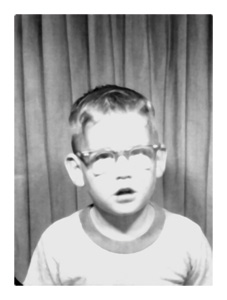
Me at age 4
In 1974 at the local drive-in theatre with my oldest brother, I smoked my first marijuana joint while viewing the full-length feature cartoon “Fritz the Cat”. We lit up a few minutes into the movie, and I’ll never forget it; until then I had never been able to make out facial expressions at the movies, even on cartoon characters, but when that joint kicked in I began to see subtleties for the first time. The sarcastic grin on Fritz’s face and the gleam in his eye suddenly made the movie much more entertaining. When I later described this revelation to my doctor, his response was as to be expected. Though the ophthalmologist acknowledged marijuana would likely slow the nystagmus vibrations and improve my visual acuity, the use of marijuana was too controversial and/or not studied well enough. He felt that Phenobarbital and Valium pills were much safer forms of treatment.
Even as a 14-year old adolescent, the irony from this line of reasoning did not escape me. I immediately discontinued taking my prescriptions and immersed myself in intensive marijuana research, experimentation and advocacy. After reading the “Jamaica Report on Ganja Use Amongst Primary School Children”, the first long-term scientific study documenting both benign and beneficial properties in cannabis, I vowed to all of my friends that I would head to Jamaica upon graduation. Most of my friends weren’t even thinking about high school, much less what they’d be doing after graduation, but I knew I had a quest ahead of me. As it turned out, my graduation came earlier than expected due to estrangement from my parents and troubles at school, both stemming from my continued advocacy for cannabis; at the beginning of my junior year I was given a diploma and asked to leave quietly. So, 17 years old in December of 1977 and in pursuit of a dream, I found myself on the island of Jamaica.
December 1977 marked the end of a very magical year for Jamaica. Bob Marley and The Wailers had released their legendary album “Exodus” in July of that year, fueling fabulous European and American enthusiasm for Reggae Music and Jamaican Rastafarian culture. Also, domestic tranquility had finally been restored as Prime Minister Manley and his social-populist political party emerged victorious from the longest fought and most violent election battle in Jamaica’s history. My flight landed in Montego Bay exactly one week before Christmas. I had already done my homework on the Island’s peoples and culture, even managing to pick up a few pointers from a couple of older hippies who had lived on the island during the late sixties and early seventies. As such, I arrived in Jamaica with three definite notions: 1) Negril Beach was the place to go, although getting there could be very expensive and I’d been told I’d be best off trying to hitch a “share ride” with some locals; 2) Ganja was the name for marijuana in Jamaica and, though it would be high quality, it would also be very difficult to obtain for less than US $50 per ounce unless I was lucky and brave enough to find a local willing to take me into the 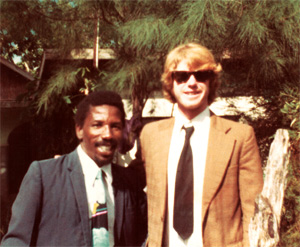 Mackey and I going to church on the 7th day of my ganja healingmountains; 3) Those mystical and dangerous mountains, where rarely a tourist had the luck or bravado to venture, were also exactly where I would have the greatest chance of encountering a “bush doctor” who might be willing to treat my eye condition. While I assumed such an encounter would be a very remote possibility for my first trip, it was definitely the “Holy Grail” of my quest.
After spending the entire day asking around the airport, I finally landed a ride that would take me across the mountains to the other side of the Island. There I could pick up a taxi to Negril for only $5. It was a bit scary getting into that car at night with six unfamiliar locals, knowing only that we were headed into the mountains. Along the road winding further above the city into the sparsely populated hills, my feelings of apprehension soon turned to excitement as it all began to sink in. Some crazy magic was pulling me into those fabled Jamaican mountains, and I had not yet been 24 hours on the Island. For quite some time on that ride I thought I could actually see magical spirits dancing in the mountains, but my eyesight was poor and I had massive coke-bottle-lens glasses so it was hard to make out the figures. It wasn’t until arriving in the first little roadside town that the driver explained the dancing spirits. At Christmas time in the mountains, the people from every town set out walking along the road with candles and singing songs until they reach the next town, where the people of that town welcome the visitors into their homes with feasts and plenty of rum. Once the visitors are made comfortable, their hosts venture off in the same fashion to visit the next town, and this sets off a beautiful chain reaction of song and light throughout the hills. It was such a beautiful Jamaican tradition! After winding across the mountains we arrived in the south coast town of Savannah La Mar, at about two o’clock in the morning.
My driver quickly hailed the only cab on the street so I could finish my journey to Negril. The taxi-driver boisterously introduced himself: “I’m Willis, but my friends call me Mackey!” The first thing he asked me was if I wanted to go up to the church and play Bingo. I didn’t know what to say and I’m sure I gave him a strange look – but before I could tell him I just wanted to get to Negril, he asked if I needed ganja. Because it was so late and I was still quite uncomfortable with the surroundings I thought for a second about saying no, but what came out of my mouth was “absolutely”! The next thing I knew we were driving up a long winding dirt road past sugar cane fields in the middle of nowhere, and ended up in front of a little tin shack at the top of the hill. Mackey introduced me to the Rasta homeowner, and he took me into his home. It was awesome – his entire shack was filled floor to ceiling with large, sparkling green sinsemilla buds. I knew that weed of anything near this quality was selling for about $125 an ounce in Florida and thought, “Wow, even if it costs me $50 an ounce, this would be a score.” Things started to get a bit tricky, however, when the Rasta disdained my offer to buy an ounce, saying he’d not even consider selling less than a kilogram. With a lump in my throat, I asked “how much for a kilo?” and he said it would cost $280 Jamaican dollars, which was roughly equivalent to about US $125 (with 1977 exchange rates). Wishing to defuse a tense situation and knowing I couldn’t pass up such good weed, I shelled out the money for a kilo and set off again for Negril. Because I had just spent most of my vacation budget on ganja I couldn’t afford a hotel – but Mackey invited me to stay with his family in a small bamboo hut they had just built on the beach. “Jamaica, No Problem!”
In their close living conditions I came to know a great deal about Mackey and his family in a very short time. Mackey was a devout Christian and actually a third generation “healer” in the Caribbean tradition of the Adventist Church. When I discovered that I had miraculously stumbled into the company of a real “bush doctor”, I couldn’t wait to relate the story of my quest. Mackey insisted we travel to a home in the hills where he could prepare treatments to improve my eyesight, and I soon found myself a guest in a somewhat luxurious home (by Jamaican standards) along the banks of the beautiful Cabareta River.
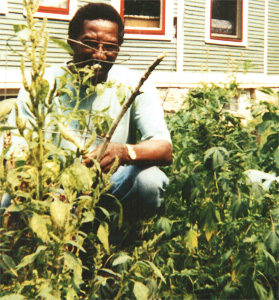 Mackey’s garden in 1977
We began the treatment by bathing in the cold, crystal clear stream, thoroughly scrubbing my skin with special leaves from a riverside bush. Mackey removed my coke bottle lenses, and threw them into the river’s rushing current! Of course, I completely freaked out as I had depended on glasses since I was three years old and knew they weren’t cheap to replace, but Mackey told me to “just take it easy” and explained I would no longer need glasses after he was done.
He covered my eyes with an aromatic poultice of cannabis and herbs, and explained it would be affixed like a blindfold for an entire week. He assured me that he would lead me around by the hand and all my needs would be attended to. For seven days the poultice kept me from noticing whether it was night or day and I was hand-fed soups and stews Mackey concocted from ganja, yams, carrots, pumpkins, magic mushrooms, more ganja and God only knows what other special herbs and roots. On the seventh day, Mackey removed the poultice and had me put on a coat and tie – it was the Sabbath for Seventh Day Adventists and we were going to attend church service together. I didn’t notice any miraculous improvement in my vision at first, but soon it began to dawn on me that I was seeing as well as ever… but without cumbersome glasses! After church we drove back down to Negril, where I spent one of the most joyous New Year’s of my life, hanging with Toots Maytal and others by a fire on the beach. The next day I had to say some heartfelt goodbyes before Mackey dropped me at the airport to catch my flight home to Florida. I knew I’d be back soon.
Upon returning home, I made an appointment with my ophthalmologist to be fitted for a new pair of glasses. The doctor discovered that my old lens prescription offered no vision improvement, which left him quite dismayed; in fact, no lenses – not even special contacts that were the latest, greatest trick for correcting nystagmus – seemed to benefit my visual acuity. But lenses were no longer necessary, as I was reading further down the eye chart than I ever could with glasses! To explain why my eyesight had changed, I told the doctor of my adventures in Jamaica. Of course, he scoffed at the highly controversial notion of marijuana as medicine, and suggested that I make a follow-up appointment for one year later.
While the specialist discounted the Jamaica stories, other associates – particularly my weed connections – began to take increased interest in my miraculous healing in Jamaica. Soon enough I was back on the Island, but this time it was to facilitate large weed buys and load bales of ganja onto prop planes headed for Florida (as told in CC #61).
Though my smuggling escapades certainly provided me with a ready source of high-quality medicine, the lifestyle also led to many scrapes with the law that nearly ruined my life. After several narrow escapes from the snare of long-term prison sentences, I decided to get out of “the mother business” for good. Fortunately, around this same time I was lucky to come across an ophthalmologist who was very sympathetic to my pursuit of herbal medication, which he also felt could have great promise in the treatment of nystagmus. He first attempted to gain permission for medical trials with marijuana, undertaking Herculean efforts while putting his practice at great risk. In the end he was denied, so he suggested I consider moving from Florida to California – but even his colleagues out west were not interested in the risks and scrutiny such controversial studies would bring. Finally, my doctor recommended we try a new medication, Marinol®. Marinol is synthetic THC, but it’s actually THD (Tetrahydradronabinal). The medicine seemed at first to be a miracle; though I had to take three to six times the recommended highest daily dosage of 10mg, it would typically improve my visual acuity by more than 150 percent.
Because I was finally able to read and work at the computer, I could hold down a well paying 40-hour per week job for the first time in my life. Ironically, I was able to land a job as assistant to a federal research scientist with the US Department of Interior mainly due to my extensive knowledge of the Everglades backwaters gained from my smuggling career. The job was working out very well… until I turned into a “Marinol Monster”.
That’s right kids, despite all the laughs we’ve had over the years from ridiculous claims in movies like “Reefer Madness”, government-sanctioned THD really does make you go crazy. Marinol is a very potent, extremely addictive and dangerous drug; if you’ve tried it and haven’t gone off, you simply haven’t done enough for an extended period of time. Due to the unknown long-term side effects from Marinol, I soon began finding myself launching into crazy tirades in the office and, on my better days, spending much of my time giggling to myself while hiding under my work desk, pretending to work on fixing my computer and hoping nobody noticed me. On top of this I had to spend most of my earnings on Marinol because it was not covered by insurance – it came to cost me over $3,000 a month. Additionally, I was still putting myself in legal jeopardy buying weed to smoke so I could come down from the Marinol jitters and delusions. After five years of “Marinol Monster” madness at work, I was eventually forced to resign my position.
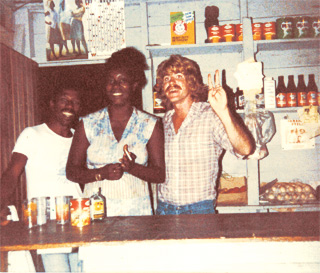 First day of no glasses
Once again, my pursuit of simple herbal treatment for my eye condition had landed me in another huge life dilemma. Not only that, I was hopelessly addicted to Marinol and could only quit one way: “cold turkey”. Withdrawal put me through months of pure hell replete with headaches, eating and sleeping disorders, flu-like cold sweats, and vomiting. When I finally made it through to the other side I was determined to move where I could legally treat myself with the much safer and more benign natural cannabis herb. I checked into all the recent laws that had been passed by US states, and visited British Columbia and Amsterdam. I eventually determined that Washington State’s medicinal marijuana law made the most sense; it allows a licensed state physician to certify a patient with a qualifying condition covered under the statute. Then, once the physician advises the patient as to the risks and benefits of marijuana use for their condition, the law allows the patient to possess and/or cultivate up to a sixty-day supply, with no statutory definition of quantity (as we know, dosage requirements tend to vary greatly for different conditions and patients). There is no requirement for state registration, which can’t be said for California, Oregon and most other medicinal states; in Washington, the treatment decision is kept solely between the doctor and patient.
After moving from Florida to the greener pastures of Washington in the spring of 2005, however, I found things were no longer as utopian as I had come to believe. Medicinal marijuana laws were under increasing attack from the Bush administration and the Supreme Court was siding with the Drug Enforcement Administration, (“Raich vs. Gonzales”). This political climate made it impossible for me to find an ophthalmologist willing to certify my condition. But after coming all this way I was not going to be deterred by DEA henchmen! I answered an advertisement in a flyer for “The THC Medical Clinic”, an advocacy group with a Washington doctor committed to certifying medical marijuana for patients in true need. After a five-month ordeal and several denials, I was finally able to convince this physician to certify me.
I immediately hopped the Amtrak to Vancouver, BC on a mission to buy some high-quality seeds from the Marc Emery Direct Seed Bank. Emery Seeds gave free starter seeds to anyone with a medical marijuana license/exemption. The mixed medical seed pack, containing various strains, allowed medical users to find the strain that worked best for their condition. I went to the Seed Desk at the back of the BC Marijuana Party Bookstore, produced a copy of my doctor’s certification letter, and received the free medical marijuana starter test pack. Little did I know what would happen soon after I left that wonderful place.
Upon returning home I was absolutely shocked to learn that Emery Seeds had been raided and shut down by the Vancouver Police and the US Drug Enforcement Administration! I checked my passport stamp against the time and date of the raid (which began at 11:00am
on July 29) and realized I may well have been the last person to successfully obtain strains from Emery Seeds, that very morning. With great respect for my magical fortune, I lovingly nurtured those seeds to fruition and have successfully harvested eleven different wonderful strains.
In celebration of my first legal medicinal harvest in 2006, I decided to take a break from the rigors of gardening in order to travel a bit. I had two “must do” destinations in mind. First, I wanted to return to Jamaica and bring my two children with me for a much overdue reunion with old friends. We stayed two weeks with Mackey and met many familiar acquaintances – most of whom I hadn’t seen for nearly 30 years – and a few people who had previously met my son and daughter (when they were two and one years old, respectively). I also had the opportunity to bring home some really nice seed stock of “ice”, “purple skunk”, and “banana haze” that I am currently crossing with my Emery medicinal stock to produce my own new strains.
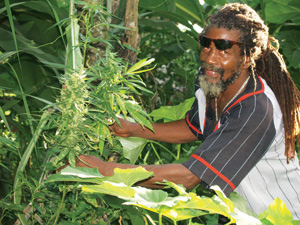 A friend in Jamaica, 2006
My second trip of the summer was an excursion I had dreamed of for quite some time: I wanted to explore Alaska, the first and only US state to ever re-legalize marijuana cultivation. From 1975 to 1990 Alaskans could legally possess up to four ounces of pot under “Ravin vs. Alaska” and the Alaskan Supreme Court decision that ruled privacy concerns exceeded the government’s drug law concerns. The Alaska government tried to recriminalize possession in 1990, and when the courts defeated that, the government tried yet again in 2005. (Currently, the law allows for one ounce stored in the home.)
I had packed my cannabis medicine to take with me because I had booked a fishing trip, and there’s no way I can see well enough to fish without using medical marijuana. Unfortunately, a search of my luggage in a small Southeast Alaska airport resulted in my arrest for marijuana possession; but fortunately, I was allowed to continue on my trip after posting a $500.00 bond. After several court proceedings, all of the charges against me were eventually dropped and I received a State of Alaska check reimbursement for my bond payment. Upon the charges being dismissed in court, the Alaska District Attorney proceeded to lecture me about medicinal marijuana certifications and how they’re not applicable from State to State. He finished off by remarking that if I ever returned to Alaska, I had better not think of bringing my “dope” with me; I responded by pointing out the contradictions in the DA’s choice of language – after all, it was medicine, not “dope” – and the judge actually admonished the DA for his words.
We obviously still have a long struggle ahead before attitudes about marijuana start to improve and the laws are changed. Although medicinal marijuana certification certainly does not offer me the liberty I once dreamed it might, thanks to people like Mackey and Marc Emery, the end of my life-long quest for better vision is more clearly in sight today than ever before.