From warrior societies like the ancient Scythians, medieval Assassins, Nihang Sikhs, Zulu Warriors, to its popularity among modern MMA fighters, cannabis has a long history of use amongst weed warriors, sometimes before battle, and in some cases more for its healing properties.
Cannabis’ modern popularity in fighting sports like MMA is astounding, and it has been suggested nearly half the fighters use cannabis.Indeed cannabis is even a prize at some jui jitsu tournaments.
Despite the World Anti-Doping Agency’s continually murky approach to the plant – cannabis is gaining recognition for being a powerful aid to MMA fighters around the globe, helping hobbyists and professionals alike approach the sport with a calm, refreshed, and unorthodox perspective.
The numbers speak for themselves: 45.9 percent of today’s MMA fighters use the plant to hone their mental and physical skills, recover from intense workouts, and heal from injuries or soreness – and 76.5 percent report to using strictly CBD for these same types of benefits. – Almost Half of the World’s MMA Fighters Use Cannabis: Here’s Why

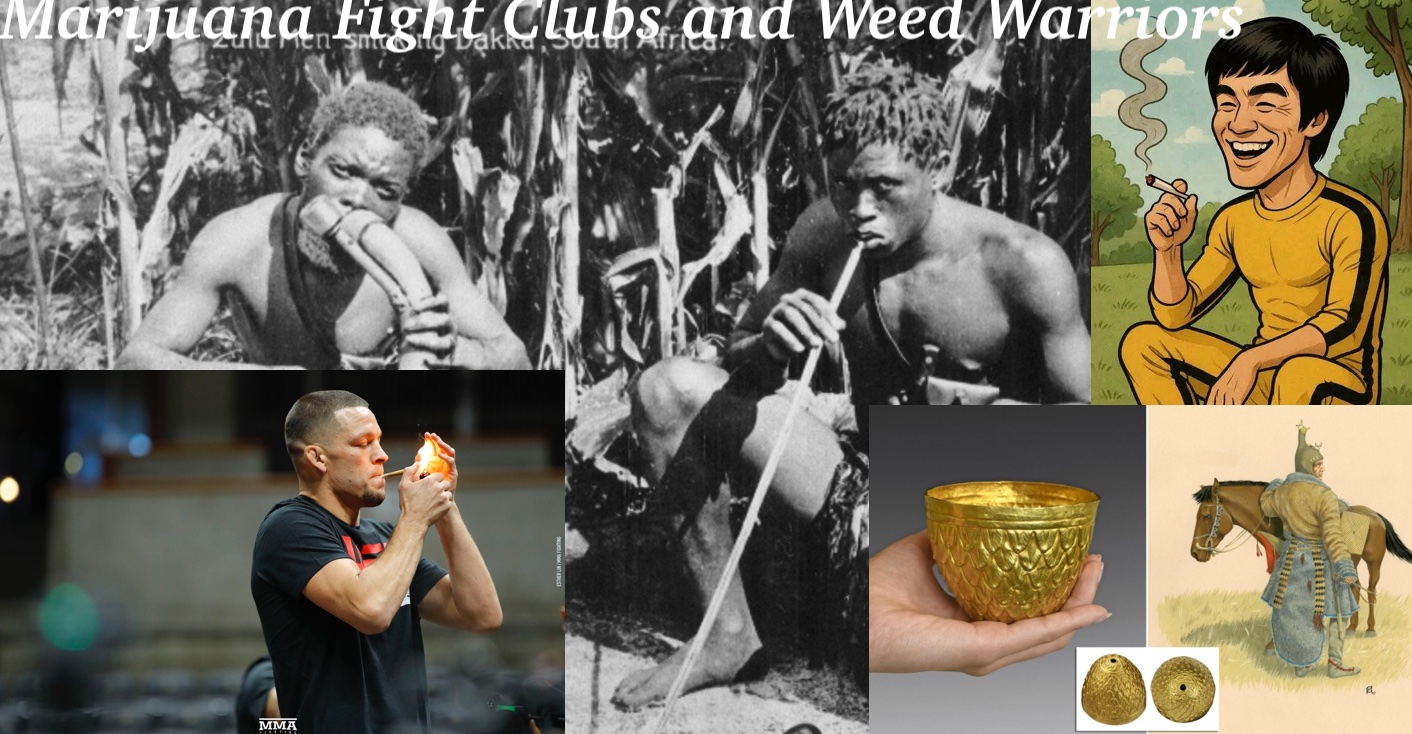
MMA fighter Nate Diaz, lights up proudly at a fight event
Videos: CANNABIS JIU JITSU (Full Documentary); Whats With Jiu Jitsu’s WEED Reputation?
It’s a long list of current and former professional fighters who have expressed a love for marijuana, and I don’t just mean Joe Rogan and Mike Tyson! We could point to the Diaz Brothers, Sean O’Malley, Connor McGreggor and many others.

Conor McGregor appears on a list of Top 5 MMA fighters who smoke cannabis
Lee… claimed to be an expert on the drug. As the astonished Bob Wall looked at the two page chart spread before his eyes and listened to Lee’s machine-gun rap, he learned that hashish was vastly superior to marijuana, because instead of damaging your lungs by smoking it, you could eat it like ordinary food. The most important thing, Lee stressed, was the drug’s marvelous capacity for producing relaxation. “At last I’ve found something to relax me!” crowed Bruce as he put one of the brownies into his mouth.In the next 10 minutes, Bruce Lee ate three or four hash brownies. Wall recalls that the brownies had been prepared according to the celebrated recipe of Alice B. Toklas. If that is the case, Bruce Lee was consuming an enormous amount of hashish. Perhaps he had found that it took a great deal to slow him down. If this was his problem he certainly found the solution. For, as Wall recalls, in just an hour Lee was totally transformed by the drug.
But Lee ended the training session at his home on this particular day with a different type of flourish. He lit a joint and started puffing away. It came from a box of marijuana cigarettes he kept in his garage. Lee would later move on to hashish, carrying it around in little bags and nibbling on it like edibles.
“It raises the consciousness level,” Lee explained when another martial artist asked him why he got high.

Illustration by Spang
Cannabis has a long history with warrior cultures as well, which extends back thousands of years.
The Scythians
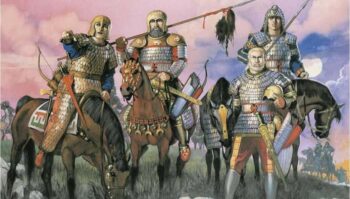
Image from Realm of History
Ancient Scythian Warriors were well known for both their ferocity on the battlefield and their love of cannabis. In the 5th century BCE, Herodotus detailed an account of cannabis vapor baths following funerals. Warriors would throw seeded buds onto red-hot stones in small tents, inhaling the intoxicating fumes to induce trance-like states—likely for purification, mourning, or communing with ancestors amid the chaos of death. Excavations, such as those at Pazyryk in Siberia, have uncovered frozen tombs containing braided horsehair, leather pouches of cannabis seeds, and even braziers with charred residues, confirming its ritual inhalation around 500 BCE. This psychoactive plant, harvested from wild steppe varieties rich in THC, may have also served practical purposes for pain relief during campaigns or enhancing endurance, integrating seamlessly into a culture where altered consciousness bridged the mundane and divine, fueling both their legendary ferocity and mystical traditions. The Scythians also drank infusions of cannabis in golden goblets.
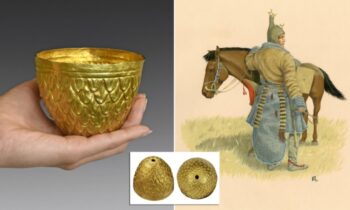
Image of one of the Scythian gold cups that contained residue of both cannabis and opium. Some researchers have suggested these vessels were for drinking haoma, and the some scythians were known as the Haomavarga, the haoma-gatherers. These bowls are often mistakenly reported on as ‘golden bongs’ by some news sites.
As The Guardian article ‘Scythians review – wine, weed and war as the Siberian nomads charge into battle‘ about a display of Scythian artifacts at the British Museum noted: “The Greek historian Herodotus, who wrote in the 5th century BC, is often accused of making up his outlandish stories. One tale he tells about the Scythians is that they loved to smoke hemp, which they burned under a kind of tent that you could put your head into. One such device is in this exhibition, recovered from a Scythian tomb. Herodotus got this one right.”
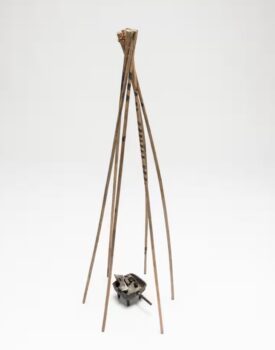
Six sticks of a smoking tent frame and brazier. Photograph: Terebenin Vladimir/© State Hermitage Museum, St Petersburg
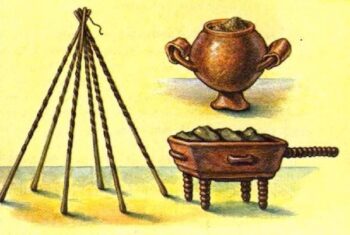
These braziers were not very big, something that could be held in your hands under your face in many cases. Likewise, tent poles in some cases were just a few feet tall, designed for poking your head in and smoking from.
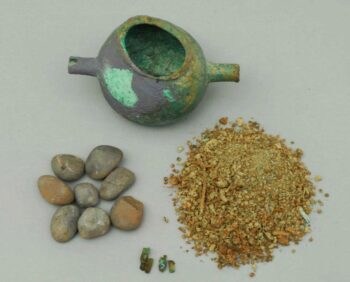
This bronze brazier is about a food in diameter, and likely had wooden handles inserted, The Rocks would be heated and seeded buds would be crumbled onto it, and the smoke inhaled.
The term “Hashishin” refers to the Nizari Isma’ili order, also known as the Assassins, founded by Hassan-i Sabbah in the 11th century. Though the origin of their name is debated, it is believed to come from the Arabic word hashish, for hashish, used by their enemies as an insult to describe them as hashish users. The order was known for their skilled assassinations of political and religious opponents in broad daylight, and their name likely contributed to the modern English word “assassin”.
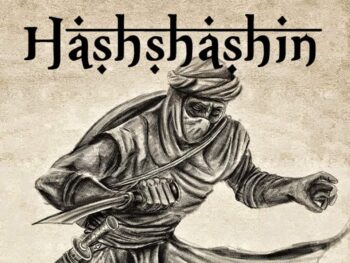
The Hashishin adopted assassination as a method, and mountaintop fortresses, as being a small fringe Islamic group, they were unable to employ battlefield tactics against the much larger groups they were in conflict with. According to stories from the time, they would send a soldier in to infiltrate the household of a enemies leader, at times for years, and then the Sheik or Caliph would wake one morning with a knife through a note on his pillow, reminding him of his mortality…. The Mountain top fortresses, provided a means of defence from all angles that was difficult to penetrate.
As the legendary and sensationalized 13th century account of the Assassins by Marco Polo recorded, novices being initiated into the sect were alleged to have been tricked through the being secretly given a potion of hashish and then taken to unconscious to a hidden garden within the Mountain top castle of the Assassins in Alamut. Through this they were said to have been tricked into believing they had received a foretaste of the afterlife Paradise described in the Koran:
The Grand Master of the Assassins, whenever he discovers a young man resolute enough to belong to his murderous legions . . . invites the youth to his table and intoxicates him with the plant “hashish.” Having been secretly transported to the pleasure gardens the young man imagines that he has entered the Paradise of Mahomet.
The girls, lovely as Houris, contribute to the illusion. After he has enjoyed to satiety all the joys promised by the Prophet to his elect, he falls back to the presence of the Grand Master. Here he is informed that he can enjoy perpetually the delights he has just tasted If he will take part in the war of the Infidel as commanded by the Prophet. (Marco Polo, 12th Century)
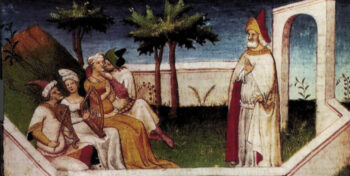
Old illustration from Marco Polo’s accounts of the Old Man of the Mountain and the Hashishin’s pleasure garden.
It should be remembered that Marco Polo’s and other European accounts were based on myths and half truths that grew around the Assassins, who were considered heretics by orthodox Islam and Crusaders alike. As well, secret drugging of potential devotees with hashish as claimed by Marco Polo is discounted by the fact that the “use and effects of hashish were known at the time, as best witnessed by the existence of the name hashishiyya. Therefore the drug could not have been the secret property of the Nizari chiefs…” (Daftary, 1992). It should also be noted that the hashish was used as an initiatory substance directed at invoking a mystical experience rather than inducing a frenzied state of murderous rage for assassination as has been suggested.;
The drug employed for initiation into the cult was used to obtain a vision of paradise. It did not nerve them up for slaughter, was not used during their missions and did not make them crazy. Quite the contrary, it… gave them at least a fleeting glimpse of an altogether higher order of existence. If anything, political and religious intrigue, not hashish, caused assassination. (Aldrich, 1978)
To find out about alleged the role of ‘hashish’ amongst the Hashishin, check out my article ‘Hashish and other psychoactive substances in the Islamic World‘ –
Cannabis and the Sikh Warriors
In a chapter on “Social and Religious Customs” the INDIAN HEMP DRUGS COMMISSION REPORT of 1894 also identified a role for cannabis in the Sikh religion of the Punjab region which began in the 16th century AD:
Among the Sikhs the use of bhang as a beverage appears to be common, and to be associated with their religious practices. The witnesses who refer to this use by the Sikhs appear to regard it as an essential part of their religious rites having the authority of the Granth or Sikh scripture. Witness Sodhi Iswar Singh, Extra Assistant Commissioner, says: “As far as I know, bhang is pounded by the Sikhs on the Dasehra day, and it is ordinarily binding upon every Sikh to drink it as a sacred draught by mixing water with it.” Legend–Guru Gobind Singh, the tenth guru, the founder of the Sikh religion, was on the gaddi of Baba Nanak in the time of Emperor Aurangzeb. When the guru was at Anandpur, tahsil Una, Hoshiarpur district, engaged in battle with the Hill Rajas of the Simla, Kangra, and the Hoshiarpur districts, the Rains sent an elephant, who was trained in attacking and slaying the forces of the enemy with a sword in his trunk and in breaking open the gates of forts, to attack and capture the Lohgarh fort near Anandpur. The guru gave one of his followers, Bachittar Singh, some bhang and a little of opium to eat, and directed him to face the said elephant. This brave man obeyed the word of command of his leader and attacked the elephant, who was intoxicated and had achieved victories in several battles before, with the result that the animal was overpowered and the Hill Rajas defeated. The use of bhang, therefore, on the Dasehra day is necessary as a sacred draught. It is customary among the Sikhs generally to drink bhang, so that Guru Gobind Singh has himself said the following poems in praise of bhang: “Give me, O Saki (butler), a cup of green colour (bhang), as it is required by me at the time of battle (vide ‘Suraj Parkash,’ the Sikh religious book).” Bhang is also used on the Chandas day, which is a festival of the god Sheoji Mahadeva. The Sikhs consider it binding to use it on the Dasehra day-The quantity then taken is too small to prove injurious.” As Sikhs are absolutely prohibited by their religion from smoking, the use of ganja and charas in this form is not practised by them. Of old Sikh times, is annually permitted to collect without interference a boat load of bhang, which is afterwards distributed throughout the year to the sadhus and beggars who are supported by the dharamsala. (IHDCR, 1894)
The sixth Sikh Guru of Sikhism, Sri Guru Hargobind Sahib ji gave bhang to Sikhs to attain Bir Ras (warrior spirit) and to get them energized, as Sikhs used to get up at around 3 am for armit vela and not go back to sleep till after the evening prayers of Sohila Sahib.
ਬਿਦਿਹ ਸਾਕੀਯਾ ਸਾਗ਼ਰੇ ਸਬਜ਼ ਗੂੰ ॥
‘Oh! Saki Give me the cup full of green (liquid)
ਕਿ ਮਾਰਾ ਬਕਾਰਸਤ ਜੰਗ ਅੰਦਰੂੰ ॥੨੦॥
‘Which I need at the time of struggle(20)
ਲਬਾਲਬ ਬਕੁਨ ਦਮ ਬਦਮ ਨੋਸ਼ ਕੁਨ ॥
‘Fill it up to the brim so that I can drink it with every breath
ਗ਼ਮੇ ਹਰ ਦੁ ਆਲਮ ਫ਼ਰਾਮੋਸ਼ ਕੁਨ ॥੨੧॥੧੨॥
‘And forget the afflictions of both the worlds(21)(12)
(Dasam Guru Granth Sahib, Ang 1428)
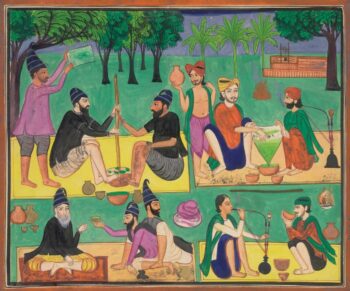
Gouache by an Amritsar artist depicting the preparation and consumption of Indian hemp (bhang) by Nihang Sikhs and Hindus, circa 1870.
Referring to the SikhTemple Guardians the Nihang Sikhs, the Missionary and Indologist George Weston Briggs, wrote “Ganja, a narcotic and intoxicant traditionally consumed by the warrior caste” (Briggs, 1935). The Nihang (‘Crocodiles’) also referred to as the Akalis (‘Imortals’), are a Sikh military order known for their military prowess, and historical victories in battle even when they were greatly outnumbered. Nihang are easily identifiable by their steel iron bracelets, weaponry and particularly by their “electric blue” attire and tall turbans. Up until 2001, Cannabis use was a condoned part of Nihang ritual and spiritual practice and this use was identified by them a “time-respected tradition’ bestowed upon the order by the tenth Guru of Sikhism, Gobind Singh (1666- 1708). The Nihang used the name of Suknidhaan, abbreviated to Suhka, meaning ‘Peace-Giver’ for the preparer of their ritual cannabis preparations which they used in the form of baked cookies and a bhang like beverage referred to . Nihang use of cannabis has been particularly associated with the Sikh holiday Hola Mohalla, a sort of military celebration.
A Nihang prepares cannabis as sukha at the Hola Mohalla, at 40 seconds in the above video.
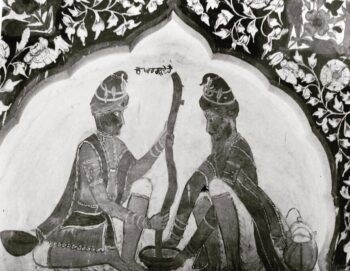
Mural of two Nihang Sikhs making Bhang or Sukh Nidhan, known as ‘Shaheedi Degh’ (the drink of martyrs).
The Rajputs and Bhang
Rajputs are a large, diverse group of communities in northern and central India who trace their origins to the Sanskrit term “raja-putra,” meaning “son of a king”. They are traditionally known as the warrior and ruling class (Kshatriyas) of the Hindu varna system and have historically been associated with bravery and military service, including a significant presence in the Indian armed forces and historically, the Indian armed forces before 1947.
Writing in 1957, for a United Nations drug bulletin, Dr. I. C. Chopra and Col. Sir R. N. Chopra, noted that “Some of the old records from Rajasthan show that ‘sidhi’ or bhang was often drunk in order to propitiate Shiva in time of war. It is stated that the Rajputs used to drink bhang as a stimulant to courage at the time of battle when courageous deeds had to be performed against their enemies” (Chopra & Chopra, 1957).
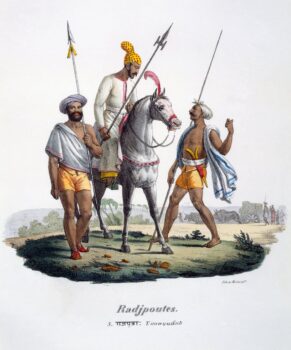
Rajputs, 1827-35 (Rahjputs, 1827-35 )
M.E. Burnouf
Faqirs and Yogis
Cannabis consuming Moslem faqir and Hindu yogis could also be counted here. As Professor Niles Green has explained “the faqirs… success on the field of war was widely recognized, and in both oral and written form, there existed scores, probably hundreds accounts of a faqir winning this or that battle. The same was true of the sadhus and yogis…. nath yogis in particular”(Green, 2009). The tridents and spears carried by Sadhus, are more than mere religious decorations.
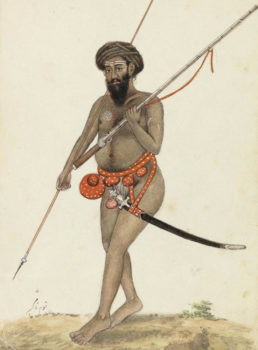
A 19th century painting of a Nath Yogi, well known for their ritual use of cannabis, armed with weapons.
Africa’s Dagga Warriors
Dagga is a term primarily used in Southern Africa as a local, informal name for cannabis (marijuana).
The word originates from the Khoekhoe word daxa (also spelled dachab), which dates back to the 1660s. The term was originally used to describe an indigenous South African plant (Leonotis leonurus, or “wild dagga”) which has mild psychoactive effects, and the sensation of intoxication, but was later extended to refer to Cannabis sativa by European settlers in the Cape Colony.
Cannabis is part of Zulu culture and it always has been. This is according to Dr Nomagugu Ngobese, who states that when you are doing a traditional ceremony you need to have cannabis. “It is a traditional plant that is also used to make traditional herbs and in some instances it is mixed with other herbs to make a certain Zulu medicine. In the past, even Zulu clan chiefs used to meet at a certain spot where they would smoke. People used to plant it in their homes and it was not a problem.”
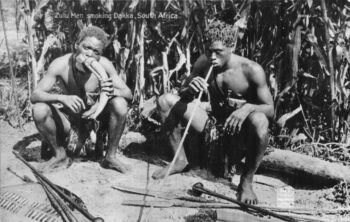
Zulu warriors smoking dagga
The Swazi Army relied heavily on cannabis to hold off fatigue and enhance aggression, before battle. They even kept ‘smoking horns’ on the battlefield. They carried it in pouches, with various charms, and would consume it as a snuff before charging into battle, as noted in Ian Knight’s Companion to the Anglo-Zulu War (2008)
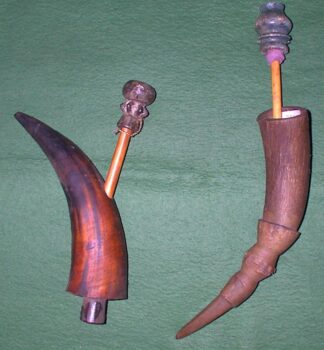
Swazi horn ‘dagga’ pipes
As noted in the Sensi Seed article Cannabis as a Weapon of War: History of Cannabis Use in Warfare (2020), “In Shooting Up: A Short History of Drugs and War (2016), the author quotes the famed, 19th-century Scottish explorer David Livingstone’s remarks regarding the Sotho, another Southern African tribe: “They sat down and smoked (cannabis), in order that they might make an effective onslaught”.
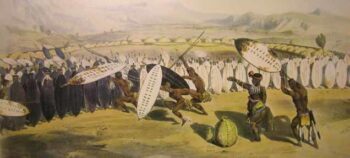
Sotho Warriors – E. Casalis (1861)
Vietnam War
Cannabis was also consumed by soldiers of both sides in the Vietnam war. More recently, the International Criminal Court (ICC) found Congolese warlord Thomas Lubanga guilty of three counts of conscripting child soldiers. At his trial, former child soldiers testified that “many were given or were forced to smoke marijuana before battles, since taking drugs made them more aggressive, even fearless, on the front lines”. (Lubanga Verdict 2012). The article Cannabis as a Weapon of War: History of Cannabis Use in Warfare gives some interesting details on this.
Conclusion
Thus we can see that cannabis has a long and extended history of use in warrior culture. Not only for healing and relaxation, but also for getting into the ‘Zone’ before battle, and creating a Zen like focus. We see this also in cannabis’ popularity in other adrenalin sports like skateboarding, surfing and snowboarding. As a surfer and skateboarder in my 60s I can personally attest to the popularity of the herb in these areas as well!.