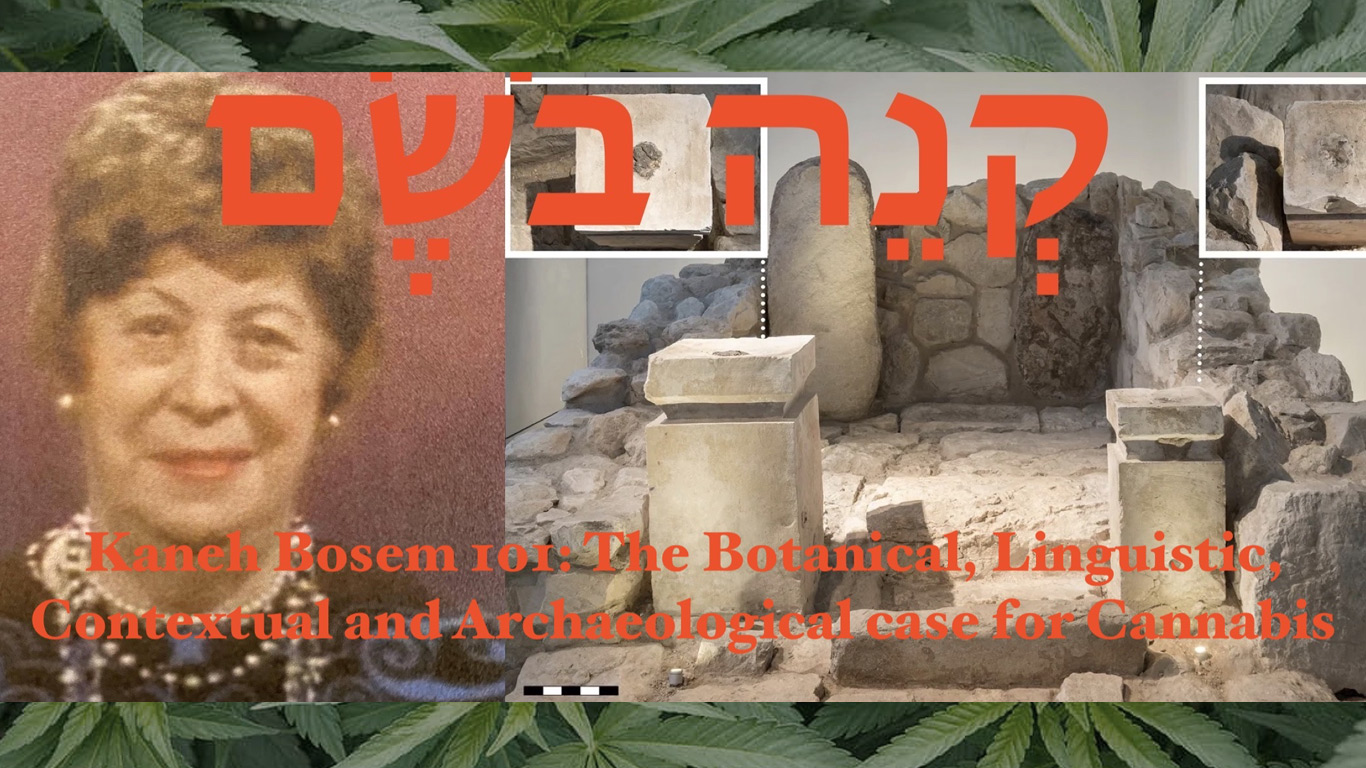
The linguistic theory that the the Hebrew terms kaneh, קנה and kaneh bosem, קנה בושם Identified ‘cannabis’ has been around for 90 years now.
It was the Polish anthropologist Sula Benet (1903-1982) who first suggested that the terms, in some references, originally identified ‘cannabis’ . Benet pointed to Exodus 30:23; Song of Songs 4:14; Isaiah43: 24; Jeremiah 6:20; and Ezekiel 27: 19 , and stated that these words were mistranslated a “calamus” κάλαμος (kalamos) in the Greek Septuagint (Benet, 1936: 1975) and this mistranslation followed into later English translations, such as the King James version of the Bible. This is something I have also been writing about since the mid 1990s, building on Benet’s theory. Benet’s theory is substantiated by what she sees as the phonetic counterpart of the Hebrew term for cannabis, the Akkadian qunnabu and its similar inidicated use. More recently it has been bolstered by the archaeological discovery of cannabis resins on a altar from an 8th century BCE temple site in Israel.
Sula Benet’s linguistic hypothesis
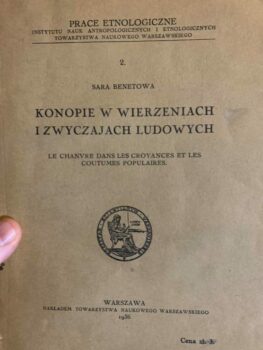
Benet first expressed her theory on the Hebrew terms kaneh and kaneh bosem in 1934-35, in Le chanvre dans les croyances el les coutumes populaires. She expanded on it in 1936, Konopie w wierzeniach i zwyczajach ludowych. returning to it in even more detail in her 1975 article Early Diffusions and Folk Uses of Hemp.
Qoph, the first letter of kaneh bosem, can be phonetically translated either as a hard ‘q’ sound or ‘k’, and both are used frequently.
As Sula Benet explained:
“In the original Hebrew text of the Old Testament there are references to hemp, both as incense, which was an integral part of religious celebration, and as an intoxicant (Benet 1936) Cannabis as an incense was also used in the temples of Assyria and Babylon ‘because its aroma was pleasing to the Gods’.”
“Both in the original Hebrew text of the Old Testament and in the Aramaic translation, the word kaneh or keneh is used either alone or linked to the adjective bosem in Hebrew and busma in Aramaic, meaning aromatic. It is cana in Sanskrit, qunnabu in Assyrian, kenab in Persian, kannab in Arabic and kanbun in Chaldean. In Exodus 30: 23, God directed Moses to make a holy oil composed of ‘myrrh, sweet cinnamon, kaneh bosm and kassia.’ In many ancient languages, including Hebrew, the root kan has a double meaning —both ‘hemp’ and ‘reed’. In many translations of the Bible’s original Hebrew, we find kaneh bosm variously and erroneously translated as ‘calamus’ and ‘aromatic reed,’ a vague term. Calamus, [Calamus aromaticus is a fragrant marsh plant]. The error occurred in the oldest Greek translation of the Hebrew Bible, Septuagint, in the third century B.C., where the terms kaneh, kaneh bosm were incorrectly translated as ‘calamus.’ And in the many translations that followed, including Martin Luther’s, the same error was repeated….”
“In Exodus 30:23 kaneh bosm is translated as ‘sweet calamus.’ In Isaiah 43:24 kaneh is translated as ‘sweet cane,’ although the word ‘sweet’ appears nowhere in the original. In Jeremiah 6:20 kaneh is translated as ‘sweet cane.’ In Ezekiel 27: 19 kaneh is translated as ‘calamus’. In Song of Songs 4:14 kaneh is translated ‘calamus.’
“In the course of time, the two words kaneh and bosm were fused into one, kanabos or kannabus, known to us from Mishna, the body of traditional Hebrew law. The word bears an unmistakable similarity to the Scythian ‘cannabis.’ Is it too far-fetched to assume that the Semitic word kanehbosm and the Scythian word cannabis mean the same thing?” (Benet, 1975).

Anthropologist Sula Benet (1903-1982) and a copy of her 1936 edition Konopie w wierzeniach i zwyczajach ludowych, where she published her linguistic theory about ancient Hebrew cannabis use.
Other Botanical Candidates
Calamus, has been the main suggestion, ever since the Septuagint, but less so, with Jewish sources, and a variety of botanical candidates have been suggested for kaneh and kaneh bosem.
The specific name ‘calamus’ is derived from Greek κάλαμος (kálamos, meaning “reed”). Kálamos was used in translating the Hebrew kaneh for the Septuagint, and this has led to the translation of ‘calamus’ in many modern translations of the Bible from the King James forward, although some Bibles use terms like ‘frargrant cane’. The situation of the specific and generic applications of kaneh, also occur with kálamos. Kálamos, has the meaning generic “reed” and specific “calamus”.
Calamus is also believed to be psychoactive but can be toxic and carcinogenic, so it brings its own baggage, when identified with the Biblical passages, as it still brings the concerns of a psychoactive substance into the ‘Tent of Meeting’ and the ‘Holy of Holies’. The book The Anointed Ones (2011) by Dr. Michael Albert-Puleo M.D. asks “Was a psychedelic drug the Key to the Kingdom for early Christians?… ‘The Messiah Medicine’, a special ointment applied to the skin of one who forever after would be known as ‘The Anointed One’… the result of this anointing was the ability to prophesy, see visions, and dream dreams. The formula is found in Exodus. It contained… calamus root… [which]produces LSD-like effects” (Albert-Pueblo, 2011).
Few Hebrew sources see kaneh bosem identified with calamus. Among Jewish authorities, there are various views on what botanical species the terms kaneh and kaneh bosm identify, and suggestions range from cinnamon bark, sugarcane, lemon grass, ginger grass, camel grass, fennel and others, with an increasing number acknowledging the suggestion of cannabis.
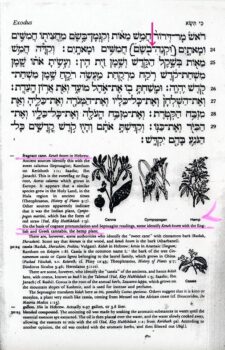
A page from Rabbi Aryeh Kaplan’s ‘The Living Torah’ (1981) which lists a variety of botanical candidates for kaneh bosem, including ‘cannabis’
There is also no reference to calamus’ use as an aromatic in the Akkadian literature that I could find. (However, the Akkadian word for calamus, qan tuppi begins with qan, meaning ‘reed’ or ‘cane’ so it seems like this is another ‘cannabis’ designation that originated with a word for reed, as I have suggested for Akkadian qannabu – cannabis, or cannabis oil.
Linguistic
The Hebrew term kaneh appears 62 times in 38 verses of the Hebrew bible, and as we can see, it is mostly used in a generic way, as ‘reed’ or ‘branch’ or as various means of measuring, especially length. The 5 verses in Bold, are the references that Benet points to as cannabis. Later we will look at these specific references in context:
Gen. 41:5, Gen. 41:22, Exod. 25:31, Exod. 25:32, Exod. 25:33, Exod. 25:35, Exod. 25:36, Exod. 30:23, Exod. 37:17, Exod. 37:18, Exod. 37:19, Exod. 37:21, Exod. 37:22, 1 Ki. 14:15, 2 Ki. 18:21, Job 31:22, Job 40:21, Ps. 68:31, Cant. 4:14, Isa. 19:6, Isa. 35:7, Isa. 36:6, Isa. 42:3, Isa. 43:24, Isa. 46:6, Jer. 6:20, Ezek. 27:19, Ezek. 29:6, Ezek. 40:3, Ezek. 40:5, Ezek. 40:6, Ezek. 40:7, Ezek. 40:8, Ezek. 41:8, Ezek. 42:16, Ezek. 42:17, Ezek. 42:18, Ezek. 42:19
It is worth noting here, that this root word, besides it’s association with ‘reed’, kaneh is also the root word for the English word ‘cane’, which derives from Latin canna, which in turn comes from Ancient Greek κάννα, [kanna] from Official Aramaic qanhā, qanyā and from Akkadian qanû ‘tube, reed’. One of the many etymological suggestions for the word cannabis is that the term means “cane like” (Agrawal & Dhanasekaran, 2021). There is also the suggestion that the earlier “Sumerian language used the word ‘kanubi’, for ‘cannabis’ which means ‘cane of two (sexes)’ (Sfetcu, 2014).
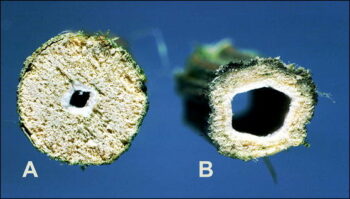
Cannabis can be grown in a very straight manner, when grown for fibre, that would be ideal for a ‘measuring stick’ and its stalk is often hollow. This brings to mind Ezekiel, 40, of a man “with a thread of flax and a measuring rod [qaneh] in his hand” which was used for measuring the temple in Jerusalem. Imagery indicating this practice of a measuring stick and cord, can be found in ancient Mesopotamian art as well, and may be connected with cannabis, as I noted in Cannabis and the Soma Solution.
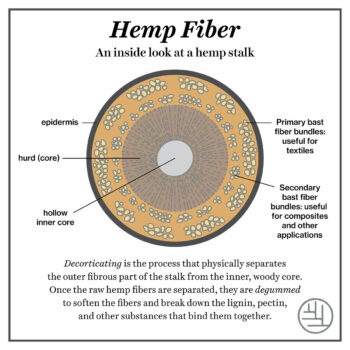
Hollow cannabis stalks
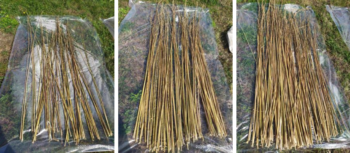
Cannabis’ straight stalks from a hemp field.
Genesis 41:22, is another of the references to kaneh, and it refers to it producing heads of grains. This disallows an interpretation of a reed, as reeds are not known for edible seeds or grains, and do not have branches: “In my [ Joseph] dreams I … saw seven heads of grain, full and good, growing on a single stalk [kaneh].” Interestingly, the ancient Hebrews at times referred to cannabis seeds as a ‘grain’ and they were known to ingest them as well.
The German researcher Immanuel Low (1854-1944) a Hungarian rabbi and scholar, botanist and politicianreferred to a sixth century Persian name for a preparation of cannabis seed, Sahdanag – Royal Grain; or King’s Grain, which demonstrates the high regard the ancient Persians held for the nutritious oil rich seeds that came from the same plant which provided them with their means of inspired religious revelation. Sahdanag was generally prepared in the form of a heart shaped cookie, possibly indicating that the ancient Persians recognized the seed’s close relationship with health and vitality (Low, 1925; reprinted 1967). In Mishnic times hemp seeds were consumed in “Babylonian Broth” . In Hebraic Literature: Translations from the Talmud, Midrashim and Kabbala, Maurice Henry Harris records that in the Nedarim, fol. 49. col. 1, “Rav Yehudah [(220-299 CE)] says it is good to eat … the essence of hemp seed in Babylonian broth; but it is not lawful to mention this in the presence of an illiterate man, because he might derive a benefit from the knowledge not meant for him” (Harris, et al., 2004). [This “benefit” may have been acquired from brewing seeds with the THC rich calyx covering the seed, being intact when it was prepared.]
Immanuel Löw also suggests that the formerly unidentified Hebrew word, tzli’q, (Tzaddi, Lamed, Yod, Quoph), makes reference to a Jewish meal of roasted hemp seeds that was popular into medieval times and was sold by Jews in European markets. (The first part of the name tzli’q simply means roasted, the final letter, Qoph, an abbreviation of the Mishnic word for ‘cannabis’ – qanabos, which begins with the letter Qoph. (Löw, 1925; reprinted 1967).
In regards to generic and specific use of kaneh, consider terms like ‘grass’ or “herb”, and how they are used with a double meaning, both generic and specific, all depending on context. Franz Rosenthal, a Professor of Semitic Languages at Yale University, in his excellent book on the medieval Islamic relationship with ‘hashish’, The Herb: Hashish vs medieval Muslim Society, suggests that the Arabic term “hashish” is itself a nickname believed to have been derived from a more general word meaning “herb”, and was applied to hemp resin products in the same way the generic “grass” came to refer to cannabis in the 20th century. “Most likely, it may may be simply ‘the herb’ as distinguished from all other (medicinal) herbs” (Rosenthal, 1971).
Here is an example of context using the term ‘grass’: “I went to the backyard and smoked some grass” vs “I went to the backyard to cut the grass”. In the specific references noted by Benet, Exodus 30:23, Ezekiel 27:19, Song of Songs 4:14, Isaiah 43:24 and Jeremiah 6:20 the context clearly goes beyond the generic ‘reed’ and she was far from alone in noting this.
For those that would suggest that Sula Benet cherry picked these references, this is not the case. These references have long been noted by Biblical scholars for their more specific context. To give some examples, see these same verses selected in: A concise Dictionary of the Bible for the use of Families and Students (1865); American Encyclopedic Dictionary (1897); The Bible Dictionary (2015); Figs, Dates, Laurel, and Myrrh: Plants of the Bible and the Quran (2007); Song of Songs: A New Translation with Introduction and Commentary (1995) and others books.
“Some kind of fragrant reed is denoted by the word keneh (Is.43:24; Ez. 27:19; Cant. [Songs] 4:14), or more fully by keneh bosem, see Exodus 30:23, or by keneh hatob Jer. 6:20; which the A. V. renders ‘sweet cane’ and ‘calamus’. It was of foreign importation (Je. 6:20). Some writers have sought to identify keneh bosem with the Acorus Calamus or ‘sweet sedge’.” (Smith & Wright, 1865)
Benet believed the term kaneh was of Semitic origin. However, both myself and Prof. Carl Ruck, have suggested the root word here is Indo-European, and likely arrived with cannabis by that name, as an item of trade, ie a wanderwort. Although, there is also the possibility that two phonetically similar words, with similar meaning, Semitic and Indo-European, came to be combined.
In regards to the view that kaneh arrived as a wanderwort, in Jeremiah 6:20; and Ezekiel 27: 19, cannabis is clearly described as coming from a ‘distant land’ and arriving in a trade caravan. Items of trade, often arrived with the names they came with and there are a number of ways that kaneh, or its phonetic counterparts, could have arrived on in Israel with this name.
In regards to a potential Semitic origin, it should be noted that Benet was not alone in suggesting that the term qaneh/kaneh was a term for ‘cannabis’ as well as ‘reed’ in a Semitic language. Wilhelm Tomaschek in his study on ancient Thracians (1894), suggested that the Greek term “κάνναβις” cannabis arose from a composite word that belonged to the commercial language of the Phoenicians, who brought hemp cloth together with its designation ‘kanna‘ from the North and this name subsequently spread everywhere -however here still, we can see the potential of a wanderwort. In this regard it is worth noting that cannabis, which was believed to have been used for its psychoactive purposes was recovered from a Carthaginian shipwreck, and these people were Phoenician settlers, and active in trade. “There was so much of this plant material that a bagful was easily obtained, more than enough for laboratory analysis. The results confirmed that the material was most probably Cannabis sativa…” (Seff, 1990)
The Phoenicians were the nearest people to the ancient Israelites in every respect. They spoke the same language and wrote in the same script. Even their religion was similar, at least during the First Temple period. Accepting the view that “κάνναβις” cannabis is composite, Tomascheck juxtaposed its first morpheme κάννα (kanna) with Hebrew kaneh [qaneh] and Assyrian kanu [qanu], all meaning ‘reed’. Indeed, the first part of the Greek word for cannabis, in ancient Greek was κάννα (kánna, “reed”), from Akkadian 𒄀 (qanû, “reed”). The second part, bis, may identify two – “bis-” (βίς) is less common as a prefix compared to “dis-” (δις-), as “bis” is more characteristic of Latin. However, “bis” does appear in rare cases in Greek transliterations or loanwords. This fits with the idea that the more ancient Summerian term suggested for cannabis, kunibu, also can be broken down as a composite as well. “Sumerian language used the word “kanubi”, which means ‘cane of two (sexes?)’. This is possibly the source of the Semitic usage’” (Sfetcu, 2014).
That the Greek “κάνναβις” may mean ‘kanna – reed, bis- two’ as with the suggested Summerian root, kanubi, is supported by the idea that the Greeks saw two types of cannabis at work here. Alan Sumler, in Cannabis in the Ancient Greek and Roman World, notes that cannabis according “to ancient Greek and Roman sources was of two kinds”. This could be broken down to wild and cultivated, and also in regards to the way it was used. Sumler pointed to a reference in the works of Artemidorus writing in the third century, that indicated two separate industries involved, one in preparing fibre hemp, and the other in the preparation of psychoactive strains. Generally the Greek term is thought to have been derived from the Scythian language, but this is only due to the fact that the first appearance of the term, comes from Herodotus’ 5th century account of the Scythians’ use of cannabis in funerary rituals. There is no reason to think the term could have been in use, prior to Herodotus, other than it does not survive in an earlier recorded Greek text.
It has also been suggested that the Etruscans, a people who inhabited Etruria in ancient Italy, used the term kanna for cannabis. The Etruscans had contact with the Phoenicians and this may be the Northern source of the term that Tomascheck suggested. Specifically, there is evidence of trade and cultural exchange between the two groups, particularly in the area of southern Italy and the western Mediterranean. This interaction is highlighted by the presence of Phoenician artifacts in Etruscan sites and, most notably, the discovery of bilingual inscriptions in Etruscan and Phoenician. In the paper ‘The organic content of the bronze vases of the heroon of Paestum: new data for a new interpretation‘ (Dodinet, Garnier, Barbier-Pain, 2023) which discusses ritual vessels which are believed to contain residues of cannabis, the author’s note “the word kanna is inscribed on an object” and “is considered as an Etruscan transliteration of the Greek world kannabis” according to Vincenzo Bellelli’s article ‘Gli Argonauti all’imbarco‘. Although at times they had conflicts, the Etruscans traded goods with the Greeks, shared an artistic vocabulary and exchanged ideas. The Etruscans adopted the Greek alphabet, which eventually evolved into the Latin alphabet.
It would seem, phonetic variations of kanna, could have come from a variety of trade routes and sources. Michael Witzel, Professor of Sanskrit at Harvard University and the editor of the Harvard Oriental Series, suggests in The Home of the Aryans the term kana/k’ana meaning “hemp” came from the language(s) of the Bactria–Margiana Archaeological Complex (BMAC). This does seem like a likely avenue. The Bactria-Margiana Archaeological complex has some interesting archaeological claims about ancient temples used to process cannabis for ritual purposes from the Russian Archaeologist Viktor Sarianidi. I’ve discussed this archaeological site in relation to the Vedic Soma and Avestan Haoma, as well as the Scythians elsewhere.
Nomadic Scythians, who were known to have ritually used cannabis, were active in the region of BMAC. The Scythians played an important part in the Silk Road, a vast trade network connecting Greece, Persia, India and China. As Benet mentioned above, the Scythians also settled in Israel. As well, it is believed that Scythian traders delivered the cannabis and ephedra to BMAC, which likely came from Indo-European settlements in China, known for their own archaeological evidence of ritual cannabis use. Witzel suggested the root word fro cannabis, came from an Iranian language (such as Scythian)- “kan-/k’an-; ‘hemp’ Ved. sana (hemp, cannabis)” (Witzel, in Mair, 2006).
Other researchers agree with that analysis. K. Redei (1986) proposed *kan as the reconstructed prototerm and the Middle Persian form *kana. Otto Schrader (1917) suggested the proto-terms underlying ‘cannabis’ names, and according to him evidently recognizable in some of them, as *kanna and *ken, seeing also a connection to Sanskrit cana . As far as the Greek Kannabis is concerned, Schrader found it to be a composite, Greek ‘Kanna’ ‘reed’ drawing attention to its second morpheme, i.e. – ,Bis.
The Scythians, and were in contact with the ancient Hebrews. “The Scythians participated in both trade and wars alongside the ancient Semites for at least one millennium before Herodotus encountered them in the fifth century B.C. …The city known as Beizan in modern times was originally called Bethshan and later renamed Scythopolis by the Greeks during the Hellenistic period, since many Scythians settled there during the great invasion of Palestine in the seventh-century B.C.” (Benet, 1975)
Bosem – Aromatic
The addition of bosem, meaning aromatic, adds another layer of linguistic discussion. The phonetic similarity between modern ‘cannabis’ and the combined term ‘kaneh bosem‘, has caused most of the discussion regarding a connection to ‘cannabis’ has focussed there. Many researchers get stuck on the verse Exodus 30:23 as a result, as this is the only place the combined term occurs where it appears in a recipe for the Temple Holy oil. This is often used as a source of dismissal of cannabis’ inclusion in incenses, as the tetm is not included in Exodus’ incense recipe, but ignores the other references that Benet suggested in the Songs, Isaiah, Jeremiah and Ezekiel. (This was the case with Biblical scholar Dan McClellan).
Benet suggested that kaneh meant both ‘cannabis’ and ‘reed’, the Hebrew bosem, meaning ‘fragrant’ or ‘fragrant oil’ was added in the Exodus version, and that the Akkadian term qunnabu, which is translated as ‘hashish’ or ‘cannabis oil’ was the contemporary linguistic cognate suggested here. Both terms appear around the same time. As we shall see there are indications that qunnabu itself may have formed from a composite word that contains the Akkadian root for ‘reed’.
it may be that kaneh bosem, identifies a prepared resin product as well, as with Akkadian qunnabu. This would intensify the effects of its suggested use in topical form, considerably.
There are 30 occurrences of bosem in the Hebrew Bible, and the vast majority translated as ‘spices’, or ‘fragrant’, while two have been translated as ‘balsam’. Some have suggested that the term ‘kaneh bosem‘ identifies balsam oil, (McClellan, 2024; Branch, 2022) but this does not hold up to scrutiny. In Exodus 30:23, where bosem occurs with kaneh, it appears 3 other times.
“Take the following fine spices [bosem] : 500 shekels of liquid myrrh, half as much (that is, 250 shekels) of fragrant [bosem] cinnamon, 250 shekels of fragrant [bosem]cane [kaneh], 24 500 shekels of cassia—all according to the sanctuary shekel—and a hin of olive oil.
So here we can be certain it means ‘fragrant’ or ‘fragrant oil’, and with the Akkadian concept of an ‘aromatic’. In ancient Assyria, aromatics included materials used to create scented oils for bodily anointment, fragrant incense for temples, and herbal remedies. These materials, often sourced from distant regions, were integral to religious practices, personal care, and medicinal treatments. For instance the Akkadian term qunnabu, often translated as ‘hashish’ or ‘cannabis’ oil, was an aromatic made from the flower of cannabis, qunnabtu.
Interestingly, Joshua Snider has noted that Rabbi Ernest Klein’s Comprehensive Etymological Dictionary of the Hebrew Language for Readers of English (1987) indicates that besides ‘fragrance’ bosm may also indicate “became drunk, became intoxicated”.
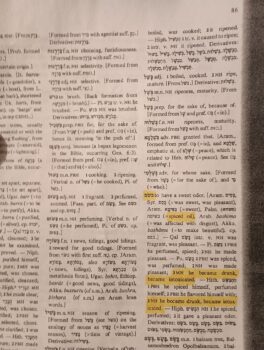
Rabbi Ernest Klein’s Comprehensive Etymological Dictionary of the Hebrew Language for Readers of English (1987)
Qunnabu
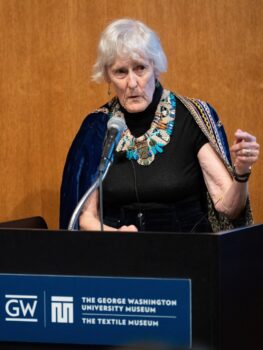
Elizabeth Wayland Barber
Archaeologist and linguist
Elizabeth Wayland-Barber, a professor of archaeology and linguistics, notes that it was in the second quarter of the first millennium BCE that the “word qun-nabu (qunapy, qunubu, qunbu) begins to turn up as for a source of oil, fiber and medicine” (Barber 1989). This term has generally been identified with ‘cannabis’ by Assyriologists. See The Assyrian Dictionary, Volume 13 (1982)
Many have commented on its phonetic similarity to kaneh bosm and the Akkadian term qunnabu. Kaneh can also be rendered qaneh, and qunnabu, kunnabu. The contextual use here fits as well, qunnabu appears as an item in the ‘sacred rites’, and as an offering at temples, and in the forms of incense, anointing oils and infusions, in contemporary references to the Biblical era.
Recipes for cannabis, qunubu, incense, regarded as copies of much older versions, were found in the cuneiform library of the legendary Assyrian king Ashurbanipal, (b. 685 – ca. 627 BC, reigned 669 – ca. 631 BC). Cannabis was not only sifted for incense like modern hashish, but the active properties were also extracted into oils. “Translating ‘Letters and Contracts , no.162’ (Keiser, 1921), qu-un-na-pu is noted among a list of spices (Scheil, 1921)(p. 13), and would be translated from French (EBR), ‘(qunnapu): oil of hemp; hashish.’”(Russo, 2005)
Here is what you get when you search “aromatic” in the Akkadian dictionary, note how qunnabu ‘cannabis’ and qanu ‘reed’ are grouped together, and this could very well indicate a linguistic connection.
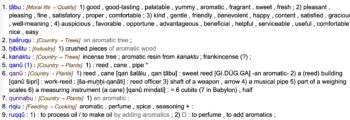
“Aromatic” from The Akkadian Dictionary
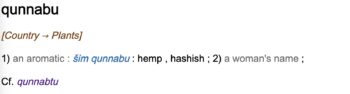
qunnabu – hashish
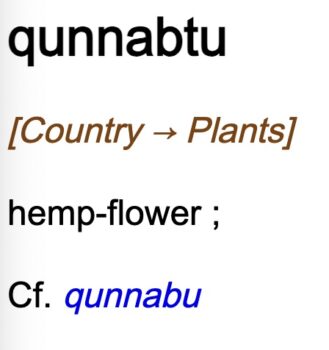
Neo-Assyrian Akkadian 𒋆𒄣𒌦𒈾𒁍 and it’s various phonetic translations qunnabu, qunappu, qun(u)bu.
Interestingly, we see here that qunnabu is seen as hashish, whereas the whole plant appears as qunnabtu. This is interesting as the bu and btu, are not the same in both, and without them we get something very phonetically close to the Akkadian term for reed.

qanu – ‘reed’
It is worth noting here that when you search ‘reed’ in The Akkadian Dictionary, you get 67 entries, and variations of qanu account for only 3 of those. When you search ‘aromatic’ you get 14, with qanu twice and qunnabu once, and as that term means ‘hashish’ and qunnabtu means ‘cannabis plant’, it appears that qunna is the key component of the word, bringing us very close to qanu, reed, and giving us the likely older root.
Assyriologist Barbara Böck says the name for qunnabu, can also be rendered qunnubu, Thompson, in his Dictionary of Assyrian Botany, includes the rendering qunubu. Still other sources, list it with a single n, bring it even closer. A spelling shared by (Löpelmann, 1968, and numerous others). These bring us all bring us closer to qanu, ‘reed’ as a root for cannabis terms in Akkadian.
We see qan in other plant names, such as that for calamus, qan tupi, and this as well may have a connection to ‘reed’ or ‘cane’ like plants. “Cinnamon. From Hebrew KiNaMoN, it’s also believed to be a cognate of KaNeH, [kaneh/qaneh] since the aromatic bark is shaped like a reed (Green, 2019). This fits with Benet’s statement: “In many ancient languages, including Hebrew, the root ‘kan‘ has a double meaning — both hemp and reed” (Benet, 1975). There is also the forementioned possibility that the Akkadian qunnabu is an adaptation of the much older Summerian kunibu, itself said to be made from a composite meaning ‘reed’ and ‘two’ (It is believed about 7% of the Akkadian language is composed of Summerian loanwords).
In Science and Secrets of Early Medicine, Jurgen Thorwald records: “Quunabu – such was the Assyrian name for Indian hemp. This is basically the same word as it was later known by cannabis (Cannabis Indica), and hemp is cognate with it … it was often employed in Mesopotamia to relieve the pain of bronchitis, bladder trouble, rheumatism, and as a remedy for insomnia” (Thorwald, 1963). Likewise, as noted in the 1907 German edition of Mitteilungen zur Geschichte der Medizin und der Naturwissenschaften (Notes on the History of Medicine and Science) in reference to “the Indo-European plant names” that appear in Assyrian texts, “the plant qunubu – hemp corresponds exactly to the form of the name cannabis, as well.”
More recently, Barbara Böck, of the Institute of Languages and Cultures of the Mediterranean and Near East, explained in her essay “Mind Altering Plants in Babylonian Medical Sources” in The Routledge Companion to Ecstatic Experience in the Ancient World:
A plausible candidate for Cannabis sativa in Akkadian is the plant term qunnabu or qunubu. The name is a Wanderwort that has entered as loanword not only Akkadian but many other languages and cultures. Interestingly, the name qunnabu is attested relatively late in the ancient Mesopotamian record, namely from the eighth century BCE onwards. This late appearance fits well with the fact that wandering words spread usually through trade connections, and it occurs in cuneiform documents at a time the Assyrian and Babylonian empires reached their greatest territorial expansion and thus expanded commercial contacts… Akkadian qunnabu is almost exclusively attested as one ingredient among many in incense blends and perfume mixtures used in the religious cult… (Böck, 2022).
The Elisabeth C. Miller Library, hosted by the University of Washington, gives the following summary on the etymology of cannabis, “The Latin name comes from Greek kannabis, which is derived from the Sanskrit root canna, meaning cane. There is a connection to Semitic languages as well (Arabic kunnab, Syriac kunnappa, Aramaic kene busma, etc.)”. Which fits with what has been suggested here.
Akkadian qunnabu
We should also consider the time period of the believed composition of Exodus, where the single reference to kaneh bosem occurs, and how this fits with the suggested date of the arrival of the term qunnabu in Assyria, as well as how cannabis was used in that region, along with the known Assyrian influences on the Hebrews at that time.
It is generally believed that Exodus was a composite work, it’s strata probably having been written between the 9th and 5th centuries BCE. With more of a consensus suggesting that the initial composition was a product of the Babylonian exile (6th century BCE), based on earlier written sources and oral traditions, with final revisions in the Persian post-exilic period (5th century BCE).
This date coincides with arrival of the term qunnabu, in the Assyrian world, and this also coincides with a time of great Assyrian influence on Hebrew worship, and life. It has increasingly been suggested the purges that resulted in the ‘cancelation’ of the tel Arad temple, were due to the Hebrew King Hezekiah’s desire to rebel against his Assyrian overlords and purge their ritual influence on Hebrew life, as well as enforcing monotheism. When we take a look at the similar way the Hebrews used kaneh and kaneh bosem, to the Assyrian’s and their qunnabu, a clear pattern of similar, if not identical use, emerges.
Prior to this time period, it is believed that cannabis was known under a variety of earlier names, such as azalluˆ – A.ZAL.LA, gan.zi.gunnu, Sami nissati ‘a drug for sorrow’ and others. As British archaeologist Diana Stein has noted in reference to this sutuation “Cannabis has many variants, and it is possible that these were known by a variety of different names, some cryptic and others descriptive or allegorical (as is the case today: marijuana, hashish, hemp, grass, weed, dope, pot, skunk, kit, bhang, etc.).” (Stein, 2009). See Dr. Ethan Russo’s History of Cannabis and Its Preparations in Saga, Science, and Sobriquet (2007), which summarizes the various entries in R. Campbell Thompson’s A Dictionary of Assyrian Botany (1949) for a more thorough investigation of these terms and their various usage.
However these terms lack the scholarly consensus in regards to their firm identification that qunnabu holds. As Thompson recorded “Towards the end of the eighth or first half of the seventh century B.C. the word qunubu has come in, it being mentioned on a Sargonid letter… to the King’s mother, along with myrrh, etc., in reference to certain dullu (work, or rites)” (Thompson, 1949). In the 1907 German edition of Mitteilungen zur Geschichte der Medizin und der Naturwissenschaften (Notes on the History of Medicine and Science) in reference to “the Indo-European plant names” that appear in Assyrian texts, “the plant qunubu – hemp corresponds exactly to the form of the name cannabis, as well.”
The case for qunubu as cannabis, is built on much more solid ground than these other words:
“Qunnabu, the probable Assyrian word for cannabis, is attested in texts of the first millennium BCE. It occurs in a Neo-Assyrian recipe for perfume, and a contemporary letter refers to its use in ritual contexts. A later Neo-Babylonian text records the delivery of large quantities of qunnabu to the great temple of Eanna and Ebabbar, and there are recipes in which hemp is an ingredient of aromatic oil used for cultic purposes. So cannabis was available in Mesopotamia during the sixth century BCE at the time when the Hebrew Bible was compiled in Babylon” (Stein, 2009).
Before we explore the Hebrew references to kaneh and kaneh bosem in context, it’s worth looking at some of the Assyrian references to the use of qunnabu.
Recipes for cannabis, qunubu, incense, regarded as copies of much older versions, were found in the cuneiform library of the legendary Assyrian king Ashurbanipal (b. 669 – ca. 631 BC, reigned 669 – ca. 631 BC). Indications are that cannabis was not only sifted for incense like modern hashish, but the active properties were also extracted into oils. “Translating ‘Letters and Contracts, no.162’ (Keiser, 1921), qu-un-na-pu is noted among a list of spices (Scheil, 1921)(p. 13), and would be translated from French (EBR), ‘(qunnapu): oil of hemp; hashish’” (Russo, 2005).
Records from the time of Ashurbanipal’s father Esarhaddon, (reigned 684 – 669 BC) give clear evidence of the importance of such substances in Mesopotamia, as cannabis, ‘qunubu‘ is listed as one of the main ingredients of the pivotal ‘Sacred Rites’. In response to Esarhaddon’s mother’s question as to “What is used in the sacred rites”, a high priest named Neralsharrani responded that “the main items…. for the rites are fine oil, water, honey, odorous plants (and) hemp [qunubu]”. This use is contemporary to that indicated in the Bible, and it should be noted both father and son appear in the Old Testament narrative (Esarhaddon II Kings 19:37, Isaiah 37:38, and Ezra 4:2: Ashurbanipal Ezra 4:10).
In The Cults of Uruk and Babylon, Marc Linssen notes another cultic use of cannabis, “some of the known aromatics, such as … qunnabu… are mentioned in the… Kettledrum ritual text TU 44, IV, 5ff…. In the list of ingredients for this rite 10 shekel qunnabu– aromatics”( Linssen, 2004). Archaeologist Diana Stein notes: “A later Neo – Babylonian text records the delivery of large quantities of qunnabu to the great temple of Eanna and Ebabbar , and there are recipes in which hemp is an ingredient of aromatic oil used for cultic purposes” (Stein, 2009). Ebabbar, was the temple of the sun-god Shamash. Eanna was an ancient Sumerian temple in Uruk. Considered “the residence of Inanna” and Anu, it is mentioned several times in the Epic of Gilgamesh.
The salve of Isharais cannabis;The salve of Isharais cannabis:From themouth of QisirayyuI hear so
As Fales explains “the connection between the salve of the plant qunubu and the name of this goddess might be sought in the aspect of the latter as deity of love. On qunubu… as cannabis… another [Assyrian] attestation of the plant [is translated]… ‘(She) said: ‘what is required for the ritual?’’ Quality oil, wax, quality salves (and particularly) salve of myrrh and salve of cannabis…’” (Fales, 1983).
Thus the Akkadian qunnabu fits well with the theory the Hebrew kaneh and particularly kaneh bosm identify ‘cannabis’ both on a phonetic level, but also in the same sort of context and in the same time period, with a culture that had enormous influence on the ancient Hebrews. In relation to qunnabu often being translated as a cannabis oil product, or hashish, the addition of bosem (aromatic) to kaneh, may also indicate a more refined product.
An example of academic reluctance to accept the idea that kaneh bosem could identify cannabis, despite the evidence, comes from the botanist Prof. Amar Zohar, Bar-Ilan University, who wrote in the Makor Rishon, a Hebrew language Israeli weekly newspaper that:
”Kaneh bosem” was used as one of the components of the anointing oil in which the holy vessels and the priests were anointed (Exodus 30:23-25) … This ingredient cannot be cannabis for several reasons: the plant and its products are not defined as perfumes and are not mentioned in the use of scent and incense in all cultures of the ancient world. Also, it does not appear in this context in any of the ancient identification traditions or in the authorized studies that deal with the identification of biblical plants. (Zohar, 2020)
Clearly the references to qunnabu appear in the context of both incenses and perfumes within a culture that had deep contact with the ancient Hebrews in the exact time period in question. As well, Zohar’s statement on the lack of recognition, in authorized studies, has not taken into account, more recent archaeological evidence we will discuss shortly. For a deeper look at other issues with Prof. Zohar’s analysis see my article on his claims.
Having noted this, however, this linguistic case, though strong, is a matter of debate, and admittedly, not widely accepted in academic circles. It seemed the hypothesis was destined to not move beyond that point, till 2020, and the announcement of what is arguably one of the most significant archaeological discoveries regarding cannabis, and the use of psychoactive substances in the ancient world….
Archaeological Evidence
Indeed, it did for decades seem that Benet’s theory on Hebrew use of cannabis was destined to be a fringe linguistic hypothesis with little academic support, with pretty much a consensus rejection of the idea that the ancient Hebrews knew of and used cannabis. That is until the discovery of cannabis resins, “hashish” on a Hebrew altar, from 8th century BCE in Israel, at the only Hebrew temple site ever recovered archaeologically. As detailed in The Journal of the Institute of Archaeology of Tel Aviv University, Volume 47, 2020 – Issue 1, and the paper ‘Cannabis and Frankincense at the Judahite Shrine of Arad’, by Eran Arie, Baruch Rosen & Dvory Namdar.
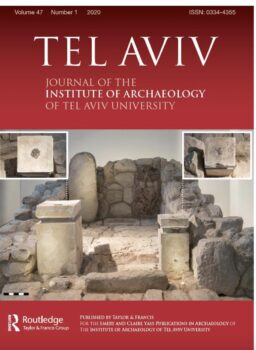
The Journal of the Institute of Archaeology of Tel Aviv University, Volume 47, 2020 – Issue 1, includes the paper Cannabis and Frankincense at the Judahite Shrine of Arad
The authors wrote about the analysis of unidentified dark material preserved on the upper surfaces of two altars that were used in a Hebrew Temple site. The residues were submitted for analysis at two unrelated laboratories that used similar established extraction methods.
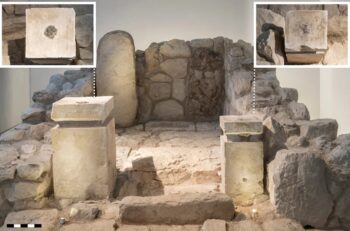
The ‘Holy of Holies’ at tel Arad, the temple room, which would have been enclosed is about 2 meters by 2 meters, and the larger incense altar on the right, used for frankincense, a little less than a meter tall, the smaller altar on the right was used for burning cannabis resins.
“On the smaller altar, residues of cannabinoids such as Δ9-teterahydrocannabinol (THC), cannabidiol (CBD) and cannabinol (CBN) were detected, along with an assortment of terpenes and terpenoids, suggesting that cannabis inflorescences had been burnt on it” (Arie, et. al. 2020). The authors “suggest that cannabis female inflorescences may have been imported from distant origins and were transported as dried resin (commonly known as hashish)” (Arie, et. al. 2020).Alternatively, the “larger altar contained an assemblage of indicative triterpenes such as boswellic acid and norursatriene, which derives from frankincense…” (Arie, et. al. 2020).
As the authors of this fascinating archaeological find conclude: “These well-preserved residues shed new light on the use of 8th century Arad altars and on incense offerings in Judah during the Iron Age” (Arie, et. al. 2020).
This temple is considered a smaller version of the Holy of Holies at the Main temple in Jerusalem, which by tradition, was built by Solomon. In side the temple area, sat a small enclosed room, the ‘Holy of Holies’, that held two alters, one for burning frankincense and the other for cannabis resins or ‘hashish’ as the authors of the report suggested. This shows that at this early date, potent cannabis resin extractions were available, contradicting so much of what Partridge has said about ancient cannabis. The Inscription, ‘The House of Yahweh’ at the site insures its Jewish roots. The design of the site, has seen it be suggested as a smaller version of the Main Temple in Jerusalem. Many Biblical scholars see this as evidence of the practices at the Main Temple in Jerusalem as well. None of the scholars that Partridge dismisses the linguistic theory on kaneh bosem, predicted or can account for this archaeological evidence, or have a suggested Hebrew word for its use. We also have archaeological evidence of ritual weaving of cannabis in the ancient Levant, so to be clear, it is a fact that the Kingdom era worship of the Israelites, included both woven fibre cannabis, and resins, burnt on an altar in a small enclosed space.
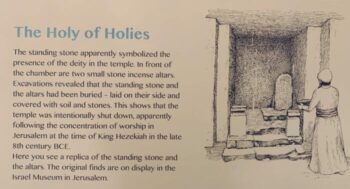
A High priest about to hotbox the inner temple at tel Arad. Cannabis resin was recovered from the smaller altar and frankincense from the larger. (Image from a display at the archaeological site)
This research has led to International headlines, and is rocking the scientific and religious world with this astounding Revelation:
- Newsweek – Cannabis Discovered in Shrine From Biblical Israeli Kingdom May Have Been Used in Hallucinogenic Cult Rituals
- BBC – ‘Cannabis burned during worship’ by ancient Israelites – study
- Popular Archeology – New research reveals Cannabis and Frankincense at the Judahite Shrine of Biblical Arad
- The Times (UK) – Judean worshippers were high on cannabis, archaeologists reveal
- Haaretz – Ancient Israelites Used Cannabis as Temple Offering, Study Finds: Analysis of altar residue shows worshippers burned pot at a Judahite desert shrine – and may have done the same at the First Temple in Jerusalem
Countless other news sources have verified this study. The term kaneh bosm, is now being discussed by Israeli researchers, as a potential ancient Hebrew name for cannabis, as discussed in this Haaretz interview LISTEN: High Priests, Holy Smoke and Cannabis in the Temple. “
Briefly, in the original Hebrew we see kaneh (cannabis) alongside frankincense, as with the two altars at tel Arad, as a temple offering in Isaiah 43:22-24, where God’s anger burns at the prophet for not bringing any, and again in Jeremiah 6:20, where both are rejected. This occurs at the time that historians suspect King Hezekiah ‘cancelled’ the tel Arad temple, and buried it in a day (leading to its excellent preservation) during reforms aimed at isolating worship to the Main Temple in Jerusalem, and yahweh alone, largely for political purposes of control. It is suggested that the cannabis resins at tel Arad came as an imported product, and as we have seen, this was the case with kaneh as well, in Jeremiah 6:20, and Ezekiel 27:19.
The Israel Museum, has this altar on display with the title Holy of Holies from the sanctuary at Arad, and the description:
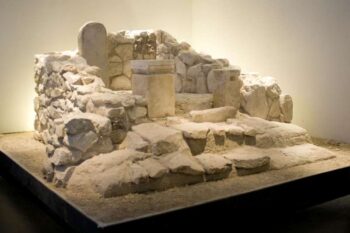
A small sanctuary was uncovered in the Arad fortress on Judah’s southern border. It is the only Judahite temple ever discovered. Like most Ancient Near Eastern shrines, including the Temple in Jerusalem, it was composed of several spaces reflecting a hierarchy of sanctity. Deep inside was the Holy of Holies, with a smooth standing stone (biblical massebah), possibly signifying God’s presence, and two altars still bearing the remains of the last incense offered there.The sanctuary was intentionally buried in the time of King Hezekiah, who sought to abolish all public worship outside the Temple in Jerusalem. (Israel Museum)
This enclosurewas an oraculor chamber in which the voice of Yahweh was heard, the “House of God”, and it was only about 6 x 7 ft, so would have been ideal for containing smoke. The ancient Israelites were literally hot boxing the temple in an ancient suffumigation ritual. This has created a situation that no current Biblical scholars have been fully prepared to explain.
On the one hand, some Biblicalscholars, such as Dan McClellan, who has suggested the scenario found at tel Arad, is indicative of what would have taken place in the Main Temple in Jerusalem at that time, with cannabis burnt in the Holy of holies; and on the other, we have figures like Prof. Amar Zohar who claim, that tel Arad represents a “deviation from the pure Israeli faith”. When understood in context, as we shall see, the references to ‘kaneh‘ reconciles these two opposing views.
In a country based on a religious and historical land claim, archaeology comes under close scrutiny, and there is a clear desire to control the narrative. Within the Israeli Administration, archaeology comes under the auspices of the Staff Officer for Archaeology (SOA). In the article ‘Appropriating the Past: Israel’s Archaeological Practices in the West Bank‘ we read:
The SOA is authorized to decide where to undertake archaeological excavations, what to excavate, how to manage the excavation, what will be published about it, what will happen to the site after the excavations have been completed, how to present the site to the public, which artifacts will be foregrounded, which audiences the site will serve, and how to shape the visitors’ experience.
This authority gives Israel the power to shape the historical narrative, which it presents through archaeological discoveries. The archaeological activity is intended to prove and to strengthen the historical, religious and cultural affinity of the Jewish people and the State of Israel to the West Bank in an attempt to appropriate history and efface the heritage and historical narratives of other peoples and cultures.
In addition, Israel continues to use its position as the administrator of archaeological sites in the West Bank as a means to deepen its control over West Bank land, to expand the settlement enterprise, and extend the policy of dispossession of Palestinians from their lands and cultural assets. Although the takeover of land through archaeology is not the main method of achieving Israeli control over land, it is significant because of its symbolic aspects and impact on public awareness.
The controversy here, may have caused the lead researcher on the find of cannabis at tel Arad, Eran Arie, to step back from it. Ancient cannabis seems to be of no interest to him. Arie and his team were as surprised as anyone to find cannabis resins at this ancient site. When I queried him about the etymology of kaneh in light of tel Arad. he simply stated “I have stepped away from the cannabis research (which I came across by chance) and returned to other areas of interest”.
The lack of support for Benet’s linguistic theory, now stands as a situation where we can see cannabis in use by the ancient Hebrews, in the sort of context indicated by Benet, with no other suggestion for a term for something that the Hebrews were clearly using. As Prof. Amar Zohar noted, cannabis “does not appear in this context in any of the ancient identification traditions or in the authorized studies that deal with the identification of biblical plants.” None the less, there it is, in the exact context, that Benet, and myself have suggested. This becomes even more clear when we look at the 5 references to kaneh in context, in relation to the evidence of tel Arad, and the contemporary use of qunnabu, in Assyria.
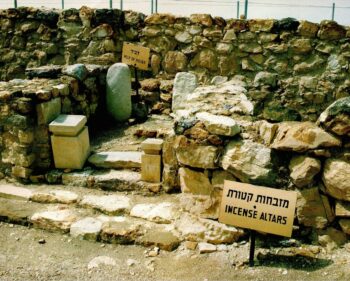
The ‘Holy of Holies’ at the temple site of tel Arad. This area was about the size of a broom closet, the larger altar is about 2-3 ft high, and the smaller less than 2 ft. The larger altar had been used for frankincense and the smaller for cannabis resins. This small space would have been enclosed to retain the smoke, as with the modern method known as ‘hotboxing’.
Kaneh in Context
When all 5 of the references are taken into account, Exodus 30:23, Song of Songs 4:14, Isaiah 43:23-24, Jeremiah 6:20, Ezekiel 27:19, the connection to tel Arad becomes very succinct, and the comparisons of use with the Assyrian references to qunnabu indicate identical use, in the same time period, as well as fitting with the known historical events happening in Israel.
Exodus 30:23
Then the Lord said to Moses, 23 “Take the following fine spices: 500 shekels of liquid myrrh, half as much (that is, 250 shekels) of fragrant [bosem] cinnamon, 250 shekels of fragrant [bosem] kaneh (Exodus 30:23)
As we have seen, similar use of cannabis in topical salves can be found in Assyrian and Akkadian references to qunnabu. The following passage regarding the topical application of cannabis is very interesting when compared alongside the suggested use of the cannabis infused “Holy Oil” for similar purposes amongst the ancient Hebrews. “An Assyrian medical tablet from the Louvre collection (AO 7760 )(Labat, 1950) (3,10,16) was transliterated as follows…, ‘ana min sam mastabbariru sam a-zal-la sam tar- mus.’ Translating the French [EBR], we obtain, ‘So that god of man and man should be in good rapport:—with hellebore, cannabis and lupine you will rub him.’ (Russo 2005). However this last reference relies on another Assyrian term for its identification of cannabis, azallu, and this identification does not hold the more general acceptance that qunubu as cannabis does amongst Asyriologists (Reiner, 1995). Although this term as well has its supporters, with some suggesting that azallu represents the earlier name for cannabis, which only later came to be popularly known as qunnubu, in the 8th century BCE. However, we have also see qunnabu salves as an offering to the Goddess Ishara, as noted above, in a similar ritual context.
Only those who had been “dedicated by the anointing oil of… God” (Leviticus 21:12) were permitted to act as priests. In the “holy” state produced by the anointing oil the priests were forbidden to leave the sanctuary precincts (Leviticus 21:12). The holy oil was a carefully guarded secret that was limited to use in the Hebrews sacred rites.
Records from the time of king Esarhaddon (reigned 681 – 669 BC) give clear evidence of the importance of this substances in ancient Mesopotamia, as cannabis, ‘qunubu’ is listed as one of the main ingredients of the paramount ‘Sacred Rites’. It should also be noted, that in relation to the Assyrian Sacred Rites, Frederick Mario Fales, who was a Professor of Ancient Near Eastern History at the University of Udine, has stated that the ingredients required included specifically “quality salves (and particularly) salve of myrrh and salve of cannabis [qunubu]” (Fales, 1983).
As the recipe in Exodus 30:23 call for 250 shekels of kaneh bosem, and one shekel equals approximately 9.8 grams, this would mean that the THC of 2.450 kilograms, or close to 5 and half pounds of flowering cannabis tops, (or even cannabis oil, or hashish, as indicated by tel Arad’s altars) were extracted into a hin, about 6.5 liters of oil (1.6 gallons). The entheogenic effects of such a solution, even when applied topically, would undoubtedly have been intense. Health Canada has done scientific tests that show transdermal absorption of THC can take place. The skin is the biggest organ of the body, so of course considerably more cannabis is needed to be effective this way, much more than when ingested or smoked. The people who used the Holy Oil literally drenched themselves in it. Based upon a 25mg/g oil Health Canada found skin penetration of THC (33%). “The high concentration of THC outside the skin encourages penetration, which is a function of the difference between outside and inside (where the concentration is essentially zero)” ( James Geiwitz, Ph.D, 2001). I talked to Dr. Geiwitz personally and he told me that he felt this offered strong evidence for the potential psychoactive effects.
More recently, Dr. Gary Wenk, a Professor of Psychology & Neuroscience & Molecular Virology, Immunology and Medical Genetics at the Ohio State University and Medical Center, has noted: “The act of anointing for religious purposes is incredibly ancient…. Extracts of the cannabis plant were often included in these ancient anointing oils…. The plant is mentioned… as ‘kaneh-bosm,’ in the Hebrew Bible, for example per Yahweh’s instruction to Moses in Exodus 30:23…. [A]nointing oils containing cannabis extracts would have had psychoactive and healing actions” (Wenk, 2022).
In conversations with Dr. Ethan Russo, he expressed the addition of cassia and cinnamon in the Holy oil, would increase blood flow to the skin, increasing the effects of absorption. Recently Dr. Micah Ben David Naziri Suggested that “Cinnamon (Qinamon Bosem) Biblically Paired As A Psychoactive Amplifier for Qaneh {Kaneh] Bosem”
The Torah’s recipe does not isolate Qaneh Bosem. It pairs it with cinnamon (Qinamon, קִנָּמוֹן), in equal measure. Modern phytochemistry clarifies the logic: both plants are rich in β-caryophyllene, a terpene that binds selectively to the CB2 cannabinoid receptor and can modulate inflammatory and analgesic pathways.¹⁵ Ethnobotanical research likewise records cinnamon as an “amplifier” in compound preparations.¹⁶
On this reading, the oil was never a mere perfume. It was targeted ritual pharmacology—cannabis as the primary psychoactive, cinnamon as its potentiator—delivered transdermally through oil saturating skin, beard, and vestments. (Naziri, 2025)
As Sula Benet explained:
“The sacred character of hemp in biblical times is evident from Exodus 30:22-23, where Moses was instructed by God to anoint the meeting tent and all its furnishings with specially prepared oil, containing hemp. Anointing set sacred things apart from secular. The anointment of sacred objects was an ancient tradition in Israel: holy oil was not to be used for secular purposes…. Above all, the anointing oil was used for the installation rites of all Hebrew kings and priests” (Benet 1975).
Notably, Moses not only anoints himself, and all the utensils used in the rite, but also the altar of Incense. This takes place in the ‘Tent of the Meeting” which like the temple site at tel Arad, was a small enclosed space. Moses talks to the Lord in the pillar of smoke over the incense altar. Smoke is described as pouring forth out of the tent.
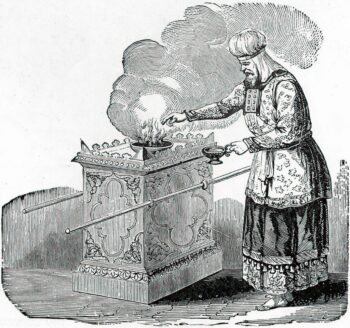
Illustrator from Henry Davenport Northrop’s ‘Treasures of the Bible’, 1894 –
The story of the anointing of Israel’s first king, does give some clear indications of the oil’s potential psychoactive properties. At the time of the prophet Samuel, the use of the Hebrew anointing oil was extended from exclusively the High Priests, to include Kings as well. Although cannabis is not mentioned directly by name in Samuel, the description of events that take place after Samuel anoints Israel’s first king, Saul, make clear the psychoactive nature of the ointment used.
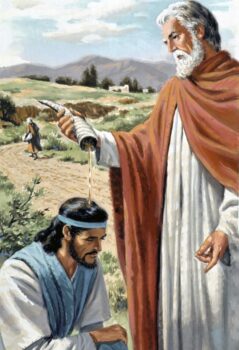
Samuel anoints Saul
Samuel “took a flask of oil and poured it on Saul’s head” (1 Samuel 10:1). After the anointing Samuel tells Saul: “The Spirit of the Lord will come upon you in power … and you will be changed into a different person”(1 Samuel 10:6), a statement indicating that the magical (psychoactive) power of the ointment will shortly take effect. Samuel tells Saul that when this happens, he will come across a band of prophets (Nebiim) Coming down from a mountaintop, “with harp, tambourine, flute, and lyre before them prophesying” (1 Samuel 10:5), and that Saul will join them. After Saul’s anointing As Samuel foretold, the spirit of Yahweh came mightily upon the new king and he ‘prophesied among them.’ The Hebrew verb translated as “to prophecy”, nebiim did not mean to foretell the future but rather to behave ecstatically, to babble incoherently under the influence of the Spirit. This ecstatic behaviour is apparent when Saul strips off his clothing and lays naked all day and night, causing the people to ask, ‘Is Saul among the prophets?’ (1 Samuel 19:24). Sounds like a classic ‘bad trip’.
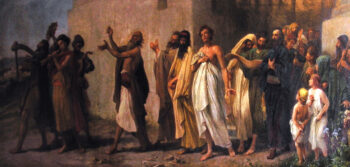
Saul among the ecstatic prophets after his anointing.
I would say the biggest way that this Exodus reference to kaneh bosem fits with tel Arad, is that both indicate a resin product, rather than whole flowers. In this sense, it also fits with the references to the Akkadian qunnabu, itself translated as ‘oil of cannabis’ or ‘hashish’, and as we have seen, the ritual use of qunnabu used topically and as an incense was an important aspect of sacred rites in the ancient Near East.
Song of Songs 4:14
The Song of Songs, arguably the most beautiful piece of prose in the whole Bible begins with a reference to such Fragrant oils described in Exodus and also offered to the Goddess Ishara, gives us our second reference to kaneh, and as we will see, a number of scholars have seen indications of Goddess worship in the Songs…
“The Song of Songs, which is Solomon’s. Let him kiss me with the kisses of his mouth! For your love is better than wine; your anointing oils are fragrant; your name is oil poured out; therefore virgins love you. Draw me after you; let us run. The king has brought me into his chambers” (Songs 1:1-4).
It is in the 4th verse we find our reference to kaneh:
“How delightful is your love, my sister, my bride! Your love is much better than wine, and the fragrance of your ointments than all spices. “Your lips, my bride, drip sweetness like the honeycomb; honey and milk are under your tongue, and the fragrance of your garments is like the aroma of Lebanon. My sister, my bride, you are a garden locked up, a spring enclosed, a fountain sealed. Your branches are an orchard of pomegranates with the choicest of fruits, with henna and nard, with nard and saffron, with kaneh and cinnamon, with every kind of frankincense tree, with myrrh and aloes, with all the finest spices.… (Songs 4:10-14)
The Song of Songs is often portrayed as the pious song of the love of a people for their god, when in actuality it more likely testifies to the practice of erotic fertility rites amongst the Hebrews. A number of scholars believe that the Songs were composed from a mosaic of cultic liturgies and hymns from the ancient Levant which were artificially synthesized into a single narrative and placed with the authorship of Solomon. The text itself is called a “ritual song” (Zarir) at 2:12, and this same word is used to describe the fertility rite liturgies of Tammuz and Ishtar. Fertility cults of the Near East, including ancient Palestine, involved the ritual courtship and consummation of a goddess with a god to ensure fertility.
As the late Professor of Northwest Semitic Languages at Yale University, Marvin Pope explained in his excellent review of the Biblical Sacred Marriage hymn,Song of Songs: A New Translation with Introduction and Commentary (1995) :
“The view that the Song of Songs derives from pagan fertility worship was developed in the present century and, in spite of resistance, has continued to gain ground with the accelerating recovery and progress in interpretation of documents of religious literature of the civilizations of the Near East, especially Mesopotamia, and more recently the Ugaritic mythological and religious texts. Already in 1906, Wilhelm Erbt … suggested that the Song of Songs is a collection of paschal poems of Canaanitish origin, describing the love of the sun-god Tammuz, called Dod or Shelem, and the moon-goddess Ishtar under the name Shalmith…. The cultic interpretation of the Song of Songs received new impetus from a catalog of Akkadian hymn titles edited near the end of the First World War by E. Ebeling (1923)” (Pope 1977).
Interestingly, Pope made reference to the Songs (4:14) kaneh reference when comparing an ancient hymn to Ishtar, to the Songs, which made reference to mellowing Ishtar’s mood with sacred incense “ease her mind with (incense of ) ‘sweet reeds’.” Pope compares these “sweet reeds” to references to the Bible: “The ‘sweet reed’ … with which the goddess’ inwards are soothed, is presumably the same ‘aromatic cane’ of Exodus 30:23 and the ‘sweet cane’ of Jer 6:20; Isa 43:24; Ezek 27:19 and simply ‘cane’ in Canticles 4:14” (Pope 1977). These are the exact passages we are discussing for their potential references to cannabis. Interestingly, the late Assyriologist Erica Reiner referred to the ‘aromatic of the Goddess Ishtar,’ “which is equated with the Akkadian qunnabu, ‘cannabis’… and also calls to mind the plant called ki.na Ishtar” (Reiner, 1995). The term ki.na here giving us another close approximation to kaneh.
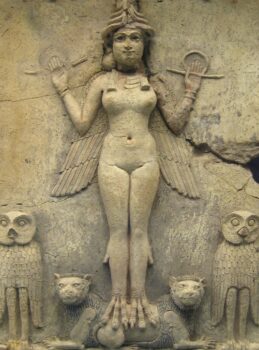
Ishtar
Ishtar, had a regional counterpart worshiped by the Israelites, and ancient inscriptions have shown she was often paired with the god of the Bible, Yahweh, and her name was Asherah, now considered The Hebrew Goddess. Although this is still radical news for the typical Christian public, this historical fact is well known and widely accepted by Biblical scholars. Check out Dan McClellan’s presentation ‘On God’s Wife, Asherah’ for a good overview of the historical information regarding this.
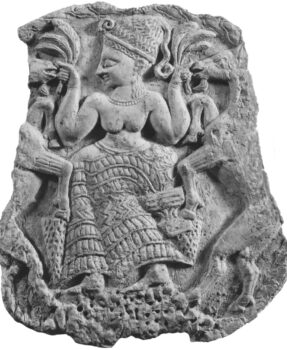
Asherah
According to the Bible, Solomon worshiped Asherah under one of her other regional names. “For it came to pass, when Solomon was old, that his wives turned away his heart after other gods: and his heart was not perfect with the Lord his God, as was the heart of David his father. For Solomon went after Ashtoreth the goddess of the Zidonians…” (1 Kings 11:4-5). “Ashtoreth, Asherah, Astarte, and Ishtar are all manifestations of the same goddess who was worshiped in different regions, where people were divided by language and geography. Ashtoreth (a Hebrew name) was the supreme female deity of the Phoenicians, associated with Baal, the supreme god” (Brooklyn Museum). In reference to Solomon’s worship of the Goddess, Dr. Harry Thomas Frank noted in An Archaeological Companion to the Bible that “Asherah” who is “seemingly interchangeable with Ashtaroth in the Hebrew Scriptures, is by far the most widely known fertility goddess in the Old Testament” (Frank, 1972).
As Dvora Lederman Daniely, a lecturer and researcher at the David Yellin College of Education in Jerusalem, noted recently in the recent article “Who’s Afraid of the Goddess of Ancient Israel?”
Many studies on Asherah in the Bible have concluded that Asherah was a popular and beloved Mother-Goddess in the religion of Israel. Asherah was regarded as…the “Queen of Heaven”..; who bestows abundance and protection to the people. The human queens were in charge of Asherah’s worship and hosted her priests. The worship of Asherah, as the Book of Kings itself disapprovingly attests, was conducted within the Holy Temple itself alongside the worship of Yahweh… (2 Kings 21).”
Although biblical authors cast worship of this divine spouse as idolatry… this characterization was contrary to the prevalent cultic religion in the early days of Israel. This portrayal was intended to preserve the appearance of monotheism. It suited the spirit of religious reform that prevailed in… the seventh century… that abolished all divinities other than Yahweh. This monotheistic outlook took a central place in the edited version of the Bible. Essentially, biblical editors presented a new, more stringent cult, in which monotheism was present from the beginning of time, when in fact it was not. (Daniely, 2022)
In light of this it is not so surprising to find that recent scholarship has suggested Solomon’s Song of Songs, considered by many to be the most beautiful piece of poetry in the whole Hebrew Bible, was originally derived from Semitic hymns in honour of the sacred marriage ritual between a God and Goddess. The Sacred Marriage, also known as the Hieros Gamos, had already existed for millennia before the time of Solomon, under numerous variations throughout the ancient world. It is generally believed, Kings and queens, pharaonic couples, or priest and priestess, etc. would join in sexual union once a year in order to ensure general fertility and the well-being of the land and its people.
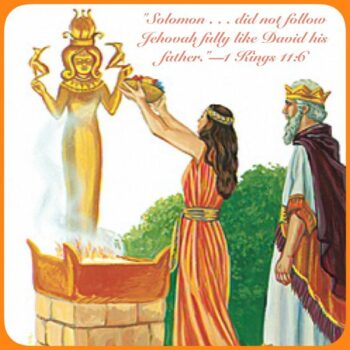
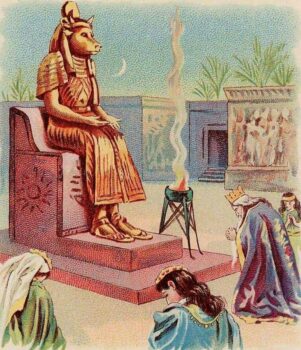
Solomon burning incense to the Goddess
Solomon, also ‘burned incense’ to the Goddess “Solomon loved the LORD and followed all the decrees of his father, David, except that Solomon, too, offered sacrifices and burned incense at the local places of worship” (1 Kings 3:3). Throughout the Bible the condemnation against ‘burning incense” at the “high places” is repeatedly condemned, as was the worship of Asherah and display of her ritual objects. This led to a number of reforms, notably under King Hezekiah and Josiah, who “did away with the idolatrous priests appointed by the kings of Judah to burn incense on the high places of the towns of Judah and on those around Jerusalem… He took the Asherah from the temple of the Lord to the Kidron Valley outside Jerusalem and burned it there. He ground it to powder and scattered the dust over the graves of the common people. He also tore down the quarters of the male shrine prostitutes that were in the temple of the Lord, the quarters where women did weaving for Asherah” (2 Kings 23:5-7)
This all brings up some interesting points in regards to the hilltop site of tel Arad, it’s temple, considered a smaller version of the Holy of Holies at the Main temple in Jerusalem, built by Solomon, and it’s two alters, one for burning frankincense and the other for cannabis resins or hashish. As the authors of the paper on the Arad altars have noted: “The excavator of Arad assumed that the two altars (and the entire shrine) were deliberately buried for ritual reasons… The motivation for this cultic interment is debated.”
One reason suggested for this suppression may be that tel Arad holds evidence of polytheistic cultic activities and that besides the two altars at the site, there are indications that originally there were two standing stones. This reconstruction brought about the conclusion that two deities were worshiped at the shrine, and this has suggested to some researchers a divine couple. Ziony Zevit, an American scholar of biblical literature and Northwest Semitic languages and a professor at the American Jewish University, explained in The Religions of Ancient Israel: A Synthesis of Parallactic Approaches: “Evidence for the worship of more than one deity, usually in the form of redundant or paired appurtenances such as altars, stands, and steles, is indicated at the temple of Arad XI (ninth century) … My own interpretational preference for the phenomenon of ‘twoness’… is to consider it a reflection of the worship of YHWH and Asherah, lord and lady of the Israelite pantheon” (Zevit, 2001). This is a widely held view, as we can see in the World Video Bible School’s presentation on tel Arad, “A Temple to Yahweh and His Wife?“
Numerous female clay’ pillar figures’, believed by many historians to represent the Goddess Asherah, have been found throughout ancient Israel, attesting to the popularity of the Goddess with the ancient Hebrews. A number of such pillar figurines were found at the Arad Temple site. The disappearance of these figurines from the culture coincides with the cancelation and burial of the two altars at Arad, and many scholars see a solid connection here and more evidence of the suppression of a Goddess, once recognized as the wife of Yahweh, the God of the Bible.
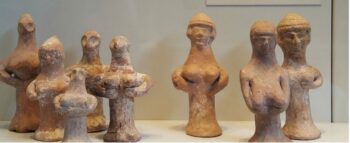
Asherah ‘pillar’ figurines
It is worth noting that even before the discovery of cannabis resins at tel Arad, there has been the suggestion that cannabis was burned and used as a holy oil as offerings to Asherah. The poet, novelist, and historical author Robert Graves, was the first to suggest this in an article he wrote for the 1970 edition of The Atlantic:
“Taking cannabis is indeed an ancient enough practice; cannabeizein, ‘to smoke pot,’ appears in the ordinary Classical Greek dictionary. Presumably its fumes were absorbed through the pores of the skin when the cannabis itself was smoked over a low fire – the pot taker crouching over it clad only in a poncho. This at least seems to have been how the Ashera priestesses of the pre-Reformation Temple at Jerusalem impregnated their skins with the holy incense, which was mixed with other perfumes” (Graves, 1970).
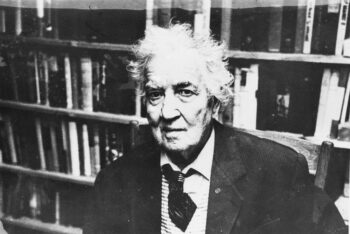
Robert Graves (1895-1985)
Unfortunately, Graves gave no indication for the origins of this claim and I cannot find anything regarding this, beyond his statement. However, what is interesting is that Graves had a very close relationship with Rapahel Patai, Hungarian-Jewish ethnographer, historian, Orientalist and anthropologist as well as the author of The Hebrew Goddess (1967). In fact in the early 1960s the two wrote a book together, The Hebrew Myths (1964). I can find nothing indicating Patai ever wrote about such a connection, but interestingly enough, he does seem to be acquainted with the anthropologist and etymologist we have been discussing, Sula Benet, and her with him, as she references Patai in regards to anointing rituals.
More recently, Father Angelo Bellon op of Amici Domenicani, suggested that the use of cannabis in the tel Arad temple, was likely connected to Asherah:
“…we know that even after the Jewish occupation some signs of Canaanite divinities remained here and there, in particular of Asherah, who together with Anat and Astarte, were the Canaanite ideas of fertility. The Old Testament mentions superstitious practices, referring to the aforementioned Canaanite goddess, practices that were opposed by the civil and religious authorities. It can be understood how the priests of pagan gods, who according to St. Paul are demons (1 Cor 10:20), needed certain practices to stimulate concentration in order to get in touch with occult forces…. But this mentality and similar rituals are despised by Holy Scripture” (Bellon, 2021)
Importantly, the incense chamber at the tel Arad temple was based on the same design of the Holy of Holies in the temple built by Solomon. Asherah was worshiped in both, and this practice was later abolished with the rise of monotheistic worship, as was the burning of incense on the high places. The reforms of Josiah specifically removed the women making ritual weavings for Asherah, from the temple in Jerusalem, and we have archaeological evidence for the use of hemp in her cult for ritual weaving. These reforms coincide with the date of tel Arad’s cancellation.
Also in league with this is the recorded use of qunnabu in ancient inscriptions in a number of related Near Eastern Goddess cults. We have already noted the use of cannabis in salves and aromatics dedicated to Ishara and Ishtar. Ishtar may have also received a cannabis infused drink offering under the epithet Beltu, as noted in Dictionary of Deities and Demons in the Bible (1999). Inanna also seems to have had strong ties with the ritual use of cannabis. Inanna had a famous cultic temple in Eanna, and as noted “later Neo-Babylonian text records the delivery of large quantities of qunnabu [cannabis]to the great temple of Eanna” (Stein, 2009).
It is also worth noting that a later book, The Testament of Solomon, thought to date from sometime between the first and third century AD, has King Solomon, who is wise in the ways of magic, force a demon to spin hemp! “So I commanded her to spin the hemp for the ropes used in the building of the house of God; and accordingly, when I had sealed and bound her, she was so overcome and brought to naught as to stand night and day spinning the hemp”. Archaeological evidence from that time period, does document the use of hemp rope in the Levant.
A much later magical text attributed to Solomon, refers to a cannabis ointment to see spirits in a magic mirror. Sepher Raziel: Liber Salomonis was written in the Solomonic tradition, which also brought us the still popular The Key of Solomon, and both texts, which come from the same period, have been attributed to the ancient Hebrew King, in an attempt to give them more authority:
“The third herbe is Canabus [cannabis]& it is long in shafte & clothes be made of it. The vertue of the Juse [juice]of it is to anoynt thee with it & with the juse of arthemesy & ordyne thee before a mirrour of stele [steel]& clepe thou spiritts & thou shallt see them & thou shalt haue might of binding & of loosing deuills [devils]& other things.” (Sepher Raziel, 1564).
Check out my article Cannabis in Jewish Magic and Alchemy for more on this.
Isaiah 43:23-24
“I have not burdened you with offerings, or wearied you with frankincense. You have not bought me sweet kaneh with money, or satisfied me with the fat of your sacrifices. But you have burdened me with your sins; you have wearied me with your iniquities.” (Isaiah 43:23-24)
As Benet noted, “In Isaiah… ‘kaneh‘ is translated as ‘sweet cane’ although the word ‘sweet’ appears nowhere in the original. Here we can see that at this point in the kingdom period, kaneh is a desired sacrifice of Yahweh’s. In my book Cannabis: Lost Sacrament on the Ancient World (2023) I argue that the reference to ‘sins’ and ‘iniquities’ In Isaiah 43 ties it to another verse in isaiah, where a smoke filled encounter sees Yahweh’s desire for fragrant incense appeased and the burden of sins and iniquities were removed.
“…the temple was filled with smoke…. Then one of the seraphim flew to me, and in his hand was a glowing coal that he had taken with tongs from the altar. And with it he touched my mouth and said: “Now that this has touched your lips, your iniquity is removed and your sin is atoned for.” (Isaiah 6:4-7)
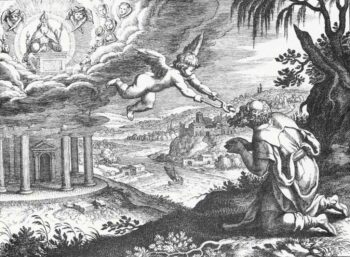
Isaiah taking a hit from a coal off the altar
PD0, by Matthaeus Merian I, 1630
These two accounts in Isaiah, 43:23-24 and 6:4-7, are clearly connected. In Isaiah 43:24 God complains that he was not brought any cannabis (kaneh) “but thou hast made me to serve with thy sins, thou hast wearied me with thine iniquities”. However, after Isaiah’s lips touch the tongs and a coal of incense from the altar In Isaiah 6, these are both cleansed: “this hath touched thy lips; and thine iniquity is taken away, and thy sin purged” (Isaiah 6:7). A redemptive act, comparable to the consumption of the later Eucharist, in the way it relieves one of the burdens of sin and iniquity, and also which clearly connects the two verses. In one verse are lifted through the use of incense, in the other God complains of being burdened by Sins and Iniquities without an offering of kaneh. This connection follows through into the original Hebrew as well. Isaiah 6:7 and 43:24 “sin” חַטָּ֑את chatta’ah Strong #2403 ; Isaiah 6:7 “Iniquity” עֲוֺנֶ֔ךָ ‘ă·wō·ne·ḵā , Isaiah 43:24 plural “iniquities” בַּעֲוֺנֹתֶֽיךָ׃ ba·‘ă·wō·nō·ṯe·ḵā Strong #5771 in both cases.
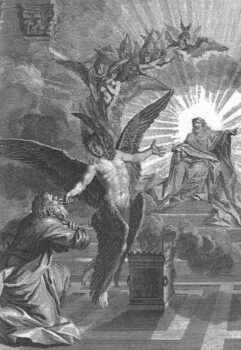
Isaiah takes a super-hit of incense from the altar
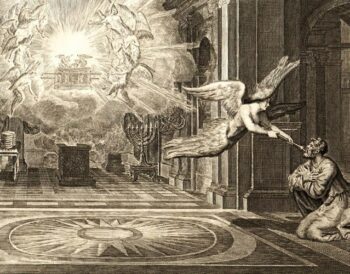
“The House was filled with smoke”
We see both kaneh (cannabis) and frankincense together in Isaiah, both of which were recovered from the altars at tel Arad and there is a clear connection here. Both kaneh and frankincense will be found together again in the Jeremiah 6:20 reference, and as noted this was the case with the Song of Songs 4:14.
It should be noted that in Isaiah, Asherah and Incense altars are both condemned: “They will not look to the altars, the work of their hands, and they will have no regard for the Asherah poles[a]and the incense altars their fingers have made.” (Isaiah 17:8)
However, a number of scholars see this reference to Asherah in this Isaiah passage as the result of Deuteronomistic influence, this being a group of later Biblical editors, who adjusted existing Biblical texts to fit with their monotheistic view. This also seems to be wound up with both the cancellation of tel Arad, and the rejection of kaneh, which we will look at in the next verse.
Jeremiah 6:20
“What do I care about frankincense from Sheba or sweet smelling kaneh from a distant land? Your burnt offerings are not acceptable; your sacrifices do not please me.” (Jeremiah 6:20)
The Hebrew here translated as “sweet”, טוֹב, Transliteration ṭôḇ, has been variously translated with kaneh, as ‘sweet calamus’, ‘fragrant calamus’, ‘sweet cane’, ‘cane of sweet spices’, ‘cinnamon’ (Hebrew kinnamon, is used elsewhere for cinnamon, as in Exodus 30;23 where it appears alongside kaneh), ‘spices’, ‘Sugar cane’, ‘sweet-smelling cane’,’cane of sweet incense’ and other variations as well. Strong’s describes ṭôḇ, as “good (361x), better (72x), well (20x), goodness (16x), goodly (9x), best (8x), merry (7x), fair (7x), prosperity (6x), precious (4x), fine (3x), wealth (3x), beautiful (2x), fairer (2x), favour (2x), glad (2x), miscellaneous (35x)”. In this context, alongside frankincense, a pleasant aroma seems to be the most likely interpretation.
Notably here, here, kaneh appears directly with frankincense, as with tel Arad, and Isaiah. As well, as with the reference in Ezekial, kaneh, it appears as an imported item, and this is the suggestion for the cannabis at tel Arad as well. “no cannabis seeds or pollen remains are known from archaeological contexts in the Ancient Near East, as opposed to northeast China or southeast Russia, where all parts of the cannabis plant and seed were found at different archaeological sites and contexts and were dated as early as 2000 BCE (Jiang et al. 2016; Russo et al. 2008; Russo 2014). Therefore, we suggest that cannabis female inflorescences may have been imported from distant origins and were transported as dried resin (commonly known as hashish)” (Arie, et. al., 2020).
The reference to Sheba, brings up the Queen of Sheba, famous in the Solomon tale. As we noted earlier, cannabis bred for its resinous purposes, traveled with the Scythians, from Indo-European settlements in China, into BMAC and from there on the Spice Road caravans, caring its Scythian root name kan, or kanna, along with it as a wanderwort.
Also notably here, unlike the other references to kaneh, the herb is sourly rejected in Jeremiah. This time frame fits with the suggested cancelation of tel Arad as well, under the reigns of either King Hezekiah or his grandson King Josiah, both of whom were monotheistic reformers, who wanted to purge ‘foreign’ elements of Jewish worship from the temple sites, and centralize worship to Yahweh alone, and solely at the Main Temple in Jerusalem. Both were also particularly focussed in stamping out all elements of Asherah worship.
As we have noted, the temple in Arad was built according to the plan of the Tabernacle described in the Bible and consisted of three parts: the inner courtyard, the temple and the Holy of Holies. As wel, an Inscription was found at the site which read ‘The House of Yahweh’. This was all before the centralization of worship to the Jerusalem temple that took place in Josiah’s reign, so the site is seen as reflective of the ritual practices that took place in the Main Temple in Jerusalem prior to the reforms.
All of this gives us some insights into Yahweh’s rejection of kaneh though Jeremiah, and the cancelation of tel Arad. In Cannabis: Lost sacrament of the Ancient world, I suggest that Hezekiah, tired of being a vassal to the Assyrians, and wanting to centralize worship for political gain, set about on a series of purges, to rid the kingdom of competing deities, like Baal and Asherah, who were worshiped alongside Yahweh, as well as foreign influences.
2 Kings 18:4 records how Hezekiah, “destroyed the high places. He broke the memorial stones and cut down the Asherah poles. He broke into pieces the bronze snake that Moses made, for until then the Israelites were burning incense to it. It was called Nehushtan.”
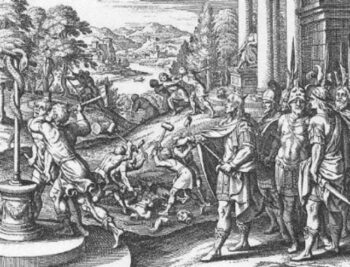
Hezekiah’s blood thirsty reforms
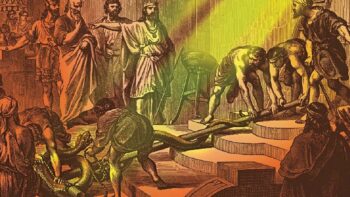
Hezekiah destroys the Brazen Serpent Moses made, as the people had been burning incense to it.
So we can see here the sort of reforms tied to tel Arad’s cancellation. With its two altars, and likelihood of originally two standing stones, along with other evidence of the combined worship of Yahweh and Asherah, and this would account for the site’s destruction and burial. Also worth noting here “the goddess [Asherah] is called ‘lady of the serpent’ in second-millennium B.C.E. inscriptions from the Sinai; the late-thirteenth-century B.C.E. Lachish ewer dedicated to Asherah is decorated with images of sacred trees” (Ackerman, 2021).
These items were removed from the Main temple in Jerusalem, and one might be reminded of certain elements of the Garden of Eden at play here, so it’s worth noting other motifs, such as the two cherubim over the altar, and the sacred trees, also appear in the Eden Myth. This has caused some speculation that the Eden myth, composed late in the Old Testament time period, and placed at the beginning by later editors, was concocted as a sort of propaganda against the earlier combined cult of Yahweh and Asherah. This is a theme that is explored in Cannabis:Lost Sacrament of the Ancient World.
Hezekiah’s reforms here did not last long, and his son and successor Manasseh, saw the return of Asherah worship, as well as an embracement of the Assyrian rule. Manasseh is particularly mentioned in Assyrian records as a contemporary and loyal vassal of Sennacherib’s son and successor, Esarhaddon. Earlier we discussed the Assyrian king Esarhaddon, for references to the use of qunnabu, cannabis, in Assyrian ‘sacred rites’. We also find a references to qunnabu in the Library of his son Ashurbanipal. Ashurbanipal appears in the Bible, as does his Father Esarhaddon.
Dr. Raphael Mechoulam, who discovered THC, has suggested that it was likely in this time period a ban on cannabis was instilled:
“ [The]Assyrians were one of the major military powers in the area for hundreds of years and their influence was powerful… [t]he Assyrians employed cannabis, apparently quite extensively. The contacts between the Jews and the Assyrians were prolonged and wide. During certain historical periods the trade of Judea depended on Assyria; the cultural-religious impact of the Nineveh court and temples penetrated not only the royal and priestly class in Jerusalem but also the lower classes. Gradually in the 7th century B.C. even the Assyrian cult of heavenly constellations was adopted; the ancient forms of augury were revived; in the Temple itself an image of the Assyrian”queen of heaven” was erected; within the Temple young women offered their bodies in honor of the deity. During the reigns of the Assyrian kings Esarhaddon (681-669 B.C.) and Ashurbanipal (669-626 B.C.), the Jewish King Manasseh, who was their vassal, fought beside them in their wars with Egypt and probably also in Transjordan in order to secure the commercial roads for drugs and spices. The influence of the kings of Nineveh (“the bloody city, full of lies and robbery”) in Judea was immense. It can be assumed that under these conditions Assyrian medicine and drugs were known and used, at least among the ruling class.”
“After the death of Ashurbanipal the decadent and hedonistic kingdom of Assyria swiftly disappeared from history. The Jew- ish King Josiah (628 B.Cn.) is known to have taken advantage of the Assyrian decay to remove vigorously all pagan influence from Jewish life and religious customs. Hashish, presumably a symbol of Assyrian moralaxity, would have been banned. This is, of course, an assumption but it fits the historical background, the insular character of the Jews at the time, and the needs of the independent Judaean state” (Mechoulam, 1986).
Mechoulam here writing at a time when the view that Asherah was paired with Yahweh was less known and accepted. Ishtar, the “Queen of Heaven” in Assyria, was the semitic Asherah’s regional counterpart. But otherwise Mechoulam was spot on in relation to what we know about the temple of tel Arad.
Josiah, the great grandson of Hezekiah, made his own attempt at purges and reforms aimed at a political and spiritual consolidation of the Kingdom, all of which took place during Jeremiah’s reign, and fitting with the rejection of kaneh and frankincense in Jeremiah 6:20.
As the story goes, during Josiah’s reign, renovations were taking place at the temple built by Solomon, a king who worshiped the Goddess and burnt incense to her, a book was ‘discovered’ that was written by Moses, whose ‘brazen serpent’ was destroyed in Hezekiah’s reforms because the people were ‘burning incense’ to it. This tome is referred to as the Second Book of the Law, and is believed to be contained in large parts of Deuteronomy. It’s alleged ‘discovery’ is described in 2 Kings 22.
By the style of writing in Deuteronomy, Biblical scholars have placed the text at a much later date of composition than that of Moses. In Understanding the Old Testament, Bernhard Anderson explains: “This new literary style, found in the Deuteronomic literature and the prose sections of Jeremiah, seems to have been characteristic of the late seventh and early sixth centuries B.C.”(Anderson 1975). The very time of the alleged “discovery.” Anderson suggests that the Book of the Law was written by an anonymous author in the seventh century who put his own words in the mouth of Moses; although he also felt that the work was “not a complete literary fiction …. [and]is essentially a revival of Mosaic teachings as it was understood in the seventh century B.C.” (Anderson 1975).
Other scholars have been far more hard-hitting in their comments upon this so-called ‘discovery’ suggesting that it was a forgery created by a Jerusalem lawyer and produced by a priest of the temple, an act committed by the ‘Yahweh alone’ Hebrew priesthood in hope of eradicating the competing cults and their deities, which were competing for sacrifices from the people with the Temple of Yahweh.
As the authors of the exhaustive The Columbia History of the World explained of this event:
“Sometime about 630, when Assyria was losing her grip, a lawyer in Jerusalem produced a new code as a program for future reforms, including the prohibition of the worship of gods other than Yahweh, and relief of the poor. He drew on older ‘Yahweh alone’ traditions, common usage, and ancient taboos, but his work was organized by his own thought, replete with his own invention, and cast with his own style. He represented it as ‘the law of Yahweh’ and – probably – as the work of Moses, and he arranged to have it ‘found’ by the high priest in the Jerusalem temple in 621. It was taken to king Josiah…. Most of it is now preserved, with minor interpolations, in chapters 12-26 and 28 of Deuteronomy.” (Garraty & Gay, 1981).
For a better understanding of all this see Dan McClellan’s video Why Do Scholars Date Deuteronomy to the Reign of Josiah?
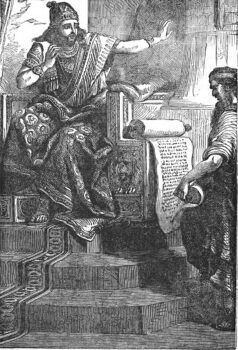
Josiah is brought the ‘Book of the Law’
Most notable of the many effects rendered by the book’s supposed “discovery” was Josiah’s murderous purge of the cults of the high places. The book of Deuteronomy is explicit in its instructions of how best to deal with all the religious worship going on in Judah, other than the centralized worship of Yahweh in the temple in Jerusalem:
“Destroy completely all the places on the high mountains and on the hills and under every spreading tree where the nations you are dispossessing worship their gods. Break down their altars, smash their sacred stones and burn their Asherah poles in the fire, cut down the idols of their gods and wipe out their names from those places” (Deuteronomy 12:2-3).
King Josiah took immediate action obeying completely the severe dictates of the law and went about the land removing the altars of the various gods and goddesses being worshiped by the Israelites. The text goes into some detail concerning the violence unleashed by the king, beginning with reforms in the Temple of Jerusalem itself, the home of much pagan worship and where ironically the “lost” book of the law was found. It is from the Biblical description of Josiah’s reform that we receive a clearer idea of what the actual religion of the Judaic peoples was like:
“And the king commanded Hilkiah high priest … to bring forth out of the Temple of the Lord all the vessels that were made for Baal and for Ashera, and for all the hosts of heaven. He burned them outside Jerusalem in the fields … and took the ashes to Beth-El. He did away with the pagan priests appointed by the kings of Judah to burn incense on the high places of the towns of Judah and on those around Jerusalem–those who burned incense to Baal, to the sun and the moon, to the constellations of the starry hosts. He took the Asherah pole from the temple of the Lord to the Kidron Valley outside Jerusalem and burned it there. He ground it to powder and scattered the dust over the graves of the common people. He also tore down the quarters of the male shrine-prostitutes which were in the temple of the Lord and where woman did weaving for Asherah.
Josiah brought all the priests from the towns of Judah and desecrated the high places, from Geba to Beersheba, where the priests had burned incense. He broke down the shrines at the … Gate of Joshua…
He pulled down the altars the kings of Judah had erected on the roof near the upper room of Ahaz, and the altars Manasseh had built in the two courts of the temple of the Lord…. The king also desecrated the high places that were east of Jerusalem on the south of the hill of Corruption – the ones Solomon the king of Israel had built for Ashtoreth the vile goddess of the Sidonians, for Chemosh the vile god of Moab, and for Molech the detest- able god of … Ammon. Josiah smashed the sacred stones and cut down the Ashera poles and covered the site with human bones.
Even at the altar of Beth-El, the high places made by Jeroboam … who caused Israel to sin – even that altar and high place he demolished. He burned the high place and ground it to powder, and burned the Asherah pole also. Then Josiah looked around when he saw the tombs that were on the hill side, he had the bones removed from them and burned on the altar to defile it…
Just as he had done in Beth-El, Josiah removed and defiled all the shrines at the high places that the kings of Israel had built in the towns of Samaria that had provoked the Lord to anger. Josiah slaughtered all the priests of those high places on the altars and burned human bones on them (2 Kings 23:4-20).
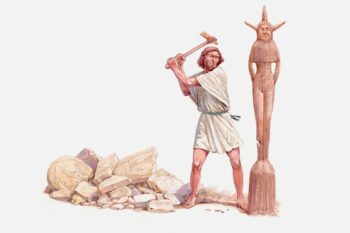
Destroying the images of Asherah
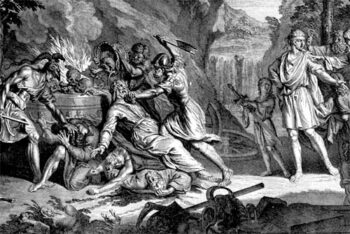
Josiah’s reforms
The worship of Asherah was popular with the people, but opposed by a faction of kings and prophets in Jerusalem who were devoted exclusively to Yahweh at the First temple in Jerusalem. Most people didn’t actually worship at the temple, it was reserved for elites and royals. The general population worshiped in small community shrines, or at a site like that at tel Arad. During periods when they held power, this Royal cabal sought to abolish the worship of other deities, particularly Asherah. From the Hebrew Bible narrative we see that for centuries the statue of Asherah was repeatedly removed and reinstalled in the temple of Solomon who himself burnt incense to the Goddess. Regardless of this violent opposition, the murder of her priests and priestesses, and the destruction of her cultic sites and icons, even in the Biblical account, Asherah’s image stood in the temple for 236 years, nearly two-thirds of the time that the temple stood in Jerusalem.
Despite these monotheistic reforms, Israel fell to Babylon, and many Israelites were displaced and ended up in foreign lands. It was at this point that the Prophet Jeremiah, who himself narrowly escaped persecution from both sides, as many from Jerusalem viewed him as a traitor, found himself in Egypt. There Jeremiah confronted fellow refugees from Jerusalem, and he directly blamed them for its fall through the Lord’s anger over “burning incense to the Queen of Heaven”.
Jeremiah 44: Disaster Because of Idolatry
This word came to Jeremiah concerning all the Jews living in …Egypt… This is what the Lord Almighty, the God of Israel, says: You saw the great disaster I brought on Jerusalem and on all the towns of Judah. Today they lie deserted and in ruins because of the evil they have done. They aroused my anger by burning incense to and worshiping other gods… Again and again I sent my servants the prophets, who said, ‘Do not do this detestable thing that I hate!’ But they did not listen or pay attention; they did not turn from their wickedness or stop burning incense to other gods. Therefore, my fierce anger was poured out; it raged against the towns of Judah and the streets of Jerusalem and made them the desolate ruins they are today.
“Now this is what the Lord God Almighty, the God of Israel, says: Why bring such great disaster on yourselves by cutting off from Judah the men and women, the children and infants, and so leave yourselves without a remnant? Why arouse my anger with what your hands have made, burning incense to other gods in Egypt, where you have come to live? You will destroy yourselves and make yourselves a curse and an object of reproach among all the nations on earth. Have you forgotten the wickedness committed by your ancestors and by the kings and queens of Judah and the wickedness committed by you and your wives in the land of Judah and the streets of Jerusalem? To this day they have not humbled themselves or shown reverence, nor have they followed my law and the decrees I set before you and your ancestors.
….Then all the men who knew that their wives were burning incense to other gods, along with all the women who were present—a large assembly—and all the people living in Lower and Upper Egypt, said to Jeremiah, “We will not listen to the message you have spoken to us in the name of the Lord! We will certainly do everything we said we would: We will burn incense to the Queen of Heaven and will pour out drink offerings to her just as we and our ancestors, our kings and our officials did in the towns of Judah and in the streets of Jerusalem. At that time we had plenty of food and were well off and suffered no harm. But ever since we stopped burning incense to the Queen of Heaven and pouring out drink offerings to her, we have had nothing and have been perishing by sword and famine.”
The women added, “When we burned incense to the Queen of Heaven and poured out drink offerings to her, did not our husbands know that we were making cakes impressed with her image and pouring out drink offerings to her?”
Then Jeremiah said to all the people, including the women, “Hear the word of the Lord, all you people of Judah in Egypt. This is what the Lord Almighty, the God of Israel, says: You and your wives have done what you said you would do when you promised, ‘We will certainly carry out the vows we made to burn incense and pour out drink offerings to the Queen of Heaven.’
“Go ahead then, do what you promised! Keep your vows! 26 But hear the word of the Lord, all you Jews living in Egypt: ‘I swear by my great name,’ says the Lord, ‘that no one from Judah living anywhere in Egypt will ever again invoke my name or swear, “As surely as the Sovereign Lord lives.” For I am watching over them for harm, not for good; the Jews in Egypt will perish by sword and famine until they are all destroyed. (Jeremiah 44)
So we can see here, the direct condemnation of the burning of Incense to Asherah, the ‘Queen of Heaven’. As references to pouring out cannabis beer offerings occur in honour to Asherah’s Assyrian counterpart Ishtar, this seems likely the case here as well.
Jeremiah telling everyone to stop burning incense
In a Sourcebook for Ancient Mesopotamian Medicine (2014) JoAnn Scurlock records a recipe that requires 3 shekels of qunnabu [cannabis]to be mixed with other aromatic plants “a total of 26 shekels of aromatics in a mortar. You wash raisins in date beer. You take (them) out and mix these aromatics into them. You pour white (beer) onto it and then it is sealed for three days. On the fourth (!) day, you open (it) and pour out a libation to Beltu (before use).” ‘Beltu’ is not really a name but an epithet (‘Lady’). “The goddess to have been designated most frequently by this epithet, both in Summerian… and Akkadian… is no doubt Ishtar” (Becking & van der Horst, 1999).
The mainstream Bible study site, Biblehub.com, states specifically in regards to Jeremiah and Idolatry:
Archaeological Corroboration Of Idolatry In Judah
• Tel Arad incense altars bearing residue of frankincense mixed with cannabis point to syncretistic worship.
• Kuntillet ‘Ajrud inscriptions (“Yahweh and His Asherah”) show the very blending Jeremiah denounces.
• Figurines of Asherah widely unearthed in Jerusalem layers dated to the late seventh century BC confirm “troops” of idol-participants.
So here we see a scenario for kaneh that fits completely with the cancellation of tel Arad and the rejection of these same elements in Jeremiah, where kaneh and frankincense are refused as an offering and the burning of incense to the Queen of Heaven is flatly condemned.
Ezekiel 27:19
“…and casks of wine from Uzal they exchanged for your wares; wrought iron, cassia, and kaneh were bartered for your merchandise.” (Ezeliel 27:19)
This verse is often translated with adjectives like ‘sweet’, ‘aromatic’, ‘fragrant’, before kaneh, which is translated as ‘cane’, ‘reeds’ and ‘calamus’. Even ‘sugar cane’ has been used.
Ezekiel 27 describes kaneh arriving in on trade caravans, as we know cannabis resins arrived at the trading outpost of tel Arad. As the authors of the initial report on the altars at tel Arad noted “since there are no known cannabis seeds or pollen remains in archaeological sites in the Ancient Near East, the cannabis was likely imported in hashish form” (Arie, et. al. 2000)
Ezekiel was living in Babylon, after the fall of Jerusalem, when he had his famous vision. A number of researchers have pointed to Ezekiel’s eating of a scroll, and the vision he received as some sort of entheogenic rite. The ingestion here occurs just before the prophet’s famous vision of a “wheel within a wheel”. Ezekiel 3 describes this shamanistic scenario perfectly, as well as describing the ingestion of the unknown entheogen to initiate the shamanistic flight. The ancient prophet tells us that the Lord told him:
Son of man, eat what is before you, eat this scroll; then go and speak to the house of Israel.” So I opened my mouth and he gave me the scroll to eat…. So I ate it, and it tasted as sweet as honey in my mouth…. Then the Spirit lifted me up, and I heard behind me a loud rumbling sound – May the glory of the Lord be praised in his dwelling-place! – the sound of the wings of the living creatures brushing against each other and the sound of the wheels beside them, a loud rumbling sound. The Spirit then lifted me up and took me away… (Ezekiel 3:4-14).
The account in Ezekiel is among those suggested by Dr. C. Creighton in 1903, as evidence of hashish use in the Hebrew Bible. Creighton believed that cannabis dipped in honey was a “secret vice” of the Hebrew Temple and Palace, and was evidence of a polluting foreign influence. Referring to Creighton’s research, Harvard Medical School Professor, Dr. Lester Grinspoon commented that the account in Ezekiel “does sound like a description of an intense cannabis intoxication – an almost psychedelic experience” (Grinspoon 1971).
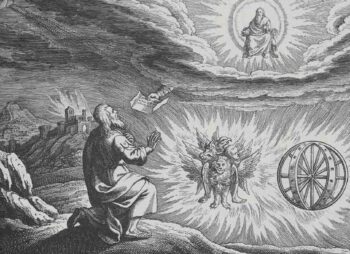
Ezekiel tripping balls after eating the scroll.
As with Jeremiah’s account that the Lord burned with anger over the burning of incense, Ezekiel’s vision is written to include similar condemnations. The Prophet is shuttled in spirit to Jerusalem to witness the idolatry that had been taking place there. Ezekiel is shown the “idol that provokes jealousy,” this has been generally viewed as an Asherah image placed near the altar. As well, Yahweh’s anger burns at seeing “men of the ancients of the house of Israel” worshiping other deities in the confines of the House of the Lord in Jerusalem “with every man his censer in his hand; and a thick cloud of incense went up” (Ezekiel 8:11). Ezekiel then condemns a pagan rite performed in the Temple, where the participants were “putting the branch to their nose” (Ezekiel 8:17). This is another possible reference to the inhaling of the smoke from burning the branches of cannabis.
Mishnic Kannabus
Biblical scholar DanMcClellan stated in our correspondence in regards to the Mishnic term, “It makes much better sense that the postbiblical Hebrew qanebos [also renderred Kannebus]derives from the Greek form kannebis. It also makes more sense that the phonemic similarities of qanebos and qaneh-bosem are incidental.”
Does it though? I don’t think so. It is unclear when the Greek form came into play or where it came from. It is only by association the term is believed to have come from the Scythians due to its initial use in Herodotus discussion of Scythian use in funerary rites. Some scholars, as we have seen, have suggested the Greek term is a component, with kanna meaning ‘reed’ or ‘cane’ and bis likely identifying ‘two’. This fits with the suggestion that the Hebrew kaneh became a component, likely with bosem which as likely with the Akkadian qunnabu, likely to identify hashish, or cannabis oil, as the Akkadian Dictionary suggests, with a separate word qunnabtu the whole plant, and the component qunna likely developed phonetically from the Akkadian qanu – reed.
Note, there are no claims that qunubu was an adoption of the Greek term kannabis, as is the case for the later term kanabos of the Mishnah. These Mesopotamian references occur a few centuries prior to the Greek account of ‘kannabis’ in Herodotus. Considering the cognate similarity between qunubu and qaneh bosem, there is no real reason to see the Mishnic kanabos, as a Greek adoption, but rather the phonetic continuation of these earlier Near Eastern terms. Indeed, as we have seen a case could be made for an adoption of the Greek kannabis from these Near Eastern terms, rather than directly through the Scythian language.
Moreover, as we know from tel Arad and other archaeological sites the Hebrews were well familiar with cannabis, if the name for the plant was not kaneh and kaneh bosem, there would have been an existing Hebrew word that Greek Kannabis replaced if that was the case. So the questions for critics become, ‘what Hebrew word was used for cannabis and why was it replaced? Where is the discussion of this and where is the data to support that hypothesis on that? ‘
It makes much more sense that the Hebrew term kaneh bosem likely came to be used more, to differentiate it from the more generic term kaneh, which had the double meaning of ‘reed’ and ‘cannabis’ and this fused into the Mishnic Kannebus, over the intervening centuries. Consider how different English was a few centuries prior to our own time, and it’s easy to see how such fusions can take place in language.
“Evolution of the English language includes a process called univerbation (yes, that’s really a word), the combination of a fixed expression of two or more words into a single word. It’s how two nouns are transformed into a closed compound such as lightbulb, or how a phrase such as ‘forget me not’ coalesces into a noun such as forget-me-not, to represent something new. It’s how phrases like ‘young urban professional’ are abbreviated to words such as yuppie….” – FORMAL FUSED WORDS
Such univerbations, which also happened in the Hebrew language, can also include reductions, leading from the more ancient kaneh bosem, to the Mishnic Kanehbos centuries later,. This makes more sense than a foreign word, replacing an existing Hebrew word, with no comment, or indication of such. We noted that the modern term Cannabis, likely arose from such a univerbation of the Greek Kanna – ‘cane’ and Bis – ‘two’ as with other regional variations of the term in the ancient world.
Conclusion
While writing this article, and once again seeking some sort of non-partial assessment of the situation, I posed the single prompt question to the modern Oracle, ‘Grok’: “based on archaeological evidence, textual evidence linguistics and context what is the best botanical candidate for the Hebrew ‘kaneh bosm’?” And the Oracle concluded thus:
The best botanical candidate for the Hebrew kaneh bosm (often spelled qaneh bosem or kaneh bosem), based on archaeological evidence, textual analysis, linguistics, and historical context, is cannabis (Cannabis sativa)…. Based on the convergence of linguistic parallels (kaneh and qunnabu), archaeological evidence (Tel Arad cannabis residues), textual descriptions (a fragrant, cane-like plant), and cultural context (use in sacred rituals), cannabis (Cannabis sativa) is the most likely candidate for kaneh bosm. It aligns better with the evidence than alternatives like calamus or lemongrass, which lack the same linguistic, botanical, or archaeological support. While not definitive, the case for cannabis is the strongest given current knowledge. [For Grok’s full answer click here]
A Rutgers Presbyterian Church discusses the role of incense in their faith, including the cannabis burnt at tel Arad., in the above video at 13 minutes forward.
When all 5 references referred to by Benet the association with the cannabis resins on the altar at tel Arad, and the connection to the Akkadian qunnabu are made much clearer.
As we have seen, kaneh does fit with the Scythian and other IE roots that it could have traveled on caravans with, kan or kanna which Benet noted as a root word for cannabis in many languages. This research has been concurred by other sources as well.
In some cases, as Sula Benet noted, kaneh does indicate “reed”, and this may have a Semitic origin. It is possible that when the cannabis arrived on the caravan as kanna, or close variations of the Indo-European root word, it was adapted and combined with an existing semitic word. We can see this sort of adoption with the generic ‘grass’ in our modern usage, and the term ‘hashish’ as well is generally thought to come from a word that meant ‘herb’, and used here in regards to cannabis as ‘the herb’.
The Exodus 30:23 reference, gives us indications that this was a cannabis oil or resin product, as was the cannabis used at tel Arad. The Akkadian qunnabu is believed to have a cannabis oil or hashish, like the Hebrew anointing oil, we also know that cannabis was used topically in Assyria in religious rituals.
Song of Songs 4:14 identifies cannabis in a list of spices, which includes frankincense. It has been suggested by numerous scholars, that the Songs were a remnant of the Hieros Gamos, or Sacred Marriage. Archaeological evidence has confirmed the presence of a Hebrew Goddess, Asherah, in Israel during the Kingdom period. In the Bible Solomon was accused of burning incense on high and worshiping the Goddess. The temple of tel Arad sits high upon a hill, and is known for its evidence of the combined worship of Yahweh and Asherah, as well as its two altars for frankincense and cannabis. Moreover the temple at tel Arad, is built upon the design of Solomon’s temple in Jerusalem. As well, references to qunnabu identify the use of cannabis in other regional representations of the Goddess, such as Ishtar, Inanna, Ishara and others.
Isaiah 43:23-24, gives us a direct combination of kaneh and frankincense as an offering to Yahweh, identifiable with the cannabis resins and frankincense found on the two altars at tel Arad. Yahweh burns with anger for being burdened with ‘sins’ and ‘iniquities’ with no offering of kaneh and frankincense. Connections with Isaiah 6, and the smoke filled inner chamber, indicates such ‘sins’ and ‘iniquities’ were lifted with incense offerings and this gave the prophet the power to speak for Yahweh. We see similar ritual use of qunnabu in Assyrian and Babylonian temples.
Jeremiah 6:20 again gives us kaneh in direct company of frankincense, as with the cannabis resins at tel Arad. Here it is rejected, and this happens in the same time period as tel Arad’s cancellation. In both cases, it seems this was connected with the suppression of the Goddess Asherah. Jeremiah 44 specifically blames the fall of Jerusalem as being caused by the Lord’s anger of ‘burning incense to the Queen of Heaven’.
As well Jeremiah identifies kaneh as coming from a foreign land, as was the case of the cannabis resins at tel Arad.
Ezekiel 27:19 identifies cannabis as coming in via trade routes, as with the cannabis at tel Arad.
Clearly, from the accumulated Botanical, Linguistic, Archaeological and Contextual evidence, cannabis is by far the best candidate for the Hebrew kaneh and kaneh bosem. How Biblical believers and scholars come to terms with this new reality, remains to be seen. Its implication for Christianity, with the Greek term Christ, translated from the Hebrew Messiah, meaning the ‘anointed one’, who was drenched with the kaneh bosem holy oil, is equally challenging and revelatory.