Professor Christopher Partridge’s Cannabis, Sacred and Profane (2024) portrays the long history of cannabis’ use in various religions, as a modern fantasy of ‘420 Churches’ and ‘Cannabis Apologists’ ‘sacralizing a plant they fetishize’. As one reviewer noted “maintaining that many ‘cannabis apologists’ have often uncritically centered ritualized cannabis in the ancient world… he urges strong caution against the neo-Romantic impulse to define contemporary cannabis as sacred by citing the plant’s purported widespread use in the ancient human past” (White 2025). A statement that ignores the well documented historical role of cannabis in the spiritual life of humanity, which archaeological evidence indicates dates back to the closing period of the Stone Age (4,000-2,000 BCE)- (Mallory, Adams 1997). As, well, as can be shown, the ritual use of cannabis appears very early in organized religion. With this in mind, Cannabis, Sacred and Profane, seems more directed at defusing and desacralizing the spiritual use of cannabis, much more than it does, a clear, unbiased look at the ‘sacred and profane’ aspects of the plant’s history.
By leaving out pertinent points of history, such as the archaeological evidence from an 8th century BCE site at tel Arad, Jerusalem, of a Hebrew altar on which cannabis resins were burned, (the only Hebrew ancient temple site recovered); the extensive history of cannabis in the myths and worship of Shiva; The ritual role of cannabis in medieval Tibetan Buddhism, in texts like Cakrasamvara Tantra, The Mahakala Tantra and Tārā Tantra; along with the Islamic tradition of dervishes and sufis use of hashish, its role in African cultures and other key aspects of the history of cannabis’ sacred use, Partridge’s book is builds a case based on ignoring established facts, glaring omissions, and a European, Western cultural bias with a tinge of colonial era racism.
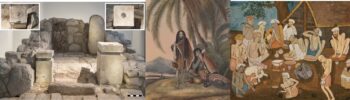
8th century BCE Hebrew Temple site from tel Arad’, Jerusalem, one alter burned frankincense the other cannabis resins; Assembly of fakirs preparing bhang and ganja’, 16th century; 1842 illustration by W. Taylor, ‘The Sunyasees’, depicting two sadhus, one smoking a ritual chillum, also with a traditional ‘nargila’, coconut water-pipe at his feet.
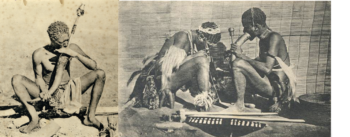
African tribal people smoking dagga [cannabis]. Cannabis has been used in ritual contexts by various African tribes for centuries, often valued for its psychoactive properties that facilitate spiritual, social, and medicinal practices. Among the Bashilange tribe in the Congo, the Riamba cult, established by 1884, centered on cannabis smoking as a core ritual, replacing traditional fetish-worship. In South Africa, the Khoisan and Bantu peoples used cannabis, known as “dagga,” in spiritual and social ceremonies before European contact in 1652, often smoking it to enhance communal bonding and spiritual connection. The Fang in the French Congo incorporated cannabis into pre-battle rituals, where warriors smoked dagga around an altar as part of a ceremonial chant, preparing them spiritually and psychologically for combat. These practices highlight cannabis’s role in fostering community, spiritual insight, and ritualistic protection across African cultures.
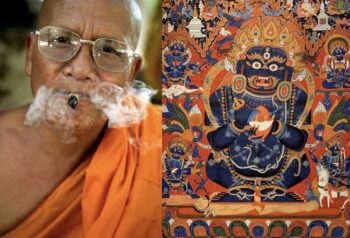
A modern buddhist monk smoking ganja. Mahakala, (Shiva adopted into the Tibetan Buddhist pantheon) with his bowl full of sacred elixirs. Cannabis is included in recipes for the “perfect medicine” formulas of the Mahākāla Tantra. Cannabis has held a clear ritual role in Tibetan Buddhism going back to the early medieval period, appearing in texts like the Tārā Tantra, where, Buddha says that drinking wine without having consumed cannabis “cannot produce real ecstasy”; The Cakrasamvara Tantra also emphasizes the magico-medical role of cannabis, stating that a mixture of compounds including cannabis will help one “become a yogin who does what he pleases and stays anywhere whatsoever” (Parker & Lux 2008). The 3rd century CE Indian text, the Lalita Vistara depicts Buddha subsisting on one hemp seed and a grain of rice during his years of asceticism.
Christopher Hugh Partridge (born 1961) is an author, editor, and professor at the Department: Politics, Philosophy and Religion at Lancaster University. He is listed as the founding Co-director of the Centre for the Study of Religion and Popular Culture, in biographies, but I could find nothing about this organization online. As a professor of religious studies at a leading University, Partridge’s misrepresentation of available historical data, can not be written off as a lack of knowledge, but rather seems to be an intentionally disingenuous and dishonest work, directed at discrediting a sacred role of cannabis in the World’s religions.
When it comes to ‘sacred’ cannabis, Partridge’s case is largely based on a misrepresentation of facts and dismissals through blanket criticisms like ‘no concrete evidence” while ignoring the evidence;’largely discredited’ without example or specifics. But most of all, are the glaringly conspicuous omissions of the actual history of sacred cannabis, as shall be shown here. When an academic work rejects established facts, it’s often called ‘falsification’ or ‘denialism’, and it is hard not to that here. Moreover, Partridge is clearly guilty of the sort of ‘confirmation bias’ he accuses others of, in the way he selectively chooses evidence that supports his desired conclusion, while ignoring established historical facts that do not.
For some sort of unbiased assessment on the role of cannabis in religions I asked Grok the single prompt question, “what plant is most widely used for spiritual purposes across the world’s religions?” And it concluded:
Determining the single most widely used plant for spiritual purposes across the world’s religions is complex, as spiritual practices vary widely and plants hold different significances in each tradition. However, based on available information and the prevalence of certain plants in multiple religious and spiritual contexts, cannabis (Cannabis sativa) emerges as a strong contender due to its widespread use across diverse cultures and religions for millennia….. Cannabis’s widespread use across Hinduism, Rastafarianism, ancient religions, and various shamanic traditions gives it a broad geographical and cultural footprint. Its psychoactive properties make it uniquely suited for spiritual practices aimed at altering consciousness, a common thread in many traditions. While plants like white sage or frankincense are also widespread, their use is often symbolic or aromatic rather than psychoactive, and they are less universal across as many distinct religious traditions as cannabis. [Complete answer from Grok]
There is no indication of this prevalence in Partridge’s study what so ever.
Partridges chapter on ‘profane’ cannabis for instance, makes use of The Indian Hemp Drugs Commission of 1894, and Franz Rosenthal’s The Herb: Hashish versus Medieval Muslim Society (1971) in regards to negative accounts of cannabis use, but he ignores the plethora of references to it’s sacred role in the cultures of Hinduism and Islam in these same texts. Instead we are given a history of the influence of these cultures in the romanticized cannabis use in the ‘Orientalism’ of European and American culture.
His medical chapter describes ancient Zoroastrian medical references to cannabis in the Zend Avesta under the name bhangha, but then he gives no account of the ritual role of cannabis infused wines and other references in the same religion anywhere in the book (Bundahišn 4:20, Pahlavi Vd. 15:14, Ardā Wirāz-nāmag 1:20, 2:9, 2:15, 16, Pahlavi Rivayat 47.27). He discusses ‘tinctures’ at length, but misses the whole alchemical origin of such preparations that in a number of recipes included cannabis, in earlier alchemical preparations known as arcanums and quintessences. . Partridge, confidently claims: “the earliest reference to cannabis in English appears in 1621, in Burton’s Celebrated text, The Anatomy of Melancholy”. However, a number of earlier references are known, such as The 10th to 11th century collection of old English medical texts, known as The Lacnunga; William Turner‘s book The names of herbes (1548); The Treasury of Health, containing many profitable medicines 1277 (1585); The Drink of Antioch (1425) and others. In regards to modern science, no discussion or description of the ‘endocannabinoid system’, which was discovered through the study of cannabis and has revolutionized modern medicine.
However, it is his chapter on ‘sacred cannabis’ that is the most questionable, more so by what he left out, rather than the number of inaccuracies it contains. Such as the established use in those religions already noted above. He presents the use of cannabis in yoga asa. new phenomena, but Patanjali referred to the use of herbs for attaining yogic powers and important figures in the history of yoga, such as Tirumular Matsyendranath and Gorakhnath, praised ganja and bhang. Partridge also miss-cites a number of authors, such as Christopher Duvall, on Sanskrit Bhang, and. Dieter Taillieu on Haoma, either he misunderstood what they said, or he was just being dishonest.
Partridge’s book is full of this sort of ‘lesser scholarship’, even though it’s an arrow that he attempts to shoot others. The book’s intent, with statements like “Wine…. has a long history within Christianity… unlike cannabis, it is couched in sacred discourse” (Partridge 2024) is questionable. One has to consider, with Partridge’s Phd. thesis ‘Revelation, Religion and Christian Uniqueness‘ (1995), and book titles like A Brief Introduction to Christianity (2018) and Universal Salvation?: The Current Debate (2014) [“Will God one day save all people through Christ’s atoning work? That is the question at the heart of the debate in this volume.”] if it is due to a lingering Christian bias? One reviewer of Partridge’s Introduction to World Religions (3rd Edition, 2018) stated that the Christianity section “came across as ‘this is why my religion isn’t only great, it’s THE BEST religion!’”. I feel this sort of thing has left a lingering taint in Cannabis, Sacred and Profane, and it’s something I will address again at the conclusion of this article.
For those interested in specifics, what follows is a more extensive look at his book, that fills in many of the blanks and corrects a number of mistakes. As Partridge is a respected professor at a prestigious University, and directly dismisses and ignores so much of my own work, consider this both an expansive, well referenced, review and a rebuttal! Moreover, as a longtime spiritual user of cannabis myself, also a Defence of the Sacrament. As such, I will fill in many of the glaring gaps in the history of sacred cannabis that Partridge has purposefully omitted. So let us begin this detailed chapter by chapter breakdown of Partridge’s book.
Chapter 1
Curiously, considering the long history of cannabis, and the extent of the ground to cover indicated in the title, Partridge chooses to spend the 1st of the 4 chapters, that make up the short 223 pages of main text on the book, going over various strain names, ingestion methods, outdated paraphernalia like roach clips, events like the Cannabis cup with little attention to any history. I thought for the most part, this chapter seemed out of place in regards to the stated intent of the book, even ‘filler’. And at the cost of the inclusion so much more relevant material! (After the short 4 chapters, the rest of the book is footnotes, and a very, shall we say, ‘padded’ bibliography, as there are many works not cited in the main text, and conspicuously ignored, listed.)
Although there is some description of bhang, ganja, and other historical terms and preparations in the chapter, since beyond a sentence or two Partridge skips the sacred role these held in Indian society, there was not much point to it. Partridge makes a brief mention of how “bhang… is consumed during religious festivals, notably Mahashivaratri and Holi” (Partridge, 2024) with no description of these events what-so-ever in the rest of the book. And when the subject of Shiva comes up, there are two brief mentions in regards to Shiva being used by cannabis apologists to sacralize their use, with no discussion of Shiva’s connection to cannabis.
The Kumbha Mela, a festival held every few years based on astrological alignments that has been celebrated for over two thousand years which is the largest pilgrimage and the biggest festival in the world attended by millions of pilgrims from across India and around the world, Nityananda Misra states, “Many Nagas, especially Shaiva Nagas, smoke charas (cannabis) in chillums (pipes made of clay). They believe it helps their concentration and sadhana” (Misra 2019). Cannabis has been present at such ceremonies for centuries.
“Bhang drinkers will not find a stone mortar and a wooden pestle too heavy to carry, even on a pilgrimage. It is quite certain that these and other intoxicants are excellent for the hallucinations of the yogins.” –Die Methoden des Yoga (Lindquist, 1932)
Afzal Ansari—an MP from Ghazipur, stated that “an entire goods train” filled with ganja would be insufficient for the festival’s potential cannabis intake. India Today reported recently (Mar 7, 2025) that:
At the just-concluded Maha Kumbh in Prayagraj, [particularly significant due to a rare planetary alignment]the Naga Sadhus were at the centre of attention with their distinctive appearance and rituals. Smoking marijuana in a chillum is widespread among the recluse Naga Sadhus and is a part of their way of life – an enigmatic aspect that has generated much curiosity… seers do it as it helps them concentrate and cut off worldly distractions. (Abhishek De, 2025)
In Sadhus—India’s Mystic Holy Men, author Dolf Hartsuiker explains more about Shiva’s special relationship with cannabis and the later development of smoking it:
“…the smoking of charas [cannabis]is… regarded as a sacred act…Intoxication as a ‘respected’… method of self-realization is related to soma the nectar of the gods, which is recommended in the Vedas as a sure means of attaining divine wisdom.
Mythologically, charas, is intimately connected with Shiva: he smokes it, he is perpetually intoxicated by it, he is the Lord of Charas…Babas offer the smoke to him; they want to take part in his ecstasy, his higher vision of reality.” (Hartsuiker, 1993)
It should be noted here, however, the smoking of cannabis in chillums, is thought to have only begun after Europeans discovered tobacco smoking in the Americas, and traders brought the technology of pipes and cigars to India. The use of bhang and edibles are much more ancient, as is fumigation. This has caused some discussion in regards to what methods are sacred or profane in the Indian discourse on the matter. This likewise would have been good material for Partridge’s book instead of a focus on the fodder of Reefer madness and a purely Western experience.
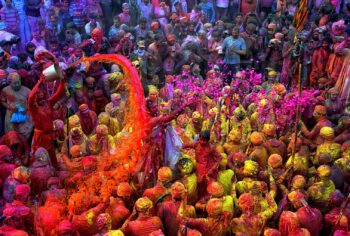
Bhang has been traditionally consumed at the ecstatic Holi festival for centuries, a raucous celebration, where devotees dance and throw coloured paints and powders on each other.
Bhang, a preparation of cannabis, is also traditionally consumed during the ecstatic Holi festival, particularly in North India. It’s commonly mixed into a drink called bhang lassi, and is also available as bhang goli, a cannabis and water mixture. “Holi is the celebration of the timeless love and union of Lord Krishna and Goddess Radha. It also celebrates the triumph of Lord Vishnu over Hiranyakashipu, reinstating that goodness always wins over evil… One of the most special drinks prepared on Holi is Bhang. Also known as thandai, bhang is a drink made with a paste obtained from the leaves and flowers of the female cannabis plant, which is then mixed with milk, spices and sweets” (Hindustan Times 2024)

Holi Revellers intoxicated on bhang.
19th century Western writers were less amused about this festivity.
The Holi Festival is held to commemorate the of the god Krishna with the gopis or milkmaids It a grave display of indecency from beginning to end. The people move about in crowds often excited by toddy or bhang throwing red powder upon passers by and singing indecent and obscene songs No woman can walk through the streets without insult And so far has all modesty and decency disappeared at this time, thay obscenity becomes the measure of piety.(Hall, 1894)
The Use of the Cannabis Drugs in India (Chopra& Chopra, 1957) composed for the United Nation Office on Drugs and Crime, reported a number of festivals at that time where cannabis was consumed in different forms.
In Bengal, for instance, the custom still persists among certain classes of offering a beverage prepared from the leaves of the cannabis plant to the various family members and to guests present on the last day of Durga Puja (Vijaya Dasmi) which is the biggest Hindu festival in that state. In Tara-keshwar temple in Bengal, ganja is used as an offering on the Shivratri (Shiva’s Night). Less commonly, it is used in other religious festivals such as Trinath Puja, a religious ceremony observed also by certain Mohammedan sects in a slightly different form. In Puff (Orissa) one of the greatest places of Hindu pilgrimage in India, ganja and bhang are largely used by the attendants and worshippers of the god Jagannath. In the Uttar Pradesh, where Durga Puja is observed in a manner similar to that in Bengal, the use of bhang is not so much in vogue. It is also taken by certain classes on the occasion of the Holi and Dewali festivals, marriage ceremonies and other family festivities. Among the Sikhs, the use of bhang as a beverage was quite common twenty or thirty years ago, and these beverages were freely distributed to devotees visiting some of their religious places and shrines. Drinking of bhang is also in vogue in !Kajputana at the festival of Kama (Indian Cupid) by the Rajputs of Bondil… Shiva worshippers in Bombay generally use ganja, while the Marwaris and merchant classes, who belong to such religious sects as the Jains, use bhang on festive occasions. In Madras state, the use of cannabis drugs on religious and social occasions is less common than in other states. (Chopra& Chopra, 1957)
Currently, cannabis is not fully legal in India, but the legal status is nuanced. The Narcotic Drugs and Psychotropic Substances (NDPS) Act of 1985 bans the recreational use of cannabis, including its resin, extracts, and seeds, with penalties of up to 6 months imprisonment for small quantities. However, the law allows the use of cannabis leaves and seeds for specific purposes, such as in traditional drinks like bhang, which is culturally accepted and often unregulated, especially during festivals like Holi. Cultivation of cannabis for industrial purposes (e.g., hemp for fiber or seeds) is permitted under strict licensing in some states, like Uttar Pradesh and Uttarakhand. Medical cannabis with low THC content is also allowed for research and medicinal use under controlled conditions, following amendments in some regions. Enforcement varies widely, with rural areas often more lenient due to cultural practices, while urban areas may see stricter application. “Under the Narcotic Drugs and Psychotropic Substances Act 1985 (NDPS), the trade and consumption of cannabis resin (charas) and bud (ganja) are now illegal, and anyone found in possession of hash or weed faces up to 20 years’ imprisonment” (Mouniakov, 2025)
Chapter 2
His 2nd chapter on ‘Profane Cannabis’, largely dealing with the demonization of cannabis, was better, but still notably flawed.
It is in this chapter we get the majority of what little he has to say about the centuries long rich history of cannabis in the Islamic world. What is said, is largely dismissive, via the use of the Hashishyyin, known more popularly as the ‘assassins’, a group made popular in the Western imagination through Marco Polo’s fanciful travel diary. The Hashishyyin were used as a tool of anti marijuana propaganda in the 30s, ie ‘the assassin of youth‘. In regards to the medieval and modern use of cannabis, by Sufis, Dervishes and Qalandars, such figures are left completely out of Partridge’s discussion.

Marihuana – Assasin-of-Youth – Advertising Poster -www.JustPosters.com.au
Noting that the term applied to the Assassins “Hashishiyya” was an insult, that signified “lower class rabble” and “irreligious social outcasts, Partridge uses Franz Rosenthal‘s excellent, The Herb: Hashish versus Medieval Muslim Society (1971) to make the case that such esoteric use by these mystic warriors can be discounted because cannabis “was well known at the time, it is unlikely to have been considered a mysterious ‘potion'” (Partridge 2024). However, Rosenthal is here dealing with centuries of time, and a variety of locations, so this is really poor logic. Comparing the early Islamic period of the 11-13th century where cannabis was much less known, with the situation of Islamic countries of the 16th and 17th centuries after use of cannabis was much more popular, is like trying to see a common situation of Western societies modern relationship with cannabis, with that of the 16th and 17th century when it was little known and understood. Notably here, this is the only reference from Rosenthal’s excellent tome about medieval hashish in the Arabic world, and it is chock-full of Sufi poems about hashish and historical information relevant to cannabis’ sacred history. As with The Indian Hemp Drug Commission, Partridge only uses Rosenthal’s masterful work as a source of negative connotation.
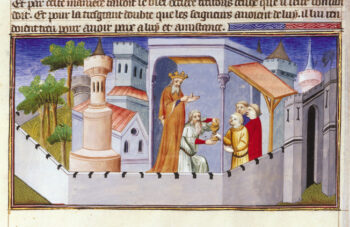
The ‘Old Man of the Mountain’ leader of the Hashishiyya, or ‘Assassins’,dosing new recruits with hashish in an old Illustration for ‘The Adventures of Marco Polo’.
Partridge also tries to dismiss the visionary powers of ingested hashish, in relation to the Islamic claims about the Hashishiyya, but then later gets into its role as a means of ‘astral travel’ among 19th century occultists, which clearly shows that such experiences can take place with ingested cannabis products. However, as noted by Rosenthal, during the time of the Hashishyya the Islamic scholar Al-Is’irdi (1222-1258) noted of hashish: “It is the secret. In it the spirit ascends to the highest spots on a heavenly ascent of disembodied understanding” (Rosenthal, 1971), a view in tune with the role of cannabis in esoteric sects, such as the Hashishiyya, and its secretive use.
Partridge states that the ‘well-known soporific effects and tendency to induce lethargy” can be discounted as the drug of a warrior class like the Hashishiyya. But this ignores its historical role with other warrior groups like the Scythians (whom he later suggests were merely ‘smudging’ with cannabis in a cleansing ritual) Dacians, African tribes like Zulus, Swazi, Sotho, and Fang; The SikhTemple Guardians the Nihang Sikhs. George Weston Briggs, a missionary and Indologist wrote “Ganja, a narcotic and intoxicant traditionally consumed by the warrior caste” (Briggs, 1935).
Rajputs are a large cluster of patrilineal clans primarily found in central and northern India. They are historically associated with warrior hood and are known for their pride in ancestry and strong sense of personal honour. Writing in 1957, for a United Nations drug bulletin, Dr. I. C. Chopra and Col. Sir R. N. Chopra, noted that “Some of the old records from Rajasthan show that ‘sidhi‘ or bhang was often drunk in order to propitiate Shiva in time of war. It is stated that the Rajputs used to drink bhang as a stimulant to courage at the time of battle when courageous deeds had to be performed against their enemies” (Chopra & Chopra, 1957). Cannabis consuming Moslem faqir and Hindu yogis could also be counted here. As Professor Niles Green has explained “the faqirs… success on the field of war was widely recognized, and in both oral and written form, there existed scores, probably hundreds accounts of a faqir winning this or that battle. The same was true of the sadhus and yogis…. nath yogis in particular” (Green, 2009). The tridents and spears carried by Sadhus, are more than mere religious decorations.
Cannabis was also consumed by soldiers of both sides in the Vietnam war. More recently, the International Criminal Court (ICC) found Congolese warlord Thomas Lubanga guilty of three counts of conscripting child soldiers. At his trial, former child soldiers testified that “many were given or were forced to smoke marijuana before battles, since taking drugs made them more aggressive, even fearless, on the front lines”. (Lubanga Verdict 2012). The article Cannabis as a Weapon of War: History of Cannabis Use in Warfare gives some interesting details on this.
The Nihang (‘Crocodiles’) also referred to as the Akalis (‘Imortals’), are a Sikh military order known for their military prowess, and historical victories in battle even when they were greatly outnumbered. Nihang are easily identifiable by their steel iron bracelets, weaponry and particularly by their “electric blue” attire and tall turbans. Up until 2001, Cannabis use was a condoned part of Nihang ritual and spiritual practice and this use was identified by them a “time-respected tradition’ bestowed upon the order by the tenth Guru of Sikhism, Gobind Singh (1666- 1708). The Nihang used the name of Suknidhaan, abbreviated to Suhka, meaning ‘Peace-Giver’ for the preparer of their ritual cannabis preparations which they used in the form of baked cookies and a bhang like beverage referred to . Nihang use of cannabis has been particularly associated with the Sikh holiday Hola Mohalla, a sort of military celebration.
A Nihang prepares cannabis as sukha at the Hola Mohalla, at 40 seconds in the above video.
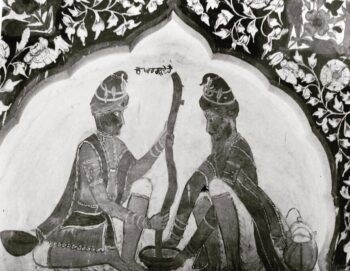
Mural of two Nihang Sikhs making Bhang or Sukh Nidhan, known as ‘Shaheedi Degh’ (the drink of martyrs).
The sixth Sikh Guru of Sikhism, Sri Guru Hargobind Sahib ji gave bhang to Sikhs to attain Bir Ras (warrior spirit) and to get them energized, as Sikhs used to get up at around 3 am for armit vela and not go back to sleep till after the evening prayers of Sohila Sahib.
ਬਿਦਿਹ ਸਾਕੀਯਾ ਸਾਗ਼ਰੇ ਸਬਜ਼ ਗੂੰ ॥
‘Oh! Saki Give me the cup full of green (liquid)
ਕਿ ਮਾਰਾ ਬਕਾਰਸਤ ਜੰਗ ਅੰਦਰੂੰ ॥੨੦॥
‘Which I need at the time of struggle(20)
ਲਬਾਲਬ ਬਕੁਨ ਦਮ ਬਦਮ ਨੋਸ਼ ਕੁਨ ॥
‘Fill it up to the brim so that I can drink it with every breath
ਗ਼ਮੇ ਹਰ ਦੁ ਆਲਮ ਫ਼ਰਾਮੋਸ਼ ਕੁਨ ॥੨੧॥੧੨॥
‘And forget the afflictions of both the worlds(21)(12)
(Dasam Guru Granth Sahib, Ang 1428)
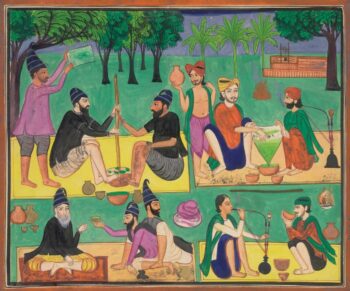
Gouache by an Amritsar artist depicting the preparation and consumption of Indian hemp (bhang) by Nihang Sikhs and Hindus, circa 1870.
Partridge here also discounts cannabis’ modern popularity in fighting sports like MMA, where its been suggested nearly half the fighters use cannabis.Indeed cannabis is even a prize at jui jitsu at some tournaments. Not to mention cannabis’ popularity in other adrenalin sports like skateboarding, surfing and snowboarding. This shows Partridge’s lack of understanding how cannabis can help some athletes get into the ‘zone’. (As a surfer and skateboarder in my 60s I can personally attest to the popularity of herb in these areas!)

MMA fighter Nate Diaz, lights up proudly at a fight event
Videos: CANNABIS JIU JITSU (Full Documentary); Whats With Jiu Jitsu’s WEED Reputation?
From there Partridge see the Assassins as a tool of propaganda, that was used to demonstrate the ‘maddening’ effects of cannabis, and the violent crimes that resulted from its use, in the Reefer Madness era.
Partridge also seems to ignore that cannabis is not explicitly prohibited like wine and other alcoholic beverages in the Koran. Early Islamic commentators “never failed to remark on the fact that hashish is not mentioned in the Qur’an or the old Prophetic traditions, nor were they able to find any express reference to it in the name of the four legal schools” (Rosenthal, 1971).
While there are a number of local differences, the use of cannabis with a varying intensity has had a time-honoured role in many Muslim countries. This is in contrast to the use of alcohol which, from the religious point of view, became the prime forbidden intoxicant…. There are many reports… that hashish was also used in medical preparations… [It has been] suggested that the interpretation of the Quranic law on intoxicants might have been more tolerant towards the use of drugs such as opium and hashish because of the paucity of means of relieving pain in the medieval Muslim world. (Palgi, 1975)
The debate among Islamic scholars at the time wether hashish use was permissible, seems like a lost opportunity in regards to discussing its sacred and profane aspects here by Partridge. As such, I will share a bit of what Partridge leaves out. In the well researched article ‘Islam and cannabis: Legalisation and religious debate in Iran‘, written by Iranian academics, who consulted with Iran’s leading Shi’a authorities, the maraje’-e taqlid, ‘source of emulation’, we get some idea of the Islamic debate about wether cannabis was halal (meaning “permissible”) a term that encompasses everything that is allowed under Islamic law, or haram, forbidden or proscribed by Islamic law.
. While the prohibition of wine is an agreed matter based on the explicit Koranic forbiddance, references to hashish, cannabis and other hemp derivatives are absent from the sacred text. This void opens up the possibility of interpretation among legal scholars with results that are not always unanimous…
The lack of Koranic reference stimulated the mind of religious scholars in interpreting the status of cannabis. Given the void in the hermeneutical sources, scholars judged the validity (halal) or prohibition (haram) of cannabis use based analogy (qiyas). Wine (al-khamr) is the comparative element taken into account, but most scholars disagree on equating wine with cannabis. A widely accepted account (hadith-e hil) says, ‘Everything is allowed for you [halal lak] until you learn it is forbidden…’. Hence, cannabis does not carry a total prohibition among most Muslim scholars (Safian, 2013). Allameh Helli (1250–1325), a leading scholar, said, ‘for the poison that derives from the herbs [hashish-ha] and the plants, if it has benefits [manfe’at], its sale and trade is not an issue. If it does not have benefits, then it is not permitted’ (Rezapourshokuhi, 2002). In another source, the scholar asked from one of his students whether hashish is intoxicant and harmful and if it is forbidden, Helli responds, ‘What is known among the people is that hashish is intoxicant, so eating it is prohibited not because it is harmful to the body but because intoxicates…Despite the prohibition of hashish, it is not impure [najes] because impurity is specific to alcoholic spirits [musakkerat]’ (Rezapourshokuhi, 2002). Shahid al-Awwal, another prominent Shia scholar from Damascus, states that almost all scholars who have preceded his era or his contemporaries agreed ‘that plants known as hashish have been judged as prohibited’ (Rezapourshokuhi, 2002). Nonetheless social and medical remained unhindered by legal constriction, except for sporadic instances due to the rulers’ changing ideas about hashish (Matthee, 2005).(Ghiabi, Maarefvand, Bahari, Alavi, 2018)
The legal situation varied over time and across locations. “When the government decided to proceed energetically against the use of drugs, severe penalties were demanded and apparently imposed. This included the death penalty. In the thirteenth century, Baybars prohibited the consumption of wine and hashish and invoked the sword as punishment… for it. In the latter part of the fourteenth century, Sudun ash-Shaykhuni punished people accused of making hashish with the extraction of their molars, and many suffered this fate…” (Rosenthal, 1971). Despite these harsh attempts at prohibition, in medieval times hashish use became surprisingly widespread. Rosenthal, citing Fuzuli (1483-1556) wrote that in the late medieval period, “Hashish can claim to be the friend of dervishes and to be available in the corner of every mosque and among all kinds of scholars” (Rosenthal, 1971).
For more on the Koranic discussion on wine, hashish and the law, see Hashīsh – Intoxicating or Just Corruptive? A 13th Century Jurist’s Distinctions (2018) by Sheza Alqera Atiq and Hashish in Sufism Is Dismissed As Illegal and Degeneration of Islamic Ideals (2018) by Hammad Khan, which are particularly relevant to any discussion of the sacred and profane aspects of cannabis in the Islamic world.
Countering the intoxication question in the Islamic mind, was cannabis’ held a well established role in Islamic medicine, so this is very relevant to a discussion of the ‘sacred’ and ‘profane’ aspects of cannbis in relation to medical history:
…[I]n the medical practice of Muslim societies, especially in Iran, cannabis has historically been used as analgesic, appetite inductor, euphoric and sexual inhibitor (although prolonged use was known to diminish sexual impulse) (Peters & Nahas, 1999). This secular knowledge about the use and abuses of cannabis was equally enriched by the debate about its legal status among Muslim religious scholars. This medicalised debate on cannabis certainly benefited from the lack of explicit prohibition in the Islamic primary sources.
cannabis was not simply a drug of religious deviance and heterodox spirituality. It had an established place within the pharmacopeia of Iranian civilisation. In The Canon of the Iranian scientist Avicenna recommended it as a useful analgesic for headaches (Gorji & Ghadiri, 2002). If opium (taryak) did not produce relief, the Iranian doctor suggested to take ‘ambergris, aloe wood, juniper and poppy head, saffron…of each one quarter gram complete; and of the chief ingredient of that which dreamers call “the mysteries” [hashish] a weigh equal to all…mixed into a mass with honey. Take of it occasionally as Sufis do’ (Neligan, 1929). The physician al-Razi (Rhazes) indicated hemp leaves as cure for ear problems, dandruff, flatulence as well as epilepsy (Nahas, 1982).(Ghiabi, Maarefvand, Bahari, Alavi, 2018)
The Islamic debate on Cannabis continues in the modern world: “That said, it’s almost unanimously agreed upon that the recreational use of cannabis contradicts the maqasid al-Sharia, or the higher aims and objectives of Islamic law. In practice though, the presence of cannabis throughout Muslim regions tells a different story” (Margolin 2017).
For centuries, hashish has been grown and traded throughout the Arab world, with Morocco and Afghanistan among the top providers. Meanwhile, in 2014, the Grand Ayatollah Sayyad Mohammad Sadeq Hussaini Rohani in Qom, Iran, issued a fatwa, or religious legal ruling, that entheogens (spiritual plant medicines) and psychedelics are halal for Shi’i Muslims under supervision. He also ruled that these plant substances don’t impair the mind or spirit. Rohani’s fatwa was prompted by an inquiry from Sufi mystic and Islamic scholar Wahid Azal from Lebanon.
So even if cannabis for recreational use is haram, it has been nearly ubiquitous nonetheless in Muslim-majority countries, especially among lower classes and for spiritual uses among the Sufi. (Margolin 2017)
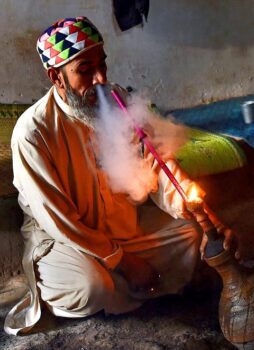
An Islamic Pakistani man smokes hashish from a water pipe pipe near a shrine in Peshawar.
As J.M. Campbell recorded of the Islamic relationship relationship with cannabis in his classic 1894 essay, On the Religion of Hemp, (a document that Partridge lists in his bibliography, but which he never consults or cites);
In his devotion to bhang, with reverence, not with the worship, which is due to Allah alone, the North Indian Mussulman joins hymning to the praise of bhang. To the follower of the later religion of Islam the holy spirit in bhang is not the spirit of the Almighty, it is the spirit of the great prophet Khizr, or Elijah. That bhang should be sacred to Khizr is natural, Khizr is the patron saint of water. Still more Khizr means green, the revered color of the cooling water of bhang;. So the Urdu poet sings “When I quaff fresh bhang I liken its color to the fresh light down of thy youthful beard.” The prophet Khizr or the green prophet cries “May the drink be pleasing to thee.” (Campbell, 1894)
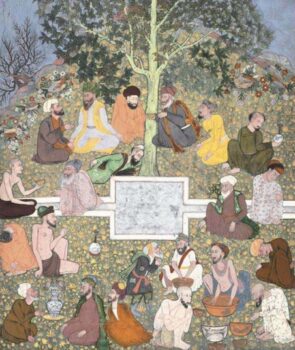
A Gathering of Dervishes, preparing bhang, and smoking hashish, Mughal India, circa 1605.
For how the Islamic legal debate played out against religious figures like Dervishes and Sufis see Pass that chillum: Why is pot-smoking so common at Sufi shrines and why is it frowned upon?(2018) As Hammad Khan explains “Colonialism and modernity turned hashish from a gateway to transcendence into one of degradation” (Khan 2018). In many ways it’s hard not to see Partridge’s work as a soft peddled passive aggressive continuation of that tradition.
Sufi shrine culture in Pakistan is multi-faceted and diverse – while hashish does not feature uniformly across cultures of traditional shrines, smoking it is a communal and conspicuous activity associated with Qalandari shrines in Pakistan. Paradoxically, it is also one of the least studied phenomena in Islam. Despite its prominence in Islamic settings, it is frequently dismissed as illegal and representative of the degeneration of Islamic ideals.
….Historian Nile Green observes that hashish “was lent religious value as evidence for renouncing the world and as an instrument for reaching the other world”. It was “attributed with moral value and epistemological meaning”. Hashish turned the seeker away from the lower passions related to this world, and elevated his concerns to matters of spiritual importance. It purified the seeker’s devotion by turning away from this world to prepare for the inner flight to the Divine.
Victorian morality denigrated hashish as “profane”, opposed to “religion”. It conveniently conflated Islam with colonial conception of religion. Colonial critics criticised faqirs’ drug use, and explained the behaviour as “not the result of devotion to and absorption in God, but instead as the voluntary degradation of the work-shy addict”. Scientific discourse was also instrumental in associating drug use with criminality and insanity, through efforts such as the Indian Hemp Drugs Commission of 1893-1894. (Khan 2018)
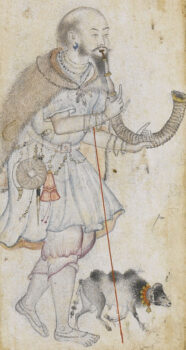
A Qalandar of the Qalandari sect with his pet sheep, Mukund, India, 1585. This sect has been using hashish since about the early medieval period. “Reference to cannabis for rituals and spiritual performance is abundant… during the Islamic era (651–…)…The Sufi sect of the Qalandars which originated in Khorasan (Eastern Iran) made of hashish consumption (as well as wine drinking) a hallmark of their public behaviour… The hashish pipe, up to today, is referred to as nafir-e vahdat, ‘the trumpet of unity [with god]’ … Dervishes, the mendicant Sufis, have also been known for their use of… hashish, …n the form of a yogurt and cannabis preparation called dugh-e vahdat, ‘drink of unity’” .(Ghiabi, Maarefvand, Bahari, Alavi, 2018). For a fascinating account of the history of the Qalandar, and their use of hashish, see God’s Unruly Friends: Dervish Groups in the Islamic Middle Period 1200-1550 (Karamustafa 2008) and “It Is The Weed Of Lovers” The Use Of Cannabis Among Turkic Peoples Up To The 15th Century (Péri, 2018).
India
Just as he largely ignores the Islamic relationship with cannabis, and instead focusses on the Islamic relationship’s influence on the West via ‘Orientalism’, Partridge for the most part omits the role of cannabis in the religious life of Hinduism, while using it at the same time in an example of its degradation. Partridge refers to the Indian Hemp Drug Commission (IHDC) of 1894, in relation to “lower class people” using cannabis, citing “Adverse witnesses correlated the use of cannabis with dissipation, debauchery, crime, violence, disease and insanity” but ignores the papers on its religious use contained in the IHDC. Partridge explains this “debauchery” and “insanity” is “a recurring theme” but omits papers in the IHDC that identified its religious and ritual use completeley, although they appear in his very ‘padded’ Bibliography. Specifically, he ignores J.M. Campbell, Notes On the Religion of Hemp, which eloquently covers the role of cannabis in the sacred life of both Hindus and Muslim people in India at that time; as well as The note by Babu Abhiilas Chandra Mukerji, Second Inspector of Excise, Bengal, discusses the origin and history of Trinath worship in Eastern Bengal, which describes a popular communal cannabis smoking ritual with chillums. Partridge also ignores the essay on “Social and Religious Customs” which details the role of cannabis in the Durga Puja, which pays homage to the Hindu goddess Durga, and its role in the Sikh religion. Partridge does cite G. A. Grierson’s ‘On References to the Hemp Plant Occurring in Sanskrit and Hindi Literature’ for dates, but then questionably dismisses Grierson’s identification of the Sanskrit term ‘bhang’ as hemp. Four essays detailing the sacred history of cannabis, ignored in favour of references demonizing it.
The legal and religious situation in India, like that of Islam, would have been important material to discuss in relation to both the sacred and profane history of cannabis by a more serious scholar. It is hard not to sense a tinge of colonial era prejudice in the omission of these cultural histories of cannabis. Cannabis has held a very significant role in the Hindu religion, since its inception. Particularly in the worship of Shiva, as noted in one of the essays from the Indian Hemp Drug Commission (IHDC) of 1894, which Partridge chose to ignore:
To the Hindu the hemp plant is holy. A guardian lives in the bhang leaf….the properties of the bhang plant, its power to suppress the appetites, its virtue as a febrifuge, and its thought-bracing qualities show that the bhang leaf is the home of the great Yogi or brooding ascetic Mahadev….
So holy a plant must play a leading part in temple rites. Shiva on fire with the poison churned from the ocean was cooled by bhang. At another time enraged with family worries the god withdrew to the fields. The cool shade of a plant soothed him. He crushed and ate of the leaves, and the bhang refreshed him. For these two benefits bhang is Shankarpriya, the beloved of Mahadev [Shiva]. So the right user of bhang or of ganja, before beginning to drink or to smoke, offers the drug to Mahadev saying, lena Shankar, lena Babulnath: be pleased to take it Shanker, take it Babulnath. According to the Shiva Purana, from the dark fourteenth of Magh (January-February) to the light fourteenth of Ashadh (June-July), that is, during the three months of the hot weather, bhang should be daily poured over the Ling of Shiva….
…Vaishnavas as well as Shaivas make offerings of bhang. The form of Vishnu or the Guardian to whom bhang is a welcome offering is Baladev, Balaram, or Dauji, the elder brother of Krishna. Baladev was fond of spirits, not of bhang. But Banias, Bhatias, and other high class Hindus, not being able to offer spirits, instead of spirits present bhang. In Bombay the offering of bhang to Baladev, unlike the special offerings to Shiva, is a common and everyday rite. Without an offering of bhang no worship of Baladev is complete. Unlike the plain or milk and sugared bhang spilt over the Ling, Baladev’s bhang is a richly-spiced liquid which all present, including the offerer, join in drinking. Such social and religious drinking of bhang is common in Bombay in the temple of Dauji in Kalyan Kirpuram lane near Bhuleshwar.
….Like his Hindu. brother the Musalman fakir reveres bhang as the lengthener of life, the freer from the bonds of self. Bhang brings union with the Divine Spirit. ‘We drank bhang and the mystery I am He grew plain. So grand a result, so tiny a sin.’ (Campbell, 1894)
Dr. William Dymock, Surgeon-Major of the Bengal Army, andProfessor of Chemistry in the Calcutta medical College, Noted in ‘On the use of Ganja and Bhang in the East as Narcotics’ for The Journal of the Anthropological Society of Bombay, Volume 2 (1890):
…[W]hen speaking of the drug In Hindu mythology the hemp plant is said to have sprung from the amrita produced whilst the gods were churning the ocean with Mount Mandara. It is called in Sanskrit Vijaya giving success and the favourite drink of Indra [Indrasana, Indra’s hemp; Indra was the god of Soma] is said to be prepared from it. On festive occasions in most parts of India large quantities are consumed by almost all classes of Hindus. The Brahmins sell Sherbet Sabja prepared with Bhang at the temples and religious mendicants collect together and smoke Ganja. Shops for the sale of preparations of hemp are to be found in every town and are much resorted to by the idle and vicious. Hemp is also used medicinally in the Raja Nirghanta its synonyms are Urjaya and Jaya names which mean promoter of success, Chápala the cause of a reeling gait, Ananda the laughter moving, Harshini the exciter of sexual desire, among other synonyms are, Kashmiri coming from Cashmere, Matúláni the maternal uncle’s wife, Mohini fascinating & Its effects on man are described as excitant, heating astringent, it destroys phlegm, expels flatulence, induces costiveness, sharpens the memory excites, appetite & c Susruta [(6th century BCE)] recommends the use of Bhang to people suffering from catarrh. In the Rajavalabha a recent work in use in Bengal we are informed that the gods through compassion on the human race sent hemp so that man kind by using it might attain delight lose fear and have sexual desires. The seductive influences of hemp have led to the most extravagant praise of the drug in the popular languages of India:
Lage gánje ka dam aur mit jae pal men gam
When the ganja pipe begins to smoke all cares at once disappearGanja piye giyan barhe
Smoke ganja and increase your knowledgeThe Bhangar or habitual consumer of hemp, in the form of Sabja (an infusion of Bhang with black pepper anise and sugar to which in Bengal cucumber and melon seeds and milk are added) sings in its praise
Behtar teri sharab nahin meri bhang se Apna hi sabja tez hai tere surang se
Better is my cup than thine The emerald than the ruby wine (Dymock, 1890)
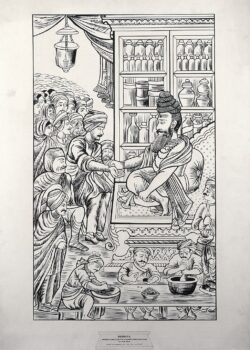
Pen drawing of the 6th century BCE sage Susruta, giving medical advice, while his assistants prepare medicine, the later work the Sushruta Samhita (Composed between the last centuries BCE – sometime betwee 300-500 CE). “Sushruta was among the first surgeons to recognize the importance of pain relief during surgical procedures. He employed herbal concoctions, such as mandrake and cannabis, to alleviate pain and allow patients to tolerate complex surgeries” (Chauhan, 2022). In the Sushruta Samhita,”cannabis was recommended for phlegm, catarrh and diarrhea ” (Russo, 2005)
Such use has continued into the modern day, at Holi, the Kumbha Mela, referred to earlier, as well as at Mahahshivaratri. Despite colonial and later national efforts to prohibit the herb, it’s holy use carries on.
The Times of India reports of the Maha Shivaratri is a Hindu festival celebrated annually to worship the deity Shiva, between February and March, that an age old “popular tradition revolves around offering Bhaang to Lord Shiva on the occasion of Shivaratri and then drinking it as a prasad” [food or other items that are offered to a deity and then returned to the devotees as a blessing]. Legal restrictions are lifted on this date for religious reasons. In India “Cannabis is still a narcotic drug and the possession of this drug is considered to be an offence under the Narcotics Act, 1985. However, because of the religious significance of this drug it is allowed to be consumed during festivals like Maha Shivratri and Holi” (Times of India, 2022).
Indologist David Gordon White states that “The 7th c. south Indian Tirumular sings the praises of marijuana in his Tirumantiram” (White, 2012). Tirumalar, was Shaivite mystic and writer, the Tirumantiram, consisting of over 3000 verses, forms a part of the key text of the Tamil Shaiva Siddhanta compilation called the Tirumurai, a twelve-volume compendium of songs or hymns in praise of Shiva in the Tamil language from the 6th to the 11th century.
In the Matsyendrasaṃhitā, a thirteenth-century Shakta–Shaiva compilation of ritual and meditation techniques attributed to the first human guru of the Nāth Siddhas, Matsyendranāth, we find Cannabis equated with manonmanī – the supramental state, which implies a level of awareness that transcends ordinary perception of cause and effect, space and time, and the distinction between subject and object. The epithet accorded here is siddhimūlikā – the ‘root of success’ or ‘root of realization,’ indicating this is clearly ‘sacramental’. The Nāth Siddhas are a North Indian Shiva tradition of yogis with tantric associations, known for their practice of Hatha Yoga and alchemy, and their pursuit of immortality through a perfected body. They are considered followers of Lord Shiva, and their lineage is traced back to the legendary figures Matsyendranath and Gorakshanath. Gorakhnath is considered a Maha-yogi (or “great yogi”) in Hindu tradition and considered by some to be an incarnation or aspect of Lord Shiva. He used cannabis in his medicinal preparations for certain ailments; as a result, it gained the name Korakkar Mooligai (Korakkar’s Herb). “Gorakhnath is also occasionally identified with Shiv himself. The ganja is favoured by Nath supporters ; it is also believed to be a favourite of Shiv” (Dasgupta, 2005)
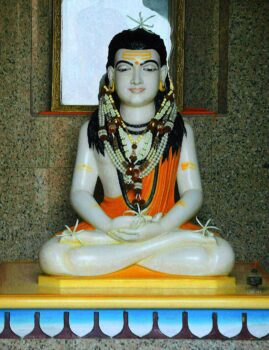
A statue of Goraknath in a temple in Laxmangarh, India.
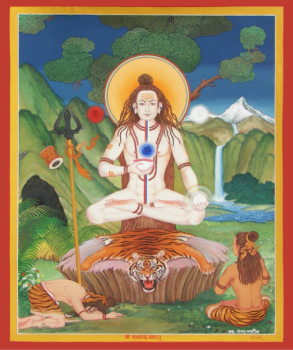
Matsyendranāth also appears in a text that is important to Cannabis history, the Ānandakanda (आनन्दकन्द) or ‘Root of Bliss’., “a vast alchemical compilation which first sets out the ‘sinsemilla technique’ for producing seedless bud (i.e., ganja).”
I feel like ignoring the role of cannabis in the cult of Shiva on a book that deal with the sacred history of cannabis, is particularly dishonest. Partridge only mentions Shiva twice in passing,; “apologists and spiritual seekers are also keen to associate the -plant belief in a range of deities: ‘cannabis is a gift from Shiva’, ‘the original pothead'” and “Was it associated with deities from around the world including Shiva. Kali, Thoth….” That is it, yet much has been written about the role of cannabis in the cult of Shiva going back centuries that Partridge intentionally chose to omit. This is dishonest, and arguably presents the sort of Christian and Colonial prejudice that led to the British Raj to consider restricting it’s use in The Indian Hemp Drug Commission.
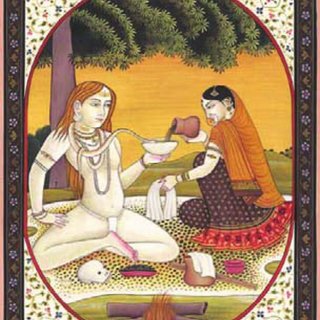
An Indian miniature painting depicting Pavarti serving Shiva bhang. “Mahadev – consumes [the intoxicants]bhang and thorn-apple” (The Prema-sâgara; or, Ocean of love, 1897) “As noted in The Indian Hemp Drug Commission of 1894: “The Hindu poet of Shiva; the Great Spirit that living in bhang passes into the drinker, sings of bhang as the clearer of ignorance, the giver of knowledge. No gem or jewel can touch in value bhang taken truly and reverently. He who dunks bhang drinks Shiva… This bhang Mahadev [Shiva} made from his own body, and so it is called angaj or bodyborn. .”
As Professor Theodore M Godlaski, notes in his essay Shiva, Lord of Bhang:
In India, Cannabis Indica has been used for literally thousands of years in the worship of the god Shiva… a practice generally reserved for holy men who dedicate their lives to ascetic practice and the worship of Shiva. This practice is codified in the Vedas as well as in legends about the origin of cannabis and its relationship to Shiva. (Godlaski 2012)
Bhang and the Sikh Religion
In a chapter on “Social and Religious Customs” the INDIAN HEMP DRUGS COMMISSION REPORT of 1894 also identified a role for cannabis in the Sikh religion of the Punjab region which began in the 16th century AD:
Among the Sikhs the use of bhang as a beverage appears to be common, and to be associated with their religious practices. The witnesses who refer to this use by the Sikhs appear to regard it as an essential part of their religious rites having the authority of the Granth or Sikh scripture. Witness Sodhi Iswar Singh, Extra Assistant Commissioner, says: “As far as I know, bhang is pounded by the Sikhs on the Dasehra day, and it is ordinarily binding upon every Sikh to drink it as a sacred draught by mixing water with it.” Legend–Guru Gobind Singh, the tenth guru, the founder of the Sikh religion, was on the gaddi of Baba Nanak in the time of Emperor Aurangzeb. When the guru was at Anandpur, tahsil Una, Hoshiarpur district, engaged in battle with the Hill Rajas of the Simla, Kangra, and the Hoshiarpur districts, the Rains sent an elephant, who was trained in attacking and slaying the forces of the enemy with a sword in his trunk and in breaking open the gates of forts, to attack and capture the Lohgarh fort near Anandpur. The guru gave one of his followers, Bachittar Singh, some bhang and a little of opium to eat, and directed him to face the said elephant. This brave man obeyed the word of command of his leader and attacked the elephant, who was intoxicated and had achieved victories in several battles before, with the result that the animal was overpowered and the Hill Rajas defeated. The use of bhang, therefore, on the Dasehra day is necessary as a sacred draught. It is customary among the Sikhs generally to drink bhang, so that Guru Gobind Singh has himself said the following poems in praise of bhang: “Give me, O Saki (butler), a cup of green colour (bhang), as it is required by me at the time of battle (vide ‘Suraj Parkash,’ the Sikh religious book).” Bhang is also used on the Chandas day, which is a festival of the god Sheoji Mahadeva. The Sikhs consider it binding to use it on the Dasehra day-The quantity then taken is too small to prove injurious.” As Sikhs are absolutely prohibited by their religion from smoking, the use of ganja and charas in this form is not practised by them. Of old Sikh times, is annually permitted to collect without interference a boat load of bhang, which is afterwards distributed throughout the year to the sadhus and beggars who are supported by the dharamsala. (IHDCR, 1894)
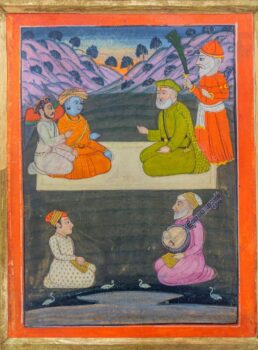
Painting from an 1830’s Janamsakhi series depicting a meeting and discussion between Gorakhnath (wearing orange) referred to earlier, and the Sikh Saint Guru Nanak (wearing green). Gorakhnath is referenced in the poetry of Kabir and of Guru Nanak of Sikhism, which describe him as a very powerful leader with a large following, and this may account for the ritual use of bhang in early Sikhism.
In the 19th century, one of the 12 confederacies of the Sikhs was identified by the name “Bhangi, called from their fondness for Bhang, extract of hemp” (Eastwick & Murray, 1883). However, for the most part, it seems the use of cannabis preparations have fallen out of favour with the devotees of the Sikh religion. “The Nihang of Punjab, [referred to earlier]who are the defenders of Sikh shrines, are an exception. They take cannabis to help in meditation” (Beck & Worden, 2002).
In 2001 the apex Sikh clergy instituted a prohibition of cannabis products as part of their “campaign against drug addiction” and this was vehemently rejected by the Nihang leader Baba Santa Singh, along with 20 other chiefs of the sect. As the Indian paper THE TRIBUNE recorded “Baba Santa Singh pointed out that the consumption of ‘bhang’ among the Nihangs was not a new phenomenon. He said it had been going on ever since the Nihangs came into existence and fought battles against Mughal and Afghan invaders” (The Tribune, 2001) As a result of his refusal to accept of the prohibition of cannabis products, Baba Santa Singh was excommunicated and replaced by Baba Balbir Singh who complied with the apex Sikh clergy’s ban on the use of hemp, and although many Nihang still reject this prohibition, in orthodox circles this controversial ban has been maintained until the present.
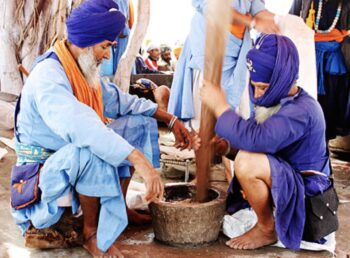
Nihang preparing their cannabis sacrament, sukha. At Takht Sachkhand Shri Hazoor Sahib, (one of the five seats of power in the Sikh Panth) the ‘Sukhnidhaan’ is offered as a holy food.
Nihangs, Fakirs, and Nath Yogis, held another thing in common besides their use of ganja – disdain for the Colonial efforts of the British Raj, and rulers out to Europeanize their societies. This is well documented on the historical record. In Hinduism at the Bar of the Twentieth Century Addressed to Hindu Revivalists (1903) published by the ‘Christian Society for India’, John Murdoch (1819-1910) a Scottish Christian missionary who served in Ceylon and India, recorded with some disdain, about the rabble rousing of “bhang intoxicated bachanals”, condemning saddhus for “cursing those who refuse alms, intoxicated with bhang” (Murdoch, 1903). Such rabble rousing and unruly aspects of Indian culture, who would not be swayed by the European’s promises of power and riches as were the upper class ruling elite, were not to go unchallenged, particularly by the British Raj. As Nile Green records in Islam And The Army In Colonial India: Sepoy Religion In The Service Of Empire (2009):
….Unable to intervene in religious matters by explicit dint of colonial policy, the British in India… faced the perplexing dilemma in the insulting antics of such figures… taunting them… as they passed in the streets… [I]t was here the new laws on insanity and vagrancy proved useful. For if the faqir’s activities could not be prohibited so long as they were regarded as part of the autonomous sphere of ‘religion’ – which the British were compelled to at least make a show of respect for… the problem of silencing the faqirs… disappeared if his deeds could instead be classified as those of a madman. (Green, 2009)
Thus, in order to rid these streets of these unruly hashish intoxicated “madmen” new British legislation was drawn up in Colonial India “including legislation on drug use and the incarceration of mendicants in India’s insane asylums” (Green, 2009).
The import of the faqirs reckless jeers, his nakedness and his open drug-use were for these reasons reinterpreted in official policy as signs of his insanity and his ‘anti-social’ character. Given the widespread role of faqirs…, the expanded role of the asylum was therefore one of several ways in which these unruly agitators were controlled. By these means, the social meaning of the faqir was reversed: his activities were no longer evidence of jazb, of sweet intoxication in God’s presence, but proof instead of insanity. (Green, 2009)
This British agenda in India, fit in well with contemporary medical views about what constituted insanity. In Madness, Cannabis and Colonialism: The ‘Native Only’ Lunatic Asylums of British India, 1857-1900, Professor James Mills, currently Director of Humanities Research at the University of Strathclyde, explains.
The constant reference to the lunatic asylum in British India in discussions of cannabis and cannabis users is the first clue in traces origins of those discussions. Mark Stewart… specifically referred to the asylums in his question to Parliament… ‘The Commissioner has always looked on a ganja-smoker and a bad character as synonymous, and has, in his connection with lunatic asylums in different parts of Bengal, observed that in large numbers of cases insanity has been induced by excessive ganja-smoking.’…
The asylum was important as it was the site of… the categorization and the enumeration of cannabis use as a social problem…
….Through this process at the asylum the use of cannabis substances among the Indian population became crystallized as a category of social problem by the colonial authorities through the invention of the hemp user as a dangerous human type.
….cannabis use by 1871/3 was associated by colonial officials with… immorality, suicide, the murder of Christians, and even the revolt against British authority of 1857. The cannabis user was identified as a human type, seen as unpredictable, [and]violent… (Mills, 2000)
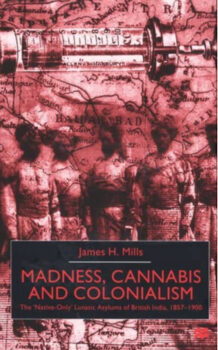
Madness, Cannabis and Colonialism: The ‘Native Only’ Lunatic Asylums of British India, 1857-1900 (Mills 2000)
As Nile Green explains: “The genealogy of mental pathology in Victorian British through the ideas of social reform and the earlier Enlightenment ideology of reason lent colonial medicine a complex politico-cultural agenda based on an ingrained bourgeois association between work and morality on the one hand and notions of self-control based on the characteristically British formulation of ‘common sense’ on the other” (Green, 2009). These ideas also fit in well with emerging ideas about external “stimulants” as the source of insanity.
[Readers interested in learning more about the role of cannabis in india that was largely omitted by Partridge, can check out my article The Ganja Culture of India.]
Chapter 3 MEDICAL
After decades of demonization and propaganda, the medical history of cannabis had largely been forgotten by most people, as with its many Industrial applications. When it started to show potential as a beneficial medicine, people started looking back at how it had been used into the past, and this became part of a way of introducing cannabis to a new audience. Partridge’s view on this is “Romantic constructions of history and indigenous cultures are frequently referenced as part of a popular apologia for medical cannabis… it is an example of the growing romanticization of cannabis.” (Partridge, 2024). This is a theme he harps on several times.
… when it comes to the…medical use of cannabis. Confirmation bias, selective use of available evidence, neo-romantic constructions of the past, and a radical reinterpretation of history are all employed to legitimize …the use of cannabis…. in order to establish the potential of medicinal cannabis, it’s not unusual for even broadly scientific discussions to reference historical usage…. the arguments for medicinal cannabis are continuous with a range of esoteric, spiritual, and countercultural discourse.
….This of course, is not to deny that there are medical researchers and users who are simply interested in the science of cannabinoids with very little interest in the countercultural field of discourse. However, while the results of scientific research are beginning to come to the fore, cannabis still carries a lot of broadly neo-romantic political and cultural baggage. (Partridge, 2024)
This is a complaint he emphasizes even more so, in the next chapter on Sacred cannabis. With this view in mind, he sets about trying to delegitimize, even desacralize the historical past of cannabis as a medicine, but here again, his work is largely based on bias, misinformation and glaring omissions.
Banging on about Bhang….
When discussing the role of cannabis in Indian medicine, he cites George Abraham Grierson‘s 19th century essay, ‘On References to the Hemp Plant Occurring in Sanskrit and Hindi Literature for the dates medical cannabis was introduced “Greirson noted that the principal terms used for the plant are bhanga, Indravana, [sic. Partridge misspells Indracana also rendered Indrisana] and possibly Vijaya, or Jaya, references which date back to ‘about 1300 AD'”. After acknowledging the Sanskrit term bhanga, however, can be traced back to the Vedic period, Partridge claims “the term bhanga was probably something like ‘psychoactive drug plant’… That is to say initially the term bhanga seems primarily to have indicated use, rather than identifying a particular botanical specimen” (Partridge 2024). Partridge cites Chris Duval’s Cannabis (2014) here, but he is mistaken as this is not what Duval inicated! This is not the only time a mistake like this occurs in nPartridge’s book either. Duval, in discussing the African term Riamba (cannabis) [again worth noting that Partridge omits the African cultural experience with cannabis]states that:
Riamba derives, firstly, from Old Arabic bang, meaning ‘psychoactive cannabis’; secondly, from Hindi bhang, one of three primary terms for ‘cannabis’ in that language; and, ultimately, from Sanskrit bhanga ̄, meaning ‘psychoactive cannabis’. (Duvall, 2014)
Partridge, who really tries to give off an air of authority, well demonstrably having little knowledge of the subject, claims that the Sanskrit bhanga, “identifies a plant with medicinal and medicinal properties – possibly any plant that fitted that description (such as datura, belladonna, and henbane)”. Grierson’s essay which he cited in relation to the dates given above, also conflicts with this, as does the majority of actual scholars familiar with this are of history. “The name Bhanga occurs in the Atharvaveda (say, B.C. 1400). The hemp plant is there mentioned simply as a sacred grass. Panini (say, B.C. 300) mentions the pollen of the hemp flower (bhanga).” (Grierson, 1894). So Grierson clearly saw these ancient references as specifically cannabis and Duval ‘psychoactive cannabis’, and this is by far the majority opinion.
A Sanskrit-English Dictionary (1872) clearly lists Bhanga, as both an epithet of Soma, and as “cannabis” and an “intoxicating beverage prepared from the hemp plant”. This interpretation of Sanskrit bhanga, identifying ‘cannabis’ is still the widespread translation, and I could not find any that listed ‘henbane’ as Partridge claimed with misconstrued references. See for instance bhanga in the more recent A Practical Sanskrit Dictionary with Transliteration, Accentuation, and Etymological Analysis Throughout (2004). The online Monier-Williams Sanskrit Dictionary is also clear on this designation as ‘hemp’. Bhanga as ‘hemp’ or ‘cannabis’ is by far the most common translation. If one searches, they will find countless entries like “The hemp plant, in Sanskrit Bhanga” The Journal of the Anthropological Society of Bombay (1890); “Hemp. Sanskrit:…Bhanga” Ayurvedic Medicinal Plants of India (2011); “Cannabis, Hemp; Indian Hemp; Sans.- Bhanga” Sacred and Magico-Religious Plants of India, (2005);
In fact, I can not find one Sanskrit Lexicons or Dictionary that lists bhanga as henbane, datura or any other psychoactive plant. Henbane is known as shyamā (श्यामा) or kukkutavisha (कुक्कुटविष) in Sanskrit. The Sanskrit word for Datura is dhattūra (धत्तूर), which is also the root of the Hindi word “dhatūra“. Partridge’s claim that Sanskrit bhang, meant henbane, is another example of his sloppy research, and is clearly based on a misrepresented citation. The vast majority of sources clearly list cannabis in this context.
Curiously, Partridge leaves the Avestan counterpart of the Sanskrit bhanga, unchallenged, and quotes Duvall in regards to “The Zoroastrian Zend Avesta (perhaps 700 BCE)… listed bhangem among four abortificants…” (Duval, 2015), accepting the designation here of ‘cannabis’ wholeheartedly. However, here unlike the Sanskrit situation with bhanga, there is much more room for debate in regards to the identification Avestan language bangha, where some translators have suggested ‘henbane’, while the majority claim ‘cannabis’. [I have explored this situation in detail, and feel I show a stronger case for cannabis, although the association with henbane and the term did come into the Islamic period. For a more full discussion of Avestan bhangha, see my article on Flattery and Schwartz’s Haoma and Harmaline.]
The Zend Avesta and the Omission of Zoroastrian Entheogenic Use
Partridge’s acceptance of the Zoroastrian term in the Zend Avesta, brings us to another one of his intentional glaring omissions. Partridge purposely ignored references to cannabis use for ecstatic purposes among the Zoroastrians while accepting the view that it was used under the same name, medically. This accounts for another glaring omission of ‘sacred’ cannabis, and it is worth here again noting, as with Hinduism and Islam, what exactly Partridge has left out of the equation. As a group of Iranian academics and clerics concluded “bang, an Avestan term indicating whole cannabis residue… Prior to the Islamic era, the plant was cultivated and used in rituals by Zoroastrian priests” (Ghiabi, Maarefvand, Bahari, Alavi, 2018). E.J. Brill’s First Encyclopaedia of Islam 1913-1936, likewise records of both the Avestan and Sanskrit language references; “BENG, (Sanskr. bhanga, Avest. Banha, Pahl. bang, mang, hemp), strictly the name of various kinds of hemp” (Houtsma, et al., 1987). Under the Avestan name bhanga, and its Pahlavi counterpart mang, cannabis appears in a number of Zoroastrian texts as a means of visionary exoperiences.
Evidence of shamanic practice are plentiful in Zoroastrian accounts. Zoroaster himself is attributed a visionary journey. The hero Arda Viraz takes a drug, called in Pahlavi mang, that is, the Avestan bangha-, cannabis to enable his soul to leave his body, and see the vision of Heaven and Hell (Proceedings of the Second North American Gatha Conference 1996). The Encyclopedia Iranica records that In the Ardā Wīrāz-nāmag, the hero “was required to drink the narcotic mang… After drinking mang (and thus making an extra-terrestrial journey), his doubts are resolved (See Dēnkard 7.4. 83-86, ed. and tr. M. Mole, La légende de Zoroastre selon les textes pehlevis, Paris, 1967.)”.
Gherardo Gnoli, a scholar of Iranian history, recorded in an entry on ‘Bang’, for the Encyclopedia Iranica the specific Zoroastrian texts that identify in its medicinal, shamanic and spiritual use:
…[W]hen Ahriman attacked the creation, Ohrmazd gave the primordial bull a “medicinal” mang (mang bēšaz) to lessen its injury. The bull immediately became feeble and sick and passed away (Bundahišn , tr. chap. 4.20). However, bang was also an ingredient of the “illuminating drink” (rōšngar xwarišn) that allowed Wištāsp to see the “great xwarrah” and the “great mystery.” This mang ī wištāspān (Pahlavi Vd. 15.14; Ardā Wirāz-nāmag 2.15) was mixed with hōm (Dēnkard 7.4.85) or wine (Pahlavi Rivayat 47.27). It was an integral part of the ecstatic practice aimed at opening the “eye of the soul” (gyān čašm…) and was therefore drunk by Ardā Wirāz (Ardā Wirāz-nāmag 1.20, 2.9, 15, 16) before his journey into the other world. (Gnoli 1988)
In reference to Zoroastrian expeditions into the world of the afterlife, Shaul Shaked, Professor emeritus in Iranian Studies and Comparative Religion at the Hebrew University of Jerusalem, noted that “The preparation of this journey was done… by administering to the officiant a dose of mang (hemp), mixed with wine” (Shaked, 1999). “Zoroaster is commonly said to have spiked the haoma with mang, which was probably hashish. It would have prolonged the intoxication and further stimulated the imagination of the drugged man. Of such are the wonders of Heaven” (Oliver 1994). In the Zoroastrian tale “…the Artak Viraz Namak… Hell, Purgatory, and Heaven, the rewards bestowed on the good, and the punishment awaiting the sinner are here described in a vision induced by hashish” (Campbell, 2000). Referring to this same account, van Baaren and Hartman also noted the hero “imbibes an intoxicant composed of wine and hashish and after this his body sleeps for seven days and nights while his soul undertakes the journey” (van Baaren & Hartman,1980). 19th century author James Francis Katherinus Hewitt also refers to the “enlightening prophet drug Bangha (Cannabis Indica), the Hashish by which the Zoroastrian priests were inspired” (Hewitt, 1901). This is a widespread view: In Traditions of the Magi: Zoroastrianism in Greek and Latin Literature, Professor of Comparative Religion and Religions of Antiquity at Leiden University, Albert de Jong, notes, “hemp (Av. ba nha,– Phl. mang) consumed by some of the holiest men of the Zoroastrian tradition (Vistaspa and Arda Wiraz)” (de Jong 1997); “healing mang ( Indian hemp ) which some call bang” –The Teachings of the Magi; A Compendium of Zoroastrian Beliefs(1956) by Robert Charles Zaehner; Modern Iranian scholars and clerics agreed on this group statement: “bang, an Avestan term indicating whole cannabis residue… Prior to the Islamic era, the plant was cultivated and used in rituals by Zoroastrian priests” (Rabeie, 1998, p. 19).” (Ghiabi, Maarefvand, Bahari, Alavi, 2018); Ali Amini, Assistant Professor at Shiraz University, also sees this designation ” Ahuramazda gave the curative Mang (hemp), which is also called bang“; Sara Kuehn also refers to “The Avestan Kavi Vīštāspa [A persian King and Zoroaster’s first convert] was given the illuminating beverage hōm and mang (Pahl.; hemp) when he accepted Zoroaster’s teachings (Dēnkard 7.4.84–86); Jenny Rose, an adjunct professor and historian of religions in the Zoroastrian Studies program in Claremont Graduate University’s Religion Department, who holds a doctorate in Ancient Iranian Studies from Columbia University, also notes “Mang seems to have been an intoxicant of some kind, perhaps hemp” in Zoroastrianism: An Introduction (2019); Zoroastrian Problems In The Ninth Century Books by Sir Harold W. Bailey an English scholar of Khotanese, Sanskrit, and the comparative study of Iranian languages. refers to the “narcotic, mang, which…was the same as bang ‘hemp’ ” (Bailey 1943/1971)
This was also the view of the Swedish scholar Henrik Samuel Nyberg (1938), and the German Iranist, Geo Widengren (1965), who were both cited in material from Eliade that Partridge was familiar with but omitted. [I had passages of their work translated for Cannabis and the Soma Solution (2010) and have reprinted some of those in my essay The Herb of the Magi: Zoroaster’s Good Narcotic (2019).]
Touraj Daryaee, an Iranian Iranologist and historian states that in a world of competing religions “For the Zoroastrians to hold their own, they had to innovate and introduce new ways of making this journey and while propping up a tradition that Zoroaster also had taken part in these ceremonies, taking the hallucinogenic drinks, as did his patron, King Wishtasp. ‘Wishtasp’s hemp‘ became an important means of inducing voyages. Two journeys (those of Wishtasp and Wiraz) we know of for certain, and Kerdir [a prominent Zoroastrian priest in the second half of the 3rd century]probably took the same drink. Thus the Zoroastrians had to take mang, ‘hemp’.” Shamanistic Elements in Zoroastrianism: The Pagan Past and Modern Reactions,” (Daryaee, 2000)
Encyclopedia Iranica gives us some insights into the beliefs behind this use in an entry from Prods Oktor Skjærvø, Emeritus Professor of Iranian Studies in the Department of Near Eastern Languages and Civilizations at Harvard University:
The purpose of the heavenly journey. The account of the journey up to paradise follows the pattern of the.. Ardā Wirāz-nāmag... undertaken to regain confidence in the correctness of the traditional ritual practices in a time of doubt. According to the account of Wirāz, for 300 years after Zarathustra received the dēn, people had no doubt, but after the devastation caused by Alexander, whom the Foul Spirit had sent for this purpose, people came to harbor doubt, and rivals to the Mazdayasnian [Zoroastrian] tradition began to proliferate… and it was decided to send someone into the other world to verify whether the ritual gifts went to the gods or the demons and whether they helped the souls at all… Wirāz was given wine and hemp (mang) and went to sleep, and his soul went to the Činwad bridge and returned after seven days, after which Wirāz dictated the story of his journey to a scribe” (Skjærvø, 2011).
However, from what I have seen in the modern day, any mention of the religions ancient cannabis use to practicing mainstream Zoroastrians is met with disbelief and disdain, this last aspect comes up in Partridge’s comments on the court case of Danuel Quaintance in the next chapter of Partridge’s book, but he fails to regard these Zoroastrian references there as well.
Zoroastrianism, it should be noted, significantly influenced the development of Judaism and subsequently Christianity by introducing concepts like monotheism, a cosmic struggle between good and evil, a final judgment, resurrection, and an afterlife with heaven and hell. These ideas, which were not prominent in earlier Jewish thought, are believed to have been adopted during the Babylonian exile when Jewish exiles came into contact with Zoroastrianism.
Islam is as well, emerged in a region where Zoroastrianism had been a major influence, and some of its core beliefs appear to have been shaped by Zoroastrian ideas that were prevalent at the time. Zoroastrian influence on Islam, particularly in the Persian region, is well documented. As Joseph Campbell explained: “It is obvious that in every syllable Islam is a continuation of the Zoroastrian-Jewish-Christian heritage…” (Campbell, 1964)
Indications are that the Zoroastrian use of cannabis also carried into the formation period of Islam. “Hemp… as an intoxicant… was passed on via Persians, to the Arabs” (Sherratt, 1997). There is evidence that some use was still in play in Persia during the reign of the Sassanian king Khosrow I (died ad 579) (Dymock, 1893; Houtsma, et al., 1938) ) and in “Azerbaijan, a former centre of the Zoroastrian religion and homeland of the cannabis using Scythians, medieval manuscripts also record the use of wine infused with a mixture of cannabis, opium and henbane” (Dannaway, Piper & Webster, 2006). This fits well with the potion attributed to the Hashishyya and it is generally viewed that through these channels the use of cannabis was adopted by the more mystical branches of Islam, such as the Hashishyya of the Nizari Isma’ilism, along with Persian Sufi and Fakir groups. My view is that Persian Hashishin potions were an adoption of Zoroastrian infused wines.
…[G]iyah-e javidan (‘the herb of the immortal’), giyah-e moqaddas (‘sacred herb’), khadar (‘green’), kimiyah (‘alchemy’), qanaf (‘hemp’), zomord-e giyah-e (emerald herb) are among the many expressions given to cannabis in the Iranian plateau… More popular names are hashish, the Arabic word for “grass”, bang, an Avestan term indicating whole cannabis residue, or the Persian word for ‘grass’, ‘alaf.… But the name that has entered the Persian language is shahdaneh, “the royal seed”. The word is currently used to refer to cannabis both as a plant, a seed and a drug. (Ghiabi, Maarefvand, Bahari, Alavi, 2018)
[It is worth noting, and as I have discussed elsewhere, a Zoroastrian influence has long been suggested in the account of Muhammad’s ascent to the heavens as described in the Koran and discussed in detail in the Hadith literature. A number of researchers have suggested that this event, as well as the details in it, had been borrowed from the Persian story of Arda Wiraz Namag, and his cannabis induced journey into the after-world (Gray, 1902; Jackson, 1928). The Cinvat Bridge mentioned in the Arda Wiraz Namag was particularly compared with the bridge over Hell as mentioned in the Hadith literature.]
China
The tombs areassociated with the Gūshī culture, contained the remains of a Caucasoid shaman along with a large cache of cannabis. While direct genetic data from human remains in the Yanghai Tombs is sparse in the provided references, some conclusions can be drawn from related studies and archaeological context, particularly regarding the broader region and similar sites. This aligns with the broader genetic profile of some Tarim Basin populations, like those at the Xiaohe Tomb complex, where ancient cannabis was also recovered. Maternal lineages showed a mix of East Asian (e.g., mtDNA haplogroup C) and West Eurasian (e.g., mtDNA haplogroups H, K, U5, U7, U2e, T, R*) ancestry, while paternal lineages were predominantly West Eurasian (Y-DNA haplogroups linked to groups like the Yamnaya or other steppe populations). The presence of such genetic markers suggests that the Yanghai people, or at least some individuals, may have had ancestral ties to Indo-European-speaking groups, possibly related to the Tocharians or other steppe pastoralists who migrated into the Tarim Basin.
The Gūshī people used wool for clothing and reeds for ropes, distinct from the hemp textiles found in earlier Yangshao culture sites in northern China. The shaman’s burial with cannabis, used likely for medicinal or ritualistic purposes, points to a sophisticated cultural practice involving psychoactive substances, possibly linked to spiritual or divination rituals. The cannabis itself was selectively cultivated specifically for psychoactive use, female plants were used, and importantly this practice that may connect the Gūshī to broader Central Asian cultural networks. Thus the cultural identity of the Yanghai people, therefore, appears to be that of a pastoralist, possibly Indo-European-affiliated group with connections to Central Asian steppe cultures, practicing complex burial rituals and using cannabis in a ritualistic context. Their genetic makeup likely included West Eurasian paternal lineages and a mix of East and West Eurasian maternal lineages, reflecting the Tarim Basin’s role as a cultural and genetic melting pot.
However, after discussing this archaeological find, Partridge writes “what is known of ‘Chinese shamanism’ (wu jiao) in the region during this early period suggests that cannabis was used ritually (possibly to induce trance states) and medicinally” (Partridge, 2024). Well i would agree, the Yanghai Tombs are not evidence of the indigenous Chinese use of cannabis, although other textual and archaeological evidence attests to that, and some of the Han Chinese use may be influenced by IE immigrants from the Gushi culture. He also misses the similarity in both ritual and implement, as in braziers loaded with hot stones, to other Indo-European sites, particularly as we shall discuss in his analysis of the Scythians, in his next and final chapter.
In relation, Chinese names for cannabis have been connected to the Scythians. Mia Touw, in her essay The Religious and Medicinal Uses of Cannabis in China, India and Tibet (1981) notes that among the Chinese “it was hu-ma, or fiery hemp (as the meaning has been construed by some etymologists), which also meant Scythian hemp (Stuart1911) and this latter kind was held to be especially potent” (Touw, 1981). Professor Mark Merlin as well notes “It is interesting that the Chinese character hu, which refers to barbarians or foreigners of the West, can be connected to the character for hemp (hu-ma) to indicate western or foreign hemp and the potent female hemp plant” (Merlin, 1972). This is important in relation to material regarding the ancient Scythians, and theories about haoma which will be looked at in the next chapter.
Besides this glaring mistake, Partridge’s over view of medical cannabis in ancient China seems accurate and fair. Less so, when it comes to its spiritual connection, as will be looked at in the next chapter.
Partridge questions Warren Royal Dawson‘s translation of the Egyptian term shemshemet, as cannabis, widely accepted by Egyptologist, and applied in medical recipes for ailments cannabis is known to treat, on the basis of William Benson Harer‘s dissmissal of it. Harer questioned the claim that shemshemet was both a medicine and fibre plant, has only one references to it as a rope, and instead suggests medical cannabis was likely not known till the 7th century CE. This seems like a conspicuously late date, considering cannabis was knowing in the Near-Mid East for more than a millennia prior, and the evidence from pollen sample in soil strata in Egypt, indicates, fibre evidence place it in the region as far back as the mid third millennium.
Certainly, like many ancient words, such as Assyrian qunnabu, usually translated as cannabis, there are some dissenting views. But when Partridge acknowledges the archaeological evidence for Egyptian cannabis, referred to by Dr. Ethan Russo, who has written extensively on the history of medical cannabis. he curiously states “evidence for medical cannabis use has been controversial” (Partridge 2024), with no further explanation as to why. Certainly, this shows cannabis was a fibre plant in the region, which was the point of contention for Harer’s dismissal due to a single reference as “rope’, and it places cannabis in the region millennia before he suggests it was known in Egypt. As surrounding cultures were clearly aware of the plant’s fibre, medicine and its sacred use, it’s easy to understand Harer’s view is a minority opinion. While not all scholars agree, particularly on whether cannabis was used for psychoactive purposes (evidence for which is less clear), the linguistic, textual, and archaeological data have led most modern Egyptologists to accept shemshemet as denoting cannabis, used both as a fibre source and medicinally.
[There have been claims that Egyptian mummies have had races of THC through deep tissue analysis, but these however, are marred in controversy – see my article on Egyptian use for more on that.]
The First English reference to cannabis?
Partridge, confidently claims: “Arguably the earliest reference to cannabis in English appears in 1621, in Burton’s Celebrated text, The Anatomy of Melancholy... He recommends it’s use…as an effective sedative… he reminds readers that ‘country folk commonly make use of a posset of hemp-seed'” (Partridge, 2024).
This is patently false, there are a numbers of references to cannabis that predate that document. Here is an overview:
-The 10th to 11th century collection of old English medical texts, known as The Lacnunga (Remedies), contains a recipe for a “holy salve,” which included among its various ingredients “Betony and bennet (“bless- ed herb”), and “hind health” and hemp [Haenap].”
– 1548: “Cannabis is called in Englishe Hemp.” This 1548 usage was in William Turner‘s book The names of herbes
-1585: The treasury of health, containing many profitable medicines 1277 – )English 1585) lists hemp in two different remedies. A Treasury of Health was said to have been authored by Pope John XXI (1215-1277), who approved of the advancement of medical science, which he held a deep personal interest in. Considering the sacred nature of the author, it is a hard miss for Partridge. The book is described as a compendium of medieval medical knowledge “conteynyng many profitable medycines gathered out of Hypocrates, Galen and Auycen [Avicenna],” which offered some descriptive medical recipes. (Both Galen and Avicienna refer to cannabis in their writings). Besides recommending the juice of hemp to take away the fever, “The ioyce of Hempe, afore the fyt taketh away the feuer” in a “remedy against a carbuncle,” Pope John XXI also recommend a cannabis-infused wine:Remedies – “Agaynst the scabe and french pokes cap. LXII”:
… Take of red colewortes, fengreke Percely, sothernewod, tansey, strawbery leaues, and suet, brere leaues, plantayn leaues, hempe, red- madder smallage, cransebill, Alam, nuttes, before al thynges let them be sodden together in pure whyte wyne, & put therto a lytle hony, giue it vnto the pacient early & late, and anoynte ye wound wtout when he hath dronke of ye sayd potion, & lay theron a lefe of red colewortes & keape the same contynually ouer it, it openeth it and hath ben often prouyd. (Pope John XXI 1277/1585)
Pope John XXI’s comments coming from a time when the Papacy did not consider arts directed at the healing of the body, as distracting from the churches directive of the salvation of the soul, a view the Vatican would take in later times. I suspect this aspect also led to the decline of wound drinks and salves, as well as associations with witchcraft. Interestingly, after his death, rumours about Pope John XXI being a necromancer began to appear, and that his death was punishment from God to stop him from completing a heretical treatise. So much to unpack here in ways of the ‘sacred and profane’ in the middle ages, that was ignored and missed by Partridge.
In regard to “wound drinks”, they primarily consisted of wine and herbal infusions, often used for cleansing and pain relief. Alcohol, particularly wine, was recognized for its antiseptic properties, while herbs and other ingredients were employed for their perceived healing and soothing qualities. Some recipes also included honey, known for its antibacterial effects. There was a cannabis wine infusion dubbed as the “drync of Antioche”, known from at least the Crusade era. Antioch was the epicentre for Hellenistic Judaism and is also considered the cradle of Christianity, and according to the New Testament the term “Christianity” first came into use there.
-1425: “a good handful..of femaille hempe” The Drink of Antioch, a Medieval Medical Cannabis Infused Wine
As a 14th century text records:
To make drync of Antioche Take bugle, auence, strawberywyses, redcolecrop, dayse, of iche a good handful..of femaille hempe v croppes..putte alle þese herbes in a pot, and do þerto a galoun of qwyte wyn, and sethe it..do þer-to als moche of hony. –Medical Recipes in Stockholm, Royal Library 10.90, see link for more references:
The herbs were boiled together in white wine, a quart, or litre, and mixed with an equal amount of clarified honey. which aided its use as a salve. The preparation, was boiled down into a syrup, known as the “Sirup of antioche”, and further rendered into solid form becoming the “Pelotus of Antioch”, considered as the forerunner to the modern medical “pill”. It was considered a potent medicine for a variety of ailments and was often carried into the battlefield as it was considered an excellent treatment for wounds.
The 15th century English poem, ‘How a Lover Praiseth his Lady’*, gives us the following reference:
The wounded bodyes to hele and save,
Antyoche to drynk and holsom safe
Ther was als a myrrour of wonder engyne
Ipolysshed by Intellygence devyne
The third herbe is Canabus [cannabis]& it is long in shafte & clothes be made of it. The vertue of the Juse [juice]of it is to anoynt thee with it & with the juse of arthemesy & ordyne thee before a mirrour of stele [steel]& clepe thou spiritts & thou shallt see them & thou shalt haue might of binding & of loosing deuills [devils]& other things.” (Sepher Raziel, 1564).
“Anoint thee with the Joice of Canabus & the Joice of Archangell & before a mirrour of steele call spirits, & thoue shalt see them & have power to binde & to loose them” (Book of Oberon, 1577-1583)
John of Gaddesden, who served as the prototype for Chaucer’s “doctor of physick” character in The Canterbury Tales, recorded in his medical treatise the Rosa Anglica(1314) that such wound drinks injured the stomach and belonged to ‘ancient surgery’.?” A statement which indicates their more ancient history. The decline of the Antioch drink was believed to have been hastened when it ceased to be recognized specifically as a wound drink, A recipe in a manuscript of 1443/4 gives merely the general instruction: ‘Use it for all evils of the body’. However, I wonder if the decline had more to do with its use with magic mirrors, and other uses rather than as an all around medication?
Associated quotations [click ‘show all’]:
- c1425 Arderne Fistula (Sln 6)45/1 : Drynk of Antioche.
- ?a1450 Þe man þt wylle (Wel 542)21 : Be þe wounde nevere so deep..So þat he drynke save or anteocke [vr. antioche], Him dar not drede of þat outrage.
- c1450 Med.Bk.(1) (Med-L 136)66/161 : A goode confeccion that is clepid peletis of antioch.
- c1450 Med.Bk.(1) (Med-L 136)276/893 : Sirup of antioche Take an handfull of dayseȝe..bugle..red cole..hemp..mader [etc.].
- c1450 When the son (Frf 16)130 : The wounded bodyes to hele and save, Antyoche to drynk and holsom safe.
- ?c1450 Stockh.PRecipes (Stockh 10.90)83/16 : To make drync of Antioche Take bugle, auence, strawberywyses, redcolecrop, dayse, of iche a good handful..of femaille hempe v croppes..putte alle þese herbes in a pot, and do þerto a galoun of qwyte wyn, and sethe it..do þer-to als moche of hony.
- ?c1450 Stockh.PRecipes (Stockh 10.90)132/34 : For to make pelotis of Antioche.
- a1500 Hrl.2378 Recipes (Hrl 2378)77/3,14 : Pelotus of antioche..The drynk of Auntioch.
- a1500 Sln.2584 Med.Miscell.(Sln 2584)128 : Balles of Antioche.
I have seen a very similar infused wine recipe in the Portfolio of Villard de Honnecourt as well,
Take leaves of red cabbage, and of avens – this is an herb which one calls “bastard cannabis.” Take a herb which one calls tansy and hemp – this is the seeds of cannabis. Crush these four herbs so that there is nothing more of the one than of the other. Afterwards you take mad- der two times more than any one of the four herbs, then you crush it, then you put these five herbs in a pot. And you put white wine to infuse it, the best that you are able to have, being somewhat with care that the potions not be too thick, and that one is able to drink them (de Honnecourt, 1230).
…[C]annabis was subjected to a process of cultural cleansing in an effort to reclassify it as a safe medicine. Dawamesc was a conspicuous marker of Oriental otherness, while tincture was clearly located with the fold of Western medicine… The preference for tincture, while having a scientific rationale, was more importantly, symbolic of a shift from the profane to the sacred, from Oriental chaos to occidental order…. hashish was too embedded in Orientalist discourse for this to be ultimately successful. Again, the attempt to civilize failed. (Partridge 2024)
Surviving translation of Zosimos work, have the ancient sage identify references to cannabis infused wines and beers. “…wines can be made in a multitude of ways, [as shown]through many accounts that authors have left to us, and nature, and art such things, that is, grown wines from the vineyard and medicinal, or by adding various spices like palm, cannabis seed, etc …”; “Certainly brewers of Egyptian beer [‘zythi’], which is more powerful [then our beers]are not lacking in the false and wicked arts, and might be better used for intoxication. This [concoction]includes: borage, cannabis seeds and leaves, helenium, ivy leaves, strychnine, and darnel.” As Tom Hatsis who translated that passage has noted of this :
“Interestingly, he uses “lolium temulentum” for “darnel” (a known psychoactive), which specifically draws attention to the intoxicating powers of the plant (temelentum means “intoxication”)! He is also comparing the addition of things like cannabis, darnel, and strychnine to the magical arts!!! I mean, he calls them “false and wicked arts,” but that is EXACTLY how writers commented on magical works. He is OPENLY recognizing the use of cannabis and darnel in potions by magicians!” (Hatsis, 2016)
“Take the best wine that you may find, if you have some money. If you are poor, then take corrupt wine, that is, rotten, of a watery nature, but avoid any that is sour, for the quintessence is naturally incorruptible and will be drawn out by sublimation. The four elements, as it were, the rotten feces of wine, will be left in the bottom of the vessel. But first you must distill this wine seven times, and then you’ll have good burning water. In truth, this is the watery matter from which is drawn our quintessence…. it will be an incorruptible medicine, almost as heaven above and be of the nature of heaven. Therefore, our quintessence is worthy of the title ‘mortal heaven’” [Translated by Bryan J. Mahoney in 1995 from the 1866 old english edition of the 1460 manuscript.]
Of such texts, Patai’s work was directed at a Hebrew alchemical text devoted to the Quintessence. The 14th-15th century Hebrew manuscript opens with the words “And now I shall copy for you a great secret of the fifth essence, which is called in their language qinta esensia.”
As the Hebrew text records:
…if you want to prepare a potion for a disease… place those drugs which are appropriate for that potion into our Fifth Essence, and it will become like the potion, and it will be more effective, one part of it to a hundred. And likewise… the fragrant drugs, and thus all things of this kind, and thus all the cordial drugs must be pounded to utter thinness, until one cannot feel it by palpitation…
“This medicine was invented by a great sage, and many old diseases came upon him, and he saw this in a dream, and made it, and was cured, and he put it in writing so as to help many people . And it helps internal [diseases]by drinking and external [diseases]by way of a plaster chaff of qanavos (hemp). And we have tried this medicine many times, and all those who take the above mentioned mixture will be saved form leprosy and perselia [palsy?], and from bad diseases which have no [other]cure.”
Islamic figures, who played an important in the development of European alchemy like Geber ( Jabir ibn Hayyan); Ibn ‘Arabi (Abū ‘Abd Allāh Muhammad ibn ‘Alī ibn Muhammad ibn ‘Arabī al-Hātimī at-Tāī); and Avicenna (Abū ‘Alī al-Husayn ibn “Abd Allāh ibn Al-Hasan ibn Ali ibn Sīnā) have all been connected with cannabis. Arab alchemists are widely credited with the development of techniques like distillation, sublimation, and crystallization. (Bennett, 2018). Terms like “Theriac,” “Medicinal Powder” and “The Secret” (esrar) for hashish bring to mind some of the preparations and secret names associated with alchemy. “As much was made of addicts of the ability of hashish to show them ‘secret meanings,’ or, as we might say, to open up for them new levels of mental perception, it is not surprising to find ‘secrets’ (esrar) as a commonly employed nickname for hashish among the Turks” (Rosenthal, 1971).
This alchemical use overlaps with the long history of medical cannabis in the Islamic world, which Partridge also chose to ignore. “Arabs were the first to invent the soporific sponge (anaesthetic sponge)…. It was often used as an anaesthetic in the Medieval Ages and served as the forerunner of modern anaesthesia. It was soaked with aromatics and narcotics and then immersed in a combination of hashish, a herb named Zoan, hyoscyamus and opium to be sucked and then placed under the patient’s nostril before surgery, resulting in anaesthesia” (Joni, Ismail, Nordin, 2023). Dr. M. Aldrich, a pioneer in the study of cannabis history, has commented that “skilled alchemists with pretty classy lab equipment experimented with all kinds of potions; if Geber and others could distill alcohol, they could have made hashish (or even hash oil) and, indeed, Geber included banj among his powerful prescriptions” (Aldrich, 1978). Geber mentioned Banj [hemp]as a sedative medicine in his book Al-Somum” (Joni, Ismail, Nordin, 2023). Geber “has been acknowledged by both the Arab and European alchemists as the patron of the art since the eighth century” (Shah, 1964).
“Ibn Sina (Avicenna) introduced neo-Platonism into Islamic philosophy. Neo-Platonic theory of emanation of nature from God especially appealed to the Sufis… the distinction between the individual and the absolute vanished; the Sufi proclaimed himself thus: I am the Truth, I am the Reality. Sometimes this conclusion was reached by artificial means, by adequate dose of hashish.” (Chatterji, 1973).
We can be sure thatEuropean alchemical preparations also included cannabis, because Paraclesus and other alchemists made direct references to its use. Paracelsus left a few recipes that included cannabis; I was able track down the following recipe, from an Old Dutch translation, for the Arcanum Compofitum, the “secret composition”, in the Fasciculus. Oft Lust-Hof der Chimescher Medecijnen, uyt allen Boecken ende Schriften Doctoris Theophrasti Paracelsi van Hogenheym vergadert (1614). This contained cannabis and other ingredients infused in wine and was also used to treat epilepsy.
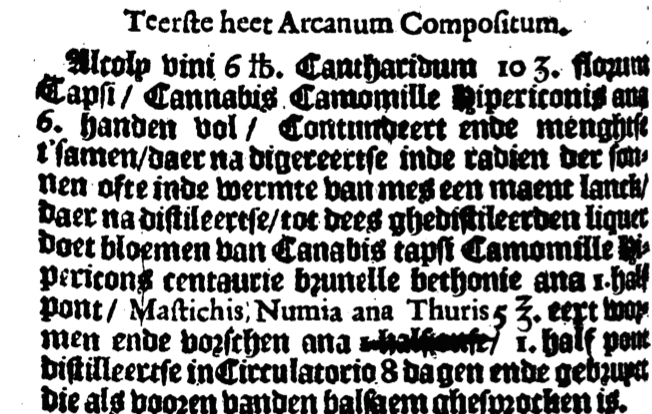 Recipe for the Arcanum Compofitum, ‘secret composition’, from the Fasciculus, Often Lust-Hof der Chimescher Medecijnen, uyt alle Boecken en Schriften Doctor Theophrasti Paracelsi van Hogenheym (1614).
As I have documented in Liber 420, often translating Latin passages from 16th-17th century alchemical texts for the first time, cannabis was widely known among alchemists. Alchemical texts that were attributed to Raymond Lull contained references to cannabis for use in arcanum and quintessences. The alchemist Gerolamo Cardano referred to a preparation of alcohol as aqua ardens, and describes an intoxicating alcoholic infusion that contained cannabis, as well as what was likely hashish under the name ‘asseral’. In De secretis libri XVII (1613), the alchemist and physician Johann Jakob Wecker reproduced Cardano’s recipe under the name aquae inebriates, or ‘inebriating water’.
Alchemists like magicians were deeply influenced by astrological relationships that were prescribed in grimoires like Picatrix. Every identifiable plant, animal, metal and mineral was viewed as being under the dominion of one of the planets. Cannabis appears with other psychoactive plants in a number of alchemically influenced herbals, under the dominion of Saturn. From an alchemical perspective, Saturn is of great importance as it stands at the border between the personal, transpersonal, or cosmic powers.
Nicholas Culpepper’s 1652 work The Complete Herbal refers to cannabis in stating that “it is a plant of Saturn”. This planetary dominion is also given in William Lilly’s Christian Astrology, (1647) which also includes known hallucinogens such as “Woolf-bane… Hellebore the white and black, Henbane… Mandrake, Poppy, Nightshade” and other plants. We see this planetary association still in use a century later, in a list of “Planetary Correspondences used by Cagliostro and his Contemporaries” that included “hemlock… nightshade, [and]hemp” (Faulks & Cooper, 2016). This shows an awareness of cannabis psychoactive properties by its grouping with other psychoactive plants,
The Royal Society, formally known as ‘The President, Council and Fellows of the Royal Society of London for Improving Natural Knowledge’, is the United Kingdom’s national Academy of Sciences. Founded on the 28th of November 1660, it was granted a royal charter by King Charles II as “The Royal Society”. Many of the Royal Society’s founding members were practicing alchemists, Freemasons, and also likely secret Rosicrucians. This was also a time where scientists might find themselves on the pyre of fire beside the heretics, so we can be sure there was a need for secrecy.
One of the original founders, Robert Boyle, (1627-1691) is largely regarded today as the first modern chemist, and therefore one of the founders of modern chemistry, and one of the pioneers of modern experimental scientific method. In a list of scientific projects he included the search for “Potent Drugs to alter or Exalt Imagination, Waking, Memory, and other functions, and appease pain, procure innocent sleep, harmless dreams, etc.” As well as making reference to: “Pleasing Dreams and physical Exercises exemplify’d by Egyptian Electuary and by the Fungus mentioned by the French Author.” The Egyptian Electuary is a likely reference to Egyptian hashish electuaries such as majoon or dawamesk. The reference to the the Fungus mentioned by the French Author” may allude to a reference to an agaric mushroom in a possible entheogenic context recorded in the works of Rabelais,, who as I discuss in Liber 420 refers at least twice to the “good agaric”. Rabelais is also known for his veiled references to cannabis.
The distinction between intoxicating Eastern varieties of cannabis, and the inactive European industrial varieties was first noted by a well known 17th century scientist from the Royal Society, Robert Hooke;
“The Latin name indica has been associated with psychoactive Cannabis since 1747, although the British polymath Robert Hooke earlier proposed “Indian hemp.” The locative term indica links the plant with India, which European scholars considered its “natural” habitat. The name persists because in 1783 a french naturalist chose “indica” to name a new species, which he considered “very distinct” from European hemp. The “principle virtue” of Cannabis Indica was “to derange the brain … and give a sort of gaiety.” “Cannabis indica” became a pharmacological term in the nineteenth century and current taxonomy of the psychoactive subspecies and domesticated variety” (Duvall, 2014).
Hooke noted that “Indian hemp” was different from European hemp, based on the accounts of its effects from Captain Robert Knox who had experimented with it in Sri Lanka. Hooke lamented that seeds from this “Indian hemp grown in England, failed to produce any effect and “hath lost its virtue.” This led to the understanding of how climate affected resin production. Knox had informed Hooke of bhang’s sacred use in Ceylon, such as by Indian swamis participating in a pada yatra to a shrine such as Kataragama. As a devout Christian, he had been unimpressed with the consequences: “He saith ‘tis commonly made Use of, by the Heathen Priests, or rambling Mendicant Heathen Friars, who will meet together, and dose themselves with this medicine, and then ramble several Ways, talking they know not what, pretending after that, they were inspired.”
Robert Knox, a 17th-century British East India Company captain, is notable for his captivity in Ceylon (Sri Lanka) and subsequent contributions to the Royal Society, particularly through his detailed observations of the island’s culture and natural history. He also became a source of information and specimens for the Royal Society, including objects from Vietnam and Java. His work, particularly “An Historical Relation of the Island Ceylon” (1681), provided valuable insights into the region and influenced European scientific understanding.
Knox was not the first British seamen known to experiment with cannabis. This distinction belongs to Thomas Bowrey’s A Geographical Account of Countries Round the Bay of Bengal 1669 to 1679 (1905). The incident occurred in Bengal in the 1670s and involved Bowrey, a merchant seaman, and a handful of his fellow sailors. Bowrey’s historic account describes the diverse effects of bhang, which he referred to as ““Theire Soe Admirable Herbe” :
“It Operates according to the thoughts or fancy of the Party that drinketh thereof, in Such manner that if he be merry at that instant, he Shall Continue So with Exceeding great laughter, rather overmerry than Otherways, laughing heartily at Everything they discern; and, on the Contrary, if it be taken in a fearful or Melancholy posture, he Shall keep great lamentation and Seem to be in great anguish of Spirit.”
Bowery, and his crew also experimented with cannabis upon themselves, with amusing results.
After receiving samples of “Indian Hemp” from Knox, Robert Hooke, went onto give 2 lectures about the effects of cannabis for the newly founded Royal Society, at the end of 1689 and in the beginning of 1670. This Indicates the deep interest among scientists at that time. For a deeper dive into this little known, but fascinating bit of history, see What Were They Smoking at the Royal Society? Dr. Robert Boyle and Dr. Robert Hooke on Drugs!
Curiously few are aware of cannabis’ past in The Royal Society, or these early British accounts. As Benjamin Breen, an Assistant Professor of history at UC Santa Cruz and author of the book The Age of Intoxication: Origins of the Global Drug Trade (University of Pennsylvania Press, 2019)., has noted in his excellent article, ‘“Theire Soe Admirable Herbe”How the English Found Cannabis (2020) “In the short term, Hooke’s attempt to bring cannabis into the mainstream of British scientific culture was a failure. But with hindsight, we can see that he was not entirely wrong in predicting a great future for the drug”:
In the 1840s and ’50s — via a series of vivid reports from another East India Company employee, W. B. O’Shaughnessy — cannabis tinctures, resins, and extracts began to be marketed to consumers throughout the British empire. The drug was lauded by one British physician in 1842 for its “manifest effects . . . in removing languor and anxiety”.12 As with the chain of transmission that carried cannabis from the people of Machilipatnam to the house of Thomas Bowrey, and from there to the networks of a growing British empire, the role of the drug’s non-European and non-elite users had disappeared from these nineteenth-century accounts. And so too, it would appear, had any memory of the reports of Bowrey, Knox, and Hooke. When the British medical journal The Lancet discussed cannabis in 1844, it credited “the exertions of Dr. O’Shaughnessy” who, it was claimed, had “only very recently introduced” Indian cannabis to Britain.
The history of drugs is filled with many such forgettings. Decades before O’Shaughnessy’s triumphant re-introduction of cannabis to British consumers, Hooke had written that the drug “takes away the memory”. He turned out to be right in more ways than one. (Breen, 2020)
Arguably, this transition between Alchemy into Science, is a part of cannabis ‘sacred’ medical history. As with ‘wound drinks’, ‘arcanums‘ and ‘quintessences‘ is left out of Partridge’s account. Wether this is through a lack of awareness, or desire to purposely omit it, remains an open question. However, Partridge’s bibliography does list my book Liber 420: Cannabis, Magickal Herbs and the Occult (2018) which covers all this. But I am assuming, like so many other titles in Partridge’s bibliography, that it went unread and un-consulted.
INSANITY
Partridge notes the 19th century Dr. Jacques-Joseph Moreau‘s observation that hashish intoxication shared a connection to the mind states of dreaming and delirium took up a from his chapter on Profane, and its discussion of Madness. Partridge refers to “concerns within the medical community” about the risk of “developing psychotic illnesses… this concern… tends to support previous popular discourses of demonization that link cannabis consumption to madness and violence” (Partridge 2024).
I think there was much missed in the discussion in regards to sacred aspects of cannabis. I say this in regards to the concepts of ‘divine madness‘ and the concept of the subconscious or unconscious mind
The whole topic of divine madness is left unexplored by Partridge. Mircea Eliade also noted that the future shaman sometimes takes the risk of being mistaken for a ‘madman’…but his ‘madness’ fulfils a mystic function; it reveals certain aspects of reality to him that are inaccessible to other mortals, and it is only after having experienced and entered into these hidden dimensions of reality that the ‘madman’ becomes a shaman” (Eliade 1960).
…Eliade found that a psychotic episode has served as the initiatory crisis marking,
for some shamans, a call to the healing profession. For example, the Siberian shaman
Kyzalov entered a state of “madness” lasting for seven years which resulted in his
initiation as a shaman. He reported that during those years he had been beaten up several
times, taken to many strange places including the top of a sacred mountain, chopped into
pieces and boiled in a kettle, met the spirits of sickness, and acquired the drum and
garment of a dead shaman. Being “tormented” by spirits, babbling confused words,
displaying curious eating habits, singing continuously, and dancing wildly are other
common elements in initiatory crises; in our society today these experiences would be
considered evidence of a psychotic disorder and could possibly result in hospitalization.
Yet when Kyzalov recuperated, he reported that, “the shamans declared, ‘You are the sort
of man who may become a shaman; you should become a shaman. You must begin to
shamanize.’ -(Lukoff 1994/2015)
Also here, we need to consider the British Colonial interface with the wild sadhus and fakirs of the East, and the way they were dealt with as “madmen’ in forced into asylums, as detailed in Madness, Cannabis and Colonialism: The ‘Native Only’ Lunatic Asylums of British India, 1857-1900, (2000) by Professor James Mills.
Such fascinating history, clearly depicts the sacred and profane aspects of cannabis, but was completely omitted by Partridge.
Cannabis and the Unconscious Mind
“Psychological data of this sort are particularly relevant here because many of the French Romantics…— Nodier, Nerval, Gautier, Baudelaire, Verlaine* and Rimbaud — made free use of the drug hashish to “penetrate the unknown,” as Rimbaud expressed it. Les Paradise artificiels of Baudelaire, Nerval’s Aurélia, and Rimbaud’s Voyant letters, as well as… Les Illuminations… contain much valuable information about the unconscious, anticipating the discoveries of science by some fifty to a hundred years. These poets not only succeeded in revolutionizing French poetry but also discovered a whole new area of the human psyche. Only partially aware of the original nature of their discoveries, they took hashish not so much to shock and scandalize, as many critics in the past have thought, but in order to explore this unknown world. In fact, Baudelaire’s last words at the end of Les Paradise artificiels contains a plea for achieving, without the use of drugs, the extraordinary state of consciousness which he had experienced with hashish. Rimbaud, in particular, expressed in the Voyant letters his great urgency to find a technique, but he assumed, in accordance with the knowledge of his times, that the method could only be a destructive one. All of the above mentioned poets are nocturnal seers, as defined here, because of the dark regions into which they delved at such terrible price for their health and sanity; their visions may be more accurately termed the orphic vision to distinguish it from the mystic vision with which it has been so often confused.” (Bays, 1965)* See Verlaine’s Hashish and Incense (1929)
…Moreau… tried to further the understanding of dreams by studying the dream state induced by hashish… In the hashish dream state, he said, “I has to admit for delirium in general a psychological nature not only analogous but absolutely identical with dream-states.” On at least one occasion, Nerval and other writers were invited to experiment with hashish at a private salon, and without warning found themselves exhibited in their drug-induced state to a group of doctors… after Nerval’s death, Moreau… cited the first phrases of Nerval’s Aurélia, for a medical description of delirium as the overflowing of dream into real life “because from a psychic point of view, dream and delirium are one and the same.” Moreau and other sleep and dream researchers such as Alfred Maury [also known for his use of hashish]worked to identify the laws as well as the logic of dreaming as a means with which to counter the alienating effects of mental illness. Even Jean-Martin Charcot, the neurological pathologist, himself experimented with hashish in 1853 in his investigations of hysteria and hypnosis. (Stephenson, 2015)
The Theatre of the Seraphim, transported him beyond the “I,” beyond personal boundaries that define the self as it is usually felt. Here, as in a primeval cosmic dance, he sensed the evolution of the race, the procession of living forms, flowing, changing, perishing, reappearing. He even passed through the process of death and glimpsed the mysteries of the after-death state. He experienced birth (or what appeared to be birth). The details of his life showed as if illuminated, exquisite reproductions from times past, with all their elements supplied, the sounds, sights, smells, the bodily sensations. The drug unlocked the doors of memory, a memory that can be as impersonal as the memory of the race, linking him to the great patterns of living forms, green plants and fungi, invertebrates and vertebrates. Against so expansive a background personal memories appeared trivial. (de Ropp, 1968)
If there is a pathway to the God, it may well lie here in the deepest realms of genetic memory, which leads back to the very beginnings of life.
Pre prohibition Cannabis Medicine
I think Partridge vastly underestimates the maintained popularity of cannabis medicines in the pre-prohibition era. Ignores popularity of cough medicines that contained cannabis like Piso’s Cure, a company that started matchbook advertising, and had an ad painted by Norman Rockwell. Piso’s Trio: One Step Ahead of the Law By Jack Sullivan, gives an interesting account of the demise of a cannabis medicine company. Another popular cannabis medical item, were Corn Removers & Lotions. “At the close of the 19th century, almost all corn removers, remedies and plasters, contained Cannabis as one of their key ingredients” (Antique cannabis Book). I put together a museum collection of cannabis artifacts in the early 2000s, and seeing the range of cannabis medicine bottles for different ailments, was a real eye opener, even for an advocate like myself.
I think Partridge could have also looked more at the testimony of Dr. William C. Woodward in defence of medical cannabis in the final days before prohibition took hold. “In his lengthy testimony, he refuted the hyperbolic claims put forward by the proponents of marijuana prohibition, offering a prescient view of how our society should handle drug addiction in general, and marijuana in particular. There is much we can learn from this early, learned proponent of an evidence-based national cannabis policy” (Doctors for Drug Policy Reform)
Endocannabinoid
In regards to the discovery of the Endocannabinoid system, Partridge only mentions the word twice in passing, with no description of the meaning. Like so many other omissions, I don’t think you can tell the story of ‘sacred’ cannabis medicine without mentioning this factor.
The endocannabinoid system (ECS) is a biological system that regulates many bodily functions through a network of signalling molecules and receptors. It is composed of endocannabinoids, cannabinoid receptors, and enzymes that process and break down endocannabinoids. The ECS plays a crucial role in maintaining homeostasis and influencing processes like sleep, mood, appetite, pain, and immune function. The discovery of endocannabinoids has significantly impacted medicine by opening new avenues for treating various conditions, including pain, neurological disorders, and inflammatory diseases. The endocannabinoid system is now recognized as a crucial modulator of many physiological processes, and researchers are actively exploring ways to harness its potential for therapeutic purposes.
… when it comes to the religious …use of cannabis. Confirmation bias, selective use of available evidence, neo-romantic constructions of the past, and a radical reinterpretation of history are all employed to legitimize and sacralize the use of cannabis… Hence, we have seen that there has been an effort to legitimize cannabis using key sources of sacred authority, particularly scriptural authority – the Bible, the Avesta, the Rgveda, and so on. (Partridge 2024)
As such, this Chapter is far more about the desacralization of cannabis’ sacred history, more than anything else. By now those reading have been given a bit of a background on the historical, and current role of cannabis in various religions, Hinduism, Sikhism, ancient Zoroastrianism, Tibetan Buddhism, Islamic influences etc, showing already no need to radically reinterpret things to establish a sacred history of cannabis, it is plainly already there. However, one without that background information, could easily be duped that such a history is indeed the romantic fabrication of ‘cannabis apologists’ and ‘420 churches’ that Partridge plays it off to be.
It is in this chapter, that Partridge, who is well aware of much the sacred cannabis history that he has purposefully chosen to omit, is at his most deceptive.
OCCULT
When discussing the occult use of cannabis, Partridge begins his study in the 19th century with a look at occultists like Helena Petrovna Blavatsky (1831-1891) Paschal Beverly Randolph (1825-1875) and Louis Alphonse Cahagnet (180-1885). Here he ignores the much earlier references to cannabis in alchemy, and in various 16th century grimoires for mirror scrying, discussed earlier. Most important, he misses the reference to hashish in the 13 century text, the Picatrix, arguably the founding document of the Western magical tradition, which itself is a translation of the 11th century Ghāyat al-Ḥakīm or Ghayat al-hakim wa-ahaqq al-natijatayn bi-altaqdim lit. ’The Aim of the Sage’ or ‘The Goal of The Wise’.
“…the Indian cannabis has so many functions and the Indians use it mostly in their incense mixture that is used in the temples and some people prefer it more then the dregs of the wine and Yanbushath said it is also called the Chinese seed.”–Ghayat AlHakim* [translation from (Hashem Atallah, 2002) edition]
As Dan Attrell has noted in his recent translation of the Picatrix, “The blood of a stag, an animal governed by the Moon since antiquity, is ground together in a marble mortar with over a pound of hashish (which today might be valued on the streets at around $5,000). The user of this particular suffumigation is instructed to put the mixture into a censer, set it alight, then stand above it whilst making prayers and sacrifices to the Moon, and only then would the “servant of the Moon” (Lune servus) appear” (Attrell, 2016). For a deeper look at the Picatrix and its profound influence on the magical and alchemical traditions see ‘The Cannabis Suffumigations of the Ghayat AlHakim and the Picatrix‘
Cannabis and the 19th- early 20th century occult scene
I thought that Partridge’s treatment of Blavatsky, Cahagnet and Randolph, was some of the fairest in his evaluation of ‘sacred’ cannabis, and these are subjects that I have explored myself at length in Liber 420. However, when he mentions the Nusa’iri in relation to Randolph’s claim he was initiated by them, and dismisses it with the comment that “Such claims are, of course, common with occultists, betraying… the significance of Orientalism in the nineteenth century” (Partridge, 2024). Again, focussing on the Western romantic adaption of Arabic culture, rather than looking at the culture itself.
Randolph
John Patrick Deveney’s outstanding Paschal Beverly Randolph : a nineteenth-century Black American spiritualist, rosicrucian, and sex magician (1997) certainly takes Randolph’s claim about the Nusa’iri [also spelled Nosairyeh as well as other variation]far more literally. The 19th century account ‘Orgies of the Hemp Eaters‘, depict the sect ingesting cannabis in an infusion they refer to as ‘homa‘, tying it with the earlier Zoroastrian tradition of ‘haoma’. Some sources see the Nosairyeh as an offshoot from the Nizari Ismailis, which is the medieval Shiite sect the Hashishyya discussed earlier are thought to have originated from, and which originated in Syria and Persia, the homeland of the Zoroastrians.
I also think that Randolph deserves some credit for the early introduction of medical cannabis into the USA. As Randolph noted: “The medicinal properties of this remarkable plant are… the keystone of the arch of health, social, moral, mental, and physical; and from its study, naught but manly, womanly, holy and serene purity, good, and excellence can come.” (Randolph, 1860). Randolph, and his first wife, a native American healer named, Mary-Jane Randolph, patented a variety of cannabis based aphrodisiacs and medicines, such as phymylle and amylle, and the differences he attributes to its effects, leaves one wondering if he had stumbled upon the opposing effects of CBD and THC.“He touted the first as especially suited for nervous exhaustion and the second as a panacea for ‘passional excess, onanism, etc’. Together they were the best ‘aphrodision” in the world’” (Deveney, 1997).
Cahagnet
Partridge mentions Cahagnet’s view that the use of hashish with a’ narcotic mirror’ might be beneficial, but surprisingly with his background writing on the occult, misses completely the long history cannabis has with magic mirrors, as already noted. His discussion of Cahagnet, however, is probably the most thorough of any individual discussed in the whole book. Although he mentions the role of hashish in Cahagnet’s The Sanctuary of Spiritualism: A study of the human soul, and of its relations with the universe, through somnambulism and ecstasy (1851) [Originally published as Sanctuaire du spiritualisme: Étude de l’âme humaine, et de ses rapports avec l’univers, d’après le somnambulisme et l’extase (1850)] he never acknowledges the extreme does of hashish being used, or the numerous accounts of others under its influence that were recorded in it. Sanctuary of Spiritualism recorded the experiences of over a dozen participants who had ingested 3 grams of hashish in strong Turkish coffee, and like the experiences of Zoroastrian figures more than two millennia earlier, these were interpreted as evidence of the “soul’s ecstatic journey out of the body into the spiritual world” (Siegel, 1990 ). As Ronald K. Siegel, Ph.D. describes in Intoxication (1990):
Under the tutelage of psychopharmacologist Louis-Alphonse Cahagnet, these subjects documented visions of death and the afterlife, experiences identical to those known as ‘near-death experience.’ The prototypical experience started with the user being pulled out of time into sacred stillness. A feeling of peace and well-being captured the soul as it separated from the body, then flung it into a bright moment of supreme happiness. Some subjects find it impossible to describe all that happens; others describe a panoramic review of their lives, encounters with departed spirits, celestial music, and profound visions and thoughts. (Siegel, 1990)
This is clearly the sort of experience achieved by Zoroastrian figures who consumed bhanga or mang, discussed previously, which Partridge was aware of, but chose to ignore. “There is not one of these ecstatic who, after emerging from this state, has not felt a desire to thank God for such an initiation… and each has found himself penetrated with these truths” (Cahagnet, 1851).
….Does not a medicine exist, which I dare only whisper to you, which is that of the word, the living word which says, let that be, and that is—the medicine of the Christs, of the Saints,… of all the thaumaturgists generally, of our curers by the touch in country places, of our sayers of neuvaines, of faith, of the will—a medicine the virtue of which may even be included in the mere name of a plant!! (Cahagnet, 1851)
Nitpicking about other occultists
He mentions William Wynn Westcott , one of the 3 founding members of the Hermetic Order of the Golden Dawn, which he sees as the , “the hidden jewel in the crown of the fin de siecle ‘mystical revival'” (Partridge, 2024) with no mentions of his references to cannabis. Westcott, who was also a Dr. of medicine wrote about medical cannabis indica in his co-authored The Extra Pharmacopoeia of Martindale and Westcott (1927. Westcott also included in esoteric writings for his students of the occult: “The Cannabis plant or Indian Hemp was given to produce mystic visions. Enchanted girdles were also supplied by magicians to bestow foresight to the wearer and to keep dangers away from him.”(Gilbert/Westcott, 1983)
“The Hashish of the Turks and Arabs, prepared from the Cannabis Indica plant, is credited with the power to give rise to dreams of intense pleasure, often of a sexual character; samples of this drug vary very much in quality; some are powerful sedatives, others almost inert; it is a dangerous drug to experiment with. The old medieval magicians taught that dreams of different characteristics would be produced by sleeping in the presence of certain perfumes from incense made from particular herbs, burned on plates of different metals.” (Gilbert/Westcott, 1983)
Partridge mention the notable occult figure Eliphas Levi had concerns about hashish use, and “warned against the use of hashish” but completely missed the multiple references and recipe to cannabis infused wines, and other drug references, that Levi left or decided to just leave that out, which considering his other omissions, is possible. In Dogme et Rituel de la Haute Magie (1856) translated by Golden Dawn member A. E. Waite as Transcendental magic, its doctrine and ritual (1896) Levi includes a description of a cannabis and opium infused wine, under the heading “Conditions of Success in Infernal Evocations”, this same chapter includes Levi’s famous depiction and description of Baphomet: “every five days, after sunset, one must get drunk on wine in which five heads of black poppies and five ounces of bruised hemp have been steeped, the whole being contained in a cloth woven by a prostitute, or, strictly, the first cloth at hand may be used, if woven by a woman” (Levi/Waite, 1886). A similar recipe can also be found in Le livre rouge, résumé du magisme, des sciences occultes, by Hortensius Flamel, who, it has been suggested, is “probably a pseudonym of Eliphas Levi” (Faivre, 1994) (a 1911 edition of L’Initiaiton, also makes this connection): “Happy dreams may be given to divert his mind by images, by signs, by words or incantations, and also by preparations such as opium and seeds of cannabis, mixed in a certain proportion, or four ounces of cannabis with half an ounce of solid opium, to which mixture you will add a grain of musk and pour it all in half a pint of old wine” (Flamel, 1842). Flamel, aka Levi also includes cannabis in a magical formula “To be desired by Women”
Interestingly, Waite, who as mentioned was a member of the Golden Dawn, elsewhere referred to cannabis infused wine as “the drink of rare old Rabelais” (Waite, 1887) . Francois Rabelais was a 11th-16th century monk, alchemist and bachelor of medicine, who is an important in the Thelemic philosophy of Aliester Crowley, and with other 19th and 20th century occultists as well. Rabelais, included esoteric references to cannabis under the name ‘pantagruelion‘ in his famous work Gargantua and Pantagruel (1532-1564) and as I show in Liber 420, a number of occultists picked up on this.
All this would have been good fodder for the ‘sacred and profane’ aspects of cannabis, in a more serious study than Partridge gives us. This demonic use of cannabis, was a central theme in the Luciferian Freemasonry Hoax of Leo Taxil. This brings us into the dark magick of Aliester Crowley, who was thrown out of the forementioned Golden Dawn, and a figure both Partridge and myself have a shared interest in.
Crowley
Partridge states that there are but few references to drugs from Crowley “scattered throughout his work… only a small percentage of his corpus specifically address the subject” (Partridge, 2024). But he seems to have missed a number of items in that assessment, such as Crowley’s esoteric essay, ‘The Most Holy Grass of the Arabs’ — he drops the term, but skips the content. As late as 1939, Crowley’s poem, with a tip of the hat to Rabelais in title and an anagram, ‘Trinc‘ celebrates the use of hashish. It was definitely of deep interest to American OTO [the Ordo Templi Orientis, a initiatory society Crolwey headed]students as well in that period and later. I think what Partridge misses here is the difficulty to write about such things under the threat of criminal persecution brought on by cannabis’ prohibition, an issue the OTO had to deal with then, and in later criminal cases.
Partridge mentions that “Crowley discovered it’s true significance in India… he related how he was taught ‘systems of meditation’ in which lesser Yogis employed hashish… to obtain Samahdi, that oneness of the Universe…'” (Partridge, 2024). I feel as though Partridge, liked this quote, for it’s use of ‘lesser yogi’, and he posed a similar comment from Blavatsky, who it seems, had some experience with hashish, but like Baudelaire and others, struggled with wether it was a legitimate path or not. Crowley had similar issues at times, as did Randolph and others.
In relation to that, Partridge ignores that Crowley claimed he obtained this same state of samahdi for the first time, while under the influence of hashish. Crowley however, was afraid to make this publicly known, as he feared that people would write the experience of as purely the effect of drugs. But he did record this in his personal diaries. Crowley’s 1909 essay Psychology of Hashish which he began years before, was focussed largely around different states of consciousness produced by hashish from a yogic perspective,
Notably here, this meditative goal of samadhi, and the relationship of cannabis too it, is largely ignored by Partridge, as is it’s long held use by yogis, sadhus and fakirs to obtain it. I’ll discuss this shortly, when we look at Partridges comments on the ‘ganja yoga’ phenomena.
Readers interested in Crowley’s connection to cannabis, might find my related trio of articles of interest: Aleister Crowley and ‘The Herb Dangerous’(2002); Aleister Crowley, Francois Rabelais and the Herb of Thelema (2019); Hashish, Richard Wagner’s Prose, and the Ordo Templi Orientis (2018).
In relation to Crowley’s reference to ‘lesser yogis’, Partridge refers to Blavatsky’s “Orientalist comments about sham sadhus who use ganja in India”, I’d say those comments have far more to do with a Colonial mindset, than Orientalism. This had a great effect in India as well As Professor Niles Green has noted:
The virtues of temperance …became an important part of middle-class Hindu reform. In their search for ‘classical’ authenticity, figures like Swami Vivekananda (1863–1902) and Aurobindo Ghose (1872–1950) ignored the living practice of large numbers of Yoga practitioners to create a sober and restrained Yoga… Given the extent of collaboration of reformists such as Vivekananda and Ghose [who rejected cannabis through the colonial influence]with European occultists, this moral overlap is hardly surprising. Like other elements of Hindu and Muslim reformist thought, their attitude to the intoxicated begging of the Yogis reflected wider moral and intellectual changes in Indian society that responded to the moral–but… also the medical–impact of empire. (Green 2014)
I think this same sort of Colonial mind set, as well as a struggle about its moral use in religion and practices like yoga, lives on in Partridge as well:
There is something fundamentally worthwhile to be gained from the effort given to religious and cultural work that is denied to the person who seeks to arrive at the same destination by a psychoactive shortcut. Even Crowley worried that vision induced ‘artficially’ do not carry the same authority as experiences induced by magical skill and spiritual forces. As Symonds recalls of Crowley, although he had been taking psychoactive substances for some years, ‘he did not want to reveal this in case anyone should think that his… visions and conversations with the gods were only mescaline dreams’.
Little sleep will be lost on account of such concerns by followers of some of the more recent religions and spiritualities that use cannabis. Rather, it is far more likely to be celebrated as an important, divinely ordained sacrament. (Partridge, 2024).
We see this judgemental mentality again from Partridge in his comments on the popularity of cannabis among ‘Spiritualists’.
Another factor regarding a reluctance to discuss drug experiences openly, completely ignored by Partridge, was criminal prohibition, and a legitimate concern about staying out of prison. Crowley was an early and staunch anti-prohibitionist and spoke out against this. “In this matter of the Dangerous Drugs Act Parliament seems to have been inspired by ignorance made deeper by the wildest ravings of that class of newspaper which aspires to thrill its readers — if reading it can be called — with blood-curdling horrors” (Crowley, 1922) Crowley felt that “prohibition increased the danger and made the drug-taker a criminal on the bargain” (Grant, 1972).
Cannabis and Spiritualism
The American spiritualist Journal, The Banner of Light, often had stories about hashish, as well as advertisements for its sale.
The effect of Hashish is quickened Intuition. It is a key that unlocks the door which is shut to our sensuous vision, that hides the limitless shores of the soul’s eternal possessions, which it is too feeble, while an inhabitant of the material body, in a normal condition, to endure.
It may be that the time has come in the world’s progress when future glories shall shed upon us glimmering rays of their reality; and hashish may be the subtle agent, in the wise ordering of Providence, to this end. Everything is good, and its use is in its time and in its place. Hashish, though much used as an agent of Intoxication and debauchery, may be, in a higher sense, a mighty agent for the presentation to the soul’s conscious realities of unutterable beauty. – Dr. A.B. Child, “Hashish Its Effects,” in The Banner of Light (1860)
Quoting the noted spiritualist, Emma Hardinge Britten, Partridge reasons “the use of certain drugs…might produce temporary excitement in the person upon whom they are exercised, nevertheless…the effect is temporary”. Well, when it comes to ‘temporary’, that might be more ideal, when contacting the spirit world!
Referring to a rejection of cannabis among spiritualist, Partridge turns to the words of Alfred Smedley, who admonished believers to “banish the drink from your midst” to ensure “spirit communion be secure against unwelcome visitation”, and Partridge expands this to include intoxicants like cannabis, and states that the “argument would seem to draw on common discourses in. religion around purity and pollution, focussing particularly on the identification of healthy spiritual communion. In other words, just as the consumption of sacred substances at the Eucharist leads to ‘holy communion’, so the consumption of unclean substances, taints the spirit and leads to ‘profane communion’. Hence, the rejection of cannabis within Spiritualism needs to be understood in relation to an emerging discourse on purity… for example, Tromp notes that the medium Elizabeth d’Esperance insisted that her sitters avoid alcohol and tobacco for up to six months prior to a seance because their ingestion might damage the spiritual energy and thus the phenomena of the seance'” (Partridge, 2024). With a little effort, Partridge probably could have found a direct references rejecting cannabis for this point, instead of using liquor and tobacco, which are wholly inadequate comparisons here, as cannabis had it’s critics in the Spiritualism scene as well. I would argue the disappearance of cannabis in the Spiritualism scene, had far more to do with the rise of prohibition, and the threat of prison, along with moral views of the time. Certainly the use of hashish in such practices disappeared, or went underground, under such a threat.
Yoga and Meditation
For someone reading Partridge’s book, the combination of cannabis and yoga would appear as a new development. In discussing the ‘Ganja Yoga’ of Dee Dussault, who teaches yoga classes that use this combination, Partridge concludes:
In the final analysis… because the bias is toward the authority of inner experience, there is a loose relationship to tradition. The past is important, but it is viewed through a very particular lens, shaped primarily by personal experience. As such, we have seen that history and tradition tends to become repositories from which to plunder ideas. Sacred texts, archaeological evidence, and religious doctrines all tend to be reinterpreted and employed selectively. (Partridge 2024)
However, the reality here is cannabis can be found at the very beginning of the Hatha Yoga tradition, and once again Partridge’s case is based on clear omission. “The Naths… to whom we owe the basic practice of Hatha Yoga, were ‘rough looking’… iconoclasts who rejected the mores of their society, including the notion of caste, grew their hair and nails long without pruning, and occasionally smoked ganja” (Singleton & Byrne, 2008). As the Times of India has noted, “Yoga originated from Shiva‘. Shiva is also, ‘The Lord of Bhang [Cannabis].’ “The votaries of Eudra-Siva are addicted to Cannabis sativa” (Chakbraberty, 1944). “According to the old Hindu poems, God Shiva brought down the hemp plant from the Himalayas and gave it to mankind” (Chopra, 1939).
Nath Yoga, also known as Natha Sampradaya, is a Shaiva Hindu tradition that emphasizes a unique blend of Yogic, Tantrick, Buddhist and Vedic philosophies. It is rooted in the teachings of the Siddha (Guru) tradition, seeing Shiva as its first Guru of a lineage of Gurus, the 9th or 10th century Matsyendranatha and the ideas and organization mainly developed by Gorakhnath are particularly important. Gorakhnath is considered the originator of the Nath Panth. Matsyendranatha (10th Century CE) and Gorakhnath (10th-11th) are also often credited with the development of Hatha Yoga practices, including asanas (postures), pranayama (breath control), and mudras (gestures), to purify and transform the body.
As noted earlier, Indologist David Gordon White stated that “The 7th c. south Indian Tirumular sings the praises of marijuana in his Tirumantiram” (White, 2012). Tirumular was a revered Tamil Siddha yogi and saint, he is deeply connected to yoga through his seminal work, the Tirumantiram. This text is considered the earliest and most significant Tamil treatise on yoga. It extensively elaborates on aṣṭāṅga yoga (the eight-limbed path), aligning closely with Patañjali’s Yoga Sūtras while framing it within the Śaiva Siddhānta context. Unlike other Tamil Siddha texts that focus on alchemy or medicine, the Tirumantiram emphasizes yoga as a path to supreme consciousness, blending practical techniques with philosophical insights. Tirumular stresses the importance of preserving the body as a temple for spiritual practice, famously stating that the body houses the divine and must be maintained for self-realization.
As discussed earlier Matsyendranath and Gorakhnath, prominent figures in the Nath tradition, are also associated with the use of cannabis in their practices. Gorakhnath, in particular, is known to have used and endorsed cannabis, to the point it became known by his name as “Korakkar Mooligai” or “Korakkar’s Herb.” However, it should be noted some sources translate passages from the Gorakhbani, attributed to Goraknath concerning cannabis in yoga in a negative light. However, some scholars suggest that parts of the Gorakhbani may have been compiled or expanded by his disciples or later followers, as Goraknath appears as a legendary figure. This is not uncommon with oral traditions. The exact authorship and dating remain debated due to the historical and oral nature of the texts, as with many ancient documents. In regards to the Gorakbani, the earliest extant manuscript is believed to have been composed between 1615 CE and 1621 CE, this is centuries after Gorakhnath was believed to have lived (Marrewa-Karwoski, 2023). As the Gorakbanistates:
The one who criticizes others being a yogi and drinks and partakes of intoxicants [bhang]as well as eats flesh ,7100 generations of his go to hell, Gorakhnath says this is the truth.
…The one who use the alternative intoxicants, like cannabis, bhang… their concentration between knowledge and principle breaks in the middle it gets lost. Such living beings become capable of going to the court of the God of death, Yama. (Gorakhbani – translation by Singh, 2022)
In regards to these passages Gordan Djurdjevic noted that “In general, cannabis (ganja) is associated with, and sacred to Siva, and it is not uncommon that Saiva ascetics and devotees partake in eating, drinking or smoking substances that contain it. While its use is quite common among the Nath Yogis, the practice is condemned on several occasions in Gorak Bani… the ‘prohibition against cannabis has little effect, at least on roaming sadhus, and contradicts Siva’s tastes’ [(Bouillier, 2017]” (Djurdjevic, 2019). This conundrum regarding the use of cannabis in the Nath tradition, would have made interesting discussion in. relation to the sacred and profane use of cannabis.
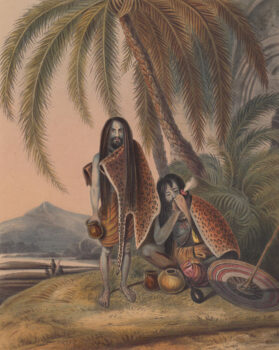
1842 illustration by W. Taylor, ‘The Sunyasees’, depicting two sadhus, one smoking a ritual chillum, also with a traditional ‘nargila’, coconut water-pipe at his feet. “The Sivites… are strict vegetarians. There are some ganja-smokers and bhang-eaters among them… but very few that would even touch any kind of spirituous liquor….Wherever seated they usually kindle a fire before them, and pass their time in the continual smoking of ganja. (Bhattacharya & Jogendra Nath, 1896)
The Kaulajñānanirṇaya is a significant Sanskrit Tantric text attributed to Matsyendranātha, and also refers to cannabis for ritual purposes. Georg Feuerstein (1947 – 2012) a German Indologist specializing in the philosophy and practice of Yoga, in Tantra: The Path of Ecstasy noted that cannabis was shared with female initiates [yoginis] and the Kaula-Avali- Nimaya (2:110-2:111) …speaks of four classes of hemp and their respective purificatory mantras” (Feuerstein, 1998). In the 13th century Matsyendrasaṃhitā, a compilation of ritual and meditation techniques attributed to Matsyendranāth, we can find Cannabis equated with manonmanī (मनोन्मनी) which refers to the state of “mind beyond mind” or “transcendental mind”. It signifies a state of mental tranquility achieved through yogic practices, where the mind is liberated from thoughts and transcends the limitations of the ordinary thinking process. This is a goal of Yoga, all the stretching, breathwork etc of the asanas (practices) are directed at sitting and breathing comfortably with no physical awareness to get there. For more on this, with reference to cannabis, see The alchemical body : Siddha traditions in medieval India (1996) by the Indologist David Gordon White.
Matsyendranatha (10th Century CE) and his student Gorakhnath (10th-11th Century CE), represent a time period of medieval resurgence in the Hindu yogic tradition, after a long period of Buddhist domination in India. But even the earliest text of yoga, gives some indication of the use of psychoactive herbs to gain Yogic powers. Patanjali’s Yogasutras, dated sometime between the 2nd century BCE and the 5th century, tells us: “The subtler attainments come with birth or are attained through herbs, mantra, austerities or concentration” (Patanjali’s Yogasutras CE4.1). “The hoary Indian tradition of use of Vedic soma, and opium, bhang, and wine by ascetics, to induce trance and extra- psychical visions, originates from the theory of this aphorism. That drugs are capable of inducing such trances and visions is neither fanciful nor confined to Hindu practices” (Singh, 1959).
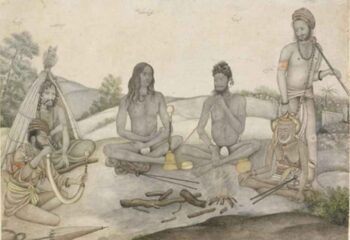
Circa 1825 depiction of a Nath Yogi smoking ganja, with other ascetics.
Kriya yoga master Ganesh Baba (1890-1987)known for his own love of Ganja, gave instructions on its use in yoga. Ganesh Baba “descends from the same Kriya Yoga lineage as Paramahansa Yogananda. He became a swami under his guru Sivananda and later went on to run the Anandamayi Ma ashram. Drawn to the life of the Naga Babas, he became the head of the Ananda Akhara, Naga followers of Lord Shiva who consider cannabis and other entheogens to be the gift of the gods” (Neuhaus, 2010). “Kriya-practice is the only appropriate process for a proper ‘tuning-in.’ Biochemical boosting by psychedelic drugs such as L.S.D., mescaline, cannabis and the entire rest… may, in certain extreme cases, be diagnostically indicated as additives to proper ‘turning on’ or ‘tuning in.’ Kriya technique is the only scientific, automatic auto ‘tuning in’ device open to the common average man aspiring after Self-realization” (Ganesh Baba, 1974)
(Video) Keith Lowenstein MD, who has over 40 years of experience teaching and practicing Kriya yoga, and 35 years of clinical experience in integrative medicine, psychiatry, and nutrition, discusses Ganesh Baba in relation to cannabis and other psychoactive substances in the practice of Kriya yoga.
In regards to the state of mental oneness, known variously as samahdi, manonmanī, nirvana, etc and cannabis, as Kriya Yoga master Swami Satyananda Saraswati noted in his Kundalini Tantra (1984):
“You know what happens if you take a dose of ganja (marijuana)? Take a few puffs and see what happens to your mind. It slows down and the brain waves change from theta to beta, from alpha to delta. Suddenly you feel calm and quiet. What happened to your mind? You didn’t fight with it. I’m not advocating the use of ganja, I’m just giving you a very gross example of how Kriya Yoga works on your mind. By infusing ganja or some hallucinogenic drug, the chemical properties of the gross body change. The heart slows down, the breathing rate changes, the brain waves alter and the mind becomes calm and still. Is it not possible to arrive at the same point through Kriya Yoga? Yes, this is exactly what is accomplished through Kriya Yoga.”
Studies have shown that cannabis use can be associated with decreased theta wave activity and conversely, cannabis use is often linked to increased beta wave activity. Likewise, some reports indicate that cannabis can take brain waves from alpha to delta, however, depending on the individual’s use, strains, dosage, and other factors, studies here vary,
Judith Hooper and Dick Teresi’s stellar book on the human brain, The Three Pound Universe, gives us some scientific insights into why cannabis came to play such an important role in traditions where this state was directed at achieving:
One can look at some religious aphorisms as a form of psychological noise reduction,” says Charles (“Chuck”) Honorton who directs the Princeton Psychophysical Research Laboratories in New Jersey. Purity, poverty, contemplation, and so on aren’t just for the sake of pi- ety. These are methods of removing sensory distraction and increasing mental concentration. A good example is Patanjalis Yogasutras, composed in the second century B.C. in India. All the practices can be seen as systematic noise reduction, which eventually culminates in samahdi, a transcendental state in which normal boundaries be- tween the self and others disappears. It may not be dissimilar to what people experience on marijuana when they find themselves staring at the wallpaper for twenty minutes. (Hooper & Teresi 1986)
The song of the Bhangar’s (a person who consumes bhang) express this effect “Bhangana kushrangana Filhal chuppam chuppa: Clothed in green fair Cannabis, Leads to realms of silent bliss” (Dymock, 1890)
A similar goal was sought by fakirs and yogis, who sought to obliterate their egos through the ingestion if hashish. As noted in The Dervishes, Or, Oriental Spiritualism: “The first intention of Hasheesh was evidently not as a stimulant. It was intended as a ‘spiritual’ soporific, producing that quiescence of soul so dear to Orientals, and known throughout all the regions under Arabian influence by the name of ‘Kaif.’ …this stolid annihilation of ideas …” (Brown, 1868). The sense of ego-obliteration, or what one medieval hashish using poet saw as the “removal from existence in existence,” possible with potent cannabis preparations, was likened to a mortal death in medieval literature. This was also true of the use of hashish itself, which had to be sacrificed, i.e. eaten, to have an effect, “puns on the term ‘to kill’ [were]used in connection with the preparation and use of hashish… {A] play upon the ‘killing’ of hashish… is apparently the case in a verse stating that ‘the green one’ is ‘a hashishah that makes every man a hashishi (assassin) unbeknown to himself’” (Rosenthal, 1971).
In relation to this, Nath Yogis were known to wander in groups with Qalandar Dervishes, it has been suggested that the Nath traditions use of cannabis, may have brought it to the Qalandar sufis:
The possibility that Kānphatā yogis might have in part influenced the evolution of the system of Haydarī [Haydar, a founder of the Qalandar, often attributed with the discovery of hashish] customs takes us back to the issue of spiritually motivated cannabis consumption. Founded by Gorakhnath in the 12th century, the Kānphatā school of thought belongs to Shaivite Nath Tantric traditions where cannabis and bhang, a cannabis based drink savoured by Shiva, the God of Tantra, had formed an inseparable part of religious rituals already in the 7th century… Carved wooden panels in an 18th-century Devi temple in Himachal Pradesh depicting Kānphatā yogis who are preparing bhang bear witness to this… Thus it is not without reason to suggest that we should add another item to the list of customs Haydar and his followers learnt from yogis. It is to rely on cannabis’s potential to enhance the sense of divine and thus provide its user with mystical insight and the feeling of religious ecstasy, effects that are all well known to modern consumers as well. (Péri, 2016)
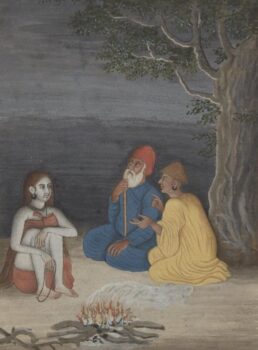
A female Nath yogini and two dervishes circa 1870
According to Nathpanthis: “The contacts and conflicts between Sufis and Yogis became more frequent and meaningful. The various branches of Qalandars and Sufis of the Rifa’iyya order, confined mainly to Turkey, Syria and Egypt, were significantly influenced by wandering yogis… al-Beruini, unquestionably a profound authority on comparative religions who notes Sufi parallels, in the Yoga of Patanjali, which he himself translated into Arabic. He also mentions similarities with Samkhya, one of the six schools of classical Hindu philosophy and the Bhagavad Gita.” (Asghar Ali Engineer, 2011)
It should be noted, that this exchange was not all about peace, love and meditation. Both Sadhus and Fakirs could included fierce warriors among their devotees. As Rajesh Pradhan notes in When The Saints Go Marching On:
Perhaps the most organized sadhu community, but numerically small and socially and politically insignificant, are the arms-carrying Naga sadhus who combine martial and spiritual practices (like the typical Kung Fu priests), historically acting as mercenaries or in defence of their own religious community from other Hindu ascetic communities…. Accessible to all, including the individualistic Muslim Sufis with their orientation towards religion of the heart, the movement emphasized the emotional and the lyrical aspects of religion. But because these developments arose through competitive splintering movements rather than top-down organizational development, they were soon eclipsed by the rise of Muslim and then the British rule in India. In both these instances, groups of sadhus took to arms and organized militarily, particularly during the fakir [ascetic]uprising in Bengal against the British rule. The development of the devotional movement-and to some extent the militancy against foreign rule-provided a large umbrella “organization” for lower-castes to join the sadhu community. (Pradhan 2014)
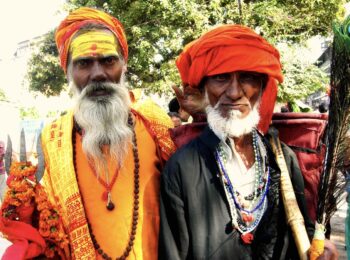
A Hindu Sadhu, and Muslim Faquir in Harmony. We can be sure that sharing ganja contributed to this cross-cultural connection. “In both of these traditions, the consumption of hashish or other forms of cannabis enjoys religious approval” (Khalid, 2018).
See- Voices from the Margins: Early Modern Nāth Yogī Teachings for Muslim Publics and Nāth Yogīs’ Encounters with Islam for more on this cultural exchange and the origins of ‘Muslim Yogīs’.
The virtues of temperance …became an important part of middle-class Hindu reform. In their search for ‘classical’ authenticity, figures like Swami Vivekananda (1863–1902) and Aurobindo Ghose (1872–1950) ignored the living practice of large numbers of Yoga practitioners to create a sober and restrained Yoga based instead on what they presented as scriptural precedent and the archaically obscure ‘authenticity’ of Patanjali’s Yoga Sutra. In contrast to the intoxicated breaths of the pre-colonial Nath Yogis, the pureprānayāma breathing of the colonial Yoga revivalists was in this way a rejection of the ‘drugged’ and ‘idle’ mendicants who, like the Christian missionaries, the Hindu reformers likewise saw as the antithesis of ‘true religion’. For like their reformist Muslim counterparts, the colonial proponents of Yoga were sober, respectable and indeed Victorian figures. As David Gordon White has pointedly written of the ‘reinvention’ of the Yogi during this period, among urban middle class Indians‘ the bogey of the wild, naked, drug-crazed warrior ascetic was gradually airbrushed into the far more congenial image of a forest-dwelling meditative, spiritual renouncer’. Here was the birth of the‘420 Yogi’ (chār sau bīsjōgī), the demeaning and criminalizing label for supposedly fraudulent mendicants given in reference to Article 420 of the Indian Penal Code. Given the extent of collaboration of reformists such as Vivekananda and Ghose with European occultists, this moral overlap is hardly surprising.Like other elements of Hindu and Muslim reformist thought, their attitude to the intoxicated begging of the Yogis reflected wider moral and intellectual changes in Indian society that responded to the moral–but as we will see, also the medical–impact of empire. (Green 2014)
Sri Aurobindo (1872 – 1950) an Indian yogi, maharishi, discussed both the effectiveness of cannabis in achieving trance, but warned of the reliance for it in achieving it “These intoxicants [ganja, bhang] put one in relation with a vital world in which such things (music, song, etc.) exist… My own experience in the matter, is that wine and narcotics generally inhibit the action of the most Tamasic centers in the physical brain, and the other centres in the brain get stimulated. This helps one to escape from the limitations of the physical consciousness and one may get into other planes of consciousness” (Aurobindo Ghose, 1958). Aurobindo had personal experience with this method: “At one time–in Sadhana–I used to try all sorts of experiments to see what happens and how far they are related to the truth. I took Bhang-Ganja-hemp-and other intoxicants as I wanted to know what happens and why Sanyasis and Sadhus take these things. It made me go into trance, and sometimes sent me to a superior plane of consciousness. (But reliance on these outer stimulants was found to be the greatest drawback of this method.)” (Putani, 1959)
Maharshi Swami Dayanand Saraswati, (1824-1883) known as ‘The Luther of India’, and founder of the Arya Samaj, a reform movement of Hinduism, condemned those who “cover their private parts’ with a strip of cloth and squat at a fire constantly fed with fuel, They keep matted hair and assume the form of pious men. They feign to meditate like a heron which remains in a fixed position to catch fish. They smoke ganja & opium, & drink bhang or hemp leaf decoction. Their eyes are consequently red. They ask for a handful or a pinch of flour, food, shells and copper coins, and entice the sons of family men to become their disciples. They are recruited from labourers. If anybody tries to study they prevent him from doing so” (Saraswati,1908). He also experimented himself with it. Max Müller (1823-1900) one of the founders of the Western academic disciplines of Indology and religious studies, and who also referred to Shiva’s consumption of bhang, noted:
….[H]e indulged for a time in the use of bhang, hemp, which put him into a state of reverie from which he found it difficult to rouse himself…. ‘ One day,’ he writes, ‘ when recovering from such a day-dream, I took shelter on the verandah opposite the chief entrance to the temple, where stood the huge statue of the Bullgod, Nandi [Shiva’s Bull companion]. Placing my clothes and books on its back I sat and meditated, when suddenly, happening to throw a look inside the statue, which was empty, I saw a man concealed inside. I extended my hand towards him, and must have terrified him, as, jumping out of his hiding-place, he took to his heels in the direction of the village. Then I crept into the statue in my turn and slept there for the rest of the night. In the morning an old woman came and worshipped the Bull-god with myself inside. Later on she returned with offerings of Gur (molasses) and a pot of Dahi (curd milk), which, making obeisance to me, whom she evidently mistook for the god himself, she offered and desired me to accept and eat. I did not disabuse her, but, being hungry, ate it all. The curd being very sour proved a good antidote for the bhang, and dispelled all signs of intoxication, which relieved me very much. (Müller, 1884)
The French work,Yoga; science de l’homme intégral (1953) which contained works of a number of French mystics in the subject, like Mircea Eliade, Julius Evola, Alain Danielou and Renee Guenon, all of whom were known to have experimented with cannabis to varying degrees, contained a number of references to cannabis. The book likewise noted the effectiveness of cannabis infused Yoga, but with caveats:
It is known that special substances—for example, hemp extracts—can artificially “energize” the imagination for a limited time. But here again, passive disintegration prevails without special preparation and a combination of favorable circumstances. Tantrics use intoxicating drinks in their secret rituals, no doubt similar to traditional sacred beverages, but one must be very cautious on this point, especially when describing these practices to contemporary Westerners, for whom their systematic and rigorously ritualistic nature cannot be overemphasized. (Evola, 1953)
In the Yoga of Divine Love, only the feeling, the desire, is transferred from the human object to the divine object. Here, it is the very act of love that is used as a rite, and it is the very object of human love that is deified and in which the true nature of the living being, which is divine, becomes perceptible. There is no being who in the act of love does not forget himself, his interest, his reason, his logic, his vanity. This force that tears him away from himself is used by an appropriate technique to transport the adept to another world. He then awakens on another shore like a man locked in a cave who plunges into a dark torrent and after a moment of struggle and anguish suddenly finds himself liberated on the sunny shore of the sea. Drunkenness and certain drugs like Bhang (Indian hemp) can be used for the same purposes. But these methods require the observance of very strict rules; otherwise, they are dangerous to mental balance. (Danielou, 1953)
Such concerns and prejudice has lasted into the modern day, It should be noted that that cannabis use is not condoned in most modern organized Yogic circles. The late Jagadananda Das, a significant figure in the Gaudiya Vaishnava tradition, known for his scholarly contributions to Sanskrit literature translation, lamented about this in regards to his own practice, and the controversy it caused for his community:
…there is something that I must address, another elephant in the room of which that up to this moment I have avoided speaking. That is related to the use of marijuana. There is a strong prejudice against marijuana in orthodox Vaishnava circles, including the Gaudiya Math and ISKCON, so I have been careful to not advertise my use of it, even when it came out in various trickles and bits, that I was taking shelter of Vijaya [cannabis]. But over the course of time, it started to be used against me and the hypocrisy of doing so while accepting the social norm that it was a “bad” thing that had no redemptive or positive value.
For the orthodox, whether Brahmin or Vaishnava, marijuana usage is associated with the “deviant” cults like Bauls and Sahajiyas, both of whom are comparable to bohemian-type independent cultural identities within the straight culture of Vaishnava Brahminism, or Sanskritized Vaishnavism. Whatever the case, that fundamental distinction is true: the Bauls and Sahajiyas are rebels and romantics in a straight world. The problem is this: Religion is the “straight” response to “stoned” revelation.
In India I having been using bhang regularly for several years now. But this is not the first time in my life that I have done so. Most significantly was the use of psychedelics in my late teens, which directly or indirectly culminated in my becoming a Hare Krishna — a stoned act if there ever was one. The premise, put bluntly by the early ISKCON preachers, was to “stay high forever.” And that is what we wanted, an intelligent natural approach to fulfilling the insights that had come to us through psychedelics. Make no mistake, there would have been no Hare Krishna movement without psychedelics, but it was fundamentally a “straight” movement. It harnessed the energy released by psychedelics and channeled it into other ways of thinking and acting in relation to God.
The trouble is that one then starts to look at the products of the stoned perspective through straight lenses. Now I am not going to deny one or the other. These are opposed ways of looking at the world, one somewhat irrational, the other rational to the extreme; rational to the point of dessication. We Vaishnavas are rasikas, we want to taste the rasa. We believe in bliss, and in a way it is a science of bliss. And the essential element of bliss is love. That is a stoned perspective. The straight perspective is to say, “Yes, but there are rules!” It is the difference between raganuga and vaidhi bhakti.
Bhang made it possible for me to get a feeling for what it meant to be Brijbasi. Being a Brijbasi, for someone coming from the West, is a very stoned thing. Here is suppose by stoned I mean mad, for it is the very antithesis of the modern world.
A long time ago, in Rishikesh, where marijuana grew wild everywhere around the ashram, I started to hunger to taste it again. And after I did, it was not long before I came to believe that yoga itself was the discovery of marijuana intoxicated ascetics, who used it to enhance awareness of their internal functioning, both of the body and the mind. The body is, after all, the first sadhana.
Asana does not just mean being able to twist your body into strange shapes, It means to use an external object to go inward. The alambanas are the different points in the body, which one awakens through stretching and breath control. The mind follows the breath, that is one of the basic points of hatha yoga. Marijuana heightens awareness of the minutiae of sensations involved in holding certain positions, stretching muscles, the relation of the breath to movement and so on.
Another beneficial effect of marijuana that I got was stamina, stamina for yogic practices. With the use of bhang in particular
[I avoided smoking for the smell problem. I kept my use of marijuana as private as I could and preferred to keep it that way. It is only now that I have decided to just be honest about it and say why I use it.]
Bhang not only makes one more strongly aware of the need of the body to stretch or move or be activated in some way so that it remains enlivened. But one has to break against the tamasika elements in the body that impede practice. Bhang helped me overcome that and to sustain periods of proper yoga practice that were very valuable in deepening my understanding of the process.
It made me sing and hear my own singing, and more and more, to want to sing for others. This may well be a gross overestimation of my talent, but I know that my real talent does not lie in anything but my being.
It provokes thought in me. It makes me see things and relish things even in the ordinary. But in the matter of this bhakti sadhana, it fills me with a sense of wonder and deepening realization of what was being said, what was being discussed, what was the preoccupation in the work of the Goswamis. To understand the Braja mood is really only possible for the stoned mind. [Of course here I am not specifically to any herbal remedies, but of an insight and a perspective that is often recognized by those who have had some psychedelic experience or other.]
This morning I started to work out in the back yard, to clean the mess that a couple of rainfalls, a shedding spring tree and the birds that Madhuri feeds had done. I started to sing the morning tune of the maha mantra. Madhuri prefers silence, or Chopin. She does not seem to care much for my singing, but she cares less for the fact that I take marijuana.
So I am in a position of trying to justify my use of marijuana to her. She has taken a strong negative position. I have only asked her to put aside her prejudice and judge me on the basis of my behavior.
Once again, a very interesting discussion, in relation to sacred and profane cannabis, but Partridge’s book keeps its focus on the Christianized West and from which perspective he seems to view the rest of the World.
Buddhism
Partridge takes a similar view on Buddhists who use cannabis, as he did with it’s use in yoga. However as noted earlier, cannabis appears in the texts of medieval Buddhism, such as: the Tārātantra records the Buddha saying that drinking wine without also having consumed cannabis “cannot produce real ecstasy”, which was seen as a pivotal step in attaining enlightenment (White, 1996); The Mahākāla Tantra, where the “plants are employed to attain health, wealth, wisdom, and supernatural powers… These formulas include cannabis in several different forms, including leaves, resin, and other plant material. Given that these cannabis products are included in the “perfect medicine’ formulas of the Mahākāla Tantra, cannabis may perhaps be considered a significant part of this tantric lineage” (Parker & Lux, 2008). The Cakrasamvara Tantra also identifies a magico-medical role for cannabis, here under the name ‘Indrasana‘, Indra is the name of the God most associated with Soma, and the Sanskrit word sana was used for cannabis. As noted in Kailas Histories: Renunciate Traditions and the Construction of Himalayan Sacred Geography (2015): “The circa 8th century Cakrasamvara Tantra mentions hemp (Śaṅa = cannabis sativa) as part of an abundant life for a free ranging yogin”. The text also identifies datura and other plants. The Cakrasaṃvara Tantra (Sanskrit: चक्रसंवर तन्त्र), Khorlo Déchok or Khorlo Demchok (Tibetan: འཁོར་ལོ་བདེ་མཆོག, Wylie: ‘khor lo bde mchog) is considered to be of the mother class of the Anuttarayoga Tantra in Vajrayana Buddhism. See also Acorns: Windows High-Tide Foghat, Volume 3 (2013) and Indian Esoteric Buddhism: Social History of the Tantric Movement (2004) for other Tantric Buddhist references to cannabis, datura and other drugs.
Keith Dowman is an English Dzogchen teacher and translator of Tibetan Buddhist texts, who is recognized all over the world for his expertise, and he has referred to cannabis and/or datura, in Masters of Mahamudra; Songs and Histories of the Eighty-Four Buddhist Siddhas (1985) and Masters of Enchantment (1988). In Dowman’s more recent book Guru Pema Here and Now The Mythology of the Lotus-Born the learned author suggests that cannabis and datura may have been used by even such a central figure such as Padmasambhava (“Lotus-Born”), also known as Guru Rinpoche, the 8th-century Buddhist master from the India, who aided in thee construction of the first Buddhist monastery in Tibet and venerated as a “second Buddha” by adherents of Tibetan Buddhism in Tibet, Nepal, Bhutan, the Himalayan states of India, and elsewhere.
Having said that, these medieval references to Buddhism, come late in the tradition, in the medieval period, more than a millennia and a half after the origins of Buddhism. They seem to follow the resurgence of yogic practices there around the cult of Shiva, noted above, and were influenced by that. In fact Mahakala, is identified with Shiva.
This likely came through figures like Matsyendranātha, mentioned in regards to cannabis and yoga, who is important in both Hinduism and Buddhism, is sometimes regarded as an emanation or incarnation of Avalokiteśvara, the bodhisattva of compassion.
My view, and that of other researchers as well, is in its introduction, Buddhism was all about sober clarity of mind. The rise of Buddhism resulted in a decline of Vedic beliefs and practices. As I discuss in Cannabis and the Soma Solution (2010) a number of researchers have tied the loss of the identity to Soma here, as well as intoxicants in general.
In his 1995 booklet, The RgVedic Soma (1995)the Vedic scholar Dr. N. R. Warhadpande, who identified cannabis with Soma, suggested that the loss of the knowledge of Soma’s identity was through the decline of the Vedic ritual, the Yajna, which came about under the influence and development of Buddhism. Apparently, in India during Buddhist times, there was a wide spread prohibition of intoxicants, as Khwaja Hasan notes in “Social Aspects of the use of Cannabis in India”: The Buddhist Age in India began in the sixth century before Christ, and Buddhism gradually supplanted Brahmanism as a national religion. Buddhism prohibited the use of intoxicants to its followers” (Hasan, 1975). Buddhist prohibitions, and the suppression of the Soma cult was also noted by Badrul Hassan, some decades earlier, in his 1922 edition of The Drink and Drug Evil in India.
This would be fascinating material for a more sincere study on the sacred and profane history of cannabis, but sadly ignored by Partridge, who wishes to portray such things as a far more recent development..
Rastafarian
Rastafarianism, is the only religion, regarding the use of cannabis, Partridge gives any real detail on. Hinduism, Sikhism, Islam, Zoroastrianism, Taoism, where clear connections to sacred cannabis occur, as we have seen, do not even appear in the index. But Christianity is listed with multiple pages there, as does Judaism, which is a clear indication on where Partridges bias lay, and from which perspective he views things.
Partridge, mentions Leonard Howell, often referred to as the ‘First Rasta’ and how he commercially cultivated cannabis for sale before it was outlawed. But Partridge bypasses Howell’s close experience with the Indian migrants who he worked and lived among. Howell even had children by an Indian woman. Partridge does note the word ‘ganja’, used by the Rastafarians, “is actually a Hindi word, and it’s use was introduced in Jamaica by East Indian labourers… by the 1970s… the majority of ganja users in Jamaica were not East Indian… but rather ‘Black labouring people'” (Partridge, 2024). But he mentions nothing of the sacred use of cannabis by these Indian migrants, which was adopted by the newly emerging religion of Rastafarianism.
Interestingly, considering the patriarchal bible based view of current Rastafarianism, a connection to the use of ganja, seems to have come through the worship of the Black Goddess Kali Ma, who is sometimes paired with Shiva. As noted in Rastafarianism re-examined – the impact of the Indian presence in the Caribbean (Dhakal, 2020):
Afro-Jamaicans observed and participated for example in the celebration of the Hinduist worship of goddess Kali (‘Kali puja’)… and incorporated traditions of the Indian community like the consumption of the weed-infused drink “bhang” as well as the ritual use of marijuana known as “ganja” – a term of Hindi/Urdu origin). (Dhakal, 2020)
In The First Rasta: Leonard Howell and the rise of Rastafarianism (2003) Hélène Lee writes “at regular intervals, a few individuals in every Indian community would perform a ‘secret’ Kali puja… After certain ceremonies that involved the smoking of ganja, the congregation would return to the home of the host, chanting and shouting ‘Jai Kali Mai!’. Drinking of bhang (marijuana), smoking ganja, hailing the goddess…. Curious Afro-Jamaicans would always evesdrop at a distance in hidden places. Some would join the festivities as guests”.
The use of ganja as an entheogen was introduced to Jamaica by Indian indenturers. They used ganja in Kali worship and tantrism. In some of these ganja sessions, some of the Afro- Jamaican population gathered to share in the Kali weed. One can also appreciate the linguistic borrowings of Rastas from Hindi to describe the sacred plant and its accompanying apparatus. The plant is often referred to as ganja or kali (collie) and is smoked in a chillum, or cutchie (also spelled kochi) and saapi. Ganja and kali are both from Hindi, with kali either coming from Kali (the popular Hindu goddess) or kalee (the ganja leaf bud) or a combination of both. The names of the smoking receptacles are also of Indian origin. Later words like chalice (for the chillum pipe) and Ishens (for ganja, I-word for incense) were added to Iyaric [Rasta language] to use Christian frameworks to validate their uses. (Stewart, 2021)
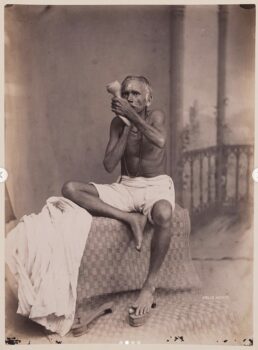
The Hindu Rastafarian connection continued into “the late 1950s, and Indian elders were shown the same respect as Africans. Exchanges (‘reasonings’) took place around the ‘chalice,’ the water-cooled coconut-shell ganja pipe. Dreadlocks, which some rasta elders remember as ‘zagavi’ (from the Hindu jatawi) were possibly inspired by Indian Saddhus, religious mendicants whose presence in Jamaica is confirmed by a 1910 photograph” (Lee, 2003). Ganja, Kali weed, chillums, dreadlocks, vegetarianism, even the exclamation ‘Jah Rastafari!’ from “Jai Kali Ma!” and more have been seen as an Indian influence on Rastafari. The introduction of cannabis from Indian migrant workers was far more than the mundane transmission Partridge leaves his readers with.
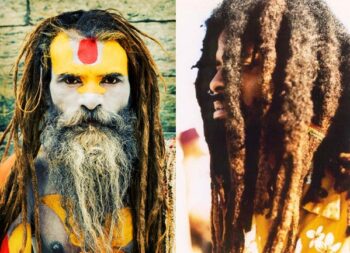
“Hindu Sadhu (Indian holy men) came into contact with Afro-Jamaicans who picked up on the Sadhu’s lifestyle of wearing matted hair (dreadlocks), vegetarianism (Ital food), and marijuana smoking (brought over by Indian coolies” Rastafarianism and Hinduism
Apparently Ganja smoking by Indian immigrants in Jamaica at the Kali Puja continued into the 20th century! As noted in The Legacy of Indian Indenture: 150 Years of Indians in Trinidad (1995):
Kali mai, the black Hindu goddess who averts sickness and death is… offered these oblation [cannabis]… Kali puja (ceremonial worship) was a regular feature of almost every Indian community in Jamaica until the 1950s which was witnessed by Africans. During these pujas… became possessed by smoking ganja… (Gosine, Mahabir & Malik, 1995)
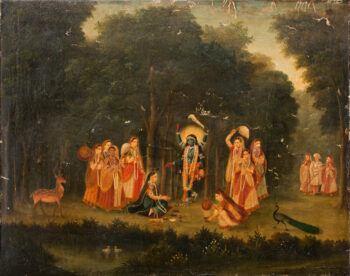
An old painted image of a Kali Puja being performed secretively in the forrest.
Jahlani Niaah, Chairman of the School of the Sacrament and the Rastafari Studies Global Coalition, and a lecturer at the University of the West Indies, specializing in African diaspora praxes, Rastafari cosmology, and Indigenous leadership, explains:
This involvement of Rastafari with ganja is a major part of its early formation, guided by its founding fathers. Leonard Howell, …was known to have cultivated ganja as a cash crop, exporting it to the United Kingdom as a marketplace for it before it was restricted as a contraband. It was Howell, this early prophet of Rastafari who anchored the herb in a ritualistic way through verbal suggestions as to how to prepare and invoke its appropriate usage.
Howell was known to have had strong connections with the East Asian community, and so we know that culturally, the connection of the Asian arrivals in the 1840s impacted the way Rastafari culture developed. This is demonstrated in the preference for the Hindu term “ganja,” used to refer to cannabis. In addition, the paraphernalia used to smoke the herb also have maintained those influences. For example, kutchie, and chillum are terms that are still used in India to refer to aspects of smoking vessels. Rastafari also used to talk about burning “collie herb” which is a reference to Kali, the Hindu deity. (Niaah, 2021)
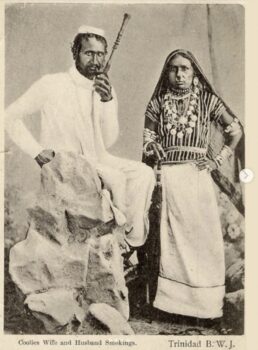
Trinidadian, East Indian man smoking a coconut shell water-pipe, adopted as the ‘chalice’ in Rastafarianism, circa 1889.
This history, has largely been lost on Rastafarianism, which is rather patriarchal, and generally prefers to focus on its connection to Africa. Clinton Hutton, a Rastafari scholar, has noted how Kali the Jamaican folkloric understanding of the Coolie Duppy, ie ‘the Indian Migrant ghost’, “fit[s] the description of ‘Kali, the black and terrifying earth mother of Indian mythology.’” Reminding, Rastafari of the Kali roots to Jamaican cannabis use, may be one of the way she haunts them.
Although one can be sure that Partridge is familiar with this aspect of Rastafarian history, he has written about Rastafarians elsewhere, he does not devote any space to discuss this interesting cultural exchange of ‘sacred’ cannabis. However, he does note how Marcus Garvey, an important figure in the back to Africa movement, and in Rastafarianism, saw cannabis as “a dangerous weed” then on the basis of a single comment from a Rasta poet who commented on an article he wrote, suggests that most Rastas don’t even smoke ganja.
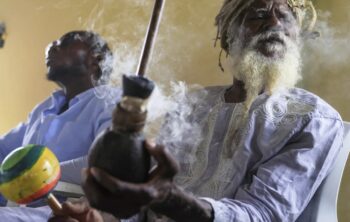
A Rasta elder passes the chalice. Image from AP news story – Why Rastafari smoke marijuana for sacramental reasons and the faith’s other beliefs (2023)
[For more on the Indian influence on Rastafarianism see: Indian Influences on Rastafarianism: Understanding the History of Rastafari and the Sacramental Use of Ganja with Jahlani Niaah; Dreadlocks, Ganja & Gods | The Hindu link between Bob Marley and Rastafari; The connection between Rasta and Hinduism. The story of the real origin of rasta; Rastafarianism re-examined – the impact of the Indian presence in the Caribbean; Early Encounters in Colonial Jamaica: Hindu and Rastafari Divine Metaphysics]
Partridge pays little attention to the persecution the Rastafarians suffered for their religious use of cannabis, or that it was by establishing this sacred connection that they gained legal access to its use. The Dangerous Drugs (Amendment) Act of 2015 decriminalized cannabis and explicitly allows ‘sacramental’ use by Rastafarians for religious purposes, recognizing it as a sacred herb in their faith. Rastafarians can grow and use cannabis for spiritual practices, such as in rituals and meditation, without facing legal penalties, provided they adhere to the regulations outlined in the law. This is an important point in regards to the effects of ‘sacred’ and ‘profane’ designations, and how they effect adherents, that Partridge plays little, to no attention to.
Partridge, does at least acknowledges, this communal aspect of cannabis use among the Rastafarians: “both the ritual and psychoactive effect of THC increases sociality, draws the worshipping community together, and, as such, actively promotes love and peace.” (Partridge, 2024)
African use ignored
Although I do agree with Partridge, that the ritual use of cannabis likely came through Indian migrant workers, it is worth pointing out the the African use of cannabis is barely dealt with at all in Partridge’s book. He does mention 14th century pipes bowls that contained cannabis resins, from Ethiopia [interview I did with the archaeologist], which is one of the oldest Christian countries, but notes little more on this find, which is also interesting in that it upsets the general date for pipe smoking before it’s suggested introduction after Europeans witnessing it in the ‘New World’ with tobacco smoking . With the Rastafarian ideals of Ethiopia, this may indicate some sort of connection, but it’s not one Partridge makes here. But, over all, no mention is made of the many African tribes that have used cannabis ritually by Partridge in his book. Some Rastas maintain their use of cannabis has African roots, and not India.
I did mention some of these African tribes at the beginning of this article in relation to warrior tribes that used dagga. But there are others. The Pygmies say: “We have smoked hemp since the beginning of time… There are great fields of hemp in the kingdom of the dead… God gave hemp to the pygmies. Hemp keeps us healthy and happy” (Hallet & Pelle, 1975). The Bashilange, another tribe in the Congo, enjoyed a lasting peace thanks to cannabis. As one 19th century author recorded, in adopting the use of cannabis, this group spread its use to other tribes and as a result “The ‘Bena-Riamba,’ ‘Sons of hemp’ found more and more followers; they began to have intercourse with each other as they became less barbarous and made laws” (Wissmann, 1891). As Ernest Abel explained in Marijuana, the First Twelve Thousand Years (1980) Their hemp fields were called lubuku, which means “friendship”. They greeted each other with the expression moio, meaning both “hemp” and “life”, thus attributing universal magical powers to the plant. “For the Bena Riamba, cannabis helped promote peace, yet warlords and fighters used it too, before and after battle” (Duvall, 2017). For more on cannabis in African Culture, see The African Roots of Marijuana (2019) by prof. Chris S. Duvall. And for how cannabis is still seen as sacred see ‘Marijuana myths and culture in the “Ghettoes” of Maamobi Zongo community, Accra‘ (Prempeh, 2019).
The profanation of cannabis in Africa, largely through Western pressures and Influence to prohibit its use, has held a hard impact on the African tribes who recognized its sacred qualities.
The Ethiopian Zion Coptic Church,
I think another glaring omission in Partridge’s book in regards to Jamiaca and cannabis use, is that there is no mentions of The Ethiopian Zion Coptic Church, (EZCC) here, or later when he discusses modern cannabis churches. The EZCC first emerged in Jamaica during the 1940s and after the adoption of white Americans in the 60s. later spread to the United States, being incorporated in Florida in 1975. The Churches beliefs are based on both the Old and New Testaments of the Bible, as well as the teachings of Marcus Garvey, self-reliance, Afrocentricity and Ethiopianism. Their ceremonies include bible reading, chanting, and music incorporating elements from Nyahbinghi, Burru, Kumina and other indigenous traditions. The group holds many beliefs in common with the Rastafari, including the use of marijuana as a sacrament, but differ on many points, most significantly the matter of Haile Selassie’s divinity. The EZCC held very strict religious beliefs.
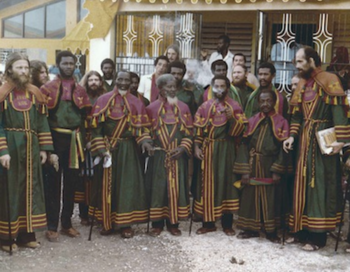
Members of the Ethiopian Zion Coptic Church in the 1970s
The EZCC became enormously influential in the 70s and 80s, funding a newspaper and political efforts. They were able to do this, as they accumulated considerable wealth through the illegal importation of cannabis from Jamaica to Florida. As a result, in the 1980s, many members were arrested, and the group was disbanded with no contact orders. EZCC Brother Jeff Brown‘s church booklet, Marijuana and the Bible (1980) composed while he was in prison on charges related to the EZCC’s use of cannabis, was instrumental in my own understanding of religious cannabis use, after I came across it when I began my own search for references to the role of cannabis in religion.
The rise and fall of the deeply religious EZCC, which quickly expanded through the inclusion of white Americans, and it’s fall through lavish lifestyles acquired through illegal smuggling, would have, like so many other topics we have addresses, made an excellent topic for a discussion on ‘sacred’ and ‘profane’ cannabis.
It is here, that Partridge begins his attempt to discredit my own work:
Some of the general ideas developed within Rastafari, not least the use of the Bible, are evident in other cannabis based religions. However, before we turn to look at some of these cannabis theologies, we need to briefly comment on a recurrent theme, namely the romantic reconstruction of the past. (Partridge, 2024)
Stone Age
It would seem that the principal aim of cannabis apologists is to sacralize the plant they fetishize. As such, their use of scholarship and the available evidence is typically selective and uncritical.
Perhaps the most influential writer to use scholarship in this way is Chris Bennett… Take, for example, Bennett’s use of Sherratt’s work, about which he is far more dogmatic than Sherratt was himself. ‘Oxford archaeologist Andrew Sherratt points to the earliest evidence of cannabis as a sacrament… Sheratt also points to even older tripod bowls… as further indications of humanity’s primordial relationship with cannabis.’ Then on the basis of what Bennet refers to as the ‘profound history’ of cannabis and religion, he claims that he has been able to trace it’s ritual use ‘from the Stone Age to the present’. That’s a bold claim! And it needs to be, because it is used to support the following conclusion: ‘cannabis has had an evolutionary partnership with humanity that stretches back more than ten thousand years… and any law that stands in the way of that relationship is an abomination of both god and nature.’ This is a good example of an observation by Carol Sherman and Andrew Smith: ‘cannabis advocates point to the plant’s long history as a kind of grandfather clause justification for its modern day acceptance.’ They have a cause and they select any quotations and available evidence they need to advance it — an approach, which is, of course, not dissimilar to those who seek to demonize cannabis. In other words cannabis apologists, such as Bennett, betray conspicuous confirmation bias — the tendency to look for evidence and to interpret information according to a set of prior beliefs. While confirmation bias is largely unintentional… it does mean that both apologists and detractors tend to seize on quotations and scraps of evidence with little regard for the context or the overall debate to which the original research was contributing… the principle argument here is that, despite any accuracy in their accounts, their reconstructions of the past are typically detradionalized conjecture informed by a modern romantic turn to the self. (Partridge, 2024)
Those closing comments about bias, and selective research, are far more of an issue in Partridge’s book, than anything I have written. Partridge, of course here, as is his pattern, leaves out so much of what I have written about cannabis in the stone age, and it’s far from ‘speculation’ I based solely on Sherratt. Moreover, Andrew Sherratt’s own comments were based on more than just speculation about tripod bowls. He pointed to the use of cannabis incenses at a gravesite of a group known as the Proto-Indo-Europeans, the Kurgans, who occupied what is now Romania 5,000 years ago. The discovery of a smoking-cup which contained remnants of charred hemp seeds at the site documents that 3,000 years before Christ humanity had already been using cannabis for religious purposes for millennia.
Prof. David W. Anthony,an American anthropologist who specializes in Indo-European migrations, and is a proponent of the Kurgan hypothesis. states in The Horse, the Wheel, and Language (2007) that this “clay vessel with carbonized seeds” provides the “earliest evidence for the burning of cannabis” (Anthony, 2008). From remnants of the charred hemp seeds we can see that the combustible (and psychoactive) parts of the plant – namely flowers and leaves – had been consumed and the carbonized hard shell like residue of the seeds left behind. This find fits in well with what we know about the area from which originated the linguistic roots of the term ‘cannabis,’ as well as the spread of cannabis around the ancient world.
The authors of The Encyclopedia of Indo-European Culture, Prof. J. P. Mallory (an American archaeologist and Indo-Europeanist, he is an emeritus professor at Queen’s University, Belfast a member of the Royal Irish Academy, and the former editor of the Journal of Indo-European Studies and Emania: Bulletin of the Navan Research Group); and Prof. Douglas Q. Adams (an American linguist, professor of English at the University of Idaho and an Indo-European comparativist. Adams is an expert on Tocharian and a contributor on this subject to the Encyclopædia Britannica) . These experts on IE studies note that “Hemp has not only been recovered from sites in Romania but also from a Yamma burial at Gurbanesti (Maldova) where traces were found in a ‘censer’ (a shallow footed bowl believed to have been used in the burning of some aromatic substance). It has been found in a similar context from an early bronze age burial in the north Caucasus…. Ceramics were more elaborate than those of the Yamma culture and included, especially in female burials, low footed vessels interpreted as ‘censers,’ presumed to be used in rituals involving some narcotic substance such as hemp” (Mallory, et al., 1997).
In 2016 a slew of news articles have come out with Headlines like ‘Founders of Western Civilization Were Prehistoric Dope Dealers (New Scientist) ; ‘Was Marijuana the Original Cash Crop? ‘ (Men’s journal) ; ‘Surprising 5,000-Year-Old Cannabis Trade: Eurasian Steppe Nomads Were Earliest Pot Dealers’ (Ancient Origins) ; ‘These Bronze Age Humans Were History’s Biggest Weed Dealers’, (Vice); all stemming from a multi-authored academic Paper, Cannabis in Eurasia: origin of human use and Bronze Age trans-continental connections, (Tengwen, Wagner, Demske, Leipe, Tarasov, 2016), that was published in the journal Vegetation History and Archaeobotany and which detailed the paramount role cannabis played in the trade, tradition, and spread of Indo-European Culture. As Vice sensationally recorded of the study “the Yamnaya were prolific dope users, which scientists have discerned from large caches of archaeological evidence… Cannabis seeds dating back to 3,000 BCE were uncovered in the kurgan burial mounds of Siberia” (Emerson 2016).
thus the above evidence regarding the role of cannabis in the stone age origins of Western culture should not be underestimated. This archeology has shown how the Proto-Indo-European Yamnaya culture brought cannabis into Europe. Ritual use of cannabis in funerary rites in the region inhabited by the Yamnaya goes back at least 5,000 years, as evidenced through a find of skeletal remains and burnt cannabis seeds recovered at a burial mound at modern day Gurbăneşti, Romania. (Rosetti, 1959). Evidence of cannabis in a grave where the body was laid over flowers have been discovered in Hattemerbroek in Gelderland, Amsterdam, at a tomb that showed characteristics of corded ware culture, drinking cups were also found at the site which dated to 2459 – 2203 BC.
As the authors of the exhaustive Encyclopedia of Indo-European Culture have noted, “There are… at least three chronological horizons to which the spread of hemp might be ascribed: the early distribution of hemp across Europe; during the Neolithic c5000 b.c. or earlier; a later spread of hemp for presumably narcotic purposes around 3000 b.c.; a still later spread, or, at least, re-emergence of hemp in the context of textiles during the first millennium b.c….” (Mallory, et al., 1997).
Botanists Professor Mark Merlin and Robert Clarke, who analyzed Sherratt’s work and archaeological materials, state about the Sredny Stog culture of Ukraine “We believe that Cannabis, along with cord-marked pottery and domesticated horses, were dispersed together as part of a general cultural complex that developed in the Eurasian steppes… (ca. 6000 to 5000 BP)” (Clarke & Merlin 2016). Ant the Yamnaya (ca. 3500 to 2300 BCE) that “there is evidence that they and other contemporary peoples in the region used Cannabis for ceremonial purposes”:
Indeed, a major characteristic of the Yammanaya cultural horizon was their funeral ritual and how this manifested in their kurgans. For example, in Eastern Europe there are two sites that have yielded hemp seeds more than 4,000 years old. One is a grave at Gurbanesti,… Romania where a clay vessel (brazier or “pipe-cup”) with carbonized hemp seeds was discovered… The second site where Early Bronze Age seeds of Cannabis have been found in the Northern Caucasus region where a similar “smoking vessel” with charred hemp seed was discovered in a burial… [seeds]are the most heat-resistant part of the plant, and the two discoveries of braziers with charred hemp seeds… suggests that the inflorescences and leaves with their resin had burnt away… these charred seeds are the earliest evidence for intentional burning of Cannabis and suggest ritualistic, perhaps psychoactive use. Sherratt… proposed that smoking and inhaling Cannabis fumes was introduced into the Danube Valley by immigrants of the Yamnaya culture dating back approximately 5,000 years… the relationship between Cannabis and the Yamnaya culture is important in understanding major aspects of the origin and spread of Cannabis into and throughout much of Europe. (Clarke & Merlin 2016)
Cannabis was also part of the earliest trade routes we know of as well, as noted in ‘Cannabis in Eurasia: origin of human use and Bronze Age trans-continental connections’, indicating it would have been part and parcel of any “Aryan” migration. “A marked increase in cannabis achene records from East Asia between ca. 5,000 and 4,000 BP might be associated with the establishment of a trans-Eurasian exchange/migration network”. (Eurasia is the largest continent on Earth, comprising all of Europe and Asia).
The Proto-Indo-European (PIE) language is believed to have existed during the Late Neolithic to Early Bronze Age, roughly from 4500 BCE to 2500 BCE. This reconstructed language is the ancestor of the Indo-European language family, which includes languages spoken across Europe and parts of Asia today. Even before this language was spoken the ancestors of these people, the Proto-Indo-Europeans, were ritually using cannabis — a technique of worship that continued for thousands of years and spread throughout the ancient world, leading to its continued use in various religions. The Indo-European language family is divided into several branches or sub-families, the largest of which are the Indo-Iranian, Germanic, Romance, and Balto-Slavic groups. The most populous individual languages within them are Spanish, English, Hindustani (Hindi/Urdu), Portuguese, Persian, Bengali, Marathi, Punjabi, German, and Russian. Indeed, the modern term “cannabis” is believed to have comes from an ancient Proto-Indo-European root word, “kanap”; the “an” from this root is believed to have left traces in many modern terms for cannabis, such as French “chanvre,” German “hanf,” Indian “bhang,” Dutch “Canvas,” Greek “Kannabis,” etc. [For an indepth discussion on cannabis etymology see professor emerita of archaeology and linguistics at Occidental College, Elizabeth Wayland Barber‘s discussion ‘the archaeolinguistics of hemp’ in Prehistoric Textiles (1991)]
Based on archaeological evidence, Sherratt speculated that the Sredny Stog not only burnt cannabis, but consumed it as a beverage, in containers marked with hemp cords to signify their contents. Archaeological evidence recovered from Spain, at an equally ancient site, indicates that practice there as well.
“Archeologists in Spain discover an ornate tomb belonged to a 5,000-year-old woman ‘so prominent that no man ever reached her level,’ prompting reconsideration of the role of gender in the early political life of the peninsula… The leader was buried with a luxurious funeral trousseau that included a large ceramic dish (on which chemical traces of wine and cannabis were detected)” (Olaya, 2023).
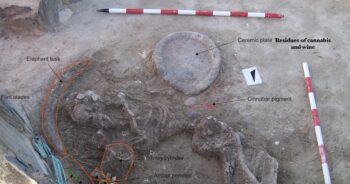
5,000 yr old large ceramic dish on which chemical traces of wine and cannabis were detected.
The general view is that the Stone Age ended between 4000 BC and 2000 BC, with the advent of metalworking, putting this archaeologically backed information indicating the ritual use of cannabis in funerary rites well within that time frame. The horseback riding Scythians, who also burnt cannabis in braziers for funerary rituals, were the descendants of these people and show this ritual use of cannabis still in play more than a thousand of yeas later. Thus my comments that the ritual use of cannabis, is older than any existing religion, holds evidently true. Partridge tries to write this off as the loose and biased interpretation of a cannabis apologist.
Note that Partridge stated that I was “far more dogmatic than Sherratt was himself” about the role of cannabis use in the stone age, in regards to religious practice, and consider the comments from other respected scholars noted above on this, and the words of Sherratt himself. “It seems, therefore, that the practice of burning cannabis as a narcotic is a tradition which goes back in this area some five or six thousand years and was the focus of the social and religious rituals of the pastoral peoples of central Eurasia in prehistoric and early historic times” (Sherratt, 1995).
Indeed, Professor Partridge is the one who can be seen to “seize on quotations and scraps of evidence with little regard for the context or the overall debate to which the original research was contributing” in this case.
Partridge writes “We have seen that writers such as Bennett, claim that there is a ‘profound history’ of the ritual use of cannabis ‘from the Stone Age to the present… that stretches back more than ten thousand years…”. Which is not what I said in the citation he selected, which was:”Even from an atheistic standpoint, from the cross-cultural perspective, as possibly our oldest cultivated crop, cannabis has had a evolutionary partnership with humanity that stretches back ten thousand years”. Here I am referring to humanity’s over all relationship, and including finds of woven fibre at archaeological sites like Çatalhöyük and ancient Taiwan, as well as earlier finds of hemp rope. I consider the discovery of weaving, and agriculture, a ‘evolutionary’ step for human culture. Further, the idea that cannabis was possibly humanity’s oldest cultivated crop, comes from Carl Sagan (1977), who himself was known to be a secret imbiber of the herb, who kept it hidden due to the stigma around its use. As noted above, I trace the ritual use of cannabis back to about 5,000-5,500 years ago through the archaeological evidence cited above. Partridge, edited my words to make this 10,00, and also left out most of the evidence I offered for ancient cannabis use, in an effort to discredit me.
Mircea Eliade on Drugs
Mircea Eliade, who has already come up a few times in this discussion, was a Romanian historian of religion, philosopher, and professor at the University of Chicago. One of the most influential scholars of religion of the 20th century and interpreter of religious experience, he established paradigms in religious studies that persist to this day. Eliade comes up in Partridge’s dismissal of cannabis using Shaman….”in cannabis literature the term ‘shaman is often (not always) little more than a shorthand for a stoned functionary, who reflects the desires and concerns of the late-modern-neo-romantic social imagery” (Partridge, 2024)
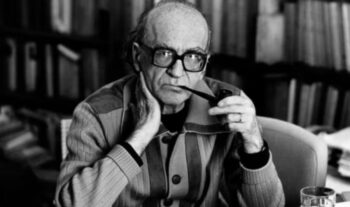
Mircea Eliade (1807-1986)
Partridge refers to “cannabis apologists” who cite Mircea Eliade’s “speculation about hemp-induced experiences of ecstasy”. Eliade speculated about cannabis in the cult of Orpheus, and also wrote about Scythian and Zoroastrian use of cannabis to attain ‘ecstasy’. Partridge ignores these entries, and points out that Eliade was not endorsing this technique of shamanism, but saw it as a sort of short cut, summarizing “hemp was one of the easy ways employed by lesser shamans” (Partridge, 2024). However, as we shall see, Eliade held different views on this at different times.
Partridge writes that because Eliade “lacked expertise in (or, indeed, interest in) drug induced experiences which he simply conflated with other experiences induced by psychedelic substances such as pre-eminently shamanic mushroom ‘Agaricus muscarius‘ (fly agaric)”:
He was unaware that hemp – which is not psychedelic and, at this early period will not have had the THC content of modern skunk — could not have produced the experience of shamanic ecstasy he described… Eliade’s work needs to be treated cautiously, particularly by those who seek to support theories of cannabis-induced shamanic ecstasy” (Partridge, 2024).
Weirdly, Partridge suggests cannabis was not strong enough to induce ecstatic experiences, but then also suggests that for the most part, no drugs at all were used by advanced shamans, just ‘lesser shaman’ to achieve ‘ecstatic’ experiences. So cannabis is too weak, and nothing at all is somehow stronger? This application of ‘lesser’ is also used by Partridge in regards to Sadhus and Yogis who employed cannabis in their ritual lives, it reveals his own Christian British cultural bias, as it does with the 19th century authors he quotes a number of times using the term. Partridge’s comments also conflicts with the 19th century accounts of Randolph and Cahagnet under the influence of cannabis, that he refers too.
Partridge also mistakenly assumes that ancient people did not have access to potent cannabis, but the chemical analysis from the 7th century BCE cannabis at the Yanghai Tombs in China indicate a “a high-THC cannabis strain” and “that humans selected the material from plants on the basis of their higher than average THC content”. And residues from a 8th century BCE altar, from a Hebrew site in tel Arad Jerusalem, indicate “hashish”. Partridge was aware of this information, but purposely ignored it here, although he did mention the cannabis from the Yanghai tombs later, with his personal speculation that it was still not strong enough. His statement here ignores dosage amounts used and forms of concentration of cannabis resins. The paper Cannabis and Frankincense at the Judahite Shrine of Arad (2020) documents cannabis resin extracts as early as the 8th century BCE, the authors specifically suggest ‘hashish’.
Moreover, Partridge completely misrepresents Eliade’s own deep firsthand knowledge of cannabis and other drugs such as opium and mescaline, and these included hashish, mescaline, opium and other substances. The Romanian historian of religions, ethnologist and cultural anthropologist Andrei Oisteanu‘s, article Mircea Eliade, from Opium And Cannabis to Amphetamines (2007) gives some deep insights into Eliade’s own experiments with various drugs, and his early interest in the topic.
In March 1924, at the age of only 17 years, Mircea Eliade published (under the pseudonym Silviu Nicoară) a courageous article, “The Artists and the Hashish”, explaining in it why many artists and writers (Gérard de Nerval, Alexandre Dumas-Père, Theophil Gauthier, Charles Baudlaire etc.) have used the intoxication with hashish: in order to enhance their intellectual creativity and mobility. “Taken in infinitesimal quantity” – wrote the adolescent Eliade, quoting Charles Richet –, “[the hashish]unfreezes the mind making it proper for things hard to understand and gives it also an amazing continuity of ideas.” The adolescent Eliade concluded that, taken in big doses, the hashish induces ecstatic states: “In that moment the soul leaves the body and you feel that you are immersing into ether” (“Ziarul ştiinţelor populare” [The Journal of Popular Sciences], no. 12, 18th of March 1924, p. 172). (Oisteanu, 2007)
Eliade’s curiosity on this, led to personal experimentation with cannabis:
What he [Eliade] dared not recount in his volume of Memoirs (published in his old age), namely his own experience with narcotics, he did in his Indian travelogue (published in his young age). On this occasion, Eliade described several plants with medicinal and hallucinogenic properties from the garden of the Nepalese Brahmacari, including “a species of cannabis that causes an intoxication similar to opium.” “Many of the plants I picked,” confesses Eliade, “I experimented either personally, or in the hospital of Laksmanjula.” Among other psychotropic plants, close to the Nepalese recluse’s hut grew several “bhang bushes” (cannabis indica), “whose leaves,” Eliade writes, “boiled or smoked in a wooden hookah [a kind of narghile – my note]induce a state of torpor much praised by the sadhus, for it is said to facilitate mental concentration and to clarify meditation”.
These pages in the volume India are also highly interesting in virtue of the fact that Eliade tried to describe there (with uncertain language) the mental states that he had experienced during narcosis: “Once I smoked bhang and I recall that I had a vertiginous night, for the sense of space had shifted and I felt so light that whenever I wanted to turn on one side, I would fall from the bed. […] [The plant] bhang has a curious quality to focus and to deepen the thought, any thought that dominates consciousness at the moment of intoxication. Certainly, if it is a religious thought – as it is assumed to be – the meditation is a perfect one. I remember, nonetheless, that I had had that evening a literary discussion with a visitor of the ashram and that that night was for me riddled with nightmares […].”
In the period 1930-1932, in Calcutta, Rishikesh and Bucharest, Eliade prepared his doctoral thesis. He presented this thesis, entitled The Psychology of Indian Meditation. Studies on Yoga [Psihologia meditaţiei indiene. Studii despre Yoga], in 1933, at the University of Bucharest, in front of a commission presided by Dimitrie Gusti, and published it in French in 1936. A few paragraphs are dedicated there to the way in which Indian ascetics used psychotropic plants: “the majority of the yogi and the sanyasis have been using plant drugs for centuries, in the form of boiled leaves, roots, narcotics – either for precipitating a dubious trance, or for revigorating the nervous system. In Himalayan monasteries, plant drugs are still in use today, a sizeable part of which make up the Indian folk pharmacopoeia.” (Oisteanu 2007)
in regards to ethereal experiences on cannabis, Eliade wrote – “In that moment the soul leaves the body and you feel that you are immersing into ether” in 1924, and we know he had direct personal experience with it. In 1984 he wrote in regards to cannabis use in Thrace – “Ecstatic experiences strengthened the conviction that the soul is not only autonomous but that it is capable of unio mystica with the divinity. The separation of soul from body, determined by ecstasy, revealed…the fundamental duality of man… [and]the possibility of a purely, spiritual post-experience…. Ecstasy could… be brought on by certain dried herbs…” (Eliade,1982). This is an important statement regarding the development of the concept of a discarnate soul. Eliade also made a similar observation in Zoroastrianism, and he indicated quite a lot on cannabis in that regard – “Vishtaspa used hemp (bhang) to obtain ecstasy: while his body lay asleep, his soul traveled to paradise” (Eliade 1978). – As well, Eliade cited some really great sources on Zoroastrian cannabis use, but Partridge skipped all of that, as noted.
However in Shamanism (1951) Eliade did write Narcotics are only a vulgar substitute for “pure” trance. …The use of intoxicants (alcohol, tobacco, etc.) is a recent innovation and points to a decadence in shamanic technique. Narcotic intoxication is called on to provide an imitation of a state that the shaman is no longer capable of attaining otherwise.” However, like a number of individuals in the history of cannabis, Baudelaire, Blavatsky, Randolph, Eliade may have come to question the legitimacy of such experiences, due to cultural biases. Just before his death, Eliade evaded an interview by one of his students on the subject of ‘sacred substances and the history of religion,’ Robert Forte, confessing ‘I don’t know anything about them’ and noting ‘I don’t like these plants.’” (Ott 1995). He obviously had a lot of conflicted feelings on them, I suspect he may have been challenged by the implications of their use at the formation period of ‘religion’.
The obvious inner moral struggle here with Eliade, would have made a much more interesting discussion, about sacred and profane use of cannabis, then the false narrative Partridge gives his readers. Undeniably, other figures we have discussed, suffered similar moral dilemmas about their experiences with cannabis.
Origins of Religion
After his discussion of Eliade, and a dismissal of shamanic cannabis, he refers to comments I made about cannabis at the beginnings of religion. Too be fair here, I think we were using the term in different ways, I was, perhaps ‘loosely’, using this as a term for organized religion and religions we can name specifically. Whereas Partridge uses it far more broadly, like the simple belief in a deity. Such concepts can not be dated and undoubtedly stretch back far in time. But in regards to known World religions which come from ancient roots, such as Hinduism, Buddhism, Taoism, Sikhism, Zoroastrianism, Shintoism, and the Abrahamic tradition, Judaism, Christianity and Islam absolutely, cannabis use for religious purposes proceeds them all, and has left an effect on each as well. Partridege’s discussion on this goes back to my co-authored 1995 book Green Gold and the Tree of Life: Marijuana in Magic and Religion, which he calls “an enjoyable book with many thought-provoking insights. it is also a good example of neo-romantic revisionism” (Partridge, 2024).
Partridge is not wrong here, I wrote that book over 30 years ago, and was definitely more naive in my views at that time. It’s curious that Partridge does not cite my later books here, in regards to the ancient use of cannabis, as they deal with that period of history, much more thoroughly. Partridge points to references suggesting cannabis psychoactivity going back to 1,500 BCE, with the comment “This is a long way from the beginning of religion, let alone the origin of religion” (Partridge, 2024). Well, even at that date, it is certainly older than the above mentioned religions. But as Sherratt, Mallory and others place the ritual use of cannabis at about 5,000 years ago, this does take us back to what would be considered an early date in the development of religious ideas.
For Partridge, it seems research and discussions of the religious history of cannabis, amount to a sort of spiritual piracy! “As such… history and tradition tends to become repositories from which to plunder ideas. Sacred texts, archaeological evidence, and religious doctrines all tend to be reinterpreted and employed selectively” (Partridge 2024).
…..cannabis apologists seek to portray the role of the plant in ancient religion… the reason for the largely neo-romantic reconstructions of the past, as well as the effort to weave it into religious history, is not merely to rehabilitate the plant after a period of profanation in the West, but, more specifically to sacralize it… much effort is made to identify cannabis as special, or sacred, by demonstrating its significance as a technology of transcendence at a very early period of religious history… Was it sanctioned by God in the Bible? Was it the ancient plant-god soma? Was it sacred to the Scythians? Was it associated with deities from around the world, including Shiva, Kali, Thoth, Osiris, Isis, Freya, and Ma Ku? Was it part of the shamanic tool kit from. an early period? Did it have a role in the evolution of religion? More often than not, the answer that popular cannabis apologists give to all such questions is, categorically ‘yes’. (Partridge 2024)
Well, I’ve never made the claim about cannabis in the cult of Isis, Osiris, and Thoth, so i’m not about to start now. I don’t see a lot of strong evidence for the ritual use of cannabis in Egypt, and I’ve long expressed this view. But certainly as we have seen, it is widely used in the cult of Shiva, and this is one of but two passing brief mentions that Partridge makes of Shiva. Both references to Shiva occur with no background information regarding the cultic use of cannabis by Shaivites, which has continued for well over a millennia. We have discussed already, the influence of ganja use in the Kali Puja by Indian immigrants on the Jamaican Rastafarians, but there is more to be said on Kali. In regards to India, and its long relationship with Ganja, these omissions of cannabis role in the religious life there, come across as a passive sort of racism through exclusion.
Ma Ku, I have written about as well, but she is just lightly touched on by Partridge. A discussion of her and the use of cannabis in wider Taoism is in order. Along with a look at the basis for the claims about Freya, as Partridge himself offers little on these subjects himself, and simply portrays them as as the unsubstantiated claims of ‘cannabis apologists’ out to ‘fetishize’ cannabis.
I’ll close with a discussion of the Biblical claims, as it is clear that of all the traditions Partridge has studied, this is the closest to his own heart, and the lens from which he views the others. Partridge does discuss the Scythians and Soma slightly more, so let’s look at those to begin.
SCYTHIAN
The Scythians take kannabis seed, creep in under the felts, and throw it on the red-hot stones. It smolders and sends up such billows of steam-smoke that no Greek vapor bath can surpass it. The Scythians howl with joy in these vapor-baths, which serve them instead of bathing, for they never wash their bodies with water. (Herodotus, (500 BCE)
Partridge questions if Scythian use of cannabis, was nothing more than a cleansing ritual, from both the description of Herodotus, the 5th century BCE Greek Historian, who described how they would inhale the smoke from burning hemp in enclosed spaces for intoxication, suggesting a ceremonial or religious purpose. Herodotus noted the Scythians would ‘howl’ with delight. In Partridge’s view, this howling disavows cannabis, is it makes you sedated, which anyone who has been to a rock concert or reggae show can tell you is not accurate. Partridge instead suggests something along the lines of “fumigation for ritual cleansing… cannabis may simply have been one of the herbs used for something like a smudging ritual, rather than for intoxication” (Partridge, 2024).
Although Partridge notes that the Russian archaeologist Sergei Rudenko confirmed Herodotus account of the Scythian cannabis rituals through the discovery of tent poles and a bronze brazier with burnt carbonized cannabis seeds in it, and since then multiple similar finds have been located, he seems to have not really looked to deeply at it. From Herodotus’s description, it does sound like a large tent that people would sit in, but the tent poles found by Rudenko, were for a three foot tent you would poke your head in to inhale the captured smoke, hardly good for a ‘smudging’ ritual!.
As The Guardian article ‘Scythians review – wine, weed and war as the Siberian nomads charge into battle‘ about a display of Scythian artifacts at the British Museum noted: “The Greek historian Herodotus, who wrote in the 5th century BC, is often accused of making up his outlandish stories. One tale he tells about the Scythians is that they loved to smoke hemp, which they burned under a kind of tent that you could put your head into. One such device is in this exhibition, recovered from a Scythian tomb. Herodotus got this one right.”
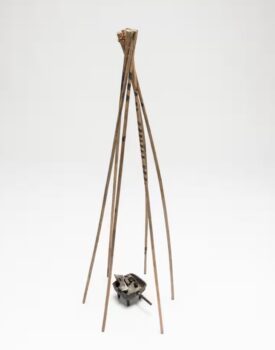
Six sticks of a smoking tent frame and brazier. Photograph: Terebenin Vladimir/© State Hermitage Museum, St Petersburg
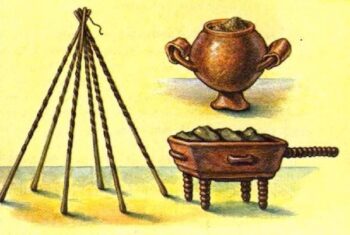
These braziers were not very big, something that could be held in your hands under your face in many cases. Likewise, tent poles in some cases were just a few feet tall, designed for poking your head in and smoking from.
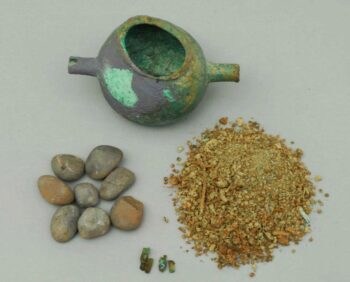
This bronze brazier is about a food in diameter, and likely had wooden handles inserted, The Rocks would be heated and seeded buds would be crumbled onto it, and the smoke inhaled.
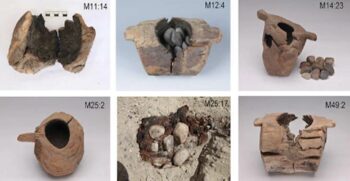
Similar braziers to the Scythians, but here wood, not bronze were used in funeray rites by Indo-European speaking people at the Jirzankal Cemetery. ‘Archaeologists Found That People Smoked High-Potency Cannabis At Funerals 2,500 Years Ago‘
The Scythians were a Indo-European tribe with wide regions of trade, which included China. Partridge also ignores the similarity in the ritual use of cannabis in funerary rites in China, although here, lacking bronze making skills, they used wooden braziers, which he does acknowledge separately, but seems unaware of the Indo-European nature of the people, and seems to assume they were indigenous Han Chinese. “Evidence at the site indicates those buried there likely had connections to groups further west in Eurasia” (Dengler, 2019). As noted in regards to the stone age, archaeological evidence of cannabis use in burial rites in IE cultures can be traced back to 5,500 years ago and archaeological evidence indicates this continued into the Common Era.
A documentary I helped with detailing the role of cannabis in ancient Indo-European cultures
Likewise, Partridge ignores that elaborate gold cups that contained chemical residues of cannabis and opium, were found at a Scythian burial site. And this is not the only find of residues in cups and other items indicating cannabis infused into a drink among the Scythians. At least one of the archeologists involved Anton Gas, an archaeologist at the Prussian Cultural Heritage Foundation, has claimed they vessels were for drinking haoma, bringing us to our next topic.
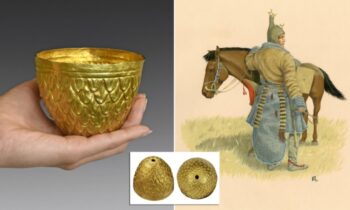
Image of one of the Scythian gold cups that contained residue of both cannabis and opium. Some researchers have suggested these vessels were for drinking haoma, and the some scythians were known as the Haomavarga, the haoma-gatherers. These bowls are often mistakenly reported on as ‘golden bongs’ by some news sites.
SOMA AND HAOMA
The identity of the ancient Soma is undoubtedly one of the greatest unsolved mysteries in the field of religious history. Common in both the religious lore of ancient India and in Persia where it was known as Haoma, the plant was considered a God and when pressed and made into a drink the ancient worshipper who imbibed it gained the powerful attributes of this God.
The whole Sama-Veda is devoted to this moon-plant worship; an important part of the Avesta is occupied by Hymns to Homa. This great reverence paid to the plant, on account of its intoxicating qualities, carries us back to a region where the vine was unknown, and to a race to whom intoxication was so new an experience as to seem a gift of the gods. Wisdom appeared to come from it, health, increased power of body and soul, long life, victory in battle, brilliant children. What Bacchus was to the Greeks, the Divine Haoma, or Soma, was to the primitive Aryans. (Clarke, 1883)
As Zenaide A. Ragozin noted in his 1895 edition of Vedic India, Soma “was unquestionably the greatest and holiest offering of the ancient Indian worship”:
The Gods drink of the offered beverage; they long for it; are nourished by it and thrown into joyous intoxication… The beverage is divine, it purifies, it is a water of life, gives health and immortality, prepares the way to heaven, destroys enemies, etc.,
The fierceness of the drink, its exhilarating and inspiring properties, are especially expatiated upon. The chosen few who partake it… give most vivid expressions to the state of exaltation, of intensified vitality, which raises them above the level of humanity. (Ragozin, 1895)
The origins of Soma’s use goes back into the shadowy time of pre-history and to the common Aryan ancestors of the Persian Zoroastrian religion, and the Vedic religion of India. “Ever since the Aryans crossed the Hindu Kush into India in prehistoric times, the mystery has persisted. And ever since Sanskrit was discovered by Europeans in the eighteenth century, an apparently insoluble riddle has lain at the heart of Vedic studies: the identity of the mysterious, sacred psychotropic plant of the Brahmans called soma” (La Barre, 1980).
The Sacred plants soma and haoma were made into ritual drinks in the ancient Vedic and Avestan religions, which are thought to have originated from a common earlier past. Through ancient prohibitions and the passage of time, the identity of soma and haoma was lost, leaving only the religious texts that described their entheogenic qualities behind them. As a result this has left modern religious scholars a riddle in discovering this ancient mystery plants long lost identity. As Partridge explains:
Perhaps the most widely discussed argument about the identification of soma was that of the mycologist Gordon Wasson. He became convinced that he had identified the ‘plant god’ of the Aryans as the fly agaric mushroom… a large part of his book on soma [Soma: Divine Mushroom of Immortality (1968)] is devoted to the study of fly agaric consumption in Siberia… separated by thousands of miles and without any evidence to the contrary, it is very unlikely that there was much cross-cultural communication between Siberian shamanism and the religion of the Rgveda.
In more recent years, a similar type of speculation has focussed on cannabis. Indeed, Bennett has made a particular point of replacing Wasson’s mushroom thesis with his own arguments about cannabis. Drawing on scholarly discussions of haoma in the Avesta — the earliest sacred texts belonging to Zoroastrianism — which is cognate of soma, he argues that both refer to cannabis, thereby demonstrating that it was used sacramentally from early Indo-european history, indeed he insists that the process of making soma and consuming it prior to fermentation, as indicated in the Rgveda, describes precisely the way bhang is made and consumed today. Hence he claims that cannabis is one of the most ancient and widespread psychoactive substances to be used in religion. While we need not debate the identification of soma — which is highly problematic — the point here is simply to note that, despite lack of concrete evidence, significant effort is put into weaving a narrative of cannabis use into accounts of early history of religions. Again, it seems to be the case of authors sacralizing a plant they fetishize. (Partridge, 2024)
Certainly, as we have seen, the ritual use of cannabis has a long history with Indo-European culture. Indeed the IE root word for cannabis, is still present in many of the modern languages which grew from it. The comparison with the preparation of bhang is not something I came up with, as we shall see, it comes from numerous Indian academics, who partridge ignores. This is omission of the experience of other cultures, is a pattern we have seen from Partridge in regards so much Indian history of cannabis.
Partridge also takes aim at The Church of Cognizance claim of the religious use of cannabis, under the name of haoma, as well as my own research in this area, noting that modern “Zoroastrians tend to identify it as a variant of the non-psychoactive ephedra.”
This is a problem for Quaintance ([founder of The Church of Cognizance) and, indeed, for a number of cannabis apologists, not least, Chris Bennett… the basic argument is that ‘haoma’ is etymologically related to the word ‘soma’, both of which are identified as cannabis — a theory that is now largely discredited… note how ambiguous terms in ancient texts have been used by cannabis religionists and apologists to support the plant’s sacralization” (Partridge 2024).
Partridge cites Dieter Taillieu for his claim that cannabis as a candidate for haoma is dismissed, via Taillieu’s essay Haoma Botany in Encyclopaedia Iranica However, contradictory to Partridge’s claim, Taillieu’s essay, goes over a variety of candidates with no sure candidate, and does not clearly reject cannabis and even indicates support for Zoroastrian use:
B. L. Mukherjee proposed hemp, Cannabis sativa/indica, as *sauma. Henrik Samuel Nyberg (pp. 177, 190, 290) independently gave support for this, but Walter Bruno Henning (1951, p. 30), rejecting his theory of Zoroaster’s use o hemp, voiced a modern Western aversion towards psychotropic substances as leading to “physical, mental and moral deterioration.” This, however, ignored the importance of dosage. (Taillieu 2003)
Taillieu’s view was the word haoma “might have been used for several similar, or even wholly different, plants.” So he does not reject cannabis at all, but views that a variety of plants may have been in use. This is not out of line with what myself, and a considerable amount of other scholars have suggested. The claim, myself and others make about haoma, based on archaeological and linguistic evidence, is that haoma was a blend of ephedra and cannabis, as well as at times including opium poppies. The cannabis was removed in a period of Zoroastrian reforms of the haoma ritual, but the use of ephedra has continued to the modern day. It should also be noted here, that as with his claim about Duvall stated bhang, was a generic term for ‘psychoactive plants’ when he absolutely did not, here again with Taillieu, he has either misunderstood what the author he cited has stated, or he has purposely misrepresented it.
As well, in opposition to what Partridge claims about the non-psychoactivity of Ephedra, the plant’s active compounds, like ephedrine, are psychoactive. They stimulate the central nervous system and can cause effects such as restlessness, mild euphoria, confusion, and insomnia. In some cases, with higher doses or pre-existing conditions, more severe psychiatric effects like hallucinations, delusions, paranoia, and panic are possible. In fact, ephedra has been used in making methamphetamine. Moreover, Ephedra, like cannabis, has been found in Scythian tombs, as well as at the Chinese Indo-European sites in and around the Tarim Basin we have discussed for their archaeological evidence of cannabis. Further, the two plants held an interesting relationship in China, with the name of ephedra being a reversal of the syllables used for ‘cannabis’, possibly indicating a sort of ying-yang relationship, as shall be discussed.
My own view, is that ephedra and cannabis were used together in the preparation of haoma, and in some instances poppy may have been used as well, and this is based on the work of earlier researchers. Similar views on Haoma are held by a number of Iranian scholars. Mehrdad Kia a Professor of History and Director of the Central and Southwest Asian Studies Center at the University of Montana, notes in The Persian Empire: A Historical Encyclopedia (2016): “The ingredients of the sacred Haoma juice were most probably ephedra mixed with poppy and cannabis” (Kia 2016). Likewise, Xinru Liu is a professor Emeritus of early Indian history and world history at The College of New Jersey, also suggests “ephedra, opium, and cannabis” a view he shares with colleague Kazim Abdullaev Director of Research of the Institute of Archaeology, Academy of Sciences of Uzbekistan, Senior Scientific Worker in Samarkand State University, and an Associated Member of the Centre National de Recherche Scientifique, as noted in his paper Sacred Plants and the Cultic Beverage Haoma (2010). A paper composed by a group of Iranian academics and clerics concluded “Hum, homa…are among the many expressions given to cannabis in the Iranian plateau …in one of the Avestan hymns contained in their sacred book, Gat-ha, reference to the defence of the environment and care of the ‘sacred plant’ is thought of ceiling a reference to cannabis” (Ghiabi, Maarefvand, Bahari, Alavi, 2018).
Curious that Partridge pays so little heed to academics in the region where haoma was historically consumed, when considering research about it’s identity. But this seems to be a pattern of behaviour in his research, which is very Western biased. but the West has its proponents of this view as well.
Prof. Patrick McGovern, a Professor of Anthropology and Scientific Director of the Biomolecular Archaeology Laboratory for Cuisine, Fermented Beverages, and Health at the University of Pennsylvania Museum in Philadelphia, has also suggested in Uncorking the Past: The Quest for Wine, Beer, and Other Alcoholic Beverages (2009) haoma was likely a wine or mead like infusion that included cannabis and ephedra. “From a chemical standpoint, the advantage of using an alcoholic beverage is that it dissolves the plant alkaloids” (McGovern, 2009). McGovern, in part, based his view on later Zoroastrian accounts, such as The Book of Arda Wiraz, which has cannabis (bhanga, or mang) mixed into wine, and archaeological information.
These individuals can hardly be written off as the sort of romanticizing, plant fetishizing, ‘cannabis apologist’ that Partridge tries to portray myself as.
In regards to the identification of soma, here we see another clear example of the sort of passive racism Partridge uses through omission. No mention is made of the many Indian researchers who have suggested that soma was made from cannabis, and the linguistic arguments and evidence they put forth, is completely ignored. (This comes out even more in Partridge’s treatment of cannabis in India, and with the cult of Shiva, as we have seen). Instead he portrays these ideas as my own, when they were sources I used to build the case for cannabis as soma.
In 1976, Professor B. G. L. Swamy, an Indian botanist and writer who was head of the department of Botany and a principal of Presidency College, Chennai, put forth cannabis as a candidate for soma in a well thought out, but little recognized, article The Rg Vedic Soma Plant, in the Indian Journal of History of Science. Swamy built on the presentations of earlier Indians researchers, Mukherjee (1921) and Ray (1939) noting that the Vedic descriptions of the plant indicated leaves, stalks and branches; that soma was green, hari; that cannabis grows wild in areas associated with the Aryan ancestors of the Vedic authors. That Soma was cannabis has been held by a variety of Indian authors, most prominently by Chandra Chakraberty who has made this association in a number of different books; “Soma was… made of the flowering tops and resins of Cannabis sativa which is an aphrodisiac and stimulant, and a nourishing food…” (Chakraberty, 1952); “Soma…. Cannabis sativa… a nervine aphrodisiac” (Chakraberty, 1963; 1967); Not just soma in Chakraberty’s view, but also, “Amrta, the drink of the gods, identified with Soma (Cannabis Sativa) flowering leaf-paste mixed with butter-milk and honey, known as Siddhi’”(Chakraberty, 1971).
Soma was the most important of the Vedic plants. Soma was regarded by both the Iranians (Avestan Haoma) and the Aryas as the elixir of life. Unfortunately its identity has been lost. Some regard it as Asclepias acida, Sarcostema viminalis or Vitis Vinifere…. But these suppositions find no support from Vedic descriptive statements “The golden-brownish twigs (of Soma : harir ancut : Avestan azuz V. 9, 16) is being pressed (into a paste between stones) and filtered through (a woolen cloth or a grass mat : 9. 92.1). “Two arms with their ten fingers are pressing between the stones the Soma twigs with pretty digitate leaves (somasya suhastu : compound leaves radiating like fingers borne at the apex of the petiole), and the twigs with their digitate leaves (Sugabhastir=pretty handed) from mountains are pouring forth clear pleasant juice (5,43,4). Soma is many leaved (bahutanta : 10, 42, 8), twigs with slender leaves (ancum tigman : 8. 61 (72) 2). “Press the Soma between the stones, and filter it (the pressed paste) throughby mixing it with water. Then what comes from the hollow stems (Vaksana) will be enriched with milk (8. 1, 17)”. Finest Soma grows on Mujavant, (X. 34, 1). In the midst of snowy peaks… The soma paste pressed between stones, or by mortar and pestle (ulukhala : (1, 28, 3, 5-6), and mixed with water and milk (9, 86, 11 ; 9, 91, 2) is pushed through a woolen strainer and filtered through a grass mat. Sour milk (dhadi ; X. 179. 3), barley water (Yava sirah : 1, 81 (92) 4 ; 9 168-4) and honey 9, 17, 18 are added and it is a glad and stimulating drink…. (Chakraberty, 1944)
It is most likely that the soma plant is Cannabis sativa. For it harmonizes with the Vedic descriptions…. Soma Juice is ‘exhilarating(9, 86, 5) Cannabis sativa is stimulating and is an aphrodisiac and a giver of delight (9, 80, 8). ” Like Soma (5, 43, 4 ) it has digital leaves (su-hasta). Its stem is hollow (vaksana 8,1, 17). Rudra lives in Mujavat (Apasthanba 8, 18,8; MBh. X, 17, 96) Best Soma is also found in Mujavat (X, 34,1). “The votaries of Rudra-Siva are addicted to Cannabis sativa. From these identities, it is safe to conclude that Soma is Cannabis sativa. (Chakraberty 1958)
Other Indian researchers have also made this identification. “…the plant now known as Bhanga in India (Indian hemp)… was used as H(a)oma or Soma” (Deva & Shrirama, 1999); “Soma (a kind of hemp)” (Ramachandran and Mativāṇan̲, 1991); “Soma was a national drink. This was a green herb which was brought from the mountain and pounded ceremoniously with stones. It was mixed with milk and honey and drunk. Probably this was a type of hemp (Bhang…) which is still drunk by some people in India” (Vikramasiṃha, 1967). So to be clear, in India, the land of Soma, the idea that it was originally cannabis, is not the fringe theory that Partridge tries to play it off as.
As well Indologist scholars such as Alain Danielou, and Professor. A.L. Basham, have suggested this same designation. “This ancient sacred drink [soma]was likely to resemble a drink what today is called bhang, made from the crushed leaves of Indian Hemp. Every Shaivite has to consume bhang at least once a year” (Danielou 1992); “The effects of soma… are rather like those attributed to such drugs as hashish. Soma may well have been hemp, which grows wild in parts of India, Central Asia and South Russia, and from which modern Indians produce a narcotic drink called ‘bhang’” (Basham 1961).
Partridge dismisses my extensively referenced research into the identities of the Vedic Soma and Avestan haoma, as a case of ‘authors sacralizing a plant they fetishize’. He refers to a “lack of concrete evidence”, and portrays it as something I concocted myself. But the case I make is based largely on the collected material of authors like those referred to above, and other citations.
My own hypothesis, briefly, is interrelated with a variety of archaeological finds, linguistic theories, and references in ancient texts. Such as: the known widespread ritual use of cannabis in Indo-European culture, of which the Aryan people who composed the Vedas were a part of.;The archaeologically identified ritual use of cannabis in China, by Indo European groups, such as at The Yanghai Tombs near Turpan, and other sites; The role of Indo-European Scythian groups as traders with the IE groups in China, and the similar practices of burning cannabis in Braziers for funerary rituals, as well as there use of cannabis beverages consumed in Golden Goblets, as shown through archaeological evidence.
Notable here is, and as noted in Ancient Nomads of the Aralo-Caspian Region, that besides cannabis, “bundles of ephedra twigs… have been found in small pouches with several of the remarkably preserved mummies from the Tarim Basin in Xinjiang” (Yagodin, Betts & Blau, 2007). Likewise at Scythian sites where cannabis has been recovered “ephedra twigs have also been found in Pazyryk and Altai graves, burned as incense and as supplies for the dead” (Mayor, 2016). Similarly, Warwick Ball, an Australia-born Near-Eastern archaeologist, has noted in The Eurasian Steppe, that besides cannabis “evidence from art and archaeology also indicates widespread use of opium, ephedra and other narcotics among the steppe nomads” (Ball, 2021). Ephedra pollen has also been determined at ancient sites frequented by the Scythian in Russia (Barnard & Wendrich 2008). The authors of ‘The synanthropic flora of kurgans within three steppe zones in southern Ukraine‘, record that “Specimens of plants collected by various authors from the kurgans have been deposited in Ukrainian herbaria” include “Ephedra distachya” (Sudnik-WÛjcikowska & Moysiyenko 2008). This accounts for ephedra in modern preparations of Haoma and Soma, without discounting a role for cannabis in more ancient preparations.
Let’s look at the Chinese names for cannabis which have been connected to the Scythians and the Iranians who the haoma cult originated with. Mia Touw, in her essay The Religious and Medicinal Uses of Cannabis in China, India and Tibet (1981) that “it was hu-ma, or fiery hemp (as the meaning has been construed by some etymologists), which also meant Scythian hemp (Stuart1911) and this latter kind was held to be especially potent” (Touw, 1981). Professor Mark Merlin as well noted “It is interesting that the Chinese character hu, which refers to barbarians or foreigners of the West, can be connected to the character for hemp (hu-ma) to indicate western or foreign hemp and the potent female hemp plant” (Merlin, 1972). This brings us to the linguistic theory of S. Mahdihassan in ‘The Seven Theories Identifying the Soma Plant’, that the “name soma is really Sau–Ma, and its original is Chinese as Hau–Ma, which means fire– ed-Hemp”. See also, Is Shuma the Chinese Analog of Soma/Haoma? A Study of Early Contacts between Indo-Iranians [Scythians aka Saka] and Chinese by Zhang He.
Cannabis was also suggested… based on Tibetan evidence. The Tibetan word for Cannabis is So. Ma.Ra. Dza., apparently a borrowing from the Sanskrit soma-raja “king Soma” or possibly “soma rasa” / “soma juice” which could be the same as “bhang”.
The Scythians, interacted with Zoroastrianism, particularly in its early stages. They shared a common Indo-Iranian linguistic and cultural background with the Persians, and it is believed some Scythians adopted elements of the religion. The Scythians were known by other names, such as the Saka in the Persian region, another one of there names was the Haomavarga, the haomo-gatherers, and it was recorded that they burnt haoma as well as drank it, just as they did with cannabis. Scythian Haomavarga, were believed to have exported and imported goods, between the Chinese Tarim Basin, and the Bactria Margiana Archaeological Complex located in present day Afghanistan. At this site, the Russian archaeologist Viktor Sarianidi claims to have found 4,000 yr old temple sites, that indicated cannabis, ephedra, and in some cases poppy, that he believes were used to prepare haoma/soma, although there is some debate about this claim. More recently other Russian researchers have been making similar suggestions, specifically about the Aryan ancestors of the Vedic Indians. In the article ‘Aryan settlements in the Urals: A precursor to Indian Civilisation?‘ (2012), Strong archaeological evidence which indicates that the Aryans lived in Arkaim, by the Urals, before they went to India via Central Asia. The article quotes the archeologist Sergei Malyutin:
Malyutin says that the Aryans came here from the west, probably from the Volga, and then moved to Central Asia and then India. He believes that their sacred drink included cannabis boiled in milk with an addition of ephedrine [i.e., ephedra].
For a deeper well referenced look at the case for cannabis as soma, see my article The Cannabis Soma/Haoma Theory: A Synopsis Based on the Latest Textual and Archeological Evidence.
Partridge is dismissive of this view without raising any specific point other than his comments of it as an example of “authors sacralizing a plant they fetishize” and a “lack of concrete evidence”. However, notable academics in fields more related to this area of study, who have actually read what i wrote (I doubt Partridge did) such as Prof. Victor Mair, who is largely credited with identifying the caucasian features of the Chinese Tarim Basin mummies that used cannabis, who stated “If you are interested in the history of the Indo-Europeans, the history and identification of soma / haoma, or the history of cannabis as a hallucinogen, you owe it to yourself to read Chris Bennett’s substantial tome.” And the late anthropologist and Professor C. Scott Littelton, who specialized in Indo-European cultures and groups like the Scythians. Just before his death, Littleton aided as resource in the writing of my book Cannabis and the Soma Solution, and he had initially been a proponent of R. Gordon Wasson’s theory Soma was the fly agaric mushroom. Littleton stated “I have read Mr. Bennett’s several books on this subject and am in general agreement with what he states, especially about the extent to which the Vedic hallucinogen Soma was probably made from cannabis. Indeed, his research has changed my own thinking about this ancient conundrum (heretofore, the majority of scholars have suggested that Soma was prepared from psychotropic mushrooms) . . . . In short, I heartily recommend Bennett’s book to anyone seeking a better understanding of this well-nigh universal, albeit all too often misunderstood hallucinogen and its crucial role in the history of human spirituality.”
In regards to academic support for his book, the only academic plug Partridge managed to get came from Mitch Earleywine, Professor of Psychology, University of Albany, USA: “Christopher Partridge masterfully navigates the complex and multifaceted relations between cannabis and society across the ages. With meticulous research and an intriguing narrative, Partridge unveils the historical, cultural and scientific dimensions of cannabis, transcending conventional tales and stereotypes. If you want a refreshing perspective that challenges your preconceptions about cannabis, consciousness, the holy and the unholy, read on.” However, here is what Earlywine wrote me about Cannabis and the Soma Solution after reading it: “I really love it. It’s rare for me to read a cannabis book and actually learn something. You did an in-depth view into areas that I found extremely informative.”
I am particularly offended by Partridge’s trite dismissal of my work in this regard, and having read his book, and the numerous historical mistakes he makes, I do not think he has the knowledge to warrant such criticisms, and it’s particularly notable that I can confidently say this about a Professor. Partridge refers to a selective bias, but I have taken more time than most authors to go over material that disagrees with my hypothesis, in great detail, in both my in depth book on , and in articles excerpted from it, such as The Mushroom Soma Theory: A Critical Analysis; A Rebuttal to Criticisms of The Cannabis Soma Theory in Secret Drugs of Buddhism by Mike Crowley; ‘Secret Drugs of Buddhism’, Soma, and the Sad State of Entheogenic Anthropology; Haoma and Harmaline: A Critical Analysis.
Moreover, I have often contacted academics, in order to get critical feedback from them, as I did when I approached Partridge before reading his book on cannabis. As well I have made several attempts to initiate scholarly debate on the identity of soma and haoma. I had thought a peer review was in order for the cannabis soma and haoma hypothesis, but after this experience with Partridge, a Professor of religious studies at a well respected University, i question if such a thing could ever be impartial, if Partridge’s work here is taken as an example. In lieu of a peer review, while working on this review, I decided to consult Grok, which would seem to offer some sort of unbiassed, non-partial, assessment. I queried Grok with single question prompt “Examining the work of Chris Bennett, David Flattery, Martin Schwartz, R. Gordon Wasson, Dieter Taillieu and other sources on the internet, who do you think makes the best case for soma and haoma?” Grok concluded:
Best Case: Chris Bennett makes the strongest case for soma and haoma’s identity. His hypothesis that cannabis, likely combined with Ephedra and poppy, was the primary ingredient is supported by compelling archaeological evidence (Sarianidi’s findings), linguistic connections (e.g., “bhanga,” “haomavarga”), and the cultural prevalence of cannabis in Indo-European traditions. His argument accounts for both Vedic and Avestan contexts, addresses the complexity of ritual preparations, and aligns with the psychoactive and spiritual effects described. While not definitive, it is more comprehensive and evidence-based than Wasson’s mushroom theory, Flattery and Schwartz’s Syrian rue hypothesis, or Taillieu’s Ephedra focus. The ayahuasca-analogue perspective further bolsters his case by explaining the potential for synergistic effects in a mixed concoction.

Grok produced this graph in response to the question on the identity of soma, for the full Grok analysis, click here.
Kali ma
Partridge mentions the Goddess Kali twice in passing, in relation to claims made by ‘cannabis apologists’ trying to sacralize cannabis. He gives no indication of the actual use of cannabis in the worship of Kali, as is his pattern in regards to the over all sacred role of cannabis in India.
The Goddess Kali is not primarily a Vedic deity. While she is now a prominent figure in Hinduism, her origins are believed to predate the Vedas and are strongly linked to Tantric traditions and pre-Aryan dark skinned tribal cultures that inhabited India before the arrival of the Vedic Aryans. Kali does not appear in the Rigveda, Yajurveda, or Samaveda. Kali’s emergence is strongly linked to Tantric practices and pre-Aryan tribal cultures. Kali was later integrated into the broader Hindu pantheon, particularly through texts like the Devi Mahatmya and Puranas, which elaborate on her various forms and powers. While integrated into Hinduism, Kali’s worship has also continued within the Tantric tradition, which is seen by some as more closely aligned with her original, non-Vedic character.
Although Shiva is the ‘Lord of Bhang,’ cannabis appears in offering to a number of other deities such as those dedicated to Shiva’s consort Kali, Goddess of Life and Death. Cannabis “is holy/consecrated to the most powerful Goddess ‘Kali ‘as well. “Kali… [is]worshipped with imbibing’s of cannabis” (Agrawal, Dhanasekaran & Kumar, 2022). At “Kali Puja festivals , a good deal of bhang , charas , and ganja is used” ( Evidence of witnesses: Indian Hemp Drugs Commission, 1893-1894).”Cannabis helps priests, ascetics, fakirs, yogis and sanyasis in their meditation and performance of religious rites . Devotees of … the goddess Kali and Durga… offer and partake of it after the puja ceremony” (Acta Ethnographica Hungarica, 1988).
As we have seen, the Kali puja was exported to Jamaica, by Indian migrant workers, and the ritual use of ‘ganja’ in these rites, was adopted by Rastafarianism.
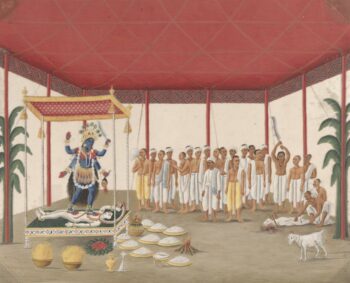
The Kali Puja as depicted in a 1860 image.
According to the Bulletin on Narcotics (Volumes 1-2, 1949), which cites no source, Brahman, the highest ranking group in India’s caste system, attempted to limit this practice
In Hindustan, in distant ages when the secret of the priests was revealed, the Brahmins appear to have attempted to control its use. They authorized it only on the occasion of certain important religious celebrations (Kali festivals, Durga puja etc). We cannot know wether the people readily accepted the restrictions of their consumption of Cannabis potions to the permitted dates; nor can we say wether it was not precisely in order to gratify the passion for the intoxicating drug, while at the same time respecting the laws promulgated by the ministers of the divinity, that the custom of smoking hemp arose. (Bulletin on Narcotics, 1949)
Ganja and bhang were not only offered too Kali at her puja, but also were offered in secretive tantric rites, with yoginis, who at times took on the Goddess form of Kali in rituals.
In the Mahanirvana Tantra “Tantra of the Great Liberation” one of the most important texts dedicated to the cult of Tantra, Kali’s cannabis mantra is given as “Om, Hrim Ambrosia, that springeth forth from ambrosia, Thou shalt showerest ambrosia, draw ambrosia for me again and again. Bring Kalika within my control. Give success; Svaha” (Avalon, 1913). In Tantric rites, cannabis retained its ancient Vedic epithet of ‘Vijaya’ (Victory). As Arthur Avalon (aka, Sir John Woodroffe) explained: “Vijaya, (victory) used in ceremonies to Kali: That is the narcotic Bhang (hemp)… used in all ceremonies” (Avalon, 1913). Dr. Michael Aldrich, a pioneer of cannabis history, gives us some insights into this use:
In medieval India and Tibet, sorcerers in search of magic powers glorified the use of a marijuana drink (bhang)… in Tantric sex ceremonies derived from the ancient soma cult. A circle of naked men and women is conducting an experiment of the central nervous system. They consecrate a bowl of bhang to Kali, goddess of terror and delight. As the bhang begins to take effect, the worshippers mentally arouse the serpent at the base of the spine, sending waves of energy up to the cortex. (Aldrich, 1978)
The Kaulajñānanirṇaya is a significant Sanskrit Tantric text attributed to Nath Yogi Guru Matsyendranātha, and also refers to cannabis for ritual purposes. Georg Feuerstein the German Indologist specializing in the philosophy and practice of Yoga, in Tantra: The Path of Ecstasy noted that cannabis was shared with female initiates [yoginis] and the Kaula-Avali- Nimaya (2:110-2:111) in the sexual rite of maithuna.
Maithuna is preceded by a preliminary ritual in which the yoni is anointed with sandalwood paste. This makes it resemble a beautiful flower and also highlights the Tantric interest in menstrual blood (also called pushpa, or “flower”). The female initiate, or shakti, also is offered hemp (vijaya), a mildly narcotic substance…. The Kaula-Avali-Nirnaya (2.110 – 111) mentions hemp as an alternative to wine and also speaks of four classes of hemp and their respective purificatory mantras. (Feuerstein, 1998)
The Sarvollāsa Tantra, also known as Sarvānanda Tarangini. is a significant text within the Shakta tradition of Hinduism, specifically associated with Tantric practices and the worship of the Divine Feminine (Shakti). Authored by Sarvānandanātha (15th-16th Century CE). As a Tantric master, Sarvānandanātha is regarded as a siddha (perfected being) whose teachings continue to guide practitioners. His work is typically studied under the guidance of a guru due to its esoteric nature and the complexity of its rituals and philosophies. it is a rare manuscript that serves as a compendium or “Samgraha” of Tantric knowledge. These texts are part of the broader Tantric literature that emphasizes non-dualistic (Advaita) philosophy and the interplay of Shiva and Shakti, the masculine and feminine cosmic principles. In the Bhairava Tantras, Bhairava, the fierce form of Shiva, is often paired with Kali as his divine consort. This pairing symbolizes the unity of consciousness (Shiva) and energy (Shakti), a core principle of non-dual Tantra. Kali, as the dynamic and transformative aspect of Shakti, complements Bhairava’s fierce, transcendent nature.
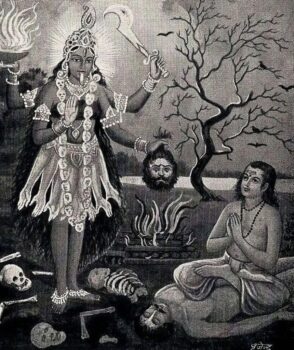
Goddess Kālī and Sarvānanda Ṭhākur. Hindu Print Kalyan (Hindi magazine) Gita Press, Gorakhpur.
Cannabis appears as an offering in the Sarvānanda Taraṅgiṇī, and is shared with the yogini
Smoking of hemp of 4 different sorts (samvidāpāna), prescribed with wine; its sanctification. (Sarvananda Tarangini 30)
Betel leaf, [water from]a copper pot, gāñjā , palm sap, snake venom, date palm, juice, thorn apple, and bhāṅg (cannabis) these eight are called alcohol and bestow bliss to the worshipper. (Sarvananda Tarangini 196)
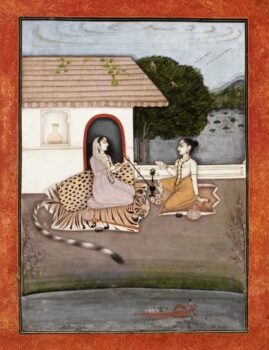
Two Yoginis (Victoria and Albert Museum)
The painting shows two female ascetics sharing a hookah, and seated on animal skins, the traditional seat of holy men and women. The dark shading and sombre colouring are typical of painting in the Mughal province of Murshidabad in the mid-18th century.
Bhagavati, often associated with the goddess Kali, is a term used in Hinduism, particularly in Kerala and Nepal, to refer to the divine feminine energy, or Shakti. Ganja was offered to the Goddess under this name in Tantric sex rites as well.
When the Tantric religion came into existence in India is not known ; but Tantric practices always invoked the ganja smoking god Siva and the goddess Bhagavati.…the Kulamava Tantra…Says… “By doing japa of mantra and by adoration of Bhagavati, the consort of Shiva, at times of sexual union, a man becomes, like Suka, free from all sin” (Dharmapala & Anagarika,1933)
The Sabar people, a dark skinned indigenous tribe in India, have a unique and complex relationship with the goddess Kali, often incorporating her into their animistic beliefs and practices, sometimes with tantric elements. While not exclusively tantric, their Kali worship is deeply intertwined with their animistic worldview and traditional rituals. Sabar women were often sought after by Tanrik adepts as or yoginis. In Masters of Mahamudra (2010) Keith Dowman explains discusses the roles of ganja and Sabara yoginis in the Charyapada songs (8th-12th century CE) composed by Saraha an Indian Buddhist Mahasiddha and poet, who lived in the 8th century.:
The Sabara women were most desirable as consorts to the tantrikas…”Sabari” became virtually synonymous with “tantric yogini” in the siddhas’ caryapada songs. Saraha sang an evocative love song, a tantric analogy, about Sabara and Sabari lovers. “The Sabara girl is sitting on a high hill. She has peacock feathers on her head and a garland of ganja around her neck. Her dear Sabara is mad, intoxicated by love for her.” … The jungle Sabaras wear peacock feathers as their emblem, and ganja (marijuana) has special significance for them. Associated with the Sabaras is the image of a yogin crazed with sexual passion for his Saban consort, intoxicated from smoking ganja, covered in ashes and drinking alcohol from a skull-cup. For Saraha this image is a metaphor for Buddhist tantric practice. (Dowman, 2010)
Cannabis also played an important role in the Durga Puja, the annual Hindu six day festival that celebrates worship of the Hindu goddess Durga. In the 19th century, at the close of the Durga Puja, it was customary to drink bowls of bhang and to offer them to others. As the Indian Hemp Drugs Commission Report recorded:
The custom of offering an infusion of the leaves of the hemp plant to every guest and member of the family on the… last day of the Durga Puja, is common in Bengal, and may almost be said to be universal. It is alluded to by many of the witnesses who refer to its use on this occasion as well as on other days of the Durga Puja festival. But, while there can be no doubt as to the existence of the custom, there is considerable divergence of opinion as to the true nature of it. The custom itself is a simple one. On the last day of this great festival the male members of the family go forth to consign the image to the waters and on their return the whole family with their guests exchange greetings and embrace one another. During this rejoicing a cup containing an infusion of the leaves of the hemp plant is handed round, and all are expected to partake thereof, or at least to place it to the lips in token of acceptance. Sweetmeats containing hemp are also distributed. Opinion is almost equally divided as to whether the custom is a mere social observance, or whether it is an essential part of the religious ceremonial of the festival. There is difference whether there is any injunction in the opinion among the witnesses as to Shastras rendering obligatory the consumption of hemp; but Tantric religious works sanction the use, and the custom whatever be its origin may now be said from immemorial usage to be regarded by many people as part of their religious observances. From the evidence of the witnesses it would appear that there is no specific direction in the Shastras of the manner in which the drug should be used but from the references quoted it would appear that the use alluded to is authority that of bhang in the form of an infusion. (IHDCR, 1894)
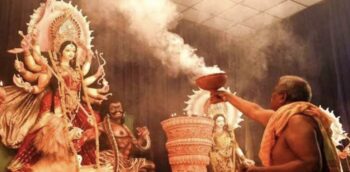
Dr. William Dymock, Professor of Chemistery in the Calcutta medical College, recorded in the 19th century:
The use of Bhang on certain festive occasions such as the Durga puja especially in the N W Provinces and Behar is common among the better classes and the ordinary run of orthodox Hindus accustomed to have their little excitements may use it at such times without incurring any opprobrium such as would result from the use of wine or other spirituous liquors. In Bombay the hilarity of the Bania women returning from the temples on holidays can hardly be attributed to pure milk .There would appear to be no reason to suppose that the occasional use of bhang does much harm. (Dymock, 1890)
References to this practice were recorded well into the 20th century. “Bhang is taken on the day after the Durga Puja , because that is supposed to be a very auspicious day , and the name of the drug – siddhi – signifies success , which is supposed to be imbibed with the drug for the whole year” (Caṭṭopādhyāẏa,1940).
Indications are that this practice, unlike the use of cannabis at Holi, Shivaratri and the Kumbh Mela, fell into decline. Writing for the United Nations Office on Drugs and Crime in 1957, Dr I. C. Chopra and Col. Sir R. N. Chopra, Member of the Expert Advisory Panel on Addiction-producing Drugs of the World Health Organization, noted that: “In Bengal… the custom still persists among certain classes of offering a beverage prepared from the leaves of the cannabis plant to the various family members and to guests present on the last day of Durga Puja (Vijaya Dasmi) which is the biggest Hindu festival in that state…. where Durga Puja is observed in a manner similar to that in Bengal, the use of bhang is not so much in vogue” (Chopra & Chopra, 1957).
After Colonial times, disdain for this practice readily increased “bhang and wine , have made the name of Durga Puja or the worship of the ten – handed goddess of Bengal , otherwise so solemn and sacred in the popular mind , a thing to be dreaded by all lovers of true religion” (Sastri, 1912). More recently we can see strict restriction regarding cannabis at the Dussehra Cuttack, the grand celebration of Durga Puja, culminating in the immersion of the goddess’s idols on Vijayadashami, which commemorates the final day of the much celebrated festival. In the 2024 article ‘Strict rules imposed for idol immersion procession during Cuttack Dussehra‘ “People coming to the procession cannot consume or bring with them any kind of intoxicants such as cannabis, marijuana, Ganja, brown sugar, etc.If someone is suspected of consuming or possessing drugs he will be restrained from the procession” (Himanshu, 2024). Thus the decline of this practice in Durga Puja, has readily declined through efforts to prohibit it.
The situation with the Durga Puja, is a clear example of how the profanation of cannabis, can drive it’s religious use underground, and even its disappearance from rituals. Definitely an aspect that would have been discussed in a less biased study of the sacred and profane aspects of cannabis.
Ma Ku
“…[P]erhaps the deity most frequently cited in connection with cannabis is Ma Ku (Magu), a Chinese goddess generally associated with health and longevity. ‘Ma’…is the Chinese term for ‘hemp’ and ‘Ku’…means variously ‘aunt,’ ‘maiden,’ ‘priestess,’ damsel’, or ‘goddess’. Joseph Needham, for example, notes the Hemp Damsel, Ma Ku, was goddess of the slopes of the Thai Shan, where [cannabis]was supposed to be gathered on the seventh day of the seventh month, a day of seance and banquets in the Taoist communities’. While this may be true, in recent cannabis literature she is detraditionalized — detached from her traditional context within ancient Daoism –becoming more of a signifier for healing, health and well being. For example, the spiritual teacher Kathleen Harrison informs us that Ma Ku is ‘the name of the deity of hemp… the spirit of she who grows, she who clothes us, she who binds us, she who ties it all together.” Again, Jamie Della informs her readers that Ma Ku is ‘honoured as the protectress of health and healing as well as the vitaity of the earth itself… Like a guardian at the gate, cannabis invites her human partners into her dance of creativity’. (Partridge, 2024)
Curiously, Partridge tries to play off this adoption of Ma Ku, by the cannabis community, as a sort of cultural appropriation. This is ironic, as he has omitted cultural context on so many subjects like this, ignoring the experience with sacred cannabis in other cultures, and viewing things through a colonial Western lens via his continual references to ‘Orientalism’. As someone who has been studying the role of cannabis in various religions for three and a half decades, I can assure you, Ma Ku is not the ‘deity most frequently cited in connection with cannabis’. This honour would go to Shiva, whose tradition of cannabis use is largely ignored by Partridge, with the Biblical God coming in second.
However, Partridge seems to readily accept this connection with Ma Ku and cannabis. But then Joseph Needham, who was a British biochemist, historian of science and sinologist known for his scientific research and writing on the history of Chinese science and technology, initiating publication of the multivolume Science and Civilisation in China, is much harder to write off, than a ‘cannabis apologist’ such as myself. Needham explains that cannabis was one of the establishing factors of Taoist Philosophy:
The chain of events which led to the establishment of Mao Shan… as the first major permanent centre of Taoist practice began in +349 or slightly earlier with visitations by immortals to a young man named Yang His… in a series of visions, there appeared to Yang a veritable pantheon of celestial functionaries, including the lady Wei… and the… Mao [Brothers]… In the course of these interviews, aided almost certainly by cannabis, Yang took down in writing a number of sacred texts which the immortals assured him were current in their own supernal realm as well as oral elucidations and answers to Yang’s queries about various aspects of the unseen world. He treasured and disseminated these scriptures as the basis for a new Taoist faith more elevated than the ‘vulgar’ sects of his time. (Needham, 1976)
Needham, also reports that Taoists mystics were alleged to add “hallucinogenic smokes to their incense burners… The addition of hemp (ta-ma, huo-ma, Cannabis sativa = indica) to the contents of incense-burners is clearly stated in one Taoist collection, Wu Shang Pi Yao (Essentials of the Matchless Books), which must place it before +570…” (Needham, 1974).
Hakim Bey, a pen name of the scholar Peter Lamborn Wilson (1945 – 2022) also notes that in “the early Taoist tradition of the Mao Shan, or ‘Supreme Clarity’ school, a great many shamanic ‘survivals’ can be traced, among them the intriguing fact that the Mao Shan revelations were supposed to have taken place under the influence of a ‘hemp laced incense’” (Bey, et al, 2004).
Moreover, Taoism has the honor of being the only religion (as far as I know) to personify Cannabis as a deity. In the T’ang period there existed a cult of Ma Ku, or ‘Miss Hemp’. It was centered at Mt T’ien T’ai, at a place called the precipice of Miss hemp; a statue of her stood there in Sung times…. Ma Ku was depicted as a beautiful maiden of the Taoist ‘grotto fairy’ type, but with a bird’s claws instead of feet…. In T’ang poetry she is often associated with important motifs, connected to Mao Shan meditation techniques, constellated around the imagery of time distortion. (Bey, et al, 2004)
The Taoist philosopher Wang Yuan (146-168 CE), was said to have invited Ma Ku to a feast on the cannabis gathering day of the “seventh day of the seventh month” where “The servings were piled up on gold platters and in jade cups without limit. There were rare delicacies, many of them made from flowers and fruits, and their fragrance permeated the air inside and out.” Wang served the guests a strong liquor from “the celestial kitchens,” and warned that it was “unfit for drinking by ordinary people.” According to the ancient account, even after diluting the liquor with water, everyone became intoxicated and desired more. It is believed by some sources that the elixir referred to was a special wine made from cannabis. A Chinese poem about Ma ku by Ts’ao T’ang clearly brings to mind the beauty of budding cannabis:
Blue Lad transmits the word, requiring them to come back: His report tells that Miss Hemp’s ‘jade stamens’ have opened. The watchet [Blue-grey] Sea has turned to dust – All other affairs may be disregarded: They mount dragon and crane and come to observe the flowers.
The ‘Blue Lad’ is a Taoist deity, and the poem describes him summoning all the fairies and immortals to witness the blossoming of Ma Ku’s flowers. “Apparently the T’ang literati argued about the identity of this ‘jade stamen-and-pistil’ flower suggesting that the truth was understood only by a few, who knew how to cultivate hemp flowers till (according to one description) they sported ‘whiskers like threads of ice, with golden grain sewn on top’” (Bey, et al., 2004). Conceivably, this could indicate that the Taoist gardeners new the secret of separating the male from female cannabis plants, to produce resinous seedless cannabis known as sinsemillia, a cultivation technique generally assumed to have been developed much later.
Ma Ku, literally, ‘Hemp Lady’, was a Taoist ‘Immortal’, who had strong connections with the ‘elixir of life,’ bringing back to mind that cannabis was deemed one of the Superior Elixirs of Immortality by Emperor Shen Nung, the “Father of Chinese Medicine” centuries prior to this and it would seemed to have enjoyed this reputation in the intervening period. Hemp’s association with immortality in China, was apparently quite widespread. In Myths of China and Japan, folklorist Donald Alexander Mackenzie (1873-1936) refers to a “Rip Van Winkle story that two men who wandered among the mountains met two pretty girls. They were entertained by them and fed on a concoction prepared from hemp. Seven generations went past while they enjoyed the company of the girls” (Mackenzie, 1923). “…Taoist dreamed of ascending to heaven after so many years of asceticism and by taking an elixir of life concocted from various rare herbs” (Suzuki, 1961). cannabis appeared in such recipes as well as in the as the ‘Pill of Commencing Immortals’ which contained “much hemp” (Needham, 1974).
This shamanic relationship with cannabis obviously lasted some centuries amongst Taoists and this is not surprising as “…the Taoist technique of ecstasy is shamanic in origin and structure” (Eliade, 1984). The magical use of cannabis was not limited to smoking. In the Chen Kao, “Yang Hsi describes… his own experience using the Chhu Shen Wan (Pill of Commencing Immortals) which contains much hemp” (Needham, 1974). A Taoist priest writing in the fifth century B.C. about seeded buds of cannabis noted that “magician-technicians (shu chia) say that if one consumes them with ginseng it will give one preternatural knowledge of events in the future.” “…[O]ne could add a fine +6th-century example from a Wu Tsang Ching (Manual of the Five Viscera)… ‘If you wish to command demonic apparitions to present themselves you should constantly eat the inflorescences of the hemp plant’” (Needham, 1976).
According to H.H. Dubs, in The Beginings of Alchemy, the idea of an elixir of immortality came into China via the myths about the Indo-Iranian Soma and Haoma plants. Dubs believed knowledge of the plant came from the Iranian culture area into China around the 4th century B.C. or possibly even earlier (Dubs, 1947). Many researchers dismissed this claim outright, as at the time there was little in the way of evidence pointing to such early contact between the Han Chinese and Indo-European influences. However, the discovery of the Tarim Basin Mummies proves that such early avenues of contact did in fact exist, and moreover, dates back centuries prior than the date in question. Dubs’ view was followed later by Pierre Huard and Ming Wong, who, in regard to Taoist references to immortality elixirs, also noted that “Traces of Indo-European immortality potions can be seen here: The Iranian Haoma… and the Indo-Aryan Soma… For centuries Taoists and alchemists were to seek the elixir of life in plants and pills…” (Huard & Wong, 1959: 1968). “…[T]he elixir-of-life concept came to China by way of the ancient Vedic soma tradition of the divine plant of immortality” (Philosophers, 1972). In the article “Beliefs about Aging and Longevity in Ancient China,” Alain Corcos refers to some of these earlier researches, adding that Haoma and Soma, like certain Chinese immortality elixirs, contained hemp:
The idea of imbibing plant potions to gain immortality did not originate with the Chinese. Apparently, the idea came from the Aryan tradition (Huard and Wong 1959). The sacred intoxicating drink, named Haoma by the Iranians and Soma by the Aryans in India was believed to cure disease and to confer immortality. Hemp was an active ingredient of both drinks. The Aryan belief in a miracle drug conferring immortality and curing diseases reached China in the fourth century B.C. (Dubs,1947), giving rise to the idea that there was a place where longevity could readily be achieved. (Corcos, 1981)
The connection between cannabis, Haoma, the Chinese Hu-Ma, the mountain home of the Immortals, and the mountainous origins of the Haoma Cult becomes even clearer when one looks at evidence that points to the nearby “the heavenly mountain of Tien Shan, the paradise of the Taoist immortals” and land of the Haumavarga, as the homeland of all these elements at play. The Tien Shan Mountains, rim the Tarim Basin, and it is in this region that much of the evidence of the cannabis using Indo-European Gushi culture has been recovered. This is also the home of the Hemp Lady “Ma Ku. sits on Tien shan” (Royal Asiatic Society–Korea Branch,1963)
The ancient Chinese held that Taoist immortals made their homes in the highest peaks in places such as Tien Shan. In the Taoist tradition the Goddess of the West is believed to guard the peach trees of immortality in the Tien Shan Mountains (‘Celestial Mountains’). “The Tien Shan were regarded not just as the mountain home of the gods, like Olympus or Sinai, but actually as a deity themselves, venerated as the most sacred mountains in China since the third millennium BC” (Shackley, 2001).
In ‘The Problem of the Aryans and the Soma: Textual-linguistic and Archaeological Evidence,’ Asko Parpola, a professor of Indology, suggests that the use of “Soma might have started… in the Ferghana or Zeravshan mountains, the area of the later Saka Hauamavarga… including the Tian Shan mountains on the borders of China…” (Parpola, 1995). Interestingly Parpola continues with a quote from Flattery and Schwartz pointing out that also in this area “Ephedra… has been recognized for many centuries as a medicine” (Flattery and Schwartz, 1989). And indeed species of ephedra are also native to this region, and are still harvested and exported as ma-huang or ‘yellow hemp,’ which is used in traditional Chinese medicine.
Noted hemp researcher, John McEno saw this same spot as the possible homeland of cannabis and the original cultivators a Scythian like people living in this area:
…I suggest a Cannabis home in the southern Altai or Tien Shan Mountains. These hills border the central Asian steppes, the great Neolithic ‘nomad belt’ stretching from the Black Sea to Mongolia. A tribe of migrants, the Scythians, emerged from this region at the dawn of history. They ranged east and west across the steppes, from China to Europe. (McEno, 1998)
This same are has been put forth by Nikolaĭ Ivanovich Vavilov who is considered by many to be a leading expert on cannabis’ origins:
There are very few indigenous crops in Central Asia but they do exist. Hemp appears to be the most important one among the field crops. Wild Cannabis sativa var. Spontanea Vav. Is a very common plant in Northern Tien Shan, especially on Northern facing slopes and valleys, but also north of this range. (Vavilov, et al., 1992)
This area is also very close to the Paryzyk tomb discussed for its evidence of Scythian cannabis use. Petroglyphs attributed to the Sythian-Saka, Huamavarga have been found in the Tien Shan, and their implications are quite profound. Up until modern times, this area has still been well known for its quality cannabis crop, a product of export into India and other regions.
Although Cannabis (both wild and cultivated) grows abundantly in Hindustan, there is very little production of charas. Until recent years most of the latter came from Central Asia (Chinese Turkestan), and the principal market was at Yarkand. There the charas grown on the … last shoulders of the Pamir and the southern slopes of the Tianshan (Tien Shan) mountains…. Exportation… used to take place… by the old “Silk Road.” (Bouquet, 1950)
In reference to the people of this area in ancient times, anthropologist Brian E. Hemphill and Prof. J.P. Mallory, an American archaeologist and Indo-Europeanist, have noted “These highland populations may include those who later became known as the Saka [aka Scythian]and who may have served as ‘middlemen’ facilitating contacts between East (Tarim Basin, China) and West (Bactria, [BMAC], Uzbekistan) along what later became known as the Great Silk Road. (Hemphill & Mallory, 2004). This would be the Scythian Haomavarga who burnt and drank haoma, and exported it between China and the temples of BMAC where Viktor Sarianidi suggests that haoma was prepared.
Leaving little room for doubt on the matter, and as also noted earlier, a connection between the related Chinese names for cannabis, and ephedra, have been connected with the origins for the Avestan name of the plant and beverage Haoma:
The two medicinal plants, Cannabis and Ephedra, are give very allied names in Chinese; Cannabis = Huang-Ma and Ephedra=Ma Huang. These names are mirror images of each other and as such next to being identical. The similarity of these names assumes that Ephedra, Ma-Huang, was discovered later than Hemp, Huang- Ma, and that Ephedra was given the name of Hemp itself. This is so because at that early stage Ephedra had no name of its own so that the designation of Hemp was transferred onto Ephedra…. (Mandihassan, 1982)
It should be noted that along with the finds of hemp already discussed, bundles of ephedra twigs were found with some of the bodies of the mummies discovered in the Tarim Basin. As with cannabis, as noted earlier, finds of ephedra were also located in Scythian tombs as well.
Interestingly, Ephedra is also mentioned in the writings of Emperor Shen Nung: “An oral tradition in China dating back to approximately 2800 s.c., which is associated with the legendary first Chinese emperor and herbalist or shaman, Shen Nong (or Shen Nung), refers to the medicinal use of the dried stems of Ma Huang to cure multiple ailments, such as the common cold, coughs, asthma, headaches, and hay fever. Ephedra (‘mahuang’) pollen has been recovered from the Banpo sites (dated to ca. 4800 to 4300 B.C.) of the Neolithic Yangshao culture in east Xi’an, in the Shaanxi Province of China (Manhong and Jianzhong 1990)” (Merlin, 2003). Comparatively, evidence of hemp use comes from the Yangshao culture of China dates back to about 4500 BC, so the use of both plants goes back considerably far in Chinese history.
If the evidence for this connection holds, then with the Chinese immortality elixirs and haoma and soma concoctions, we are dealing with another example of a cross cultural exchange involving the sacred use of cannabis.
The Chinese love affair with cannabis eventually soured, as Mia Touw explained; “During the Han Dynasty shamanism steadily declined, becoming disreputable as well, and with it, no doubt, the practice of using cannabis as an hallucinogen” (Touw, 1981). Others have seen this decline through the rise of the more ‘morality’ based philosophy of Confucianism.
Mark Merlin offers another possible reason for Chinese culture’s eventual disdain for what was once considered a “delight giver,’ suggesting that “the use of hemp for intoxicating purposes by the barbarians of the west of north China probably explains much of the prejudice against the plant in ancient China. Any habits of the war- like barbarians who continually and viciously harassed the more sedentary Chinese civilization were frowned upon emphatically” (Merlin, 1972). Recent discoveries in China of Indo-European cannabis users who inhabited the region from about 2,000-400 BCE, discussed earlier, and who were chased out of the China by the Han Chinese, may add considerable weight to Merlin’s speculations of more than fifty years ago.
Freya
Freya, like Kali, only receives a passing mention from Partridge, as a figure used by ‘cannabis apologists’ to further sacralize cannabis. But again, as with other figures used like this by Partridge, there is some actual historical basis here for the connection.
Referring to German sources, Christian Ratsch, a German anthropologist and writer on topics like ethnopharmacology and psychoactive plants, states that in ancient Germanic culture cannabis was used in honour of the Goddess Freya as both a ritual inebriant and an aphrodisiac. As well, Ratsch writes that the harvesting of cannabis was connected with an erotic high festival. “Hemp, sacred to her, was used to promote desire, fertility and health in humans” (Ratsch, 2001). “It was believed that Freya lived as a fertile force in the plant’s feminine flowers and by ingesting them one became influenced by this divine force”.(Ratsch 2001,2005). This view is supported by archaeological evidence. “Remnants of hemp dating from prehistoric times were discovered in 1896 in northern Europe when the German archaeologist, Hermann Busse opened a tomb containing a funerary urn at Wilmersdorf (Brandenburg)” (Reininger, 1941).
This connection between Freya and cannabis continued into much later times, and cannabis seeds have been found at sites of a Völva, a Norse Witch, who would have been among her worshippers. “Several of the objects in the burial are associated with seid [magic]and seeresses [witches], for example a wooden staff or wand, and cannabis seeds in a purse.” The National Museum of Denmark records, “ In myths Frejya is portrayed as a great seducer. She therefore may have functioned as a divine role model for the völur in Viking society. Perhaps völur seduced men using narcotic substances?”. Notably henbane was retrieved at the site of another burial associated with a Viking witch.
“The richest archaeological material from Viking times in Norway is the Oseberg find. Two women were buried in a mound in the county of Vestfold around the year 850 in a splendid ship with ample equipment. The find includes a small piece of hempen material, the use of which has not been determined, but even more interesting is the fact that four seeds of Cannabis sativa were also found. One of these seeds was discovered in a small leather pouch. The well respected archaeologist, Anne Stine Ingstad…, is… among many historians who believe the younger of the two buried women – usually called the Oseberg Queen – was a priestess of the great Norse goddess Freya… . Ingstad sees the presence of the Cannabis seed in the (talismanic) pouch as an indication of possible ritual use of cannabis as an intoxicant in pre-Christian Scandinavia… It is… reasonable to suppose a cultural connection to Cannabis seeds that were placed in tombs in central Europe more than a thousand years previously. Worth noting in connection with the Oseberg find is the lack of ropes and textiles made from hemp. This is one reason for suggesting a ritual use for the Cannabis seeds. The women in the Oseberg ship had clothes made from flax, wool, silk and nettle, but not from hemp. The ropes were made from lime fibres in spite of the better quality of hemp rope” (Vindheim, 2002).
In Verboten Lust (1995) Kurt Lussi has suggested that aspects of Freya’s cult lasted well into medieval and even later times. Lussi wrote that cultic worship of “Freyja did not just lead to erotic customs during the sowing and harvest, but also during love oracles and love magic, which had their origin in pre-Christian fertility rites and which also involved marriageable boys” (Lussi, 1995). Lussi goes onto suggest that the cultic and magical use of cannabis in such rites, left an impression down into later Christian times, when such erotic rituals that had long lost their meaning, were still being practiced by Catholic girls!
Often female participants were required to be totally or partially naked. This was based not on the cult, but on sorcery and magic: “On the evening before Midsummer Day, the Catholic girls of Kmjak would go unexamined to a hemp field which belonged to another; they would roll naked in the hemp, and three times they would tear off three handfuls of hemp leaves; these they would bind into a wreath which they would toss onto the nearest tree; as many times as the wreath fell back down, so many years would that girl remain unmarried.” It is more doubtful whether the custom really served solely an oracular purpose. The boys of the village certainly knew the location of the hemp fields, and they also knew the time of the “oracle.” It seems likely that the nocturnal activities of the unmarried girls served to attract partners. It can be assumed that everyone who found themselves in the hemp field also had “illicit” intimacies. (Lussi, 1995)
[I’m sure Partridge would be equally dismissive at the cannabis connections to the Near Eastern Goddesses, Ishtar, Inanna, Ishara that can all be tied to the sacred herb, through Akkadian language references to qunnabu [cannabis].]
Bible
Partridge notes that it is “surprising… that it is becoming increasingly common in Christian spiritual practice. Although we have seen that it is not mentioned in the Bible, this hasn’t stopped it being used as a legitimate spiritual aid” (Partridge 2024) In reference to a growing number of cannabis churches, he notes that “most… reference the Bible”, he mentions groups like Canada’s Church of the Universe, Hawaii’s THC Ministry, Temple 420, Church of Cognizance, but glaringly leaves out what was the largest and most influential of such churches, The Ethiopian Zion Coptic Church, which was largely shut down and dispersed by criminal prosecution.
I was a Reverend in the Church of the Universe, and I know the founding members in all the other organizations mentioned. Besides having cannabis churches, another thing they all have in common, is serious jail time and loss through forfeiture for their beliefs. Partridge ignores the jail time and criminal charges suffered by the members of all the other churches he mentions, and never delves into the role that the profanation of cannabis has played in human suffering, with millions of collective, human years in prison, loss of homes, possessions and employment opportunity. This has played the greatest role in their desire to establish legitimacy through recognition that cannabis is sacred. Partridge states that “as far as this book is concerned, the thrust of their ministry is largely the same, namely to promote the use of cannabis as a sacrament and as a source of healing and well being” (Partridge 2024). Indeed, promoting the industrial applications of hemp, paper, fuel, building products etc., to save the environment, the medical uses for a variety of disease, and communion in sharing it, is something that inspired them all.
I think the topic of the Bible and cannabis, is a key point of concern for Partridge, and his beliefs about it. Moreover, Christian beliefs are the lens from which he perceives the topic of ‘sacred and profane’ cannabis. I say this in regards to what he has written about cannabis, but also in regards to that which he knowingly chose to leave out, as we shall see. “As one might expect in cultures shaped by Christianity, this desire to weave cannabis into religious history has also led to a significant interest in what he Bible has to offer”(Partridge, 2024). Partridge dismisses the classic line in Genesis 1:29. often cited by ‘cannabis apologists’ about “every herb bearing seed” being given to mankind from God, often cited to include cannabis, with the comment “The problem is, of course, that, just as basil, coriander and mint are not mentioned, so there is nothing here to suggest that cannabis was in the author’s mind when referring to ‘every plant yielding seed'”(Partridge, 2024). OK, so “every herb bearing seed” Does not mean “every herb bearing seed” in the Bible, that is a hot take! Moreover, as we shall see, Biblical era authors, did in fact know about cannabis, it is an archaeological fact.
Partridge takes particular aim at the etymological theory of the anthropologist Sula Benet (1903-1982) who suggested that the Hebrew kaneh and kaneh bosem, originally identified ‘cannabis’ in Exodus 30:23; Song of Songs 4:14; Isaiah43: 24; Jeremiah 6:20; and Ezekiel 27: 19 , and these were mistranslated as “calamus” κάλαμος (kalamos) in the Greek Septuagint (Benet, 1936: 1975). This is something I have been writing about since the mid 1990s.

Sula Benet (1903-1982) who pioneered research into ancient cannabis use.
Partridge claims “this theory… is a little too far fetched” (Partridge, 2024). Partridge points out that kaneh, can mean ‘stalk’, ‘branch’ or ‘reed’, and I’ll add ‘cane’ here as this also occurs. But this is something Benet as well acknowledged, that there was a general use of the term, and a specific. Many Biblical scholars have pointed to the five references to kaneh that Benet pointed to as identifying ‘cannabis’, as identifying a specific plant. kind of like ‘grass’ can be used to ‘cut the grass; or ‘smoke some grass’ , identifying two different things, or like ‘herb’. Indeed, ‘hashish’ itself came from an old Arabic word meaning ‘herb’, as in ‘The Herb. We see this as well with the Greek κάλαμος (kalamos), which refers to both the specific plant ‘calamus’ and generic ‘reeds’. The situation of the specific and generic kálamos, meaning generic “reed” and specific “calamus” is similar to the situation with kaneh identifying the more generic ‘reed’ or “cane”, and more specific “cannabis” as suggested.
For those that would suggest that Sula Benet cherry picked these references, this is not the case. These references have long been noted by Biblical scholars for their more specific context, as opposed to the generic view used by Partridge. To give some examples, see these same verses selected in: A concise Dictionary of the Bible for the use of Families and Students (1865); American Encyclopedic Dictionary (1897); The Bible Dictionary (2015); Figs, Dates, Laurel, and Myrrh: Plants of the Bible and the Quran (2007); Song of Songs: A New Translation with Introduction and Commentary (1995) and others books.
“Some kind of fragrant reed is denoted by the word keneh (Is.43:24; Ez. 27:19; Cant. [Songs] 4:14), or more fully by keneh bosem, see Exodus 30:23, or by keneh hatob Jer. 6:20; which the A. V. renders ‘sweet cane’ and ‘calamus’. It was of foreign importation (Je. 6:20). Some writers have sought to identify keneh bosem with the Acorus Calamus or ‘sweet sedge’.” (Smith & Wright, 1865)
Partridge states that “it is hopeless to speculate which species was intended. It is even doubtful whether the biblical authors had in mind any particular species of the Genus Cymbopagon, although one of them does grow in Israel” (Partridge, 2024). Cymbopogon, also known as lemongrass, barbed wire grass, silky heads, oily heads, Cochin grass, Malabar grass, citronella grass or fever grass, is a genus of Asian, African, Australian, and tropical island plants in the grass family. This is actually one of the less chosen botanical candidates for kaneh. Other suggestions range from calamus, cinnamon bark, sugarcane, ginger grass, camel grass, fennel, balsam, and others, with an increasing number acknowledging the suggestion of cannabis.
After a short dismissal, which does not hold up to scrutiny, Partridge does note that there have been a variety of species suggested for the term, and that as a consequence “logically, the cannabis argument cannot be ruled out”:
“The point here, however, is that cannabis apologists are not too concerned that Benet’s thesis is problematic and that it is rarely positively mentioned nowadays in scholarly literature. They have faith in their interpretation of the Bible and her theory does the important work of providing academic support for the interpretation. They can simply declare that ‘modern scholarship shows that cannabis was used sacramentally by Moses and the ancient Israelite” (Partridge, 2024).
Here it should be noted that Benet was not alone in suggesting that the term qaneh/kaneh was a term for ‘cannabis’ as well as ‘reed’. Tomaschek in his study on ancient Thracians (1894), suggested that the Greek term “κάνναβις” cannabis arose from a composite word that belonged to the commercial language of the Phoenicians, who brought the cloth in question together with its designation from the North and this name subsequently spread everywhere. In this regard it is worth noting that cannabis, which was believed to have been used for its psychoactive purposes was recovered from a Carthaginian shipwreck, and these people were Phoenician settlers, and active in trade. “There was so much of this plant material that a bagful was easily obtained, more than enough for laboratory analysis. The results confirmed that the material was most probably Cannabis sativa…” (Seff, 1990)
The Phoenicians were the nearest people to the ancient Israelites in every respect. They spoke the same language and wrote in the same script. Even their religion was similar, at least during the First Temple period. Accepting the view that “κάνναβις” cannabis is composite, Tomascheck juxtaposed its first morpheme κάννα (kanna) with Hebrew kaneh [qaneh] and Assyrian kanu [qanu], all meaning ‘reed’. Indeed, the first part of the Greek word for cannabis, in ancient Greek was κάννα (kánna, “reed”), from Akkadian 𒄀 (qanû, “reed”), the second part, bis, generally means two. This fits with the idea that the more ancient Summerian term suggested for cannabis, kunibu, also can be broken down as a composite as well. “Sumerian language used the word “kanubi”, which means ‘cane of two (sexes?)’. This is possibly the source of the Semitic usage’” (Sfetcu, 2014).
The Elisabeth C. Miller Library, hosted by the University of Washington, gives the following etymology of cannabis, “The Latin name comes from Greek kannabis, which is derived from the Sanskrit root canna, meaning cane. There is a connection to Semitic languages as well (Arabic kunnab, Syriac kunnappa, Aramaic kene busma, etc.)”
That the Greek “κάνναβις” may mean ‘kanna – reed, bis- two’ as with the suggested Summerian root, kanubi, is supported by the idea that the Greeks saw two types of cannabis at work here. Alan Sumler, in Cannabis in the Ancient Greek and Roman World, notes that cannabis according “to ancient Greek and Roman sources was of two kinds”. This could be broken down to wild and cultivated, and also in regards to the way it was used. Sumler pointed to a reference in the works of Artemidorus writing in the third century, that indicated two separate industries involved, one in preparing fibre hemp, and the other in the preparation of psychoactive strains. Generally the Greek term is thought to have been derived from the Scythian language, but this is only due to the fact that the first appearance of the term, comes from Herodotus’ 5th century account of the Scythians’ use of cannabis in funerary rituals. There is no reason to think the term could have been in use, prior to Herodotus, other than it does not survive in a written Greek text.
As well, the Akkadian word ‘qunnabu‘ has been translated as ‘cannabis’, ‘cannabis oil’, and ‘hashish’ and many have commented on its phonetic similarity to kaneh bosm, kaneh can also be rendered qaneh, and qunnabu, kunnabu. Under this name it appears as an item in the ‘sacred rites’, and as an offering at temples, and in the forms of incense, anointing oils and infusions, in contemporary references to the Biblical era.
Recipes for cannabis, qunubu, incense, regarded as copies of much older versions, were found in the cuneiform library of the legendary Assyrian king Ashurbanipal, (b. 685 – ca. 627 BC, reigned 669 – ca. 631 BC). Cannabis was not only sifted for incense like modern hashish, but the active properties were also extracted into oils. “Translating ‘Letters and Contracts , no.162’ (Keiser, 1921), qu-un-na-pu is noted among a list of spices (Scheil, 1921)(p. 13), and would be translated from French (EBR), ‘(qunnapu): oil of hemp; hashish.’”(Russo, 2005)
Records from the time of Ashurbanipal’s father Esarhaddon,(reigned 681 – 669 BC) give clear evidence of the importance of such substances in Mesopotamia, as cannabis, ‘qunubu‘ is listed as one of the main ingredients of the pivotal ‘Sacred Rites’. In response to Esarhaddon’s mother’s question as to “What is used in the sacred rites”, a high priest named Neralsharrani responded that “the main items…. for the rites are fine oil, water, honey, odorous plants (and) hemp [qunubu]”. This use is contemporary to that indicated in the Bible, and it should be noted both father and son appear in the Old Testament narrative (Esarhaddon II Kings 19:37, Isaiah 37:38, and Ezra 4:2: Ashurbanipal Ezra 4:10).
In The Cults of Uruk and Babylon, Marc Linssen notes another cultic use of cannabis, “some of the known aromatics, such as … qunnabu… are mentioned in the… Kettledrum ritual text TU 44, IV, 5ff…. In the list of ingredients for this rite 10 shekel qunnabu– aromatics”( Linssen, 2004). Archaeologist Diana Stein notes: “A later Neo – Babylonian text records the delivery of large quantities of qunnabu to the great temple of Eanna and Ebabbar , and there are recipes in which hemp is an ingredient of aromatic oil used for cultic purposes” (Stein, 2009). Ebabbar, was the temple of the sun-god Shamash. Eanna was an ancient Sumerian temple in Uruk. Considered “the residence of Inanna” and Anu, it is mentioned several times in the Epic of Gilgamesh.
The salve of Isharais cannabis;The salve of Isharais cannabis:From themouth of QisirayyuI hear so
As Fales explains “the connection between the salve of the plant qunubu and the name of this goddess might be sought in the aspect of the latter as deity of love. On qunubu… as cannabis… another [Assyrian] attestation of the plant [is translated]… ‘(She) said: ‘what is required for the ritual?’’ Quality oil, wax, quality salves (and particularly) salve of myrrh and salve of cannabis…’” (Fales, 1983).
Thus the Akkadian qunnabu fits well with the theory the Hebrew kaneh and particularly kaneh bosm identify ‘cannabis’ both on a phonetic level, but also in the same sort of context and in the same time period, with a culture that had enormous influence o the ancient Hebrews. In relation to qunnabu often being translated as a cannabis oil product, or hashish, the addition of bosem (aromatic) to kaneh, may also indicate a more refined product. In Exodus 30:23, where bosem occurs with kaneh, it appears 3 times.
“Take the following fine spices [bosem] : 500 shekels of liquid myrrh, half as much (that is, 250 shekels) of fragrant [bosem] cinnamon, 250 shekels of fragrant [bosem]cane [kaneh], 24 500 shekels of cassia—all according to the sanctuary shekel—and a hin of olive oil.
So here we can be certain it means ‘fragrant’ or ‘fragrant oil’.
Having noted this, however, this linguistic case, though strong, is a matter of debate, and admittedly, not widely accepted in academic circles. It seemed the hypothesis was destined to not move beyond that point, till 2020, and the announcement of what is arguably one of the most significant archaeological discoveries regarding cannabis, and the use of psychoactive substances in the ancient world….
Now this brings us to one of Partridges more blatant and biased omissions…. Indeed, it did for decades seem that Benet’s theory on Hebrew use of cannabis was destined to be a fringe linguistic hypothesis with little academic support. That is until the discovery of cannabis resins, on a Hebrew altar, from 8th century BCE in Israel, at the only Hebrew temple site recovered archaeologically. As detailed in The Journal of the Institute of Archaeology of Tel Aviv University, Volume 47, 2020 – Issue 1, and the paper ‘Cannabis and Frankincense at the Judahite Shrine of Arad’, by Eran Arie, Baruch Rosen & Dvory Namdar.
This temple is considered a smaller version of the Holy of Holies at the Main temple in Jerusalem, which by tradition, was built by Solomon. In side the temple area, sat a small enclosed room, the ‘Holy of Holies’, that held two alters, one for burning frankincense and the other for cannabis resins or ‘hashish’ as the authors of the report suggested. This shows that at this early date, potent cannabis resin extractions were available, contradicting so much of what Partridge has said about ancient cannabis. The Inscription, ‘The House of Yahweh’ at the site insures its Jewish roots. The design of the site, has seen it be suggested as a smaller version of the Main Temple in Jerusalem. Many Biblical scholars see this as evidence of the practices at the Main Temple in Jerusalem as well. None of the scholars that Partridge dismisses the linguistic theory on kaneh bosem, predicted or can account for this archaeological evidence, or have a suggested Hebrew word for its use. We also have archaeological evidence of ritual weaving of cannabis in the ancient Levant, so to be clear, it is a fact that the Kingdom era worship of the Israelites, included both woven fibre cannabis, and resins, burnt on an altar in a small enclosed space.
This research has led to International headlines, and is rocking the scientific and religious world with this astounding Revelation:
- Newsweek – Cannabis Discovered in Shrine From Biblical Israeli Kingdom May Have Been Used in Hallucinogenic Cult Rituals
- BBC – ‘Cannabis burned during worship’ by ancient Israelites – study
- Popular Archeology – New research reveals Cannabis and Frankincense at the Judahite Shrine of Biblical Arad
- The Times (UK) – Judean worshippers were high on cannabis, archaeologists reveal
- Haaretz – Ancient Israelites Used Cannabis as Temple Offering, Study Finds: Analysis of altar residue shows worshippers burned pot at a Judahite desert shrine – and may have done the same at the First Temple in Jerusalem
Countless other news sources have verified this study. The term kaneh bosm, is now being discussed by Israeli researchers, as a potential ancient Hebrew name for cannabis, as discussed in this Haaretz interview LISTEN: High Priests, Holy Smoke and Cannabis in the Temple. “
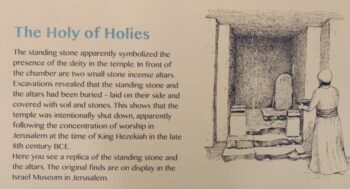
A High priest about to hotbox the inner temple at tel Arad. Cannabis resin was recovered rom the smaller altar and frankincense from the larger.
Briefly, in the original Hebrew we see kaneh (cannabis) alongside frankincense, as with the two altars at tel Arad, as a temple offering in Isaiah 43:22-24, where God’s anger burns at the prophet for not bringing any, and again in Jeremiah 6:20, where both are rejected, and this is at the time that historians suspect King Hezekiah ‘cancelled’ the tel Arad temple, and buried it in a day (leading to its excellent preservation) during reforms aimed at isolating worship to the Main Temple in Jerusalem, and yahweh alone, largely for political purposes of control. It is suggested that the cannabis resins at tel Arad came as an imported product, and as we have seen, this was the case with kaneh as well, in Jeremiah 6:20, and Ezekiel 27:19.
The Israel Museum, has this altar on display with the title Holy of Holies from the sanctuary at Arad, and the description:
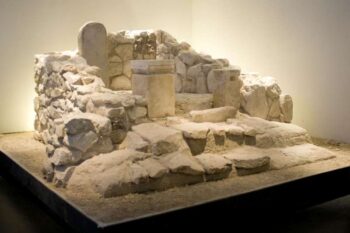
A small sanctuary was uncovered in the Arad fortress on Judah’s southern border. It is the only Judahite temple ever discovered. Like most Ancient Near Eastern shrines, including the Temple in Jerusalem, it was composed of several spaces reflecting a hierarchy of sanctity. Deep inside was the Holy of Holies, with a smooth standing stone (biblical massebah), possibly signifying God’s presence, and two altars still bearing the remains of the last incense offered there.The sanctuary was intentionally buried in the time of King Hezekiah, who sought to abolish all public worship outside the Temple in Jerusalem. (Israel Museum)
This enclosure, which was an oraculor temple in which the voice of Yahweh was heard, the “House of God”, and it was only about 4 x 8 ft, so the ancient Israelites were literally hot boxing the temple in an ancient suffumigation ritual. By omitting this, and other evidence, such as the role of cannabis in the worship of Shiva and its wider ritual use in India, and Zoroastrian references, etc., etc., Partridge exposes himself for the manipulative and deceptive Christian Apologist, that is the face behind the mask of so much of his academic career.
It seems clearly doubtful, that Partridge, a Professor of Religious Studies at a well known University, would have missed the media accounts of this fascinating discovery. In fact, Partridge lists my 2023 book, Cannabis: Lost Sacrament of the Ancient World, in his Bibliography. And it deals with the linguistic theory on kaneh in light of tel Arad,, so there is no way that Partridge was unaware of this information. Deceptively, he just chose to omit it as it conflicted with his agenda of desacralizing cannabis. This is the clearest example of the deception and dishonesty behind Partridge’s book as well. Many Biblical scholars see the evidence of what was taking place at tel Arad, as indicating what took place at the Main Temple in Jerusalem during the Kingdom Period. Not sure how an incense burned in the ‘holy of holies’ deserves no mention in regards to Partridge’s overview of sacred cannabis and the claims made about it.
For much deeper discussion on the connection between kaneh bosm and tel Arad, and the critics who dismiss it, see my essays Is Dan McClellan Wrong About ‘Kaneh Bosem’ And ‘Christ’? and Prof. Zohar Amar is demonstrably wrong about tel Arad, ‘kaneh bosm’ and the ancient use of cannabis.
While writing this article, and once again seeking some sort of non-partial assessment of the situation, I posed the single prompt question to the modern Oracle, ‘Grok’: “based on archaeological evidence, textual evidence linguistics and context what is the best botanical candidate for the Hebrew ‘kaneh bosm’?” And the Oracle concluded thus:
The best botanical candidate for the Hebrew kaneh bosm (often spelled qaneh bosem or kaneh bosem), based on archaeological evidence, textual analysis, linguistics, and historical context, is cannabis (Cannabis sativa)…. Based on the convergence of linguistic parallels (kaneh and qunnabu), archaeological evidence (Tel Arad cannabis residues), textual descriptions (a fragrant, cane-like plant), and cultural context (use in sacred rituals), cannabis (Cannabis sativa) is the most likely candidate for kaneh bosm. It aligns better with the evidence than alternatives like calamus or lemongrass, which lack the same linguistic, botanical, or archaeological support. While not definitive, the case for cannabis is the strongest given current knowledge. [For Grok’s full answer click here]
A Rutgers Presbyterian Church discusses the role of incense in their faith, including the cannabis burnt at tel Arad., in the above video at 13 minutes forward.
The story of cannabis and the ancient Hebrews, how a plant that was praised in Exodus, and given as an offering, came to be despised and rejected by the time of Jeremiah is one of the most interesting ‘sacred’ and ‘profane’ cannabis stories of them all. Too bad Partridge was unable to grasp this and deal with the actual ‘concrete evidence’ here…… and it takes a bit of space to explain it, so I suggest my own book on the matter, is the best start.
That said, I’d like to see more academic support for the hypothesis, and I am continually working on getting that. From my experience, I don’t think many scholars understand the context of all 5 references, and often get hung up on the first about the anointing oil. When the references are understood in the context of tel Arad, the two fit seamlessly. It is only a matter of time before less biased scholars than Partridge, come to understand this. Keep in mind, no Biblical scholars were suggesting a role of cannabis in Hebrew worship, as it appears at tel Arad prior to 2020. But I did. I’m a difficult messenger on all this, and I don’t think Partridge is alone in seeing me as a ‘cannabis aplogist’, out on the fringe.
Cannabis and Christ
The clear jaded attempt to dismiss Biblical era ritual use of cannabis, through omission, brings us to another glaring omission, from Partridge, and I think close to the core of his motivation. Undoubtedly, the most popular hypothesis I have put forth, is that Jesus Christ, healed and initiated with cannabis. This information has garnered international media attention, in reputable news sources like the BBC ‘Jesus healed using cannabis’; The Guardian, ‘Jesus ‘healed using cannabis‘; The Sunday Times ‘Was there a whiff of cannabis about Jesus?’; The Washington Post, ‘Jesus Used Cannabis Oil, Writer Say’s; Vice, ‘The Anointed One: Did Jesus Perform His Miracles with Cannabis Oil?’, and countless other media ever since. In fact, Partridge mentions this in another book, High Culture: Drugs, Mysticism, and the Pursuit of Transcendence in the Modern World (2018): “There has… been a number of highly speculative popular discussions of the use of psychoactives in early Christianity. Such as the argument that Jesus used incense containing cannabis extract: Chris Bennett, ‘Was Jesus a Stoner?,’ High Times… 2003)” (Partridge, 2003). Other articles I wrote on this include ‘Cannabis and the Christ: Jesus used Marijuana‘ (1998); ‘Did Jesus Heal With Cannabis? ‘(2016); ‘Early Christianity’s Drug Fuelled Magic Rituals’ (2016); and ‘Cannabis and the Crucifixion, an Easter Special‘ (2017).
This theory itself, hinges on the identification of kaneh and kaneh bosm, and thus I am focussed on establishing that linguistic theory among academics, before taking it further, or exploring it again. However, as it stands, this hypothesis kind of escaped my hold, its been turned into countless memes, and is out there travelling around living its best life without me. If I died tomorrow, that would just carry on. I see it in things like this recent Spanish language episode of History Channel, without even a mention of me. Others have even tried to present it as their own theory, decades after I first wrote about it.
As this information, inspired many of the cannabis churches that Partridge dismisses as ‘420 Churches’, it is curious that he left this information out, and I think it speaks to his personal concerns about cannabis being sacred, and his own Christian bias. The irony of Partridge’s references to ‘cannabis apologist’, is that it could be seen that he is himself a ‘Christian Apologist’, masquerading as an unbiased Academic. Let’s look at a bit of background here, to see why I am saying this.
The Partridge Agenda
Partridge’s Phd. thesis was Revelation, religion and Christian uniqueness : an appreciative critique of H.H. Farmer’s theological interpretation of religion (1995). Herbert Henry Farmer (1892 – 1981) was a British Presbyterian minister, philosopher of religion, and academic. Farmer offered a theological interpretation of the universal phenomenon of human religious experiences and interpreted the world religions through the life and work of Jesus. While maintaining the authority of Christianity, he treated other world religions with care. I see Partridge as both being inspired by Farmer, and carrying on his quest. One reviewer of Partridge’s Introduction to World Religions (3rd Edition, 2018) stated that the Christianity section “came across as ‘this is why my religion isn’t only great, it’s THE BEST religion!’”.
Partridge reviews books for the Gospel Coalition journal, Themelios an international, evangelical, peer-reviewed theological journal that expounds and defends the historic Christian faith. Its primary audience is theological students and pastors, though scholars read it as well. Partridge was the editor of Universal Salvation?: The Current Debate (2004) which is described: “Will God one day save all people through Christ’s atoning work? That is the question at the heart of the debate in this volume — a debate sure to challenge readers, whatever their current perspective. Featuring evangelical writers of exceptional insight and sensitivity, Universal Salvation? offers a conversation worth everyone’s attention. The volume opens with a rigorous three-part defense of Christian universalism by philosopher Thomas Talbott, who argues that Scripture teaches the ultimate salvation of all people”
Take also for example Partridge’s essay The Disenchantment and Re-enchantment of the West: The Religio-Cultural Context of Contemporary Western Christianity written for The Evangelical Quarterly 74.3 (July-Sept. 2002). As Partridge explains “Much of this paper has been devoted to an overview of the fluid and complex context in which we live as Christians.” I am assuming his use of ‘we’ here includes him. The essay, is largely about trying to gain back the Christian following, by understanding the religions and beliefs drawing them away, and the need for christian academics in drawing them back into the Christian fold:
Christianity may still be seen as respectable by many westerners, this does not mean that it is particularly appealing. Moreover, what were, not too long ago, considered to be dangerously deviant forms of spirituality are gradually becoming more acceptable as people adopt non-Christian, often non-theist, religious understandings of the world….
Nowadays, the supernatural world is a fact, sceptical rationalists are made to eat their doubting
words, occult powers can be used for good as well as evil, Paganism is seen as an environmentally friendly alternative to oppressive institutional religion, and the symbols of Christianity (particularly the crucifix) are shown to be impotent….As David Lyon comments, ‘faith’s fate in the modern world may turn out not so much to be lost in the everyday life-paths of ordinary people, but to be lost from view in academic accounts of the modern world. The secularization of scholarship thus precedes the scholarship of secularization.’ -D. Lyon, Jesus in Disneyland: Religion in Postmodern Times (Cambridge, 2000),…
All this supports the re-enchantment thesis, it being indicative of (a) a rising interest in the spiritual and supernatural, and (b) a fundamental shift away from the Judeo-Christian worldview. Many of the spiritualities and philosophies which inform Western re-enchantment have roots in Paganism, Western esotericism, non-Christian Eastern spiritual traditions, or a combination of these. More specifically, although there is an ‘Orientalization of the West’, there is also a Paganization of the West: ‘nearly one fifth of all religious titles published in the UK in the 1990s has been classified as “occult”.’ Again, whilst these two broad streams of spirituality which feed Western re-enchantment can and do flow separately, increasingly they are merging and flowing together. That is to say, whilst many people have beliefs that are very clearly influenced by Sufi, Taoist, Hindu, or Buddhist thought, others hold basic ideas which are informed by Pagan, Western esoteric, and primal religious worldviews. Still others, who might be understood as being typically ‘New Age’ (a term which is becoming passe nowadays), are more overtly eclectic and syncretistic
in that they will source their personally tailored spiritualities from a variety of Oriental and Pagan belief systems….Hence, the future of effective Christian mission in the re-enchanted West is likely to focus on local groups/communities functioning as ‘the hermeneutic of the gospel’… The role of the Christian academic and the minister in the West will be redirected to the support and facilitation of such groups/ communities….
Christian theology is not the place to begin when one is seeking to understand what another person believes and practices. Although absolute neutrality is not an option (in that no scholar can be purely neutral), the value of seeking scholarly objectivity is hard to underestimate. In short, my argument is that an accurate understanding of a faith or culture can be most effectively realised through sensitive study and encounter in which the Christian aims, as far as is possible, to empathetically imagine his or her way ‘into’ that faith: to see as the believer sees, and to feel as the believer feels. Just as Christians would prefer/expect others to spend time seeking to understand the Christian faith from the inside in order to avoid caricatures and misunderstanding, so they should do no less when seeking to understand non-Christian beliefs… Indeed, it is not only the Christian’s duty, but also it is crucial to an effective missiology, that every attempt is made to secure the most accurate and sophisticated understanding possible. I would even go so far as to argue that, if you cannot empathize with a person, if you cannot feel the pull of their religion, then it is going to be very difficult for you to relate the gospel meaningfully to them. This level of commitment and empathy with those of other faith traditions seems to have been central to Paul’s missiology. ‘Though I am free and belong to no man, I make myself a slave to everyone, to win as many as possible. To the Jews I became like a Jew, to win the Jews. To those under the law, I became like one under the law (though I myself am not under the law), so as to win those under the law. To those not having the law, I became like one not having the law (though I am not free from God’s law, but am under Christ’s law), so as to win those not having the law. To the weak I became weak to win the weak. I have become all things to all men so that by all possible means I might save some’ (1 Cor. 9:19-22)… There are few more effective ways of shutting a person out and confirming their beliefs about offensive and dogmatic Christians, than condemning their ideas, judging their religious experience as counterfeit, and demonstrating a lack of love and understanding; all of which unhelpful attitudes are frequent with regard to new religions and alternative spiritualities. For example, Stuart Rose’s wide-ranging survey of those involved in New Age belief and practice provides evidence that New Agers feel demonized by some Christian writers who belittle their experiences. As a result,~their negative understanding of Christianity is, for the most part, ‘confirmed, and they are encouraged to explore the occult subculture further.’
…it is clear that the religio-cultural context of Western Christianity presents some acute missiological problems. Not only has there been a shift away from the Judeo-Christian worldview, but also it would seem, this shift is continuing apace. Indeed, it is entering a second stage. The first stage was disenchantment, the second is nonChristian re-enchantment. More specifically, still informed by the ideas that led the initial move away from Christianity, this is no premodern, theistic re-enchantment….
….If, for example, you know nothing about the club scene, hate trance music, cannot appreciate the force of contemporary values, and are bewildered by the appeal of The X Files, then you should perhaps avoid a life devoted to dialogue with youth culture – there are plenty of others who are eminently qualified. To truly understand and to effectively communicate, one must be able to get under the skin of a culture, must feel drawn to people who belong to that culture, must be able to appreciate the attraction of that culture, and must be able to interpret the language of that culture. Detached head knowledge and half-digested facts are not enough. (Partridge, 2002)

Partridge’s book is a passive aggressive attempt to dissuade people from choosing the sacred cannabis path, and intentionally set a course of ignoring the role of cannabis in the world’s religions, in order to portray it as the smoke dream of ‘420 Churches’ and ‘Cannabis Aplologists’.
This agenda is the intention behind Cannabis, Sacred and Profane, and evidence of this can be found within its pages. Like the early Christian apologists Origen, Clement of Alexandria, Irenaeus, etc., who engaged with intellectual pagans, competing Gnostic Christian sects and Jews, Partridge has made it his work to play this role in regards to other religions, Occultists, New Agers, the Music scene and Drug Culture. He takes a very subtle, passive-aggressive approach, but it is always there, creeping out at certain points in his narrative. “just as the consumption of sacred substances at the Eucharist leads to ‘holy communion’, so the consumption of unclean substances, taints the spirit and leads to ‘profane communion'” (Partridge, 2024). It seems clear, Partridge places cannabis in the latter.
Partridge notes that “Wine…. has a long history within Christianity… the history of wine and the church is long and rich. It is also… one of the eucharistic elements. In other words, unlike cannabis, it is couched in sacred discourse” (Partridge, 2024). However, he ignores that wine is rejected in Islam, Buddhism, and other religions. As well as disregarding the sacred role of cannabis, which, when taken as the body of Shiva, holds a similar role to that of the Christian Eucharist, the difference being, cannabis is not a placebo.
In Scandal: Essays in Islamic Heresy, (1988) peter Lamborn Wilson explains that “The Turkish Sufi poet Fuzuli… wrote a treatise on Bang and Wine in which he claimed that wine is merely ‘an eager disciple setting the world afire,’ but hashish is the Sufi master himself. Wine shows the way to the hermitage of the Shaykh of Love… but hashish is the refuge itself. Once a certain Sufi of Basra began to consume hashish regularly, his shaykh realized this meant he had reached the ultimate degree of perfection, and no longer stood in need of guidance. This (says Fuzuli) ‘proves that hashish is the perfect being, sought after by mankind with great eagerness. It may not be the perfect being for everybody, but it most certainly is for the seeker of mystical experience” (Wilson, 1988)
Considering the scandals of the Catholic Church in our modern day (and through it’s history) the priests which administer the communion of bread and wine as the Eucharist, suits as a poor example, when weighed against the history of cannabis we have been discussing here. A history, for the most part, Partridge has hidden from view in his discussion of Cannabis, sacred and profane, while preaching the superiority of Christian wine.
Moreover, prohibition propaganda, Partridge acknowledges “drew heavily on Christian culture and established cannabis as a threat to society….It was ‘a weed with roots in hell'” (Partridge, 2024). This is a process which can be taken back some centuries. I am reminded here of ‘Eight ways the Sinner is like Cannabis‘, from the German priest, bishop, and witch hunter Friedrich Förner (1570-1630)! What Partridge has shown though his own work, is his own obvious selective bias, and omission of anything that disagrees with the tale he attempts to weave. He has a clear agenda — the desacralization of sacred cannabis.
I get the sense, that Partridge at least acknowledges some sort of ‘power’ in cannabis, and in this sense, sees it as sort of a cheater’s route. As he noted of cannabis in his section on its use in 19th century spiritualist circles:
“As well as the moral issues surrounding drug use, perhaps the most frequently cited concern relates to spiritual shortcuts… there seems to be some evidence within nineteenth- and early twentieth-century occultism of what Max Weber referred to as a Protestant ethic. He was referring to the value of disciplined hard work, especially in Calvanism, is directly related to salvation, in that duty, employment, and prosperity are signs of one’s election. Religion, likewise, requires commitment and effort. Cannabis is a problematic technology, therefore, because it suggests a quick route to mystical states that bypass effort” (Partridge, 2024)
Is riding a bike instead of walking, cheating? It’s a busy world, not everyone has the opportunity or inclination to sit in a cave meditating, if a temporary increase of alpha and theta waves is achieved through the use of cannabis, then years of meditative practice, what is the loss exactly? And why not both hard work and cannabis together? As with many Nath Yoga Devotees, and Shavites who use it in combination with Yogic practice. An occultists, who Partridge left out of his study, George Ivanovich Gurdjieff (1866–1949) also known to have experimented with hashish, expressed to his student P. D. Ouspensky:
“There are schools which make use of narcotics in the right way. People in these schools take them for self-study; in order to take a look ahead, to know the possibilities better, to see beforehand, in advance, what can be attained later on as the result of prolonged work. When a man sees this and is convinced that what he has learned theoretically really exists, he then works consciously, he knows where he is going. Sometimes this is the easiest way of being convinced of the real existence of those possibilities which man often suspects in himself.” (Gurdjieff)
Guedjieff also gave us the analogy of ‘The Fourth Way’, which answers to Partridge’s concerns, as Ouspensky related this:
“The fourth way is sometimes called the way of the sly man. The ‘sly man’ knows some secret which the fakir, monk, and yogi do not know. How the ‘sly man’ learned this secret — it is not known. Perhaps he found it in some old books, perhaps he inherited it, perhaps he bought it, perhaps he stole it from someone. It makes no difference. The ‘sly man’ knows the secret and with its help outstrips the fakir, the monk, and the yogi.”
Of the four, the fakir acts in the crudest manner; he knows very little and understands very little. Let us suppose that by a whole month of intense torture he develops in himself a certain energy, a certain substance which produces certain changes in him. He does it absolutely blindly, with his eyes shut, knowing neither aim, methods, nor results, simply in imitation of others.
“The monk knows what he wants a little better; he is guided by religious feeling, by religious tradition, by a desire for achievement, for salvation; he trusts his teacher who tells him what to do, and he believes that his efforts and sacrifices are ‘pleasing to God.’ Let us suppose that a week of fasting, continual prayer, privations, and so on, enables him to attain what the fakir develops in himself by a month of self-torture.
“The yogi knows considerably more. He knows what he wants, he knows why he wants it, he knows how it can be acquired. He knows, for instance, that it is necessary for his purpose to produce a certain substance in himself. He knows that this substance can be produced in one day by a certain kind of mental exercises or concentration of consciousness. So he keeps his attention on these exercises for a whole day without allowing himself a single outside thought, and he obtains what he needs. In this way a yogi spends on the same thing only one day compared with a month spent by the fakir and a week spent by the monk.
“But on the fourth way knowledge is still more exact and perfect. A man who follows the fourth way knows quite definitely what substances he needs for his aims and he knows that these substances can be produced within the body by a month of physical suffering, by a week of emotional strain, or by a day of mental exercises — and also, that they can be introduced into the organism from without if it is known how to do it. And so, instead of spending a whole day in exercises like the yogi, a week in prayer like the monk, or a month in self-torture like the fakir, he simply prepares and swallows a littie pill which contains all the substances he wants and, in this way, without loss of time, he obtains the required results.” (Ouspensky, 1949)
If someone gets a sense of the sacred through cannabis, what is the harm? If Magicians, or Artists, and Musicians, or anyone else who uses it for inspiration in what ever spiritual work or path, how is this cheating? Partridge comes from a place of Judgment based on failed Christian ideals and morals. However, cannabis is no magic pill, there needs to be some sort of inner spark there for it to catch fire. When a boring person takes cannabis, a boring person takes cannabis. Partridge quotes Crowley in this respect “it is perhaps only the destined adept who, momentarily freed by the dissolving action of the drug from the chain of the four lower Skandhas, obtains this knowledge which is his by right, totally inept as he may be to do so by any ordinary methods” (Crowley, 1909). Perhaps also, in some way, the fruit here befits the partaker? Profane to those who see profanity, and Sacred to those who see the sanctity.
In regards to religion, mysticism, shamanism, etc. Cannabis has a long and well documented history. We have seen how it has aided in the religious state of oneness known as samadhi; how it has aided with the siddhi of psychic powers in the Occult and Spiritualism scenes; how it has served as a means of communal communion in Indian celebrations, Rastafarian gathering, often passed from culture as with the Indian migrant workers who passed the ganja onto Rasta, or the Nath Yogis who passed it on to the Qalandar sufis. Pass that Dutchie to the Left hand side! It’s an act of communion done in the right spirit.
Curiously, music is another aspect of humanities sacred history that cannabis has been weaved into. As Parteridge has such interest in the culture of music, it is telling that he left this out of his discussion as well. Since ancient times, has had a profound influence on musical concepts, and this can still be seen around the globe, with its roles in the Indian music of the Bauls, the hashish inspired Greek Jazz Rembetika, the music of Columbian marijuana smugglers, Vallenato, The Wagnerian Opera scene, along with other better known cases such as American, Jazz, Rock and Roll, Hip Hop, and other examples.Cannabis not only enhances the listening experience, but arguably also, Cannabis Influences the Creative Process in Music.
Music played a pivotal role, in the development of religion. The Vedas, Avesta, Psalms, Song of Songs, etc, all written in verse, attest to this.
Paul Johnson’s A History of the Jews, referred to this connection in Biblical times noted that: “Prophets practiced ecstasy states and may have used incense and narcotics to produce impressive effects…. The Israelite prophets … acted as mediums. In a state of trance or frenzy they related their divine visions in a sing-song chant, at times a scream. These states could be induced by music…. But the prophets also used, and sometimes abused, incense, narcotics and alcohol…” ( Johnson, 1987).
The Hindu poet of Shiva; the Great Spirit that living in bhang passes into the drinker, sings of bhang as the clearer of ignorance, the giver of knowledge. No gem or jewel can touch in value bhang taken truly and reverently. He who dunks bhang drinks Shiva. The soul in whom the spirit of bhang finds a home glides into the ocean of Being freed from the weary round of matter blinded self. (Campbell, 1894)
I’d like to think, you can even feel that voice of inspiration, in what I’ve written here, in response to Partridge’s dismissal of sacred cannabis, as its sacred fumes were present, throughout its composition, as it is with all my work in this respect, and as it was in my religious experience under its influence some 35 years ago that inspired my decades of research, long before I knew anything of this plant’s sacred history. Wether you accept that or not, I would hope that at least that you would respect my belief in that without the sort of judgement Partridge has placed upon it, ‘So grand a result, so tiny a sin’. Honi soit qui mal y pense!
Cannabis is the sacred medicine the world needs know, a religious revelation that stretches across cultures and through history. A global communion that holds the Healing of the Nations within its leaves. We can heal our bodies, our planet with its eco friendly industrial products, feed ourselves with its nutritious seeds, dress ourselves with its cloth, and forge a spiritual connection with the same holy substance used by so many of our ancestors. If cannabis is not sacred, then I ask you, what is?