CANNABIS CULTURE – part 4: Economics and the environment
This fourth and final installment in the IPM series discusses the larger-scale economic and sustainability considerations that affect not just IPM, but your entire grow operation.
You can find the other articles in this series here: Part 1 Part 2 Part 3
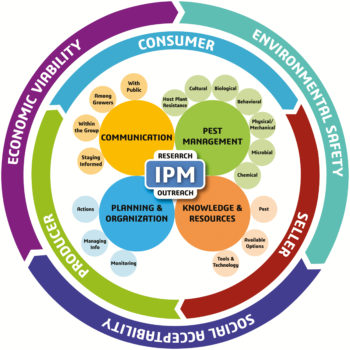
A depiction of the new IPM paradigm (Dara 2019, used with creator’s permission).
The Business of Cannabis
The business aspect surrounding commercial cannabis growing is summarized by the inner ring in the diagram above. The producer, seller, and consumer are called out as the three main parties involved who may affect and be affected by your pest management choices.
 Producer
A production operation should consider each of its processes to be internal suppliers and customers to one another. An inferior product should never be passed on through production from a supplier to a customer. A cannabis clone being delivered by a nursery team that is showing a nutritional deficiency or active pest issue, for example, should be rejected internally by the team who would grow that clone into a flowering plant. The internal supplier who provided the inferior product should then review its processes to identify why their product was of poor quality (an ineffective IPM program, bad training on scouting, or just bad communication, perhaps) using any of the many appropriate quality management tools that exist. These actions will create a better sense of ownership of and commitment to quality within staff and will help stop such rejections from happening again in the future. If these things are not done, the poor quality of a starting plant results in a poor final product and may even negatively affect other plants in the case of pest issues that can spread. IPM programs can be part of quality assurance during each of these internal processes to guarantee that quality control checks between processes are passed, preventing the loss of plants and time. Thus IPM should be incorporated into an overall quality management plan.
Seller
The seller of your product is the first stage outside of your growing operation. This may be your own dispensaries, partner dispensaries, extraction businesses that buy trim, and others. These customers, who want to use your product to generate revenue, expect a quality product. In general this means cannabis or cannabis-derived products that are free of pesticides, heavy metals, and biological contamination; high in cannabinoids and terpenes; and other typical parameters. Robust IPM programs are one way to achieve these standards through prevention and early detection of issues so that pesticide use can be greatly minimized or even eliminated.
Consumer
The consumer and the product characteristics they desire are what drive the market. IPM is a potentially marketable feature of your products that demonstrates how you are meeting customer demands. Being produced with no or minimal pesticides and in an environmentally-friendly manner are commonly desired features of agricultural products across the board, and IPM can satisfy both of these. But even the cannabis produced at the highest quality will not sell if its price point is beyond what consumers are willing to pay. Good preventive IPM programs that help avoid pest outbreaks and the corresponding costly interventions can help you keep your prices low enough to satisfy the customer’s desire for a good deal on a quality, responsible product.
Viability, Safety, and Acceptability
The economic viability, environmental sustainability, and social acceptability aspects in the outer ring of the figure above are some of the highest level considerations to be made within a Cannabis business. IPM can play a role in fulfilling all of these aspects. The economic viability of a company ultimately relies on gaining a net profit. Maximizing income and minimizing expenses, balanced with ensuring quality that meets consumer demands and demonstrates the benefit of the industry, is one basic path towards this end. IPM programs can focus on lower cost and preventive measures to help reduce costs.
IPM provides environmental sustainability by balancing and integrating all available pest management tactics to achieve set goals. IPM helps prevent and minimize wastes during plant production and should be used in conjunction with proper irrigation and fertilization monitoring to avoid water waste. IPM also contributes to a safe product by minimizing or eliminating the use of pesticides and prioritizing the use of “softer” pesticide options over synthetic pesticides. This is unlike “traditional” pest control that typically uses only rotating and repeated spraying of pesticides.
The social acceptability of the Cannabis industry as a whole is, of course, changing every day. Demonstrating the responsible growing practice that is coming to be demanded throughout agriculture is one way to meet consumer expectations. Thus the environmental sustainability provided by IPM also helps improve the acceptability of the products and the industry as a whole. These business aspects within the Cannabis industry are without a doubt the most well explored and developed considerations in many other publications, so I will leave further explanations to experts in the industry!
This is the end of this four-part series on applying the new paradigm of integrated pest management in Cannabis. I hope I created a sense of the importance of not only the traditional aspects of IPM (i.e. the various management tactics), but also the critical role that individuals and behaviors play in IPM. Thank you for reading!