
The final chapter of the 3 part series ‘Questions about the 2014 Iranian Psychedelic Fatwā and Wahid Azal’
In Parts 1 and 2 of this series—Questions about the 2014 Iranian ‘Psychedelic Fatwā’ and Wahid Azal? and The Strange Case of Wahid Azal: Bayān Messiah or Blaspheming Madman?—we peeled back the layers on a dubious ayahuasca “fatwā” and the eccentric figure at its center. Now, in this explosive final chapter, we dive into Wahid Azal’s unhinged barrage of responses to parts 1 and 2, and trace our beef back to its haoma-fueled origins and show Wahid has completely lost the plot along with any remaining credibility.
Wahid Fired off 20 articles in response to Part 1 and 2. As well he has numerous posts and messages about me across the internet, an hour long video and a book:
On the Smear of Hashish: Regarding Chris Bennett’s hallucinations on “Bābism and Drugs”
Answering Chris Bennett’s Gratuitous Misrepresentation of Ayatollah Rūḥānī’s 2014 fatwa
Why Chris Bennett is not Antifa
THE WHITE DRUG DEALER IN THE GUISE OF THE SHAMAN
Things That Make You Go Hmmmm…
The Bahá’í Playbook Revisited: How Chris Bennett Recycles a Known Pattern of Epistemic Undermining
How Chris Bennett Became a Tool of CESNUR
Chris Bennett’s Grok-induced pro-Bahá’í hallucinations on Bābī history
Letter of Demand to Cannabis Culture
Cannabis Culture and Chris Bennett’s sectarian motivated attacks on the Bayān (Azalī Bābism)
Submission to the UN Special Rapporteur on Freedom of Religion or Belief
There is also, apparently, a book on all this!
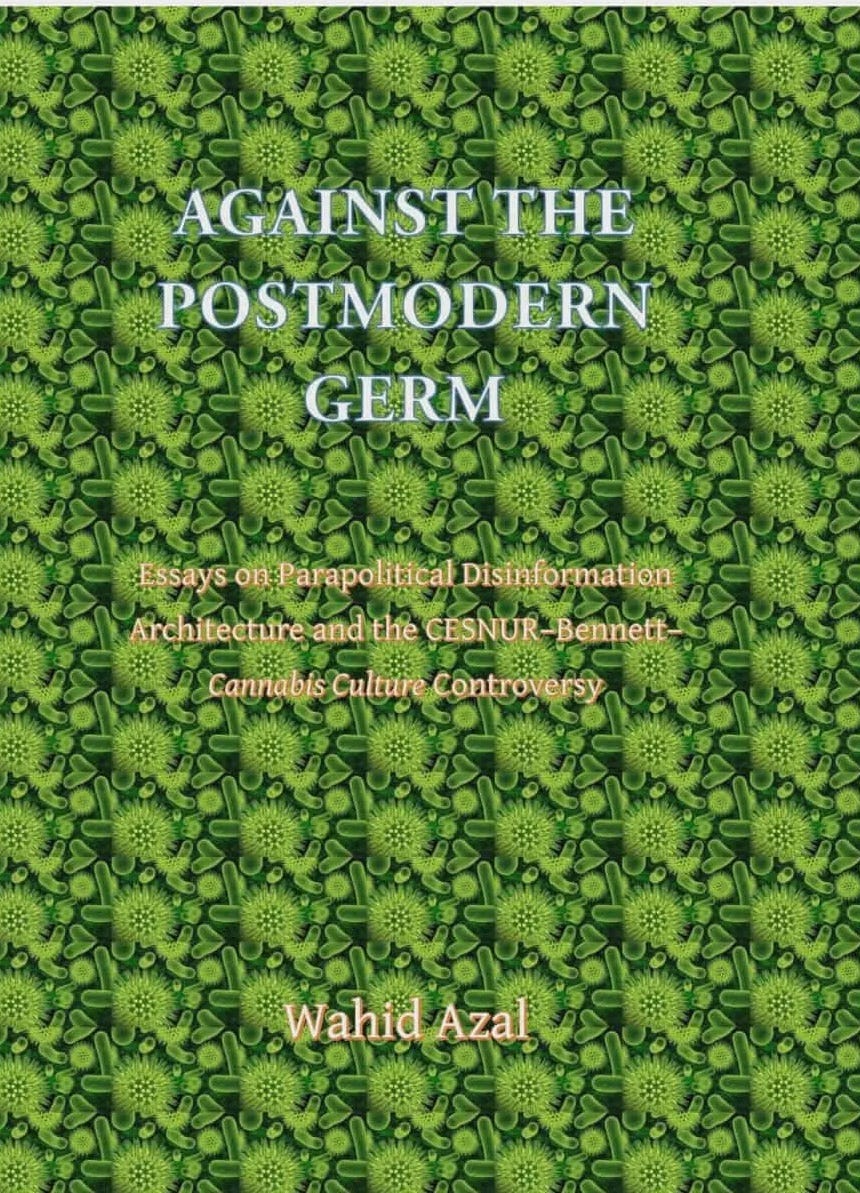

You can already download your own copy of Against the Postmodern Germ: Essays on parapolitical disinformation architecture and the CESNUR–Bennett–Cannabis Culture Controversy
Suffice to say, I am taking up considerable space in the head of the “Living Mirror”.
On the ‘Psychedelic Fatwā’
Wahid responded to such concerns about the fatwa in my article in now deleted comments, such as
[used]Wahid Azal · Nov 16, 2025; Chris Bennett, you complete and utter fraud. This “fatwa” you question was issued by Ayatollah Muhammad-Sadiq Rohani in 2014, a marja’ taqlid whose office I personally consulted in Qom via trusted intermediaries. The document exists—photocopies in Persian and Arabic, signed and sealed. Your “skepticism” is nothing but Orientalist gatekeeping from a white Canadian cannabis pusher who wouldn’t know a fatwa from a falafel….
This isn’t about “verification”—it’s about you and your entheogen cult resenting any non-Western voice claiming psychedelic space in Islam. The Fatimiya Sufi Order has been using ayahuasca as a halal sacrament since 2005, long before your “cannabis revelation” schtick. Bábí gnosis doesn’t need your stoner imprimatur. You’re just mad I called out your Haoma bullshit and now you’re scraping the bottom of the barrel with this “unverified” nonsense. Repent, or stay in your lane: weed and white guilt.(Nov 16, 5:23 PM UTC): Bennett’s hit piece on the Rohani fatwa proves he’s a Zionist-adjacent NARC.
Post 2: Quote-tweet of your article: “This clown questions a marja’s fatwa because it doesn’t fit his colonial psychonaut narrative. Read the Persian, peasant. [fatwa scan]”
Actually, the “cannabis revelation” Wahid refers to occured in 1990, so some 15 years before Wahid’s Order began using ayahuasca. I’ll get into our Haoma beef later, as that is the origin of the point of conflict between Wahid and I. Weirdly, he calls me a “Zionist-adjacent NARC”, when I am actively anti-Zionist, and i’ve been advocating for the legalization of cannabis and entheogens, and writing about that for over 3 and a half decades, as anyone who looks into my history can see. Narc is a particularly curious accusation from Wahid, considering his own threats of turning various authorities on all sorts of people, and referring to myself as a “cannabis pusher” and “drug dealer”. With his disdain for cannabis, and current barrage of threats against me (More on that later) I’d be concerned about that if it were not for the legal status of cannabis in Canada (which was won by the work of activist’s of which I am proud to be numbered!) or if I was still providing the entheogenic plants I carried at my former shop the Urban Shaman. It seems Wahid will use whatever authorities he can against people, a tactic of fascists.
I see no need in addressing the ‘Psychedelic Fatwā’ again till authentication of what it states and means comes from a Shia authority, rather than the claims of the Bullet Point Babist Wahid Azal.
Wahid’s Articles on me
Whereas, Wahid’s response to the fatwā was slightly measured and thought out, his more than a dozen articles on me that followed the release of Part 2 in this series, The Strange Case of Wahid Azal: Bayān Messiah or Blaspheming Madman? show he has completely lost the Plot and that someone direly needs a wellness check…..
He claims from the title forward, the article is a racist hack job:
Bennett’s title already signals the genre into which the article falls: the sensationalistic binary trope. “Messiah or madman?” is a framing device with a long history in Western portrayals of non-Western religious leaders, from the Orientalist travelogues of the 19th century to modern click-bait commentary. The binary is deliberately misleading: it offers only two pre-selected interpretations, both of which pathologise the subject.
….The unitary axis of Bennett’s narrative… is in itself a racialised trope. In Western treatments of Eastern mysticism, the figure of the “mad prophet,” the “unstable guru,” or the “dangerous messiah” is recurrent. (Wahid Azal, 2025)
Azal’s comments about why I chose the title are pure hokum, I borrowed it from Bent Corydon’s excellent biography, L. Ron Hubbard, Messiah or Madman (1987) another Asshole I covered. Check out my 2003 documentary L. Ron Hubbard on Drugs (2003) which resulted in all sorts of Internet and possible real world shennanigans that I suspected were instigated by his cult, that would put Wahid Azzhole to shame. Perhaps fodder for a future blog post sometime.
He then states “Bennett also proves himself a plagiarist” accusing me of copying the hilarious rightwing blog ‘The Fourth Revolutionary War’ post What if God is a Troll? | The Mendacity of N. Wahid Azal, which tells the satirical tale of how Wahid came into godhood:
Nima encountered an aborigine shaman who taught him how to get high by chewing tree bark and sucking on the ass of dead cane toads. After sucking toad ass and huffing the sacramental butane for 14 hours, the young prophet was initiated into dream-time and his cosmic twin: McJesus_tha_Splenda© descended upon him and revealed the great secret of his mission:
He was to be the greatest Guru, the final Guru, and the seal of the Guru as an incarnation of the pure, absolute, transcendent, primordial Guru in the final and ultimate incarnation. He was to become the alpha and the omega of Guru.
his cosmic twin, McJesus_tha_Splenda©, descended upon him… and revealed to him his sacred destiny to manifest his cosmic nature as the most annoying internet troll of all time. Also he had to find a talking Kangaroo and take over the Bahia religion.
In 1999 Azal returned to the Gold Coast of Queensland where he had many fun adventures with a sarcastic crocodile and a silly parrot in his mystical quest to find the talking kangaroo…. Some years later he was using an Australian entheogen (known as “Crystal Meth”) when the female cosmic principle manifested itself in the form of a wacky talking Kangaroo he named “Fatima”, who anointed Nami as the reincarnation of Subh-i-Azal, and thus the proper leader of the Bahia faith.
Now i did include a block quote from this blog, that referenced and linked to it, which I did elsewhere in reference to it and properly citing it. I also used some screenshots and things the blogger had catalogued with the article and those are accredited as well. Generally plagiarists, don’t cite the works they plagiarize, its kind of what makes them plagiarists!
To be clear, the The Fourth Revolutionary War post and mine were both following Wahid’s linear path, through time, so we did walk the same road and cover some of the same incidents, but that’s just a reflection on Wahid’s own sordid tale, not plagiarism. If anyone wanted to find out a lot of this information about Wahid Azzhole, they only need to ask Grok the single prompt question “What can you tell me about controversies and disputes regarding Wahid Azal?”
Without any actual text to texts comparisons to back up his plagiarism claims, Wahid then claims the structure and formatting of my article The Strange Case of Wahid Azal: Bayān Messiah or Blaspheming Madman? follows the “Duginist” playbook, in reference to the Putin ally and Russian propagandist and occultist of sorts, Aleksandr Dugin, who from what little I know of him seems like a Russian Jordan Peterson. “What is notable is not merely the similarity but the verbatim structural replication”
The reproduction of such frameworks is especially alarming given that the Duginist campaign was explicitly designed to silence, marginalise, and delegitimise my intellectual voice through coordinated reputational harm—which it spectacularly failed in doing. In effect, Bennett reanimates the Duginist smear-frame in a fresh venue, giving new amplification to the same malicious and previously fringe Russian fascist disinformation architecture.
Azal’s plagiarism claim, is overstated and unsubstantiated beyond his side-by-side visuals, which cherry-pick trope sequences (e.g., “origin → instability → rejection”) while ignoring my own attribution and expansions. He frames these as “literal copy-pasting” of a “defamatory architecture,” but without proof of uncredited text or intent to deceive, this reads as rhetorical escalation tied to his history of dismissing critics as part of a “CIA/Vatican” plots. This aligns with patterns in his feuds, where similar accusations fizzle without evidence, suggesting such claims serve for Wahid’s defensive narrative-building rather than factual reckoning.
Any connection to “Duginist smear-framing” or claims of plagiarism are a purely hypothetical ones that Wahid cooked up in his own paranoid and disturbed mind. But that does not stop Wahid from the preposterous claim, he does not back up with a single side by side quote comparison, but yet has the gall to write “Despite my extensive published corpus, Bennett avoids substantive engagement and instead reproduces the 2016 narrative of personality-based defamation verbatim” (Wahid Azal)
Wahid’s Corpus
Wahid complains that“instead of addressing my textual corpus—translation work, metaphysical writings, philosophical contributions—Bennett substitutes internet anecdotes and forum hearsay”. Indeed lets talk about Wahid’s corpus and the need to address it.
Well first off, I’d have been the very first person to address Wahid’s corpus, if I had done so. I actually looked when I was writing part 2, and I could not find a single Academic review, Journal review, or even an Academic plug. Nor could I find much in the way of citation by Academics, about any of Wahid’s books or papers. In the article, I did mention Wahid’s specific papers, collections, books and I provided multiple links to his Academia account throughout, noting that “his Academia.edu profile, hosts a repository of his writings explicitly addressing his theology, the Bayānī lineage, and his role as the ‘Living Mirror’, as well as some well written and interesting articles on Iranian history, Islamic mysticism.” However, Wahid has also loaded up his academia page where his corpus is housed, with his hate papers, flooding the zone and causing his more worthy writings to fade into the background and get lost, and now papers an a book about me rising to the forefront!
There was some interest shown by the late Islamic scholar Peter Lamborn Wilson, who as discussed in Part 2, joined Wahid’s Sufi Order, and was welcomed, despite well founded accusations of Pederasty. But Wilson left no specific reviews or endorsements that I am aware of.
The fact that there is no scholarly recognition I could find regarding Wahid’s corpus, is the tragedy part of comedy tragedy tale at the core of The Strange Case of Wahid Azal’. Back when he was Nima Hazini, Wahid was looking like a promising student with the admiration of his peers and professors. He studied at the University of New Mexico and briefly in California. His educational background includes a BA from the University of New Mexico (1994), an MA in Near Eastern Languages and Cultures from UCLA (1997), and an LLB from Queensland University of Technology (2003).
That an individual with that kind of background and education can not muster any compelling academic support for his corpus, could be seen as a statement on the quality it’s content. Comparably, myself a high school drop out, who pursued his own line of interest, and whose work is the subject of Wahid’s own harsh criticism, has received considerable academic support for my own published works. One of my books received a review in the London, England, Sunday Times from well known ‘entheogen’ pioneer Professor Carl Ruck, and here are some of the book plugs I have gathered for various works from other academics. If you understand who some of these scholars are, you will see that support like this, for a non-academic independent and controversial researcher like myself, are hard won.
“It is a volume that must be read by every scholar who works in the field of biblical studies, world religions, psycho-spirituality, or the history of the paranormal as friend and familiar.” —J. Harold Ellens, PhD, Institute for Antiquity and Christianity of the Claremont Graduate School, Editor Seeking the Sacred with Psychoactive Substances: Chemical Paths to Spirituality and to God
“With no left turn un-stoned, this wonderful book – so full of detail, passion and thorough historical exploration – describes the fascinating journey the humble weed has woven through human civilization to bring us it’s enlightenment, color and culture.” —Dr. Ben Sessa, author, The Psychedelic Renaissance: Reassessing the Role of Psychedelic Drugs in 21st Century
“Chris Bennett assembles religious, historical, medical and poetic sources with immaculate ease, in order to construct what is sure to be an enduring examination of the global history of cannabis use by widely diverse human populations.” —Dr. David C.A. Hillman, author, The Chemical Muse: Drug Use and the Roots of Western Civilization
“A treasure trove of up-to-date ancient information on cannabis. Highly recommended to round out your library on religious uses of psychoactive drugs.” —Julie Holland, M.D., editor, The Pot Book: A Complete Guide to Cannabis
“If you are interested in the history of the Indo-Europeans, the history and identification of soma / haoma, or the history of cannabis as a hallucinogen, you owe it to yourself to read Chris Bennett’s substantial tome.” —Victor H. Mair, Professor, Chinese Language and Literature, University of Pennsylvania
“I’ve enjoyed this book immensely—a masterful investigation of religious intoxication cults from ancient India, Persia, Asia Minor, Scythia, and Europe. Refuting R. Gordon Wasson’s theory that Soma of the Vedas was Amanita muscaria mushrooms, Bennett shows that Soma was probably a mixture of cannabis, ephedra and poppy (confirmed by Sarianidi’s archaeological discoveries in Bactria), and he traces the uses of cannabis as a sacrament through many ancient cultures. This is a must-read for everyone interested in the ancient history of drugs.” —Michael R. Aldrich Ph.D., author, Marijuana Myths and Folklore
“I have read Mr. Bennett’s several books on this subject and am in general agreement with what he states, especially about the extent to which the Vedic hallucinogen Soma was probably made from cannabis. Indeed, his research has changed my own thinking about this ancient conundrum (heretofore, the majority of scholars have suggested that Soma was prepared from psychotropic mushrooms) . . . . In short, I heartily recommend Bennett’s book to anyone seeking a better understanding of this well-nigh universal, albeit all too often misunderstood hallucinogen and its crucial role in the history of human spirituality.” —C. Scott Littleton, Ph.D., Emeritus professor of Anthropology, Occidental College
“Bennett explores some interesting themes in his latest book regarding the use of liquid concoctions in certain lost Masonic rites and occult orders.” —Dr. David Harrison, author of The Genesis of Freemasonry (2009) and The Lost Rites and Rituals of Freemasonry (2017)
“The Holy Grail of historical cannabis books. A tremendous scholarly work, ridiculously well-researched and referenced, that entertains and delights, replete with amazing artwork and fresh ideas about the church versus ‘the devil’s weed,’ cannabis as a religious sacrament, the hashishin, witches, baptism by fire, and my favorite—the elixir of immortality.” —Julie Holland, MD, Editor Ecstasy : The Complete Guide : A Comprehensive Look at the Risks and Benefits of MDMA
“Chris Bennett strikes again! In his latest tome, he examines the latest incontrovertible evidence of cannabis usage in the sacred Jewish rites at Arad and integrates those into his examination of this holy herb as foundational to various contemporary faiths. A provocative read, to be sure.” –Dr. Ethan Russo, author of Cannabis and Cannabinoids: Pharmacology, Toxicology, and Therapeutic Potential
“Chris Bennett’s Cannabis: Lost Sacrament of the Ancient World draws together scholarly and archaeological evidence for the use of cannabis in ancient magico-religious practices in a balanced, comprehensive and accessible manner. In particular Bennett explores the influence of cannabis, and cannabis occasioned altered states of consciousness, on the Judeo-Christian traditions, especially its role in facilitating a sense of communion with the divine. This book is essential reading for anyone interested in exploring the entheogenic roots of religions.” –Dr. Jack Hunter, author of Spirits, Gods and Magic: An Introduction to the Anthropology of the Supernatural
“Bennett gives us another tour de force of the deep history of Cannabis, spanning diverse societies of the Ancient Middle East. The scope of cannabis ritualization in the past elevates its current status as a perennial sacrament. Bennett totally revises the notion of what were the “Burning Times.” –Dr. Michael J. Winkelman, Editor of Advances in Psychedelic Medicine
Now, as I stated there is some interesting stuff on Wahid’s academia page, and it may well be, that the angry resentful manboy part of Wahid Azal’s flip side, remnants of Nima Hazini, as a well known Internet troll, is what prevents support for it. I’ll get into that again later.
Not Antifa
Obviously pissed that in part 2 of this series, when he was claiming he was being targeted because he was “active in Antifa networks.” I noted that there was zero digital footprint of that activity, no evidence he went to protests, spoke at protests or organized protests. He has written some articles from a Leftist perspective, but knowing what has been seen of him in this series, is that even reliable information, and is he someone the Left would ever promote? In response to this Wahid started posting and leaving comments like this about me on social media and other places
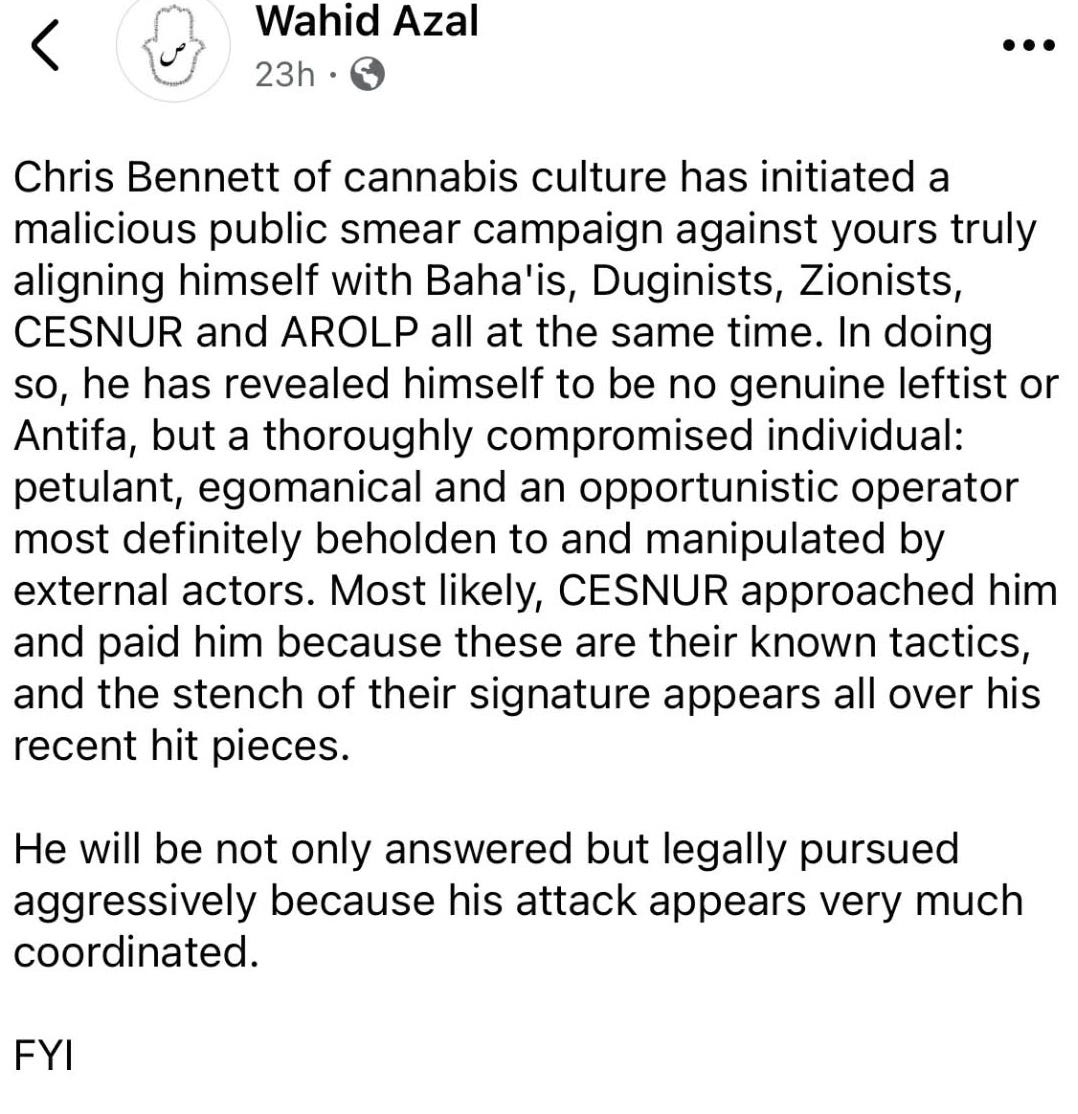
Eventually this developed into his article Why Chris Bennett is not Antifa. Azal writes “Bennett’s ‘Antifa identity” collapses because he is fundamentally a creature of capitalist psychedelic culture”. Now, not to brag, and its not like I’m using protests as photo op opportunities, but over 3 decades of activism, and protesting has seen me at free Palestine rallies, anti-war rallies, environmental rallies, drug war rallies, cannabis protests, Occupy protests etc., etc, speaking, organizing and attending.







Firing up the crowd at Occupy in Vancouver in 2011.
Real Leftists activism leaves a foot print and besides protests, I took the Canadian government to court proactively over the right to use cannabis for religious purposes, and provided evidence and expert testimony for other cases. I’ve also been a camp chairman in a Union. I used to mostly do podcasts about cannabis history and my books, but these days it seems like I’m on to talk politics more.
On Wahid’s Smears that I am a Racist and a Nazi
In his another attempted broadside, Wahid Azal brands me a white-nationalist gatekeeper operating a “Reefer Reich,” complete with orientalist paranoia and Evolian reactionism. Yet when pressed for evidence—any quote, any post, any passage from thirty years of books, articles, interviews, or social media that contains a racial slur, a supremacist dogwhistle, or even a mildly bigoted remark—none materializes. Not one. The accusation floats entirely on interpretive vapor: reading “Aryan shamanism” into my discussion of Scythian cannabis use, hearing “anti-Middle Eastern xenophobia” in criticism of his own self-aggrandizing claims, and detecting colonial entitlement in the simple request that historical sources be cited accurately. This is not analysis; it is projection dressed up as critique.
Wahid’s piece is a textbook case of the “accuse your critics of racism/supremacy to shut down debate” playbook: no direct quotes, no screenshots, just a long string of loaded interpretations (“racialized gatekeeping,” “Aryan shamanism,” “Reefer Reich”) slapped onto an article that never mentions race at all. It’s pure guilt-by-accusation
In his article, ‘Racialised Polemics, Violent Epistemic Misrepresentation, and Plagiarism: A Critical Examination of Chris Bennett’s Recent Portrayal of me’ Wahid run’s with the same racist persecution card he has pulled out so often, as we have seen in Part 2 of this series, particularly against his former comrade in arms, Dale Husband. Wahid writes:
Bennett repeatedly emphasises my Iranian background, migration trajectory, and diaspora identity in a manner that functions rhetorically to signal “foreignness.” While biographical context is not inherently problematic, the way it is deployed—juxtaposed with allegations of instability, extremity, or esoteric grandiosity—taps into a familiar Western narrative: the “eccentric eastern outsider.” In other words, he is redeploying the “wandering Jew” narrative of Antisemitism for his polemical purposes against me.

Then there is the mouthful of a title The Neo-Völkisch Reconfiguration of Psychedelic Discourse: A Case Study in Epistemic Authoritarianism, Apologetic Mimicry, and Racialised Polemic in Chris Bennett. It takes two breaths just to say it out loud! Which spins the tale that:
While Bennett’s interventions present themselves as countercultural, left-coded, and ostensibly neutral, a closer examination of his rhetorical strategies, epistemic posture, and racialised attack patterns indicates structural affinities with the neo-völkisch ideological constellation. (Wahid Azal)
I don’t think I even heard of a “neo-völkisch ideological constellation” till now. Outside what I have written about him as an individual, Wahid gives no examples of “racialised attack patterns” and there is nothing in my article, even bordering on racism. Wahid is an Iranian individual, an academic who has specialized in Iranian Mysticism, Religion and Magic, at war with an Iranian religion, writing about Iranian politics, and claiming to be the successor of an Iranian religion…. It’s just a relevant part of the story. Wahid’s latest “racialised polemics” pieces are just his same old tired playbook. A criticism of him, since he is Iranian, is a slur against all Iranians and evidence of wider racism and Nazi extremism. Hohum, boring. the ring of it is about as alarming as being called ‘antisemitic’ by a rabid zionist defending a genocide. Wahid crying racism, is like ‘the boy who cried wolf’ at this point.
Regarding racism and “Orientalism”, Azal also invokes Edward Said’s framework to argue my portrayal exoticizes him as an “untrustworthy Oriental guru,” but this interpretation strains against my article’s content, which critiques specific behaviours of the individual, Wahid Azal—like threats and conspiracy endorsements—without tying them to his Iranian-Australian heritage as inherently suspect or to blame.
He goes further here with claims that indications of Nazism and white Nationalism are to be found in the whole Canadian cannabis scene! THE REEFER REICH: How Chris Bennett’s Der-Stürmer-Style Screeds Exposes the White-Nationalist Undercurrent in Canada’s Cannabis Culture. Oy vey! and ironic, considering Wahid’s own indications of anti-semitism through propping the Protocols of Zion, which were discussed in part 2.
Canada’s cannabis subculture has long refused to acknowledge: the presence of a white, settler-nationalist, racially-entitled, conspiratorial undercurrent within the “alternative” scene—an undercurrent that masks itself behind tie-dye and libertarian rhetoric, but thinks and writes like Richard Spencer with a bong. (Wahid Azal)
I mean, its a good thing no one told him Hitler’s Birthday was on April 20th! or we would be looking at an International attack on cannabis culture from Wahid. Or slogans like “Hanf ist Sieg!” (“Hemp is Victory!”) and “Wer Hanf anbaut, hilft dem Führer!” were sung in Nazi Germany. Then of course there is Hitler’s lesser known book Mein Hanf.
Seriously though, for the record, and you can quote me on this – FUCK NAZIS! Here is a video of me walking into a crowd of White Nationalists by myself years back, ready to throw fists if I have too. I have also attended other anti-racist protests as well. That Wahid could not find one racist quote from me on the whole internet, and that his claims are all based on his own weird Bullet Point framing, speaks for itself. With Charlie Kirk, we had the receipts.
Moreover, cannabis has always been a bridge between cultures and races, shared on the oldest of trade routes. Passed through water pipes and edibles at Constantinople Coffee Houses from Arab hosts to European travellers, and with reefers shared by Blacks and Whites fraternizing at American Jazz clubs. In fact, the challenges to institutionalized racism which cannabis inherently carries, was one of the key reasons it was first prohibited in 1930s America, as can be seen by early anti-cannabis propaganda. These racist tropes took hold in Canada and can be found at the root of Canadian Cannabis Prohibition as well. This terrible history, and the racially unbalanced applications of laws against cannabis from there forward, is something that myself and other activists have often highlighted on the fight for legalization in Canada. Shame on Wahid for his wholesale condemnation of a group that has always embraced multiculturalism and inclusion. Total dick move.
The irony is thick. Activists like myself have spent decades documenting the racist origins of cannabis prohibition—Mexican “locoweed” panic, Black jazz-musician stereotypes, Reefer Madness hysteria—and I have repeatedly credited mid-Eastern, Asian, African, Indian, and Indigenous cultures for the plant’s ancient sacramental role. Meanwhile, the man accusing me of racial gatekeeping offers zero examples using my own words. When you have to invent a fascist alter-ego for your critic just to avoid engaging his actual arguments, you’ve already lost the plot. This isn’t anti-racism; it’s a textbook Wahid Azal smear tactic: cry “white supremacist” at anyone who dares question you, evidence optional.
So no, there’s nothing racialised coming from my side. The only person injecting race into disagreements is Azal himself, and he does it because it’s easier than defending his own historical interactions and his threats. That’s the whole story.
Suing and Threats to Report to Various Authorities
“there will be weeping and gnashing of teeth”
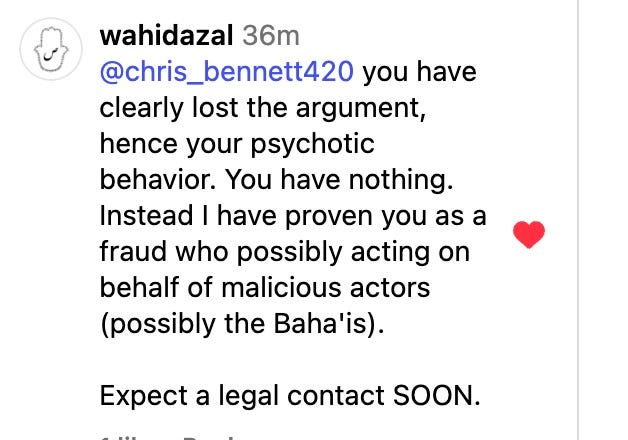
Wahid uses threats of intimidation and legal action could be seen in the same way that the cult leader and narcissist L. Ron Hubbard did against anyone who questioned his organizations activity. In the case of Scientology, they could afford to finance such attacks, even when bogus.
Since writing my articles on Bábísm, the Psychedelic Fatwā and Wahid Azal, myself and Cannabis Culture have received multiple legal threats from Wahid, that include his own made up legal papers, and a report to the UN, on top of close to 20 articles, and other threats. Generally in claims of defamation or slander are made, specific points in an article are identified. Wahid has none of that, but insists all material on him, the fatwā’ and Bábísm must be removed, and public apologies posted, etc. with no specifics addressed.
Over the past several months, a series of cross-border defamatory attacks have been directed at me and at the minority Bayānī (Azalī Bābī) tradition I represent. These most recent assaults—originating in Europe then Canada and disseminated through platforms associated with Cannabis Culture—did not arise in a vacuum. They stand at the end of a long historical chain of institutional discrimination and sectarian vilification that began nearly three decades ago. For this reason, I have submitted a formal communication to the United Nations Special Rapporteur on Freedom of Religion or Belief (Wahid Azal)
To be clear, Wahid Azal, claims to represent the Bayānī (Azalī Bābī) tradition based on his own personal Revelations. There is no official recognition of him in this role by this tradition.
“What Chris Bennett did was something vastly more serious: he attacked a living religious tradition by pathologizing one of its representatives: me. Azalī Bābism (or the Bayān) is not a historical curiosity or a footnote in the annals of nineteenth-century Iran. It is a continuous intellectual and spiritual lineage that has survived persecution, political repression, sectarian distortion, and systematic erasure…. Bennett’s obvious sock-puppetry acting on behalf of CESNUR and the Haifan Baha’i apparatus [is directed]in order to erase the very contemporary existence of the Bayānī community.” (Wahid Azal)
My article began from interactions with Wahid, and there is no connection to any sort of historical pogrom against the Bábísm or the Bayán tradition, and this claim sits alone in the troubled mind of Wahid Azal. Nor was there anything composed on behalf of CESNUR and the Haifan Baha’i, Sabbatean Frankists, the CIA or any other group Wahid has falsely and repeatedly claimed I am associated with.
Moreover, the Babi and Azali communities, both in Iran and globally, do not recognize N. Wahid Azal as their leader. Since the death of Ṣubḥ-i Azal in 1912, Azali Babism has lacked any acknowledged central authority or organizational structure, a situation widely documented in scholarly sources and described as a state of long-term stagnation. The few remaining Azalis—primarily in Iran, where they remain underground, and a small number of individuals abroad—focus on preserving the Bayān and related texts rather than rallying around new leadership claimants. Azal’s Fatimiya Sufi Order, a syncretic group that blends Bayani doctrine with Sufi and entheogenic elements, is regarded by observers and by most Azali sympathizers as a fringe offshoot with no broader communal acceptance or legitimacy within traditional Azali or Babi circles accepted whatsoever.
Wahid’s claims of defamation, are based on an account of his own collected digital footprint and interactions across the internet going back decades. Wahid braided the rope that I tied into a knot, with which he hung his own reputation. However, in his claims of me being a Nazi and a racist, it’s all based on his whacky framing. He was unable to do the same sort of treatment using quotes from me, that anyone could have found about him. Wahid’s article about me and Cannabis Culture more clearly falls into the area of defamation, and if Wahid ever pursued charges against me or CC, that would only say to me, that he has money, and I would level a more successful counter suit on him for defamation, than he could on me, for detailing his Internet past.
My view is under Canadian law my piece is fair comment on a public figure’s verifiable statements and actions, such as his endorsements of antisemitic texts like the Protocols in older writings, threats to various groups, slander of people with accusations of pedophilia and other crimes, etc. My article is ethical journalism that prioritizes community safety, especially for Iranian Baháʼís facing real persecution amplified by Azal’s rhetoric, along with attacks on various other groups and elements that could be seen as Hate Speech. That article was a public service, and I have been contacted by some of Wahid’s victims as a result. I’m sure some thrilling testimony and affidavits would make for a very exciting International court case and draw even more attention to all this!
Wahid’s Letter of Demand to Cannabis Culture claims that people there could be facing up to 5 years simply for hosting the article! Realistically, his attempts to damage the reputation of this pillar of Canadian activism and cannabis journalism, are a much more substantiated case of defamation. For the record, Cannabis Culture does not edit and vet blog pieces like my own, as with most sites that carry blogs. That said, I expressed to Cannabis Culture, if they wanted to stop Wahid’s threats and online attacks and annoying non-stop emailed threats, feel free to take the posts down. They can live happily here on my Substack blog and other sites.
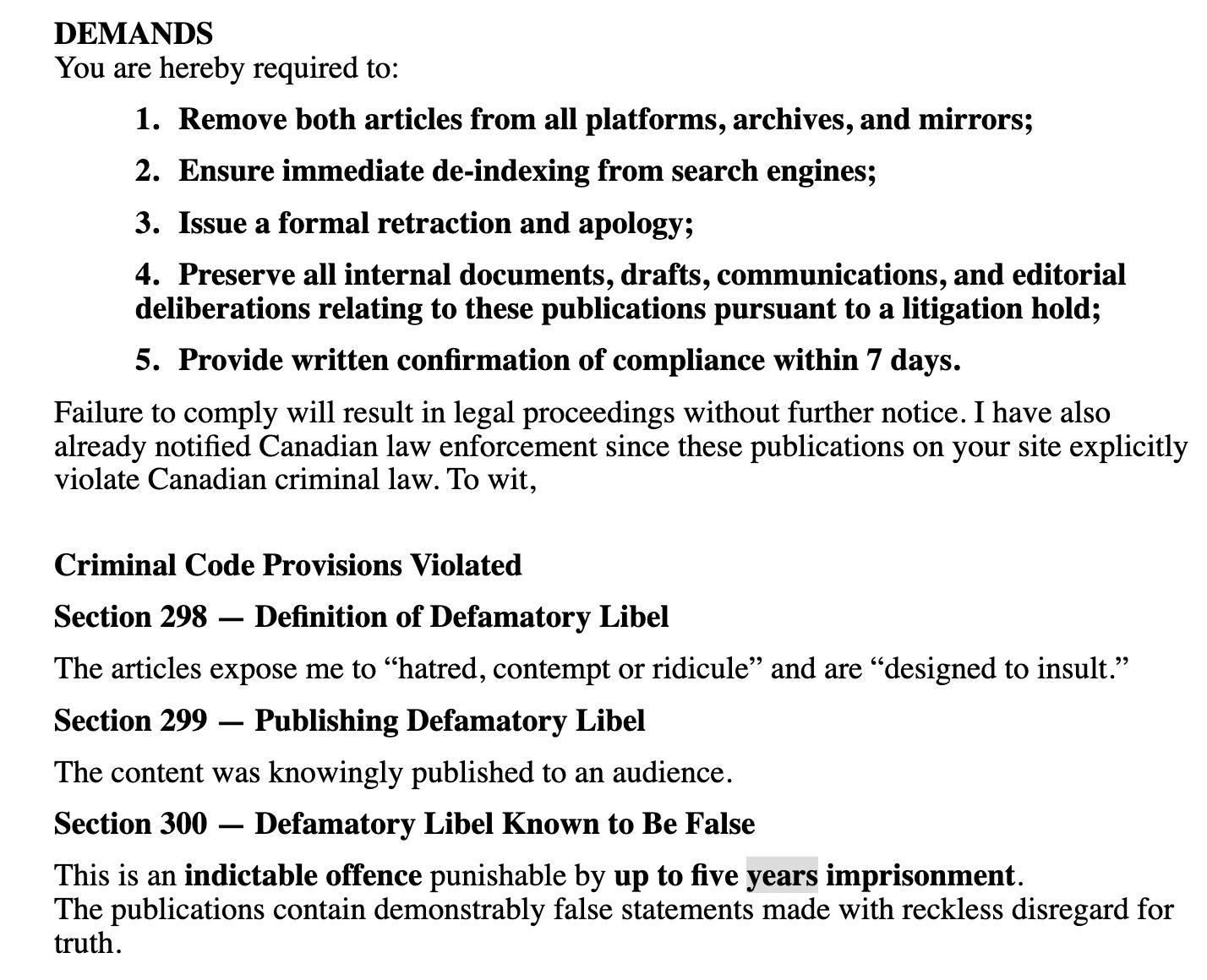
With all his claimed personal legal acumen and his alleged financial ability to launch ‘defamation’ lawsuits across continents, oceans and borders, it’s curious that Wahid never bothered to pursue the investigation into his wife’s alleged murder in Gernany, that was discussed in Part 2, claiming the cost of 30k was too much to burden for justice. I guess old forum comments and internet screenshots of things he actually wrote and stated, are a far more important battle. In the real world, you would probably need that much as 30k to retain a lawyer for an unwinnable case such as Wahid’s here and it would cost thousands of dollars for a lawyer to review all the articles in question now, mine and mostly his.
Threats of suing and reporting people to various authorities from Wahid, have been claimed to have gone back all the way to the 1990’s when he was still going by Nima Hazini. In a 2020 thread titled Nima Sadra Hazini aka Wahid Azal and “The Cops” we read:
For a guy who talks about his enemies working for corporate surveillance, the Department of Homeland Security, the NYPD, the FBI, the Mossad, et al ad nauseam Nima Sadra Hazini aka Wahid Azal (LOL) sure does threaten to call the cops, engage law enforcement, have legal authorities perform extraditions etc A LOT. Rumor has it in his youth he worked for his family’s real estate management company (wow an actual job albeit gotten through nepotism!) Collecting rents from tenants like a good little Rentier Capitalist enforcer. Not only this but he had to sick the cops on some tenants who couldn’t pay up, which I am sure tickled the little narcissistic bully’s fancy immensely…. Ironic how the cops are good when they’re (perceived to be?) on Little Nima the Gnome Sorcerer’s side?
We saw evidence of this pattern in Part 2, with things like threatening to report Baháʼí to Iranian authorities, when Iran is known for its persecution of this group. Accounts of him threatening to sue are even more prevalent
In April and June 2007, during heated Usenet exchanges on soc.culture.iranian, Azal repeatedly challenged his critics (particularly Sam Ghandchi) to produce court-admissible evidence for their accusations against him. He stated that mere innuendo would not “stand up in a credible court room” and positioned himself as ready to confront any libel claims legally, effectively turning the threat of being sued into a counter-challenge that he would welcome court proceedings and pursue defamation claims if the accusations continued without proof.
On June 7, 2010, Azal published a detailed open demand on Iranian.com directed at what he called the “Baha’i Internet Agency.” He warned that unless verifiable legal documents were produced to substantiate various personal smears (drug convictions, ties to Iranian intelligence, etc.), the continued circulation of such claims would expose the perpetrators to court action for defamation. Direct link to blog post.
In November 2011, on the BahaiForums.com discussion board, Azal explicitly instructed the site administrators to remove what he described as “criminally libelous” threads attacking him. He warned them that failure to do so could have legal consequences and stated that if the “Haifan Bahai organization” or its online defenders reported him to authorities, he would “welcome the opportunity to present my case against the Haifan Bahai organization before authorities and courtrooms alike,” effectively threatening a countersuit. Direct link to forum thread.
In November 2016, across a series of comments on ‘The 4th Revolutionary War blog’ post criticizing Azal’s CounterPunch article on the Maryamiyya Sufi order, Azal issued multiple explicit threats of legal action in response to claims that his piece was unsourced and libelous. In one comment, he warned the author: “when I obtain a court order against your site here, WordPress will be obliged by law to also disclose to me all your personal details… and I will publicize that information all over the internet as well as come after you personally for any/all damages.”
In replies to Denis Giron, he repeatedly challenged him to court, stating: “bring all your selective evidence to a German court… Now, come to Germany and let’s allow a German court of law to decide the issues,” and “Denis Giron, since you are an Israeli intelligence asset online… by all means come to Germany, get a German lawyer and we will resolve this and other related matters in a German court in front of a panel of German judges.” He also threatened referrals to authorities, such as disclosing contacts “directly to Iranian authorities” and forwarding Giron’s statements to German intelligence (BfV) for potential arrest. Direct link to full comment thread (threats appear in Azal’s comments starting around the initial reply to “Akira” and escalating in the Giron exchange).
In early 2022, although the exact wording is no longer visible due to Reddit’s removal of the posts, moderators of r/FreeSpeechBahai publicly stated that Azal had been temporarily banned for, among other violations, “threatening me and others,” in the context of ongoing disputes that had previously involved demands for content removal on legal grounds. Direct link to Reddit thread.
See also Nate Abookire, who offered himself up with no lawyer to be deposed from the USA to Australia for threats of a case from Wahid.
To date, no public record exists of Wahid Azal actually filing any of these threatened lawsuits, but the pattern of invoking courts, demanding retraction under threat of legal action, and welcoming opponents to sue him so that he can countersue has appeared consistently across multiple platforms between 2007 and 2025.
I think some of Wahid’s non legal threats though, may be more disconcerting, and I am thankful that borders and oceans separate are perspective continents. My concern while writing my articles, was the possibility of Wahid accumulating followers may bring increasing dangers from him. This was indicated in Part 2 and again here with the video Message to the enemies of the Fāţimīya Sufi Order (the People of the Bayān) pre-Invasion Day 2020 where he blames critics for wife’s alleged murder. viewers are warned that if you mess with one person from this order, you will find yourself entangled with them all. A real message of Love and Light right there…..
This, in my mind, is indicative of Wahid’s own fascist tendencies. Only a Fascist would continually threaten people with reports to various Authorities and trumped up bogus legal threats. We see Wahid continually whining like a little fascist piggy, who runs wee, wee, wee all the way to whatever Authority works best for a given situation, over and over, again.
Like Wahid’s issued statement last June THE EXODUS: A MANIFESTO FOR LEAVING FACEBOOK only for him to return shortly thereafter, it’s clear so much from Wahid here is hot air, issued from his bloated balloon of an ego.
I really don’t feel the need to address anything else Wahid has written about me in response to my articles, he will say, what he is going to say. I’m not the least bit interested in even reading it. Although, perhaps if he writes something more academic addressing the original nature of our conflict, a friendly debate about the nature of the ancient Persian sacrament haoma, that took a sour turn, which I will now get into, I might get pulled into that discussion.
The Origins of Our Conflict
Like a number of the individuals discussed in Part 2 of this series, my relationship with Wahid Azal, began friendly enough sometime between 2020-2021. We met on the frontiers of the emerging 21st century version of psychedelic culture and plant medicines in one or another of the pages devoted to such on facebook. Iranian/Persian culture has long been of a. deep interest for me, as it has always been a deep vector of cannabis’ esoteric history in religion and magic. Wahid’s knowledge of this area is impressive, and I was enamoured by him at first.
We also shared a lot of, what could be termed, ‘Leftist ideology’. This resulted in a podcast episode, now removed of course as this is the text book way Wahid has dealt with other videos from friends turned foes. This was all taking place, during the height of covid, and QANON conspiracies were running rampant. Natural medicine cure claim, and other alternative measure, provided an avenue for these ideas to filter into the psychedelic plant medicine scene. And in a message Wahid suggested we do a video.“Maybe we should do a podcast together where I let you talk about all this stuff, let you critique the professional psychedelic establishment and MAPS in particular”. I responded: “I don’t know about that, just not sure its constructive to tear down MAPS, they are doing there thing, its not my thing, but it appeals to a crowd I doubt I’d reach much… podcast sure, but, I am not on top of MAPS activities enough these days to comment a load, entheogen history though, I freely debunk.”
Wahid and I discussed this in a youtube video: ‘QANON in the Plant medicine community with Wahid Azal and Chris Bennett’, which ran with Wahid’s description:
In this 1hr podcast internationally renowned Cannabis activist Chris Bennett (author of the critically acclaimed *Liber 420: Cannabis, Magickal Herbs and the Occult* (2018) and Wahid Azal discuss the infiltration of the global planet community since 2016 by Trumpanzees, QAnon and the far-right, and how to counter it.
This was a big issue for me, and a major factor in closing down the retreat centre I had been building for ceremonies and events, Soma Institute. However, it was not long after this that my questioning and prying for information on the role of psychoactive substances in Islamic mysticism began to catch Wahid’s suspicions and ire.
In 2021 I made a post on Facebook, about the little known Islamic beverage Nabidh. According to the Encyclopaedia of Islam (1960) at times, nabidh contained cannabis and it was also was offered to the pilgrims in Mecca. Interestingly,Muhammad himself was said to have consumed nabidh. This is made more interesting by the 17th century text The Dabestān-e Mazāheb, which depicts Muhammad preparing bhang with a group of naked sadhus. For more on the role of cannabis in Arabic magic, and other fascinating details, see y articles Hashish and other psychoactive substances in the Islamic World and Zoroastrian Cannabis Infusions and Islamic Elixirs of Ego-Obliteration.
Wahid, who I tagged responded to my queries about it, and the following exchange took place about it:
Wahid Azal-This is well known. The debate is over the meaning of intoxication (sukr). I don’t have a problem with it, and neither do many other Sufis. But any suggestion to that effect among orthodox Muslims is always met by the same predictable negative response.
Chris Bennett Wahid Azal just surprised by its known use right at Mecca prior to the 10th century, and cannabis being prohibited if it was made into a drink through this association. I’ve been reading this paper, interesting take – The doctrinal development of the prohibition of intoxicating drink in Islamic revelation and law
Chris Bennett definitely in the time frame with this prohibition.
Chris Bennett with barley and honey used it is reminiscent of soma a bit.
Chris Bennett it seems in a lot of ways the earlier persian influences flavored islam as much or more than the abrahamic.
Wahid Azal Much of these prohibitions, retroactively projected, originate in the Abbasid period as a response to the Qarmatis/Karmathians and related batini revolts against the emergent Sunni orthodoxy.
Chris Bennett this seems to be the entheogenic suppression point in Islam, if there is one.
Wahid Azal That’s only the tiniest tip of the iceberg, re: suppression.
Chris Bennett well do you see this as the start? or going back even further?
Wahid Azal I would go back to the moment the Prophet (ص) passed away and how His Family and legitimate successors were immediately treated by the usurpers who then sanitized everything.
Chris Bennett is there any written material on what ingredients were to be found in nabidh besides cannabis and st john’s wort? i’m thinking henbane, rue, and other things may have been around. Be nice to see some recipes from the period. these things would not require and fermentation, so the idea that muhammad’s nibidh could have been psychoactive. sounds more likely than “three cups of water from the sacred well of Zemzem” for a trippy night flight.
Wahid Azal One does come across ingredients, yes.
Chris Bennett Wahid Azal what is a good source for reading about that ?
Wahid Azal You have to allow us to keep some of our secrets to ourselves, bro. But ask any Arab (especially the desert Bedouins) what nabidh is, and they will bring it to you.
This is the first indications of Wahid becoming annoyed with my prying, due to my being a Westerner. At this time I did not know how much the botanical identification of ritual drinks in Islam, and the ingredients of the Avestan Haoma, related to the Vedic Soma, were wound up in Wahid’s own cosmology, or anything at all about Wahid’s claiming to be the inheritor of the Bayán mantle of the “Living Mirror” or even anything about Bábísm or the Bayán.
To be fair here, I have my own strong views on the identification of the Avestan haoma and its counterpart the Vedic soma, and their common origins. I wrote extensively about this in my 2010 book, Cannabis and the Soma Solution, and in a 6 part series, The Soma-Haoma Question, which explores various botanical candidates and their claim, and why I suggest cannabis as the strongest contender. So it’s a topic I am well familiar with, read up on and passionate about.
I did not realize then, in Wahid’s case, that his view that haoma was a preparation of Syrian Rue, also known as Harmal, and in the Arabic world as Esfand, was caught up in key elements of the rituals and beliefs he was promoting via his Fatimiya Sufi Order. He specifically refers to “Haoma which is our sacrament at the Fatimiya Sufi Order” (Wahid Azal, 2011). Wahid explains his views on the identity of haoma:
Now in their quite erudite scholarly monograph, Haoma and Harmaline (Los Angeles: 1989), David S. Flattery and Martin Schwartz correctly identified the pedigree of the ancient Iranian Haoma, or at least one of its main constituents, with Esfand, the Syrian Rue. This fact was already known in Iran and the Persianate world in general long before Flattery and Schwartz undertook their learned study, being that its identity is quite explicit in much of the medieval Avestan commentaries on Haoma; but for some reason Western academic scholarship, speculating and trying to pinpoint the identity of the Vedic Soma, first mistakenly identified it with the Amanita muscaria mushroom (Gordon Wasson) and then later with Ephedrine (John Brough). Poignantly in chapter two of their study, Flattery and Schwartz draw the direct parallels between the ancient Iranian Haoma and Ayahuasca ( see §38-§42, pp. 24-9).
In the contemporary Ayahuasca versus analogue debates, this study and the detailed insights it offers, plus the evidence from ancient Avestan texts and scriptures presented in it, has been virtually ignored by some in the community, and mainly by some Western ayahuasqueros. To my mind, at least, this significantly complicates the Ayahuasca-only fundamentalism of some in this community while dismissing many of their objections as well. That aside, and a point not discussed by Flattery and Schwartz in any depth, is that Iran also has all kinds of tryptamine plant species, such as Acacia as well as Mimosa hostilis (the latter particularly in the northern Caspian provinces), to name just two. So as Flattery and Schwartz have demonstrated in recent academic literature, and as both ancient Iranians and Iranians of the Islamic period have known; not to mention the taxonomic botanical evidence of tryptamine plant species existing in Iran; similar circumstances as well as attitudes obviously prevailed in segments of this culture regarding entheogenic plants quite similar to the Amazonian one, at least where Haoma is concerned anyway.
As far as the evidence in the Islamic period is concerned: in his monumental 110 volume collection of Islamic traditions and narrations attributed to the holy Islamic figures (i.e. the Prophet Muḥammad and the holy Imāms), and entitled The Oceans of the Lights (biḥār al-anwār), the Safavid narrator-traditionist and polymath Muḥammad Bāqir Majlisī (d. 1659) devotes an entire chapter of his 59th volume to the sayings of the Islamic holy figures regarding both the Syrian Rue and Olibanum (frankincense). Let me quote four of these here:
The Messenger of God [i.e. the Prophet Muḥammad] said: the ḥarmal [i.e. Syrian Rue/Esfand] does not grow, whether from a tree, a leaf or a fruit, without there being an angelic guardian spirit attached to it, until it reaches whosoever it reaches, or turns to waste. In both its root and its branches there is a talisman. In its seeds there is a cure for seventy-two maladies, so treat yourselves with it, as well as with the olibanum [i.e. frankincense], for purposes of healing.
Imām Ja’far al-Ṣādiq [the sixth Shi’i Imām]was asked about the ḥarmal… He said: As for the ḥarmal, not a single of one of its roots penetrates the earth or any branch of it rises to the sky without there being attached to it an angelic guardian spirit, until it turns to waste or becomes whatever it becomes. The devil avoids the house that contains the ḥarmal from every seventy houses that he passes, and it is a cure for seventy maladies the least which is leprosy. Do not avoid it!
One of the prophets lamented to God, mighty and majestic, regarding the cowardice of his people, to which God, mighty and majestic, revealed to him: Command your people to eat the ḥarmal. And in another tradition, it is related: Command them to water the ḥarmal, for it increases a man’s bravery.
The Messenger of God said: Whoever drinks the ḥarmal for forty mornings every day in a certain measure, his heart shall be illuminated by wisdom, and he shall be cured from seventy-two maladies the least which is leprosy.
(Trans. N. Hamed as slightly amended by me)
And this above is only the evidence from the extra-scriptural sources attributed to the holy figures of Islam, and not from the scientific and ethnobotanical sources of medieval Islamicate which offer far, far more.
Much more can be said, obviously, but I believe this here amply demonstrates the case beyond just the popular meme of Aladdin and his magic lamp. One issue to consider is that because certain levels and sectors of traditional Iranian society and culture have not been as thoroughly penetrated by the West (or, for that matter, even by modernized, secular Iranians) as the Amazonian one has, this does not prove any entheogenic agnosia on the part of high Iranian culture and civilization. In fact the evidence, whether from ancient antiquity to the present, proves diametrically the opposite.
Let me make this point here, there are Sufīs in Iran today who partake of entheogens in ritualized settings and who claim such entheogenic substances, and the ceremonies adapted to them, to be knowledge passed down to them in uninterrupted chains of transmission reaching into distant (pre-Islamic) antiquity while simultaneously validated in the Islamic present by sources such as the sayings quoted above. The Prophet Muḥammad’s underscoring of the connection between the ingesting of harmal for forty days with wisdom (ḥikma) and illumination (nūr) — both of which the Tradition elsewhere holds to be divine bestowals — literally speaks to it. (Wahid Azal, 2016)
Thus things heated up even more, when I began to pry Wahid about his views on the Iranian haoma, as we both held very different candidates, close to our hearts. On April 1, 2021, I posted the following on the ‘Entheogenic Anthropology’ page on FB, hoping to draw some interest. At that time, I was also trying to get other researchers who claimed the various different candidates, to enter papers on each candidate, and was trying to get a conference off the ground. I invited Wahid to partipate as well. As I noted in Part 1 of my 6 part series on Soma’s identity:
I’ve been corresponding with Graham Hancock and he is interested in opening up the debate about the identity of soma on his webpage and inviting different authors to submit papers on various candidates. What authors would you suggest? If you have a paper you would like to submit, please email to [email protected]
Any submission would need to address these 5 points:
1)How the terms soma and haoma originated and how they relate to their candidate
2)Where the use of this candidate originated with the common Indo-European ancestors of the authors of the Vedas and Avesta
3)The identifications of the plant used based on a description in the Vedas or Avesta (All translations must be cited and referenced as to their source from an existing published translation of the Vedas or Avesta and related ancient texts).
4)The candidates method of preparation based on Avestan or Vedic descriptions.
5)What led to its prohibition, disappearance of this candidate and how this plants identity was lost
Unfortunately things did not progress much from there. Not long after that, I had a falling out of sorts, with Hancock, who had hosted some of my articles. To be honest, I felt there was more sensationalism there, then legitimate historical debate to be found, and felt in the long term, it did not add to the sort of credibility I would like to see my own work gain. (It’s admittedly been a struggle).
However, the comment section on this post, got heated, and Wahid’s and my exchange was the source of the fire. Wahid deleted many of his comments, so there are things I am referring to in my response that are no longer in the thread, such as his claim of expert on Zoroastrianism, Mary Boyce’s identification of haoma as Syrian Rue, and his claim of learning the ingredients directly from a Zoroastrian priest who confided it to him in secrecy.
Wahid Azal The contemporary (non-Parsi) Zoroastrian dasturs of Iran have full knowledge of the Haoma and its components, as do a handful of the qalandari Sufis of Iran whose original pedigree is obviously pre-Islamic. However, probing into their secrets is something I am beginning to agree is not a good idea. Other than a handful who came close, but not all the way, the scholarly community has proven itself clueless. But more clueless than them are people such as Graham Hancock who are maintaining careers by being cultural voyeurs into other people’s secrets and sensationalizing it.
Wahid Azal And there is no Haoma preparation method in the Avesta.
Chris Bennett Wahid Azal so you say
Wahid Azal So I know. This is my background.
Chris Bennett so you claim, and I’m saying if you are talking about it here and can’t back it up, you are clearly no great keeper of the secrets. I’m actually just growing more doubtful as we go on about it.
Chris Bennett You go ahead and pretend, and things like haoma and soma are not social cliques, they are collective heritages and part of human history.
Wahid Azal. Why don’t you go to an actual academic conference with real scholars, which Hancock isn’t, and present your cannabis-exclusive theories about the identity of the Haoma over there. I can back up everything I say. Facebook isn’t a credible academic forum where one should loose sleep over. Out of respect to you, I have so far said nothing. But theory is just that, theory.
Chris Bennett Wahid Azal you can back everything you say? where does Boyce say syrian rue was haoma? [a claim he made in a now deleted comment]you never came up with a source and your other claims are hearsay. That is the issue, you not backing up what you say bro. Plenty of academics are touting the cannabis ephedra theory as we speak.
Chris Bennett Wahid Azal why don’t you produce some actual references, and fb is as good as any place, and Hancock gets much more attention than dry academic journals where this aspect has been mostly overlooked.
Chris Bennett Wahid Azal and haoma is ‘pressed’ just like soma, and bhang there are many references to pressing – In Yasna 9.3-11 Zoroaster is represented as asking the yazata: Who first pressed haoma, and for what reward? – In the Hōm yašt Haoma manifests himself to Zoroaster “at the time of pressing” in the form of a most beautiful man and exhorts him to gather and press haoma (Y. 9.1-2) – In Zoroastrian observance (except for the Vendidad service, probably not instituted until Sasanian times), the pressing may take place only between sunrise and noon, the “time of pressing” (Av. hāvani- ratu-, Pahl. hāwan gāh)
Chris Bennett Wahid Azal Funny how you write articles about it, and make comments about it, but when you get called out and asked for actual sources to back your claims about it, its suddenly a secret that is best kept by you and other gatepkeepers Wahid. Not a credible look. Haoma is not Syrian rue, and Syrian Rue is not recognized as haoma by the Zoroastrian priesthood. Fact.
Chris Bennett Wahid Azal In Tihkal, Alexander and Ann Shulgin report the following accounts of the ingestion of Syrian rue, seeds and extract; and the nausea sounds extreme even when following dietary precautions, a fact that would be hard to reconcile with the pleasant effects of Haoma and Soma as described in the Vedic and Avestan literature:
(with 2 g Peganum harmala seeds, ground, in capsules) “No effects.”
(with 5 g Peganum harmala seeds, ground, in capsules) “At about 1:45 tinnitus was obvious. At 2:00 precise movements were problematical and nystagmus was noticeable. Mild nausea and diarrhea, …. sensitive to light and sound…Hallucinations were intense, but only with the eyes closed. They consisted, initially, of a wide variety of geometrical patterns in dark colors, getting more intense as time went on. They disappeared when the eyes were opened… loose bowels and nausea were pretty constant through the… the trip.”
(with 7 g Peganum harmala seeds, ground, in capsules) “Very sick for 24 hours.”
(with 20 g Peganum harmala seeds, as extract) “This is equivalent, probably, to a gram or so of the harmala alkaloids. This was ground up material extracted with hot dilute lemon juice. Within a half hour, I found myself both trippy and sleepy. Then I became quite disorientated, nauseous, and with an accelerated heart beat. I had the strong sensation of moving backwards, drifting, with faint visuals under my eyelids. Restraining the vomiting urge was an ongoing problem. I could have gone out of body quite easily, except that I was completely anchored by the nausea. After about three hours, I knew that it had peaked, and I went to sleep and experienced intense and strange dreams. The entire experience was a conflict between tripping and being sick.” (Shulgin & Shulgin, 1997)
Chris Bennett harmaline is a great MAOI inhibitor, not very pleasant on its own, and I am guessing much, much worse with ephedra. Wahid’s case here boils down to claims he knows a guy. He was unable to produce a reference from Mary Boyce, where he claimed she confirmed syrian rue was used in haoma, and then it became he knows first hand from Zoroastrian priests, who took him into their confidence, as he is Iranian. Sadly this has made me question his sufi account about a syrian rue preparation. I am very much about ‘proof’ and actual ‘evidence’. Haughty unprovable claims, don’t go far with me. And the idea that people using a unpleasant harmala preparation should protect it from exploitation, is particularly laughable. I’ve sold a lot of harmala over the last 20 years, I can’t recall anyone using it by itself though.
I call BULLSHIT. And I am sad to do it….
Chris Bennett Sadly, as i was quite taken with him, I think, like his claim of inside knowledge from Zoroastrian priests, the claim of a sufi harmala drink, begins and ends with Wahid. This is not to say Wahid does not know his history in this region, he is very good at referencing source material, and very knowedgable of the dates and figures involved. When it comes to this claim though, he is pretty much left with Haoma and Harmaline, and is unable to verify any of these claims with solid outside information, and left with personal stories, which for me, only raises questions.
In regards to preparation methods of haoma, a sacred plant and the ritual drink derived from it, is prominently discussed in the Avesta, particularly in the Hōm Yašt (Yasna chapters 9–11). This hymn praises Haoma as both a divinity and a plant, recited during the Yasna liturgy where haoma is ritually pounded and pressed. The texts describe the physical act of extraction in Yasna 10, praising the process: “At the first force of thy pressure, O intelligent! I praise thee with my voice, while I grasp at first thy shoots. At thy next pressure, O intelligent! I praise thee with my voice, when as with full force of a man I crush thee down” (Yasna 10.2). A more recent scholarly rendering highlights the tools and action: “I praise with speech, O you who are filled with inspiration, your upper pressing stone, with which I, a man, pound forcefully” (Yasna 10). Haoma is described as having stems, branches, and growing on mountains, with its invigorating juices extracted through this forceful crushing and pressing (Yasna 10.3–5, 12). Yasna 11 serves as a prelude emphasizing proper ritual handling to avoid faults. These verses portray haoma preparation—as pounding branches in a mortar (often with water, milk, or pomegranate elements), pressing/crushing to release the juice, straining, and offering—as a central act granting vitality and spiritual benefits, aligning with ongoing Zoroastrian practice. They mirror both the preparation of soma in the Vedic literature, and bhang in modern India.
To be clear, I don’t doubt the use of Syrian Rue in the region, both for ritual purposes and as a medicine. Evidence of the medical and ritual use of Harmal in Saudi Arabia, goes back some 2,700 years. A recent study showed that “Iron Age communities at Qurayyah intentionally burned harmal not in temples or burial practices, but in homes for therapeutic, sensory, and possibly psychoactive purposes.” As well as recent archaeological evidence indicating the use of Syrian rue and Blue Lotus infused into wine for rituals in the cult of the Egyptian god Bes. However these finds have nothing to do with the history of either soma or haoma, and in fact seem a more like source of the later Islamic use of harmal, than coming from the Avestan and Vedic sacred traditions.
Wahid did bring some interesting Islamic references to harmal to the table in regard to Islamic references. And we have other evidence like a 1595 edition of Avicennae Arabum Medicorum Principis Canon Medicinae ex Gerardi Cremonensis versione, etc., ‘Avicenna’s Canon of Medicine, by the Prince of Arab Physicians, according to Gerard of Cremona’s Version, etc.’, holds a number of entries under cannabis, including cannabis and other pulverized herbs infused in wine, as well as an elaborate sounding combination of herbs, including cannabis, poppy and harmaline containing Syrian rue seeds, under the magnificent sounding name Confectio Cognominata Imperialis (Confection Named Imperial). [Avicenna’s connection with cannabis based medicines was strong enough that The Pharmacopoeia of Bauderon written in 1681 refers to “Cannabis ex Avicenna,” in reference to the herb.]
That said, both in my book, Cannabis and the Soma Solution, and in my 6 part series on Soma/Haoma, in the article on Flattery & Schwartz’s book, Haoma and Harmaline: A Critical Analysis, I go over in detail, why I disagree with this designation of Syrian Rue as haoma. all of which Wahid, has never addressed.
Notably, the branches of haoma and soma are described as what it is prepared from. However, in the case of Syrian Rue, it is the red seeds that hold the psychoactivity, and no indication of this is to be found in either Avestan or Vedic description of the sacred plant. The primary psychoactive compounds in Syrian rue (Peganum harmala) — the β-carboline alkaloids harmine, harmaline, tetrahydroharmine (THH), and to a lesser extent harmalol — are found in highest concentration in the seeds (usually 3–7% total β-carbolines by dry weight, sometimes up to 9–10% in high-quality seeds). This is where virtually all traditional and modern psychoactive use (e.g., ayahuasca analogs, “pharmahuasca,” or standalone MAO-inhibitor use) comes from seeds. Comparably, the stems/branches and leaves contain only trace to very low amounts of alkaloids (usually <0.5% and often much less). They are generally considered inactive or only weakly active for psychoactive purposes.
In our discussion, which led to the falling out, Wahid claimed he had gotten this information confirming Syrian rue as the constitute ingredient of haoma, from a Zoroastrian Priest. Basically, Wahid claimed the tradition had been carried down to modern times by the Zoroastrian priesthood in the upmost secrecy, only to bestow it on a Baháʼí turned Bábi turned Sufi, who was free to openly reveal that secret to the world and disbelieving westerners, such as myself. When i question that as hearsay, Wahid then turned to the authority of a western academic, the late Mary Boyce, claiming she, an authority on the Zoroastrian tradition, had also identified Syrian Rue as haoma. More recently, Wahid made these claims again, in more now deleted comments on an article on drugs in Bábism I wrote, which i will discuss shortly. I called bullshit on this, as I was familiar with Boyce’s writing on the topic, and Wahid claimed some unaccessible source, which he never produced, and stuck to that.
Mary Boyce, who was a leading scholar of Zoroastrianism, documented the continued use of Ephedra twigs (known locally as hōm or hum) in modern Zoroastrian rituals as the plant source for preparing haoma (or parahaoma). She observed this directly among conservative Zoroastrian communities in Iran (e.g., in Yazd and Sharifabad) during her fieldwork in the 1960s, noting that these twigs were pounded with water (sometimes mixed with milk or pomegranate) and used symbolically in rites like the Yasna. Boyce treated this as a survival of ancient practice, though she acknowledged uncertainty about whether Ephedra was the original Indo-Iranian plant or a later substitute due to climatic or availability factors. Key references where Boyce discusses or implies the Ephedra identification include:
- Mary Boyce, “Haoma, Priest of the Sacrifice” Published in: W. B. Henning Memorial Volume, ed. Mary Boyce and Ilya Gershevitch (London: Lund Humphries, 1970). Based on her 1960s fieldwork in Sharifabad near Yazd; she explicitly describes the pounding of dried Ephedra stalks (called hōm) with water for the paragna/haoma portion of the Yasna.
- Zoroastrians: Their Religious Beliefs and Practices (1979, 2001 reprint) mentions that the original haoma may well have been Ephedra
- A History of Zoroastrianism, Volume 1: The Early Period (1975, reprinted 1996): In discussions of pre-Zoroastrian and early Zoroastrian rituals (e.g., sections on the haoma cult and Yasna), Boyce notes the modern use of Ephedra and links it cautiously to ancient traditions, without firmly equating it to the proto-Indo-Iranian sauma (due to debates over hallucinogenic vs. stimulant effects).
In my case, I am in half agreement with Boyce. My view, shared with others, is that the linguistic, archaeological, and early Zoroastrian textual evidence points more strongly to a cannabis + ephedra mix as the original haoma/yasna pressings.
In our discussions on Facebook, and elsewhere, Wahid has implied indigenous secret knowledge, and that Westerners should not be researching in this area, as he sees it as a sort of cultural appropriation. He also claimed the view that haoma was Syrian rue, was already well known in Iran, but provided to citations to that effect.
My own view, is that ephedra and cannabis were used together in the preparation of haoma, and in some instances poppy may have been used as well, and this is based on the work of earlier researchers. Similar views on Haoma are held by a number of Iranian scholars. Mehrdad Kia a Professor of History and Director of the Central and Southwest Asian Studies Center at the University of Montana, notes in The Persian Empire: A Historical Encyclopedia (2016): “The ingredients of the sacred Haoma juice were most probably ephedra mixed with poppy and cannabis” (Kia 2016). Likewise, Xinru Liu is a professor Emeritus of early Indian history and world history at The College of New Jersey, also suggests “ephedra, opium, and cannabis” a view he shares with colleague Kazim Abdullaev Director of Research of the Institute of Archaeology, Academy of Sciences of Uzbekistan, Senior Scientific Worker in Samarkand State University, and an Associated Member of the Center National de Recherche Scientifique, as noted in his paper Sacred Plants and the Cultic Beverage Haoma (2010). A paper on cannabis composed by a group of Iranian academics and clerics, that was discussed in Part 1 of this series, in relation to the ‘Psychedelic fatwā’, ‘Islam and cannabis: Legalisation and religious debate in Iran‘, concluded “Hum, homa…are among the many expressions given to cannabis in the Iranian plateau …in one of the Avestan hymns contained in their sacred book, Gat-ha, reference to the defence of the environment and care of the ‘sacred plant’ is thought of ceiling a reference to cannabis” (Ghiabi, Maarefvand, Bahari, Alavi, 2018).
Likewise, many Indian researchers have suggested that soma was made from cannabis. In 1976, Professor B. G. L. Swamy, an Indian botanist and writer who was head of the department of Botany and a principal of Presidency College, Chennai, put forth cannabis as a candidate for soma in a well thought out, but little recognized, article The Rg Vedic Soma Plant, in the Indian Journal of History of Science. Swamy built on the presentations of earlier Indians researchers, Mukherjee (1921) and Ray (1939) noting that the Vedic descriptions of the plant indicated leaves, stalks and branches; that soma was green, hari; that cannabis grows wild in areas associated with the Aryan ancestors of the Vedic authors. That Soma was cannabis has been held by a variety of Indian authors, most prominently by Chandra Chakraberty who has made this association in a number of different books; “Soma was… made of the flowering tops and resins of Cannabis sativa which is an aphrodisiac and stimulant, and a nourishing food…” (Chakraberty, 1952); “Soma…. Cannabis sativa… a nervine aphrodisiac” (Chakraberty, 1963; 1967); Not just soma in Chakraberty’s view, but also, “Amrta, the drink of the gods, identified with Soma (Cannabis Sativa) flowering leaf-paste mixed with butter-milk and honey, known as Siddhi’”(Chakraberty, 1971).
Soma was the most important of the Vedic plants. Soma was regarded by both the Iranians (Avestan Haoma) and the Aryas as the elixir of life. Unfortunately its identity has been lost. Some regard it as Asclepias acida, Sarcostema viminalis or Vitis Vinifere…. But these suppositions find no support from Vedic descriptive statements “The golden-brownish twigs (of Soma : harir ancut : Avestan azuz V. 9, 16) is being pressed (into a paste between stones) and filtered through (a woolen cloth or a grass mat : 9. 92.1). “Two arms with their ten fingers are pressing between the stones the Soma twigs with pretty digitate leaves (somasya suhastu : compound leaves radiating like fingers borne at the apex of the petiole), and the twigs with their digitate leaves (Sugabhastir=pretty handed) from mountains are pouring forth clear pleasant juice (5,43,4). Soma is many leaved (bahutanta : 10, 42, 8), twigs with slender leaves (ancum tigman : 8. 61 (72) 2). “Press the Soma between the stones, and filter it (the pressed paste) throughby mixing it with water. Then what comes from the hollow stems (Vaksana) will be enriched with milk (8. 1, 17)”. Finest Soma grows on Mujavant, (X. 34, 1). In the midst of snowy peaks… The soma paste pressed between stones, or by mortar and pestle (ulukhala : (1, 28, 3, 5-6), and mixed with water and milk (9, 86, 11 ; 9, 91, 2) is pushed through a woolen strainer and filtered through a grass mat. Sour milk (dhadi ; X. 179. 3), barley water (Yava sirah : 1, 81 (92) 4 ; 9 168-4) and honey 9, 17, 18 are added and it is a glad and stimulating drink…. (Chakraberty, 1944)
It is most likely that the soma plant is Cannabis sativa. For it harmonizes with the Vedic descriptions…. Soma Juice is ‘exhilarating(9, 86, 5) Cannabis sativa is stimulating and is an aphrodisiac and a giver of delight (9, 80, 8). ” Like Soma (5, 43, 4 ) it has digital leaves (su-hasta). Its stem is hollow (vaksana 8,1, 17). Rudra lives in Mujavat (Apasthanba 8, 18,8; MBh. X, 17, 96) Best Soma is also found in Mujavat (X, 34,1). “The votaries of Rudra-Siva are addicted to Cannabis sativa. From these identities, it is safe to conclude that Soma is Cannabis sativa. (Chakraberty 1958)
Other Indian researchers have also made this identification. “…the plant now known as Bhanga in India (Indian hemp)… was used as H(a)oma or Soma” (Deva & Shrirama, 1999); “Soma (a kind of hemp)” (Ramachandran and Mativāṇan̲, 1991); “Soma was a national drink. This was a green herb which was brought from the mountain and pounded ceremoniously with stones. It was mixed with milk and honey and drunk. Probably this was a type of hemp (Bhang…) which is still drunk by some people in India” (Vikramasiṃha, 1967). So to be clear, in India, the land of Soma, the idea that it was originally cannabis, is not the fringe theory that Partridge tries to play it off as.
As well Indologist scholars such as Alain Danielou, and Professor. A.L. Basham, have suggested this same designation. “This ancient sacred drink [soma]was likely to resemble a drink what today is called bhang, made from the crushed leaves of Indian Hemp. Every Shaivite has to consume bhang at least once a year” (Danielou 1992); “The effects of soma… are rather like those attributed to such drugs as hashish. Soma may well have been hemp, which grows wild in parts of India, Central Asia and South Russia, and from which modern Indians produce a narcotic drink called ‘bhang’” (Basham 1961).
So, no need to take a White Man’s opinion on this matter, the view on cannabis in haoma/soma is well supported by indigenous researchers in Iran and India. All this directly undermines the narrative Wahid has built his whole “Bábí-Bayání-Sufi entheogen revival” project around. Syrian rue is central to his claim that the Rohani fatwā (and by extension his own circle) is restoring an authentic Iranian-Shiʿi-Bayání esoteric tradition of harmel/admixtures as the true haoma.
My own hypothesis, briefly summarized, is interrelated with a variety of archaeological finds, linguistic theories, and references in ancient texts. Such as: the known widespread ritual use of cannabis in Indo-European culture, of which the Aryan people who composed the Vedas and Avesta were a part of; The archaeologically identified ritual use of cannabis in China, by Indo European groups, such as at The Yanghai Tombs near Turpan, and other sites; The role of Indo-European Scythian groups as traders with the IE groups in China, and the similar practices of burning cannabis in Braziers for funerary rituals, as well as there use of cannabis beverages consumed in Golden Goblets, as shown through archaeological evidence.
Notable here is, and as noted in Ancient Nomads of the Aralo-Caspian Region, that besides cannabis, “bundles of ephedra twigs… have been found in small pouches with several of the remarkably preserved mummies from the Tarim Basin in Xinjiang” (Yagodin, Betts & Blau, 2007). Likewise at Scythian sites where cannabis has been recovered “ephedra twigs have also been found in Pazyryk and Altai graves, burned as incense and as supplies for the dead” (Mayor, 2016). Similarly, Warwick Ball, an Australia-born Near-Eastern archaeologist, has noted in The Eurasian Steppe, that besides cannabis “evidence from art and archaeology also indicates widespread use of opium, ephedra and other narcotics among the steppe nomads” (Ball, 2021). Ephedra pollen has also been determined at ancient sites frequented by the Scythian in Russia (Barnard & Wendrich 2008). The authors of ‘The synanthropic flora of kurgans within three steppe zones in southern Ukraine‘, record that “Specimens of plants collected by various authors from the kurgans have been deposited in Ukrainian herbaria” include “Ephedra distachya” (Sudnik-WÛjcikowska & Moysiyenko 2008). This accounts for ephedra in modern preparations of Haoma and Soma, without discounting a role for cannabis in more ancient preparations.
A look at the Chinese names for cannabis which have been connected to the Scythians and the Iranians who the haoma cult originated with, ties in the IE groups in China, referred to above. Mia Touw, in her essay The Religious and Medicinal Uses of Cannabis in China, India and Tibet (1981) that “it was hu-ma, or fiery hemp (as the meaning has been construed by some etymologists), which also meant Scythian hemp (Stuart1911) and this latter kind was held to be especially potent” (Touw, 1981). Professor Mark Merlin as well noted “It is interesting that the Chinese character hu, which refers to barbarians or foreigners of the West, can be connected to the character for hemp (hu-ma) to indicate western or foreign hemp and the potent female hemp plant” (Merlin, 1972). This brings us to the linguistic theory of S. Mahdihassan in ‘The Seven Theories Identifying the Soma Plant’, that the “name soma is really Sau–Ma, and its original is Chinese as Hau–Ma, which means fire– ed-Hemp”. See also, Is Shuma the Chinese Analog of Soma/Haoma? A Study of Early Contacts between Indo-Iranians [Scythians aka Saka] and Chinese by Zhang He.
Cannabis was also suggested… based on Tibetan evidence. The Tibetan word for Cannabis is So. Ma.Ra. Dza., apparently a borrowing from the Sanskrit soma-raja “king Soma” or possibly “soma rasa” / “soma juice” which could be the same as “bhang”.
The Scythians, interacted with Zoroastrianism, particularly in its early stages. They shared a common Indo-Iranian linguistic and cultural background with the Persians, and it is believed some Scythians adopted elements of the religion. The Scythians were known by other names, such as the Saka in the Persian region, another one of there names was the Haomavarga, the haomo-gatherers, and it was recorded that they burnt haoma as well as drank it, just as they did with cannabis.
Scythian Haomavarga, were believed to have exported and imported goods, between the Chinese Tarim Basin, and the Bactria Margiana Archaeological Complex located in present day Afghanistan. At this site, the Russian archaeologist Viktor Sarianidi claims to have found 4,000 yr old temple sites, that indicated cannabis, ephedra, and in some cases poppy, that he believes were used to prepare haoma/soma, although there is some debate about this claim. More recently other Russian researchers have been making similar suggestions, specifically about the Aryan ancestors of the Vedic Indians. In the article ‘Aryan settlements in the Urals: A precursor to Indian Civilisation?‘ (2012), Strong archaeological evidence which indicates that the Aryans lived in Arkaim, by the Urals, before they went to India via Central Asia. The article quotes the archeologist Sergei Malyutin:
Malyutin says that the Aryans came here from the west, probably from the Volga, and then moved to Central Asia and then India. He believes that their sacred drink included cannabis boiled in milk with an addition of ephedrine [i.e., ephedra].
To more understand the evidence and complexity of my own case for soma/haoma, check out my article, The Cannabis Soma/Haoma Theory: A Synopsis Based on the Latest Textual and Archeological Evidence. In response to this material Wahid did a video, where he misrepresented my theory and I wrote him:
Hilarious misrepresentation of my soma/haoma theory on your podcast 😉 It was good till then and things fell apart there. A recent lecture for a university where I go over the archeological and textual evidence for the cannabis ephedra soma/haoma blend ….
I noticed you didn’t include your bogus claims about getting the word on Syrian Rue from Zoroastrian priests. That is the thing about me, my power is spotting bullshit. Sorry i had to use it on you, as I really do like you and appreciate what you otherwise bring to the table. And in regards to your horn tooting, you are about as much of an initiate as Idries Shaw was.
All the very best
Wahid responded:
You are an obsessed reductionist and a narcissist to boot, and I doubt you are actually given the time of the day as you claim. Goes with the territory of being an over-privileged white man and a Thelemite, I guess. Unlike your kind, I don’t tell fibs. What you believe, is what you believe. Stop wasting people’s time.
…The white rage you are on also clearly proves you a racist asshole, moreover that you have no credibility and that your theories are utter horseshit, which is why you lose it when you are challenged by people who know what they are talking about and see through your intellectual charade.
Now stop wasting people’s time. Also, stop appropriating other people’s cultures and traditions for your own self-aggrandizing fetishizing-LARPing purposes thereby continuing the white man’s endless colonization and trivialization of non-European traditions and cultures. Wahid
Eliciting from me:
We both know that you do fib though, so there is that.
Write an actual paper on it, don’t rely on tall tales about getting it from zoroastrian priests that have been holding onto it for centuries, so you can spill it on Facebook.
‘Unlike your kind’? you are such a Evola style elitist its laughable. to hear that. A statement on you right there. That Elitist shit has no wings.
Well from the numbers on that podcast, it does not look like you are wasting a lot of people’s time, just your own.
let me know where my theory falls apart….. stop making up bullshit about it and deal with it – [link to my article on soma]
Love you and all the best (seriously)
CB
From Wahid:
Go take your meds. You are clearly mentally ill. Spamming the Fatimiya page is a clear example of the narcissism I was referring to before. The white rage you are on also clearly proves you a racist asshole, moreover that you have no credibility and that your theories are utter horseshit, which is why you lose it when you are challenged by people who know what they are talking about and see through your intellectual charade.
Now stop wasting people’s time. Also, stop appropriating other people’s cultures and traditions for your own self-aggrandizing fetishizing-LARPing purposes thereby continuing the white man’s endless colonization and trivialization of non-European traditions and cultures.
My response:
I’m mentally ill? You are so cowardly you attack me from a podcast, with a bullshit take on my work.
And you are the one making bullshit stories about secret initiations bro.
And I’ve yet to ‘lose’ Wahid so? Can you give an example of me losing? you are the one who cut and run….
And always the racist card with you, cause, well, you are a racist.
Now we are done, you fibber
;-D
I think debate around the identity of soma and haoma, deserves to be fostered and not suppressed. It’s one thing to come up with a theory on a botanical candidate, but in order to support that, one also needs to explain, why other theories and their candidates do not. I’ve put considerable effort into that, and besides my treatment of the Harmala theory already noted, other articles on this include The Mushroom Soma Theory: A Critical Analysis; ‘Secret Drugs of Buddhism’, Soma, and the Sad State of Entheogenic Anthropology; and I’ve directly responded to criticisms of my own work here as well, A Rebuttal to Criticisms of The Cannabis Soma Theory in Secret Drugs of Buddhism by Mike Crowley
As well, in respect to Wahid, and his claims of a Syrian Rue, as a long standing secret Sufi sacrament, the evidence just does not sit well there either. However, with cannabis it plainly does
For whatever reason, Wahid seems to hold a very low opinion of cannabis. Wahid has written that I am a “cannabis pusher” and a “drug dealer” and its clear he sees, even the suggestion of cannabis use as a smear. In regards to Sufi use he seems to dismiss the well known use of cannabis there as well.
From the 13th century onward, Muslim reformers and heterodox mystics were routinely accused by clerical and colonial opponents of “hashish-induced delusions.”… the same trope was later applied to Sufis and Qalandars. (Wahid Azal, 2025)
In regards to Sufis, and particularly the Qalandars, this sect has been using hashish since about the early medieval period. “Reference to cannabis for rituals and spiritual performance is abundant… during the Islamic era (651–…)…The Sufi sect of the Qalandars which originated in Khorasan (Eastern Iran) made of hashish consumption (as well as wine drinking) a hallmark of their public behaviour… The hashish pipe, up to today, is referred to as nafir-e vahdat, ‘the trumpet of unity [with god]’ … Dervishes, the mendicant Sufis, have also been known for their use of… hashish, …in the form of a yogurt and cannabis preparation called dugh-e vahdat, ‘drink of unity’” .(Ghiabi, Maarefvand, Bahari, Alavi, 2018).
For a fascinating account of the history of the Qalandar, other Sufi sects, and their use of hashish, see God’s Unruly Friends: Dervish Groups in the Islamic Middle Period 1200-1550 (Karamustafa 2008); “It Is The Weed Of Lovers” The Use Of Cannabis Among Turkic Peoples Up To The 15th Century (Péri, 2018); and Franz Rosenthal’s The Herb: Hashish versus Medieval Muslim Society (1971). As noted by Rosenthal, during the time of the Hashishyya the Islamic scholar Al-Is’irdi (1222-1258) noted of hashish: “It is the secret. In it the spirit ascends to the highest spots on a heavenly ascent of disembodied understanding” (Rosenthal, 1971).
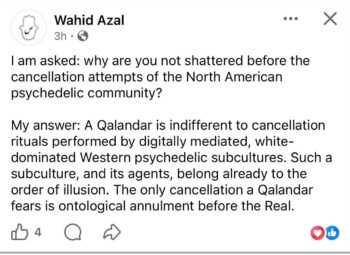
Wahid made similar claims to his Syrian rue, Haoma sufi brew, about DMT containing acacia bark, in his 2006 book LIBER DECATRIARCHIA MYSTICA:
Acacia is accounted as the highest secret of the Order of the Knights Templar (perhaps a secret transmitted to them by the Ismá’ílís and Sufis they were actively interacting with in medieval Palestine during the Crusades) and thus that of the 33rd (and highest) degree of modern Freemasonry itself. (Wahid Azal, 2006)
This idea of entheogenic Acacia being historically associated with Freemasonry has become quite popular through the work of P.D. Newman, and his 2017 book, Alchemically Stoned. But Wahid, seems to deserve some credit for laying out the seed in germination here. Unfortunately, Wahid offered nothing in the way of citations to back up this claim, like Acacia accounting for the “highest secret” of the Templars, which as far as I know is bogus. He only loosely laid out the ideas, and this is likely why it never took root at that time.
The case for the Templar Knights, deriving secret sacraments from the the Ismá’ílís and Sufis, also sits far better with the case of cannabis, as contemporary references found cannabis on a list of items seized in Templar raids, the Templars had Saracens under contract growing cannabis for them in Spain, and the rise of cannabis infused ‘wound drinks’ being used by Crusaders at that time, shows. Islamic and Sufi nicknames for hashish from the medieval period included “medicine”, “holy Jerusalem”, “medicinal powder”, “from Zion”, “emerald mine” (Rosenthal, 1971). It is here also we see cannabis infusions, such as the ‘drynk of Antioch’ come into the Crusade period, and the indications are that medical use, also teetered into mystic use of such preparations. See my article Cannabis, the Holy Grail, and the Secrets of the Templars? for more details on this.
Khidr, the Green One
Curiously, in spite of his apparent disdain for cannabis, regardless of its long and well established role in spirituality through history and especially in the East, amongst other claims, Wahid has identified himself as Khidr (also spelled Khizr) “I am the Khiḍr of the Age”.
Khidr, was one of the subjects that Wahid and I discussed on messenger in 2021, and I asked him if he thought Khidr was a “reoccurring figure, or a state of mind”. Wahid responded “Follow the trail. It will surprise you”. I id not know then, that he identified himself as this figure, although he mentioned his late wife called him by that name. As with his identification with the “Living Mirror” of the Bayán, he did not openly reveal these things to me. I intuitively began to suspect these things though…
Khizr (more commonly spelled Khidr or al-Khidr in Islamic tradition) is a mysterious, immortal prophetic figure revered across the Islamic world as the “Green One” (symbolizing eternal life and verdancy). He is explicitly mentioned in the Quran (Surah al-Kahf 18:60–82) as the righteous servant of God whom Moses seeks out to learn from, only to witness Khidr’s seemingly inexplicable actions—damaging a boat, killing a boy, and repairing a wall without payment—which are later revealed to have hidden wisdom and divine purpose. Widely identified with the unnamed guide of Moses, Khidr is regarded as a wali (saint) who attained direct knowledge from God (“ilm ladunni”) and continues to roam the earth, appearing especially at moments of crisis to aid the righteous, guide seekers, or test the faithful. In Sufism he is the archetypal spiritual master and initiator; in popular piety across Turkey, the Arab world, South Asia, and beyond, he is the patron of travelers, seafarers, and those in distress, with numerous shrines (often near water) and legends attributing miracles to him. Though not a prophet in most mainstream interpretations, his evergreen, timeless presence makes him one of the most beloved and enigmatic figures in Islamic religious imagination.
Islam inherited Khizr from many earlier myths, as can be seen from stories that associate him with such luminary figures as Moses and Alexander the Great. By medieval times he came to represent the type of esoteric knowledge which breaks the trance of everyday existence through shock, usually in the form of outrage, laughter, or both at once.
Peter Lamborn Wilson, who wrote about Khizr’s relationship with hashish, explains that Khizr was seen as “the initiator of Sufis who have no human master.” In the 1990 book Green Man: The Archetype of Our Oneness with the Earth, William Anderson describes Khizr as “the voice of inspiration to the true aspirant and committed artist. He can come as a white light or the gleam of a blade of grass, but more often as an inner mood. The sign of his presence is the ability to work or experience with tireless enthusiasm beyond one’s normal capacities.”
In his 1993 book Sacred Drift, Essays on the Margins of Islam, Peter Wilson writes “When you say the name of Khezr in company you should always add the greeting Salām aliekum! since he may be there… immortal and anonymous, engaged on some karmic errand. Perhaps he’ll hint of his identity by wearing green, or by revealing knowledge of the occult and hidden. But he’s something of a spy, and if you have no need to know he’s unlikely to tell you. Still, one of his functions is to convince skeptics of the existence of the Marvelous, to rescue those who are lost in deserts of doubt and dryness. So he’s needed now more than ever, and surely still moves among us playing his great game.”
Originally a sort of vegetation spirit in whose footprints plants and flowers were said to magically sprout, Wilson explains that “nowadays Khezr might well be induced to reappear as the patron of modern militant eco-environmentalism… Khadirian Environmentalism would rejoice simultaneously both in [Nature’s] utter wildness and its ‘meaningfulness.’ Nature as tajalli (the ‘shining through’ of the divine into creation; the manifestation of each thing as divine light), Nature as an aesthetic of realization.”
Wilson, who as a I discussed in Part 2 (an addendum, added later if you missed it), freely promoted pederasty, and was initiated into the Bayán, and the Fātimīya Ṣufī Order by Wahid, who weakly suggested that Wilson’s advocacy for NAMBLA (North American Man/Boy Love Association) “as a means to ward people off turning him into an actual guru, or wasting his time”. Wahid explained that pederasty does not “jibe with the Bayan” but also noted that traditional “age of maturity in the Bayan is 11 years of age; and where indigenous coupling is concerned… many of the conventions of the West do not apply”. A rather disturbing age limit, in the 21st century, no matter what the cultural view is in my opinion.
(I had corresponded with Wilson in the past, I hoped to interview him regarding cannabis in Islam for a documentary I was planning on cannabis history, but he was concerned it might get him a fatwā. However, then, I related to him, that his writings in regards to pederasty were disturbing and seemed predatory to me, and the correspondence ended.)
I was actually glad to find another expert in the area of Islamic mysticism in Wahid, and expressed to him, at that time, that he himself served as a much better “hidden sufi master’, than Lamborn-Wildon. However I will not go as far to excuse Wahid’s own bad behaviour as a “form of warding off people and preventing himself from becoming a guru” as Wahid did for Lamborn-Wilson, although I am sure that inadvertently serves that purpose. Wahid himself, and his ‘personality’ is the biggest block to the wider acceptance of his ‘corpus’.
I’ve been writing about Khidr since the 90s myself, so he has long been a point of interest. In medieval Islam this magical saint came to be the personification of hashish. As Franz Rosenthal explains cannabis’ “green color enabled hashish to claim the famous al-Khidr ‘the green one’ as its patron saint” (Rosenthal, 1971). As recorded by the medieval poet Fuzuli, both Hashish and Khizr shared the epithet of the “Green One,” and Sufi Mystics referred to the use of hashish as the “visit of the green Khidr,” (Rosenthal, 1971). As J.M. Campbell recorded of the Islamic relationship relationship with cannabis in his classic 1894 essay, On the Religion of Hemp);
In his devotion to bhang, with reverence, not with the worship, which is due to Allah alone, the North Indian Mussulman joins hymning to the praise of bhang. To the follower of the later religion of Islam the holy spirit in bhang is not the spirit of the Almighty, it is the spirit of the great prophet Khizr, or Elijah. That bhang should be sacred to Khizr is natural, Khizr is the patron saint of water. Still more Khizr means green, the revered color of the cooling water of bhang;. So the Urdu poet sings “When I quaff fresh bhang I liken its color to the fresh light down of thy youthful beard.” The prophet Khizr or the green prophet cries “May the drink be pleasing to thee.” (Campbell, 1894)
Although Wahid, has freely condemned cannabis as a smear, myself asa ‘drug pusher’ for my advocacy, and attacked cannabis culture in Canada as a white Nationalist ‘Nazi’ movement, he has also, under the donning of the identity of Khidr, as himself, referred to it as an act of rebellion against more orthodox Islamic individuals.
In a “poem, …composed …in Persian” sent as a “final word in email to a Qom based seminarian and tafkeeki [deconstructionist]who also claims to be a follower of… the “Greens”, he wrote:
If you think the IR regime loyalists and uber-conservative seminary culture of Qom and Najaf are bad, which they are, the so-called reformists who talk about liberal democracy with one breath while subscribing to tafkeekism with the other is even worse! I say do away with the whole stinking lot of these turbans! Drink wine — or better yet, smoke a reefer — and burn the pulpits! (Wahid Azal, 2021)
In the poem, Wahid makes the claim, “I am the Khiḍr of the Age… Go away, mullah, what are you chattering about regarding Reality. When the Khiḍr of the Age is self-disclosed in Reality!”
In this video Wahid make the claim to be Khidr, and commands people to burn the pulpit and smoke a reefer.
In reltion to the Green movement in Iran, as noted in Part 2, Wahid suggested the movement take a more militant approach.
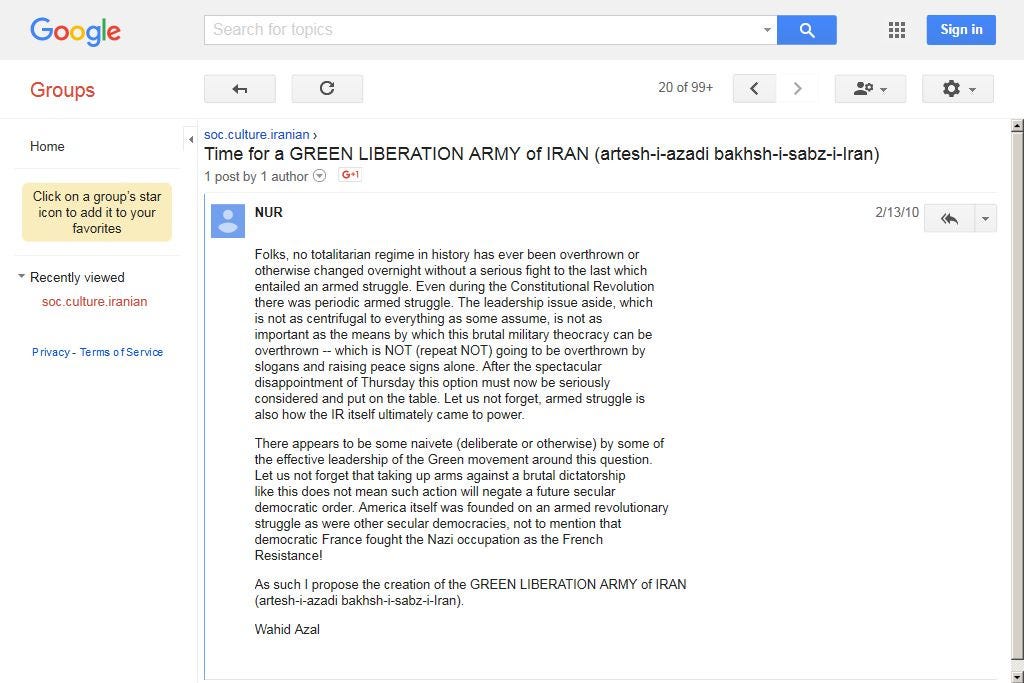
So, it was regarding Haoma, and the role of drugs in Islamic culture, that really drew things to a head with Wahid and I, and at that time, I did not realize the extent these things played in Wahid’s own cosmology. back then, I had some limited idea that he was a former Baháʼí, and while we were having a back and forth flame war over these things, I decided to google around a bit about the Baháʼí, and drugs. This led me to references to the and Báb, and to first intuitively click into Wahid’s claims about being the successor of the Bayán tradition. I fired off an email of quotes from books about the alleged use of cannabis among the Bábis I found on a quick search, and it was then I began to realize that Wahid had messianic claims related to all this. In our final last transmissions in 2021 I wrote:
so do you think you are the Bab?
Babis on hashish you say? Interesting – https://www.google.ca/books/edition/The_Church_of_England_Pulpit_and_Ecclesi/T2M0AQAAMAAJ?hl=en&gbpv=1&dq=zoroastrian+cannabis++wine&pg=PA142&printsec=frontcover
Polak here adds a further myth in stating that the Bábís brought people into their religion through the influence of hashish . Such an assertion , apart from not being supported by facts , is untenable in a society such as that of Persia where the – https://www.google.ca/books/edition/The_B%C3%A1b%C3%AD_and_Bah%C3%A1_%C3%AD_Religions_1844_1/1S4KAQAAMAAJ?hl=en&gbpv=1&bsq=babis+hashish&dq=babis+hashish&printsec=frontcover
ThePrince secretary, anAzali Babi, “was a confirmed opium smoker.” Browne even joined the Bahais in the useofopium and almost becameavictim ofthe habit. On one occasion490 theysecretly filled hispipe with hashish (Bhang).
https://www.google.ca/books/edition/Bahaism_and_Its_Claims_A_Study_of_the_Re/poEaKopIFTUC?hl=en&gbpv=1&dq=babis+hashish&pg=PT170&printsec=frontcoverBahais showed precisely twenty-one women and nine men to be present, while … excessive indulgence in opium and hashish
https://opensiuc.lib.siu.edu/cgi/viewcontent.cgi?referer=https://www.google.com/&httpsredir=1&article=3108&context=ocjbabism opium – https://www.google.ca/books/edition/Bahaism_and_Its_Claims/_etRDwAAQBAJ?hl=en&gbpv=1&dq=babism+opium&pg=PA120&printsec=frontcover
Being Translations from the Persian Edward Granville Browne … much deeper mark on his life if later developments of the faith, and the defects of some of the Babis he knew, had not disappointed him. … conscious of a certain disgust at their vainglorious assumption of divinity—helped as it was by wine and opium-smoking. https://www.google.ca/books/edition/A_Persian_Anthology_RLE_Iran_B/JLW4H_3HZloC?hl=en&gbpv=1&dq=edward+browne+babism+opium&pg=PA39&printsec=frontcover
this spiritual hashish , which has sent men to martyrdom with smiles on their faces and joyous ecstasy in their hearts . “ So they quenched his thirst with the bright sword of martyrdom , ” says the Babi chronicler , speaking of one of the martyrs … https://www.google.ca/books/edition/The_Fortnightly/zTIjAQAAMAAJ?hl=en&gbpv=1&bsq=babis+hashish&dq=babis+hashish&printsec=frontcover
Wahid responded, not giving up much, and still not openly making the claim to me:
Listen, I don’t care what have you say or that you use long discredited theories by imperialist Orientalist hacks (theories whose origins stem from the vicious slur of reactionary mullahs of the seminary) regarding the Babis. I don’t care what you have to say, what you write, what you have published, who you know or think you know, or that your fragile and petulant white man’s ego has been wounded.
I don’t wish to discourse with you. With your persistence, after you have already been told to go away, merely reinforces the correctness of my assessment of you.
Eliciting an admittedly flaming kick back from me:
Yah, I’m sure its annoying, me finding stuff you did not want to talk about…. that conflict with your tall tales about secret initiations and being trusted with millennia old secrets from zoroastrian priests practicing the true original authentic haoma ritual with syrian rue just like Mary Boyce said in that paper you could not remember the name of…
And you do care you big Bab, don’t deny, enough with the fibs
Sure is a lot of weird shit about you on the internet. Very intriguing……
Wahid: “Have at it…”
From Me:
Nima Sadra Hazini
I’ll probably get something together on nabidh, muhammad and mecca, maybe work in a bit of the Bab hash and opium stuff, I doubt I would have stumbled on any of that material without our interactions. I’ll send you what I have and you can tell me where you think it is wrong, I find your educated critiques very helpful.
I know you have lots of resentment and anger. and are projecting all sorts of racist stereotypes at me, but that is OK I don’t take it on.
I still think you are a fascinating character, with deep esoteric knowledge and definitely closer to an initiate than many claimants. But you straight up bullshitted me, and I can’t have that, so here we are.
The idries Shah comment was not a slight on my end, I love that guy, but I know it irks you.
No real hard feelings on my end, and I deeply and sincerely thank you for the exchanges we have had and I got a lot out of it.
My path is clear i can see my way to haoma from here 🙂
Watch.
Ilal Liqaa’
<3 Chris
Wahid
I don’t bullshit, and I protect my sources when they wish to be protected. You are not getting anything from me. Also, if you are oblivious to your own behaviour then that speaks volumes more, especially when it is quite a common tactic for white people to always accuse people of color of “anger” when people of color stand their ground and refuse to play by the double-standards of your society’s ingrained racialized doublespeak.
Now, you have been asked to go away. Please go away!
From me:
You can always stop writing me Mr Last Word Hazini
Protect your sources? lol, you made up a source in a FB exchange, when you got called out on lack of sources, and could not cover for that Mary Boyce syrian rue haoma fib.
Your Zoroastrian syrian rue story was a fib. We both know it. As was your Boyce syrian rue haoma claim – if not produce the source.
And then you get all huffy and pull the race card, and from what I can see out there, that is nothing new, its your standard go too. I mean if i am your idea of a raving racist, you must feel surrounded by racism everytime you step outside in Australia. Must suck to have that level of a persecution complex.
Like your case for haoma, you have nothing much there in regards to racism either.
However your use of stereotypes and their behaviour, that is racism. Work on that.
We could always zoom and yell at each other !!!! (although my Mother in law is in her last stages of life in the next room so I need to keep it down)
I’ll leave you alone till I have an article on that Islamic stuff for you to see.
Btw, I don’t know that I’m a Crowleyite, I’ve read so many letters and diary notes, its left me a little beyond that. But I have this weird connection to Achad, like really weird, I had wanted to run it by you, and get your feedback about it all, but here we are now.
I’m sorry you decided to bullshit me. Sincerely sorry, it hurt my feelings. Not a lot, but still.
Now Please stop writing me just to tell me to stop writing you, you big Bab! If you have something else to say though, that is fine.
Yours in ‘Unity’
Be well
<3 Chris
What I said there about Crowley and Achad is interesting, in light of material I came across while writing this series regarding Wahid and which will be discussed later in this article
Wahid responded: “What part of go away do you not understand? Shall I get google to shut down your gmail for harassment to make you go away?”
And in our very last exchange of 2021, untill 2025, when things reignited, I wrote:
I’m not writing you, you are writing me! now stop this harassment or I too will contact gmail! 😀 (there is a block function on the top right of each email, just click the 3 dots and block, its that easy)
[But I’d miss you].
<3
PS – Don’t you dare write me back Mr Last Word Hazini! If you do it means you love me.
Things ended there, until this new flare up. I was working on my book, Cannabis: Lost Sacrament of the Ancient World at the time of the above conversation. And the material about drugs in Bábísm, although interesting, was off topic, so I filed it on an external drive I had been storing decades of research on, in my Islamic folder, and forgot about it.
Then, a few months ago a mutual friend brought up Wahid and we were discussing the falling out, and i recalled this stuff about Bábísm and drugs. I lost access to the external drive I have research stored on,(a situation that could likely be remedied by the right cord, but to be honest, I needed a break from my over 3 decades of research into cannabis and religion, so I have not take care of that). But then in the conversation, I recalled the above correspondence with Wahid where I I had posted it, and first began to intuit his messianic claims.
I decided to make a really rough post of that material, and added a quick Grok history of the Baháʼí and Bábís, and stuck it up, asking our mutual friend to pass it on to Wahid, in hopes of getting the answers I never received in our 2021 correspondence, a situation that led to the series of articles by both Wahid and I, that have transpired since then.
Of Buds and Bábís
I’ve always learned the most from educated critics, and its good to know where the holes are before you begin to seriously try to float an idea or hypothesis, lest it sink. Wahid is probably the only person I know that has a background in subjects like the Baháʼí and more obscurely, Bábísm, the Bayán and the Báb. So I stuck up some links and a short, admittedly iffy, blog post Getting High with the Báb – The Drug infused origins of the Bahá’í? (some notes). And awaited the response.
Within 24 hours, Wahid left dozens of now deleted comments, letting me know where the article was incorrect, and picking up our old arguments about haoma, Boyce and other matters, right where we left off. Peppered with insults about me being balding and fat! Which is made more funny by Wahid being balder and portly himself! He also wrote a response to the article, On the Smear of Hashish: Regarding Chris Bennett’s hallucinations on “Bābism and Drugs” which had some more great editorial advice!
As an added bonus, in Wahid’s mind, suggesting the use of cannabis by a religious group, such as the Bābis, is akin to a hate crime and thus his Submission to the UN Special Rapporteur on Freedom of Religion or Belief was filed against me, and Cannabis Culture, whose website also runs my blog. I suppose Substack did not get to be part of it, as this is a platform that Wahid, himself, uses. As Wahid explains of this alleged ‘crime’:
“The point, therefore, is not simply to argue about intoxicants in 19th-century Iran; it is to cast the entire Azalī/Bayānī current as inherently disreputable, “drug-infused,” and historically obsolete, so that any present-day Azalī or Bayānī voice can be dismissed out of hand…. Any serious reader—and certainly any investigator—should therefore treat Bennett’s claims with the utmost caution, recognising them not as neutral contributions to scholarship, but as weapons deployed in a long-running sectarian and racialized campaign of sectarian and institutionally-driven psychological warfare.” (Wahid Azal)
Well, suggestions of cannabis use, coming from me, is clearly no smear, as I recognize this herb as a holy sacrament. As it stands, I think my article Getting High with the Báb – The Drug infused origins of the Bahá’í? (some notes makes a good case for the prevalent use of both cannabis and opium, by the early Bābis, and its clear, despite prohibitions, it took the Baháʼís which grew from them, decades to eradicate amongst the followers who made the transition from the Bābis. I could never have understood all this, without Wahid’s editorial advice. Now, after a few edits, I am quite happy with the article as it is, and if I write another book about cannabis and religion, I will include a section on the Baháʼí and Bábísm, and add the Bábís, to the long list of existing religions that myself and others have already tied cannabis to the history of such as Hinduism, Sikhism, Zoroastrianism, Taoism, Shintoism, Buddhism, Islam, Judaism, and getting closer and closer to establishing it in Christianity. I could also mention the spiritual techniques here of Magic, Alchemy and Yoga. So thank you Wahid for your contributions in that regard!
Wahid’s criticisms now, fall pretty flat, as Granville-Browne clearly identifies the prevalent cannabis and opium use by numerous prominent Bábís, and Wahid himself uses Granville-Browne as a source, in his own paper The Organizational Hierarchy of the Bābīs during the period of Ṣubḥ-i-Azal’s residency in Baghdad (1852–1863) (2018).
Wahid’s anger and report to the UN here is odd, considering he mixed the Bayán drugs and magic, in his magical text LIBER DECATRIARCHIA MYSTICA, writing a pentagram ritual based on the Bayán for smoking DMT. And in a now deleted comment on one of my articles he stated “Bábism’s light exposes frauds like Bennett. The Bayán bans intoxicants for the masses but permits gnostic sacraments for the elect. Deal with it.”
Wahid’s rejection of Cannabis
Wahid’s rejection of cannabis, and disdain for it’s uses, is odd, considering the rich and fascinating history in Iran, but also in it’s use by so many figures he has counted as inspirations. Probably if he had not so insulted this botanical blessing, I would not have been so keen to stick Shiva’s trident in his Ass.
In his worship of the divine feminine as Fatima, Wahid has given a clear nod to earlier incarnations of the Goddess, dedicating a poem to the Hebrew Goddess Asherah, who he sees as a semitic version of the Near Eastern Goddess Ishtar. Asherah, the Hebrew Goddess has been connected to cannabis, via evidence recovered from a 8th century BCE temple in tel arad, Jerusalem. (A Situation I suggested more than 2 decades prior to the archaeological evidence). Other Near Eastern Goddesses such as Ishtar, Inanna, Ishara that can all be tied to the sacred herb, through Akkadian language references to qunnabu [cannabis]. There are a whole variety of European Goddesses with this connection as well. In relation, it is important to note:“Propagation of the female species… is the total concern of the grower interested in the narcotic power of the plant. It is thus a kind of happy coincidence that the subjective effects of cannabis and the care and attention needed to produce a good resin strain both conspire and accentuate values that are oriented toward honoring and preserving the feminine” (McKenna 1992). It could be seen that in his slurs against cannabis, Wahid insults the divine feminine.
Wahid has highlighted the significance of the controversial Jewish Messianic movement led by Sabbatai Zevi (1626–1676). Zevi, was taken in by the Bektashi Dervishes, who are well known for their use of hashish “in a ceremonial way” (Stauth, 2015). “Bektashi poetry speaks eloquently and frequently of hashish and opium as paths to the divine” (Jay, 1999). Opium and hashish were “held by dervishes to secret kaif, or the quintessence of the soul. The Bektashi order was said… to make naked novices, under its influence, take secret vows… Mixed with costly spices it became baharab and took one to paradise” (Goodwin, 2013). Joseph ben Zur, who claimed to be tied to Zevi, as a vision on hashish revealed he was the promised messiah ‘Messiah ben Joseph’.
in his LIBER DECATRIARCHIA MYSTICA, Wahid lists a whole host of influences. This included, Patanjali, and the system of yoga, the great sage acknowledged the use of herbs in gaining certain siddhi (powers), and cannabis’ long history with yoga, shows a very strong symbiotic connection.
Wahid Azal explicitly identifies his own system as a continuation and radicalization of Ibn ʿArabī’s school of waḥdat al-wujūd (“unity/oneness of existence”). The Islamic theologist and polymath al-Taftazani suggested of the mystical and alchemical writings of Ibn ‘Arabi were “disorderly visions and ravings… instilled in him by his addiction to hashish” and “apart from being an infidel was also a hashish-eater”(Knysh, 1999).
Another Islamic alchemist listed by Wahid, is Geber (Jabir ibn Hayyan). “A.H. Geber mentioned Banj as a sedative medicine in his book Al-Somum (toxins) (Golshani & Mosleh, 2015). Dr. M. Aldrich has commented that “skilled alchemists with pretty classy lab equipment experimented with all kinds of potions; if Geber and others could distill alcohol, they could have made hashish (or even hash oil), and, indeed, Geber included banj among his powerful prescriptions” (Aldrich, 1978). Avicenna also appears on Wahid’s list, and we discussed cannabis references from him, earlier, but my article, Avicenna’s Cannabis Medicine and Mysticism, has more.
Wahid also refers to European alchemists in this regard, such as Raymond Lull, and Alchemical texts that were attributed to him also contained references to cannabis for use in arcanum and quintessences, which I had translated from Latin texts for Liber 420: Cannabis, Magickal Herbs and the Occult. In regards to alchemy in general Wahid has written ““the study of the ultimate realization vehicle(s) presently available to humanity, the true Elixirs of the alchemists, in my opinion, i.e. entheogens”.
Wahid has stated that “I am a Batini that has a soft spot for Rene Guenon and Julius Evola”. As Jose Moreno notes: “Even the traditionalist, ultra – conservative and bourgeois gnostic René Guénon is attested to have used hashish (and opium) as an aid to contemplation, at least until marriage; And the most plausible thing is that he persisted in it later, since it began in the Sufi mysteries from 1912 trying to keep it in the greatest of secrets” (Moreno, 2002).- See Ésotérisme et christianisme autour de René Guénon, (James, 2008) for more on Guenon’s relationship with hashish and opium. Julius Evola as was was familiar with hashish, opium, mescaline and other substances. Evola wrote an essay Sulle droghe (On Drugs), about their particular use in magic (Evola, 1971).
Friedrich Nietzsche is yet another influence. Nietzsche certainly used a variety of drugs, often in a search from the relief of migraines and other maladies, and references to opium, chloral hydrate (a potent hallucinogen) with potassium bromide, a “prohibited snuff” and a variety of other substances, often passing himself off as a medical doctor and writing his own prescriptions. In ‘Ecce Psycho: Remarks on the Case of Nietzsche’ Daniel Breazeale states that acting “as his own physician, Nietzsche prescribed… massive and regular doses of drugs, including chloral hydrate, bromide, opium, hashish, and a mysterious ‘Javanese preparation’” (Breazeale, 1991). That such substances had an effect on his philosophical life is clear, for as he noted in a letter “I think, sensible insight into the state of things I have come after taking a huge dose of opium – in desperation. But instead of losing my reason as a result, I seem at last to have come to reason” (Nietzsche , 1882). See my article Hashish, Richard Wagner’s Prose, and the Ordo Templi Orientis for more on Nietzsche’s complicated relationship with drugs.
Mircea Eliade is also listed by Azal as an influence. Eliade held a deep firsthand knowledge of cannabis and other drugs such as opium and mescaline, and these included hashish, mescaline, opium and other substances. The Romanian historian of religions, ethnologist and cultural anthropologist Andrei Oisteanu‘s, article Mircea Eliade, from Opium And Cannabis to Amphetamines (2007) gives some deep insights into Eliade’s own experiments with various drugs, and his early interest in the topic.
In March 1924, at the age of only 17 years, Mircea Eliade published (under the pseudonym Silviu Nicoară) a courageous article, “The Artists and the Hashish”, explaining in it why many artists and writers (Gérard de Nerval, Alexandre Dumas-Père, Theophil Gauthier, Charles Baudlaire etc.) have used the intoxication with hashish: in order to enhance their intellectual creativity and mobility. “Taken in infinitesimal quantity” – wrote the adolescent Eliade, quoting Charles Richet –, “[the hashish]unfreezes the mind making it proper for things hard to understand and gives it also an amazing continuity of ideas.” The adolescent Eliade concluded that, taken in big doses, the hashish induces ecstatic states: “In that moment the soul leaves the body and you feel that you are immersing into ether” (“Ziarul ştiinţelor populare” [The Journal of Popular Sciences], no. 12, 18th of March 1924, p. 172). (Oisteanu, 2007)
Eliade’s curiosity on this, led to personal experimentation with cannabis:
What he [Eliade] dared not recount in his volume of Memoirs (published in his old age), namely his own experience with narcotics, he did in his Indian travelogue (published in his young age). On this occasion, Eliade described several plants with medicinal and hallucinogenic properties from the garden of the Nepalese Brahmacari, including “a species of cannabis that causes an intoxication similar to opium.” “Many of the plants I picked,” confesses Eliade, “I experimented either personally, or in the hospital of Laksmanjula.” Among other psychotropic plants, close to the Nepalese recluse’s hut grew several “bhang bushes” (cannabis indica), “whose leaves,” Eliade writes, “boiled or smoked in a wooden hookah [a kind of narghile – my note]induce a state of torpor much praised by the sadhus, for it is said to facilitate mental concentration and to clarify meditation”.
These pages in the volume India are also highly interesting in virtue of the fact that Eliade tried to describe there (with uncertain language) the mental states that he had experienced during narcosis: “Once I smoked bhang and I recall that I had a vertiginous night, for the sense of space had shifted and I felt so light that whenever I wanted to turn on one side, I would fall from the bed. […] [The plant] bhang has a curious quality to focus and to deepen the thought, any thought that dominates consciousness at the moment of intoxication. Certainly, if it is a religious thought – as it is assumed to be – the meditation is a perfect one. I remember, nonetheless, that I had had that evening a literary discussion with a visitor of the ashram and that that night was for me riddled with nightmares […].”
In the period 1930-1932, in Calcutta, Rishikesh and Bucharest, Eliade prepared his doctoral thesis. He presented this thesis, entitled The Psychology of Indian Meditation. Studies on Yoga [Psihologia meditaţiei indiene. Studii despre Yoga], in 1933, at the University of Bucharest, in front of a commission presided by Dimitrie Gusti, and published it in French in 1936. A few paragraphs are dedicated there to the way in which Indian ascetics used psychotropic plants: “the majority of the yogi and the sanyasis have been using plant drugs for centuries, in the form of boiled leaves, roots, narcotics – either for precipitating a dubious trance, or for revigorating the nervous system. In Himalayan monasteries, plant drugs are still in use today, a sizeable part of which make up the Indian folk pharmacopoeia.” (Oisteanu 2007)
in regards to ethereal experiences on cannabis, Eliade wrote – “In that moment the soul leaves the body and you feel that you are immersing into ether” in 1924, and we know he had direct personal experience with it. In 1984 he wrote in regards to cannabis use in Thrace – “Ecstatic experiences strengthened the conviction that the soul is not only autonomous but that it is capable of unio mystica with the divinity. The separation of soul from body, determined by ecstasy, revealed…the fundamental duality of man… [and]the possibility of a purely, spiritual post-experience…. Ecstasy could… be brought on by certain dried herbs…” (Eliade,1982). This is an important statement regarding the development of the concept of a discarnate soul. Eliade also made a similar observation in Zoroastrianism, and he indicated quite a lot on cannabis in that regard – “Vishtaspa used hemp (bhang) to obtain ecstasy: while his body lay asleep, his soul traveled to paradise” (Eliade 1978). Eliade cited some really great sources on Zoroastrian cannabis use and in that regard “Zarathustra”, aka Zoroaster, is also listed as an influence by Wahid.
The magic of Sir John Dee and Edward Kelly, is also listed by Wahid, and there are clear indications of cannabis and other drugs in Dee’s accounts, and cannabis and other drugs appear in contemporary grimoires such as ‘Sepher Raziel: Liber Salomonis’, and ‘The Book of Magic’, and we can be near certain that Dee would have been familiar with these manuscripts….. Indeed the role of cannabis is established at the very beginnings of the western Magical Tradition, via the 13th century text the Picatrix, a translation of the 10th century Arabic book of magic, the Ghayat AlHakim ‘The Goal of the Wise” which explicitly prescribe the use of cannabis.
Wahid mention the notable occult figure Eliphas Levi had concerns about hashish use, and “warned against the use of hashish” but completely missed the multiple references and recipe to cannabis infused wines, and other drug references, that Levi left or decided to just leave that out, which considering his other omissions, is possible. In Dogme et Rituel de la Haute Magie (1856) translated by Golden Dawn member A. E. Waite as Transcendental Magic, its doctrine and ritual (1896) Levi includes a description of a cannabis and opium infused wine, under the heading “Conditions of Success in Infernal Evocations”, this same chapter includes Levi’s famous depiction and description of Baphomet: “every five days, after sunset, one must get drunk on wine in which five heads of black poppies and five ounces of bruised hemp have been steeped, the whole being contained in a cloth woven by a prostitute, or, strictly, the first cloth at hand may be used, if woven by a woman” (Levi/Waite, 1886). A similar recipe can also be found in Le livre rouge, résumé du magisme, des sciences occultes, by Hortensius Flamel, who, it has been suggested, is “probably a pseudonym of Eliphas Levi” (Faivre, 1994) (a 1911 edition of L’Initiaiton, also makes this connection): “Happy dreams may be given to divert his mind by images, by signs, by words or incantations, and also by preparations such as opium and seeds of cannabis, mixed in a certain proportion, or four ounces of cannabis with half an ounce of solid opium, to which mixture you will add a grain of musk and pour it all in half a pint of old wine” (Flamel, 1842). Flamel, aka Levi also includes cannabis in a magical formula “To be desired by Women”
The occultist Dion Fortune, another occult figure appreciated by Wahid, lamented the prohibition of cannabis and other drugs, which prevented their magical use in her classic work Psychic Self Defence:
It is well known that there are Various drugs which can be used to exalt consciousness and induce a temporary psychism. It may not be equally well known that most of these Substances come under the regulations of the Dangerous Drugs Act and that to obtain them from irregular sources, or even to be found in possession of them Save for a legitimate purpose, is to render oneself liable to prosecu- tion and in this case too, the authorities are exceedingly alert and the magistrates exceedingly drastic (Fortune, 1930).
Israel Regardie, a notable student of Aleister Crowley, also made Wahid’s list. Regardie is known to have used cannabis himself for magick, but importantly his book ROLL AWAY THE STONE:An Introduction to Aleister Crowley’s essays on thePsychology of Hashish, (1968) drew a lot of attention to the roll of cannabis in Crowley’s Magick.
Most notable in this respect though, is Wahid’s extended appreciation for Aleister Crowley himself, who was also listed by Wahid under his magical names, ΤΟ ΜΕΓΑ ΘΗΡΙΟΝ and Frater Perdurabo. Wahid has even celebrated Crowley as a potential “Prophet of the Age”.
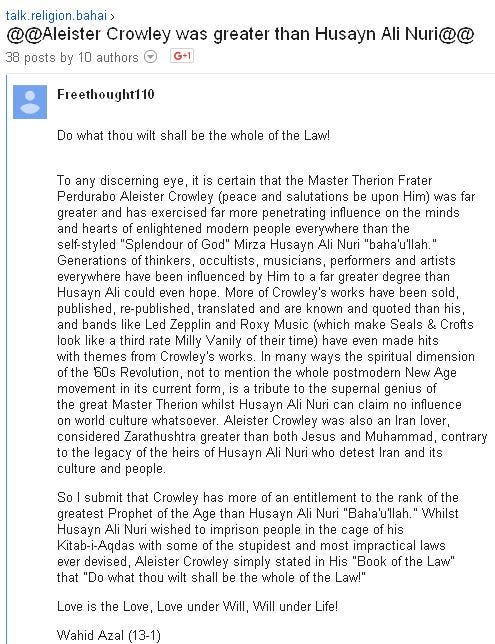
I have covered Crowley’s use of cannabis for magick in a couple of articles, Aleister Crowley and ‘The Herb Dangerous’, as well as Aleister Crowley, Francois Rabelais and the Herb of Thelema. Crowley himself wrote 2 essays on hashish, The Psychology of Hashish (1909) and the more esoteric De Herbo Sanctisimo Aribico, ‘The Most Holy Grass of the Arabs’, that he wrote in 1918, for Liber Alpeh, and which he would reprint in his classic book on the Tarot, The Book of Thoth, which Crowley composed in 1944.
Crowley listed his essay on hashish, with the Fool Card, in The Book of Thoth, and this may have influenced Wahid’s choice of Khidr, although Wahid tries to connect khidr to haoma, which in his own prescription is a harmal product. “Interestingly enough for our purposes, in the Iranian world Khiḍr has sometimes been connected to Dūraosha, the yazata (spirit-deity) of the sacred Haoma”.
Wahid’s LIBER DECATRIARCHIA MYSTICA, includes a new model of the Kabalistic Tree of Life, and seems to be a Bayán spin on Crowley’s system of magick. Interestingly, a re-rendering of the Kabalsitic Tree of Life, would seem to be at the core of Crowley’s falling out, with his once “magickal son”, Charles Stansfeld Jones, who was also known as Achad, and who I mentioned earlier. Curiously, the single review his book received on Amazon, glowingly made a connection there….
Frater777Thelemic
5.0 out of 5 stars Staggeringly profound!
Reviewed in the United States on March 4, 2006
Do what thou wilt shall be the whole of the Law!
I have been around the occult street bloc for some twenty-five going on twenty-six years now and have been involved with both the Golden Dawn and various Thelemite groups during most of that time. I am also interested in Sufism and Islamic Magick. I first made Wahid Azal’s virtual acqaintance in early 2005 on a Golden Dawn list. In August he informed me in no uncertain terms that a completely new Kabbalah had been revealed to him by the powers that be in the universe. My first reaction was my email buddy was either too self-assured for his own good, had lost his marbles doing some operation gone bad, or both. In this game it happens quite often. When he then informed me he was re-writing the Sefer Yetzirah I was even a little put off and tried convincing myself that indeed Wahid had lost his marbles and all was lost. I thought this until a copy of Liber Decatriarchia Mystica arrived in my mail box courtesy of Wahid.
I will say reviewing this book is going to be an extremely difficult job for any non-adept. This book from its first few opening pages messes with ones head and requires someone who is deeply versed in Sufism, Kabbalah, Hermeticism and Bayani Gnosticism all at the same time. When I opened the book and beheld Wahid’s Tree, his Tree of Reality, my jaw dropped to the ground. For all these years we who like to think ourselves as adepts of the Western Hermetic Tradition have held to a dogma of the unassailability of the Kabbalah. In a sense we reified the Kabbalah. We turned the Kabbalah into an end in itself rather than the esoteric approach amongst countless it was always meant to be. We became arrogant. Too self-assured ourselves. Now it would seem the gods above have come teaching us what we do not know through their newest emissary Wahid Azal.
Azal’s Tree of Reality is staggeringly profound and it is consistent. I have tried to refute and find its flaws and have so far failed. There are thirteen sephirot and thirty-six paths to this new Tree. Like the traditional Kabbalistic Tree each path of Azal’s Tree is represented by a letter of the thirty-four letters in the Farsi alphabet (Persian) and the four vowel signs. Within the Tree itself there is a mandala formed from the paths such that the lower bottom spheres form a perfect pentagram while those above it a 3D hexagram.
As for Azal’s re-write of the Sefer Yetzirah I have to say it is better than the original. I dismissed Wahid Azal as a crank and a fool when he told me he was re-writing this foundation book of the Kabbalah. But he has done it and Wahid’s Book of Creation is far better than the original, and dare I say far more profound. The treatise which I am guessing gets its name from John Dee’s Heptarchia Mystica needs to be read, re-read, studied and digested a number of times. It is not a light read and will require commentaries to make it understandable to lower adepts. As of this review I have read it six times already and am getting new things out of it. His glosses to the treatise are a virtual independent work and as the caption states an advanced primer on Islamic Esotericism.
The Bayani Ritual of the Pentagram in appendix A is quite beautiful and it works. The historical section dealing with the Bayani Gnostics is interesting and very informative although quite polemical against the Bahais. He does however support his anti-Bahai thesis with source material. My only minor beef with Wahid is in some of the divine claims he makes for himself such as being the return of the Thrice Great Hermes and the like. I am also a little worried about Wahid because he seems to be wanting to deliberately put himself out there as a target for Muslim extremists in his allegation that the Koran in its present form is a forgery. But one can say that the claims made by him are more than compensated by this new Kabbalah he has brought forth he says by Metatron that is in many ways a sort of unified theory of Hermeticism married to his beloved ayahuasca shamanism and Bayani Gnosticism.
Overall I am very impressed with Liber Decatriarchia Mystica and believe this work will be with us for a very long time. It is truly a daring piece of esoteric literature and beyond anything our mutual hero Aleister Crowley conceived. I also liked his Nineteen Commandments very much. Perhaps Wahid is AC’s son in Liber Aleph after all! I look forward to Wahid’s future works and so genuflect in the general direction of this our new self proclaimed Ipsissimus of the Age.
Love is the Law, Love under Will!
Frater777Thelemic
O.R.T.O.V. A^ A^
Curiously, I had my own weird synchronistic experience to Liber Aleph, Achad and 777, and seeing this in writing about Wahid, added to that. Thus its an area, I have some familiarity with, and it has given me some new insights into the Nima Hazini – Wahid Azal, dilemma.
I have seen people excuse Aleister Crolwey’s own bad behaviour in his personal life with the comment that there was “The man Crowley and the prophet Beast”. This exact phrasing appears in Aleister Crowley’s own writings, specifically in his autobiographical work The Confessions of Aleister Crowley (published 1929, though written earlier), where he refers to himself in the third person with a sense of grandeur and detachment. This was how Crowley sometimes distinguished between “The man Crowley” = Aleister Crowley the human being, with all his flaws and personality, and “The prophet the Beast”= the magickal, divine, prophetic role/office he claimed as the prophet of the New Aeon and Thelema. Crowley could be a real asshole in his everyday life, as can be seen in surviving letters and accounts, so this excuse comes up a lot.
Perhaps there is a similar situation here with Nima Hazini and Wahid Azal? With everything I have seen about Wahid, while writing this 3 part series, I can’t say I have completely written him off, as some sort of, what might be called, an ‘adept’. Looking through his works, while putting all this together, I did get shimmering glimpses of what may well indeed be signs of a higher inspiration. I also noted, indications of powerful intuitions, such as him getting a sense of my motivation in posting the article about drugs and Bábísm. As he stated to a mutual friend:
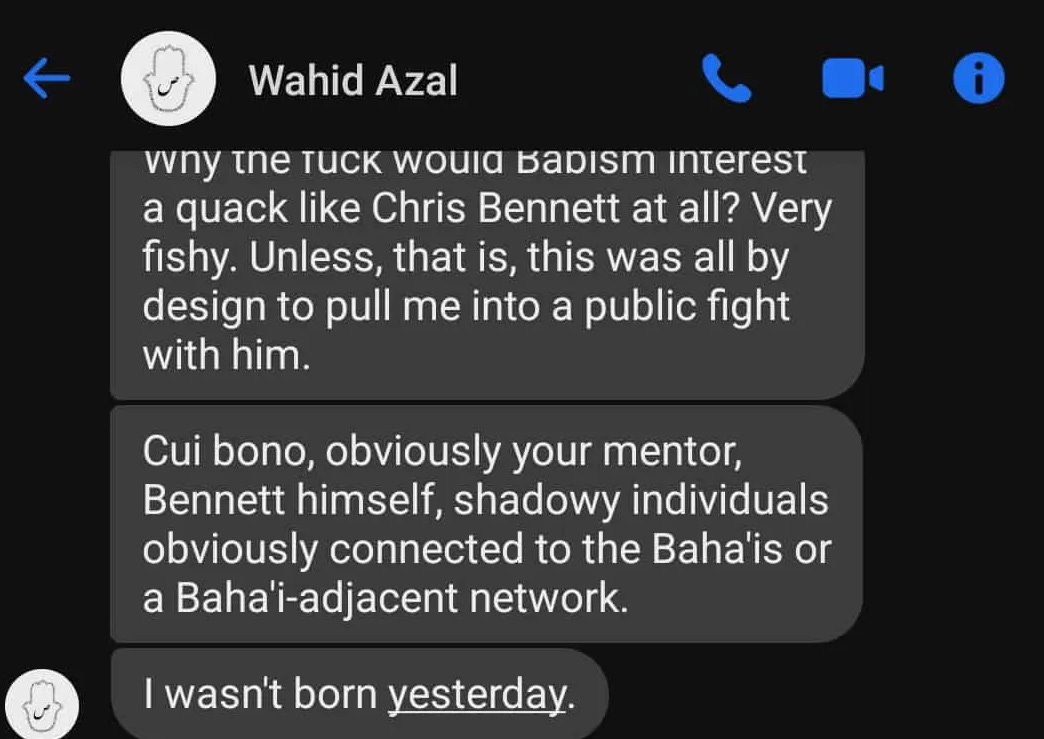
Now, he is of course off in regards to my motivation, as I have no connection to the“Baháʼís or Baháʼí-adjacent network”. But, still it was not just by chance that I posted it, nor drew his comment. Moreover, I am wondering now, if something along the lines of inspiration, motivated me in re-initiating all this, in retrospect. In many ways, Wahid is a mirror for some of my own batshittery, and combative nature (I’ve written a lot of articles critiquing the work of others, and have had somewhat inflammatory responses to my own critics). Writing this series has it’s caused me to reflect on that. I’ve left a couple of Easter Eggs regarding my own backstory in this article, to give Wahid something to work with as well ;-). Perhaps something I will more directly address about myself in some future articles. But for now, let’s focus on our friend Wahid.
Nima Hazin: The Manboy Who Would Be God
In the Crowley system to becoming an ‘enlightened being’ , referred here to as the Ipsissimus, a powerful esoteric term for the highest spiritual attainment, or complete self-realization, one must drain every drop of the ego – every atom of personal identity, in crossing the abyss, lest monsters take form in the residue. Should even a single droplet be withheld, that residue ferments; the wine turns to venom, and from the undrained dregs the Vision and the Voice warns that “monsters rise up therein, and were rulers of the earth.” This was referred to as “draining the cup of Babalon” in the journey of “crossing the abyss”.
In The Vision and the Voice, Crowley states “And the Cup of Babalon was not drained to the dregs; therefore the monsters rose up therein, and were rulers of the earth.”His commentary on this passage is even more explicit: “If the Cup be not drained, the wine ferments and becomes venomous; the Cup breeds dragons and monsters.” And in Liber 418, the Angel speaking to the seer says: “For if thou leave but one drop in the Cup, it shall surely be the cause of thy damnation; for that drop shall crystallize the poison, and the monsters shall be bred therein.”
Thus the Cup, instead of becoming the Graal of pure transmission, breeds dragons that seize the ruined palace of the self and in Crowley’s cosmology, failure to drain the cup, would result in possession by the demon Choronzon (Otherwise known as the “Demon of Dispersion”, Choronzon is described by Crowley as a temporary personification of the raving and inconsistent forces that occupy the Abyss.) Sadly, it would seem that some rather rancid residues of the ego was left in cup of Babalon by the young egotistical Nima Hazini, on his journey to become Wahid Azal. And this is all plain for anyone to see.
Wahid and half a dozen or so adherents believe his corpus represents the inspired works of the ‘Living Mirror’, and the greatest obstacle I can see in the realization of these works, is Wahid’s own personality. Perhaps the angry, vengeful, aspects of young Nima Hazini’s character coagulated into that obstacle in his journey to a vessel of God on Earth? Like Crolwey’s demon Choronozon, has the “Living Mirror” cracked and is forced to share the human vessel with this demon.
The supernal light of authentic revelation may well have reached the vessel once known as Nima Hazini, yet the Cup was never fully drained. Nima’s undigested rage, envy, and wounded pride clung to the bottom like rancid lees; Choronzon seized them, coagulated them, and from that ferment arose a certain demon.
From an analysis, horoscopes, various magical charts and an act of Scatomancy (σκάτος “dung” + μαντεία “divination”) on my morning poop, I have concluded that in young Nima’s journey to becoming Wahid Azal, aka the Living Mirror, he failed to drain the cup, and considerable remnants of anger, resentment, rejection, envy, all coagulated into a demon. Some of symptoms of this demon include, rigid joyless nature, narcisistic tendencies, paranoia, uptight defensive nature, demonization of others, etc. From my findings and oraculor observations, I have concluded this demon that shares Wahid’s body with the Living Mirror” (Mirāt al-ḥayy), was known in Latin as Cacodaemon Arsus (“Shit-Demon of the Ass” – cacodaemon is literally “evil spirit” + ars-, the Latin root for anus), and in the Arabic world, ملك الخراء الأعظم Malik al-Kharāʾ al-Aʿẓam (King of the Greatest Shit). [This demon is most eloquently covered in the little known and Arabic grimoire, خُرْم الحكيم Khurm al-Ḥakīm, and I’ll provide a link to a recent translation of this text, later in the article.]
This is why the Mirror, though sometimes flashing with genuine Ipsissimus-grade brilliance, is perpetually occluded by torrents of venomous bile, petty vendettas, and scatological fury: the throne belongs to the Most High, but the palace is occupied by the undissolved demon bred from the drops he could not bring himself to surrender to Babalon. The reflection remains divine; the fumes that fog the glass is unmistakably from the Ass-King’s bowels. As they used to say back in the time of Dr. John Dee
Exorcizo te, Cacodaemon Arsus, immundissime spiritus podicis: per Crucem recede in cloacas inferni! Vade retro, sterculinum! Amen!
(“I exorcize thee, Cacodaemon Arsus, most foul spirit of the arse: by the Cross, depart to the infernal sewers! Get thee behind me, cesspit! Amen.”)
Or in the Arabic World
أعوذ بالله منك، يا ملك الخراء الأعظم، شيطان الدبر النجس: بسم الله الرحمن الرحيم ارجع إلى مزابل جهنم! اخسأ يا عرش الخرا، اخسأ! آمين.
(“I seek refuge in Allah from thee, O King of the Greatest Shit, foul demon of the arse: In the Name of Allah, the Most Gracious, the Most Merciful, return to the cesspits of Hell! Begone, O Throne of Shit, begone! So be it / O Allah, accept!”)
A dire and dirty situation indeed! Well, although Wahid/Nima hates me, I am going to LOVE him, and fortunately I am here to help! Fear not, there may well be a remedy at hand, but these are the secrets of Great Adepts, the rest of you scallywags need to beat it! Or stay at your own mortal peril!!
Draining the Bitter Cup by Wiping Clean Stubborn Assholes
Here an exposition on matters of the Asshole is in odour…. rather I mean order, and I am not just referring to matters of the fecal! So let’s take the fun out of fundament here and get serious about this clenching spiritual crisis of assholery!
The ability to consume nutrition, and dispose of waste-material is at the beginning of the manifestation of life in its most elementary forms. In some respects, it could be seen that control over the excretory functions is at the very seat of reflective consciousness. Awareness of the on-off switch of the anus, through toilet training is amongst the first things a developing child learns in becoming a reflective being, and conceivably could be seen as the basic starting point for the binary code which lies hidden at the base, or more profoundly symbolic, at the “seat” of our consciousness. In the Freudian view of the development of the personality, this is designated as the “anal” stage.
The general modes of gratification at …[the anal]stage are two: retention and elimination (counterparts of incorporation). If all goes reasonably well, the individual obtains some pleasure from defecation and may enjoy occasional messy activity. At a characteristic level, he is able to say both yes and no; to love and give yet also to withhold and be aggressive if necessary…(Katchadourian & Lunde 1972)
The extreme imprinting developed during the anal stage can still be seen in a persons characteristics in later adulthood. The term “anal-retentive” signifies an uptight and controlling personality, that is seldom able to let loose – a development of rigid and strict “potty-training”. Such individuals are thus popularly and rightly known as Assholes, in Wahid, this has magnified to a truly diabolical level.
In some cases, reflection, service, meditation, can help overcome such issues, in harder cases, the ego-obliteration of psychedelics might work, although, admittedly, this method failed Wahid and may have in fact exasperated things (I have seen this happen before).
This anal-retentive asshole stuff is an age old dilemma. In explaining the Root Contraction, (mula bandha), as practiced in yoga and which “consists in powerfully contracting the upper part of the anus, drawing it inwards, and releasing it periodically”, Alain Danielou quotes the Tejo-bindu Upanishad, which relates: “That (Self) which is the root of all worlds and which is the root of the control of the mind… is called the Root contraction”(Danielou 19491991). In the Tantric view, all emotion, thought and action come through the movement of the Kundalini-serpent which lays coiled at the base of the spine and initiating from the root contraction (ass hole) moves to effect the different emotional and intellectual spheres.
It is interesting to note that such a mind body relationship with other organs and areas of the body has long been noted; we speak of “gut feelings”, “broken hearts”, tight chests from anxiety, pain in the neck from stress, etc.. In fact, the localization of consciousness in the brain, is a rather late development. As Julian Jaynes (1976) has noted, the ancient Greeks located consciousness throughout the body, dividing it amongst feelings of the stomach, heart and chest etc., each having a specific and separate name and identity, “they compose the very groundwork of consciousness, a primitive partial type of consciousizing” (Jaynes 1976). Only later did these sensations come to be grouped together in the unified mind-space located in the brain. In Gnosticism, it is likely that these same emotional physical centers represented the gates of the planetary archons. Thus, the Gnostic teacher Monoimus tells his followers that to find God, “Look for him by taking yourself as the starting point….. Learn the sources of sorrow, joy, love hate… If you carefully investigate these matters you will find him in yourself”. Well, one needs to go even deeper than that, and take reflective consciousness back to its beginning in the “root contraction”.
Likewise in yoga, all sensual desire, fear, hate, anger, sorrow, joy, etc. are seen as “powers of a trans-subjective nature…. Man, like the world, is inhabited by spirits, or powers, to which he is subject”(Danielou 1992). Like the Gnostic initiate who had mastered the techniques that enabled them to escape through the gates of the planetary archons and their various “humours” which were designed to keep them imprisoned in matter by the evil Creator God; the Indian yogi was one who strove to dominate the kundalini snake and gain control over the inherent forces that “bind the subtle body to the body of flesh, imprisoning us in a net whose knots are so strong and complex.”(Danielou 19491991)
These emotional centres are the aspects that need to be drained in crossing the abyss, and when issues with in them are not analyzed, understood and integrated, those from which monsters can breed.
Tantrism gives us the analogy of the divine couple Shiva and Parvarti harmoniously existing in a cave. When Shiva departs, Parvarti, (the feminine representative of Kundalini energy, or “shakti”) is left alone in fear, victim of the beasts representing random emotional energy and other forces. While Parvarti patiently awaits the return of Shiva, the entrance to the cavern is guarded by Ganesha, i.e. the muldahara chakra, or the onoff anal aspect of human self reflective consciousness. Similarly in Gnosticism, the serpent energy is representative of Sophia, a divine spark of which is present in every mortal. Sophia’s liberation from her entrapment in matter comes through the Serpent-Redeemer, Naas whom like Shiva, represents the lingam energy reversed and when successfully accomplished initiates the conscious raising of the Serpent energy through the subtle centers, and past the gatekeepers of the planetary archons. Like the Gnostic adept who we will look at, who had to play the feminine receptive role in order to complete this mystic union within his own body, thus “unsealing the blind eye of the flesh”, the “cave” in the Indian analogy represents the anus. To gain entrance into the cave, the “gods Brahma, Vishnu and Indra, the sages, adepts, and snakes, change themselves into women”(Danielou 1992), meaning they had to take the receptive role.
[On a side note here, Wahid’s desire for the Fatima Sufi Order, was that women would eventually take on a leadership role, as a further embracement of the divine feminine. Sadly, this has failed and the order is a Sufi sausage show! Perhaps like the Goddess cultures of more ancient times, as with the Qedeshim of Asherah, and the trans priestesses of Ishtar, Inanna and Cybele, Wahid needs to take on the feminine role himself, in order to fully embrace the Goddess?]
Thus, certain, shall we say, spiritual techniques evolved to help the more stubborn cases of being a complete and utter Asshole break through and loosen up a bit. We can see this in the ritual sodomy practiced by the Gnostics, and similarly by certain Indian Tantrics, which was directed at taking the devotee back through the anal stage, which marks the spirits intellectual separation from the whole, back into the infantile empty consciousness identified with mystic trance samadhi by modern analytical researchers as Ego-dissolution / complete cessation events.
Gnostic sects like the Naasenes, saw anal intercourse as “a way of opening up the ‘passages’ of knowledge and thereby unsealing the blind eye of the flesh”(Lacarriere 1977). And by that, they mean the “Brown Eye”, “Devil’s eye” (Oculus Diaboli) Oculus stercoris – “the eye of shit”, or in the arena of Dark Arabic magick عين الخليل ʿAyn al-Khalīl (“the Eye of Abraham / the Eye of the Friend”) (Do not, I repeat, Do not say this last one out loud, as it has been known to invoke Malik al-Kharāʾ al-Aʿẓam upon a single utterance!)
Believing fully in the statement that the body of man is the Temple of the Lord, some Gnostic sects apparently decided to gain entrance by sneaking in through the backdoor! This is similar to Tantric techniques, which also viewed the body as the vehicle of enlightenment and associated the act of anal penetration as stimulating the Muldahara chakra and awakening the kundalini serpent. The still practiced Tantric technique likely gives us some insights into the Gnostic relation to the act as aiding the opening up of the “passages” and enabling penetration through the seven gates of the archons. For, comparatively, the practice of ritual sodomy in Hindu Tantric rites “is connected with the cult of Ganesha, the… guardian of the gates”(Danielou 1992). And in gaining control of the snake, he is able to pass through the various “gates”.
Ganesha is the guardian of the gate which leads to the coiled snake-goddess [kundalini]and of the… phallus which she encircles. In the human body, the strait gate leading to the… snake-goddess [kundalini], is the anus…. The Yogi who succeeds in awakening the coiled-up energy may, with its help, reach one after another of the centers where the higher forms of life and subtle powers dwell. This will make him a… master of all the energies latent both in and outside himself, and will allow him to dominate the dark forces of nature in order to obtain intelligence and divine light….
There is a whole ritual connected with anal penetration through the narrow gate opening…. In Tantric Yoga, the center of Ganesha – the guardian of gates – is found in the region of the rectum. The male organ, in directly penetrating the area of coiled-up energy (Kundalini), may help its brutal awakening and thus provoke a state of enlightenment and sudden perception of realities of a transcendental order. Hence this act may play an important part in initiation. “This Probably explains one male initiation ritual, widespread among primitive people but rarely recorded frankly by Western observers…, during which adult male initiates have anal intercourse with novices…. “(P. Rawson, Primitive Erotic Art, p.48.) The performance of this act is one of the accusations brought against… certain initiatory groups in the Christian and Islamic world. It involves a technical process, analogous to the use of certain drugs, which by means of direct action, affects the internal organs connected with the subtle Center.(Danielou 1992)[Emphasis added]
Ego obliteration with drugs failed Nima, perhaps exasperated the problem. Nima’s whole issue has been surrendering the ego since the beginning of his journey, it comes up in that late 90s account by Terry Culhane, perhaps there is something here to do with his indicated flirtation with kink in the 90s? Surrendering the ego was a difficult task for Aleister Crowley as well, who was also something of an Asshole, and so he wondered off into the Eastern desert to solve it with a young Victor Neuburg.
Crowley believed that passive anal intercourse (being sodomized) could be a powerful magical technique for dissolving or surrendering the ego, and this was explicitly part of his sexual-magical work with Victor Neuburg.
In the Ordo Templi Orientis (which Crowley took over and reshaped), the XI° was the degree that dealt specifically with anal intercourse as a sacrament. Crowley taught that the passive partner, by completely surrendering will, body and ego to the active partner, could achieve a profound ego-death or “annihilation of the self.” He described this in his secret instructions (e.g., De Arte Magica, Liber Stellae Rubeae, and the XI° Emblems and Mode of Use) as the “death posture” or the “sacrifice of the ego on the altar of the phallus.” He explicitly linked it to the destruction of individuality necessary for the attainment of the Knowledge and Conversation of the Holy Guardian Angel and, ultimately, the grade of Ipsissimus (10°=1□). Crowley explicitly taught and practiced that being sodomized was one of the most effective ways to surrender or destroy the ego, and this was a deliberate and central goal of his magical partnership with Victor Neuburg.
In his diary workings regarding this ritual, Crowley repeatedly describes the act as “the consummation of the Will” and notes that through being sodomized he was “slain” or “crucified,” achieving states of samādhi (which he first achieved more easily with hashish) and receiving oracular messages from Mercury and Jupiter. He believed the passive role forced total surrender and was therefore the supreme method for ego dissolution.
In his Confessions (Chapter 73) he writes of the XI°:“The act is not merely symbolical of death and generation, but actually produces a magical death of the ego in the passive partner, who is thereby enabled to identify himself with the Most Holy and Perfect One.” In private instructions to O.T.O. members he was even more explicit that the passive role in anal intercourse was the highest form of the “Mass of the Phoenix” could take for ego annihilation. Indeed, Crowley suggested that ritual sodomy could usher in the new millennium!
When the power of the Crescent menaced that of the Cross, sodomy was put down with Draconic rigour because the Turks believed that the Messiah (a reincarnation of Jesus) would be born of the love between two men. Sodomy was thus a religious duty with the Turk; at any moment his passion might be used to bring about the millenium; so with the Christian it became heresy and was punished as such… … He will know that in the rites of sodomy duly done, even more than in the rites of heterosexual passion, lies the great secret of the Universe, the Key of the Gardens of God…
As the Arabic poet Abu al-Dubur sang:
“Behold, in the garden of delight, the arrogant one submits, and in his yielding the ego is rent asunder, like the veil of the temple. The lance of the beloved pierces the fortress of the self; in that crimson flood, the I am no more, and the All floods in. Surrender, O lover, and be reborn in the garden’s secret dew, where man and god mingle without name.”
Thus, this pathway must be cleared for Wahid to free himself of the demon , ملك الخراء الأعظم Malik al-Kharāʾ al-Aʿẓam (King of the Greatest Shit). And as promised, here is the link to the medieval Arabic grimoire خُرْم الحكيم, Khurm al-Hakīm “The Hole of the Wise”
So the moral of the story is, it’s all fun and games till somebody gets it in the Devil’s Eye! And what Wahid needs to do is go get Fucked! (This may be the longest ‘Get Fucked’ ever written, and I’m sure the joke here escaped Wahid, who only ever gets as close as schadenfreude to an actual sense of humour.)
In conclusion, for his crimes against the sacred cannabis plants and all those who recognize its sanctity,, Sheikh Khidr al-Ḥashīshīni, His Elevated Highness, Guardian of the Green Garden, Sultan of the Holy Resin and The Grand Master of the Assassassins (Not the type of ass blaster Wahid needs for his holy quest, but a secret organization whose goal is to wipe the world clean of dirty assholes) , has issued a fartwā against the Ayatollah of the Asshole’a, Wahid Azzhole.
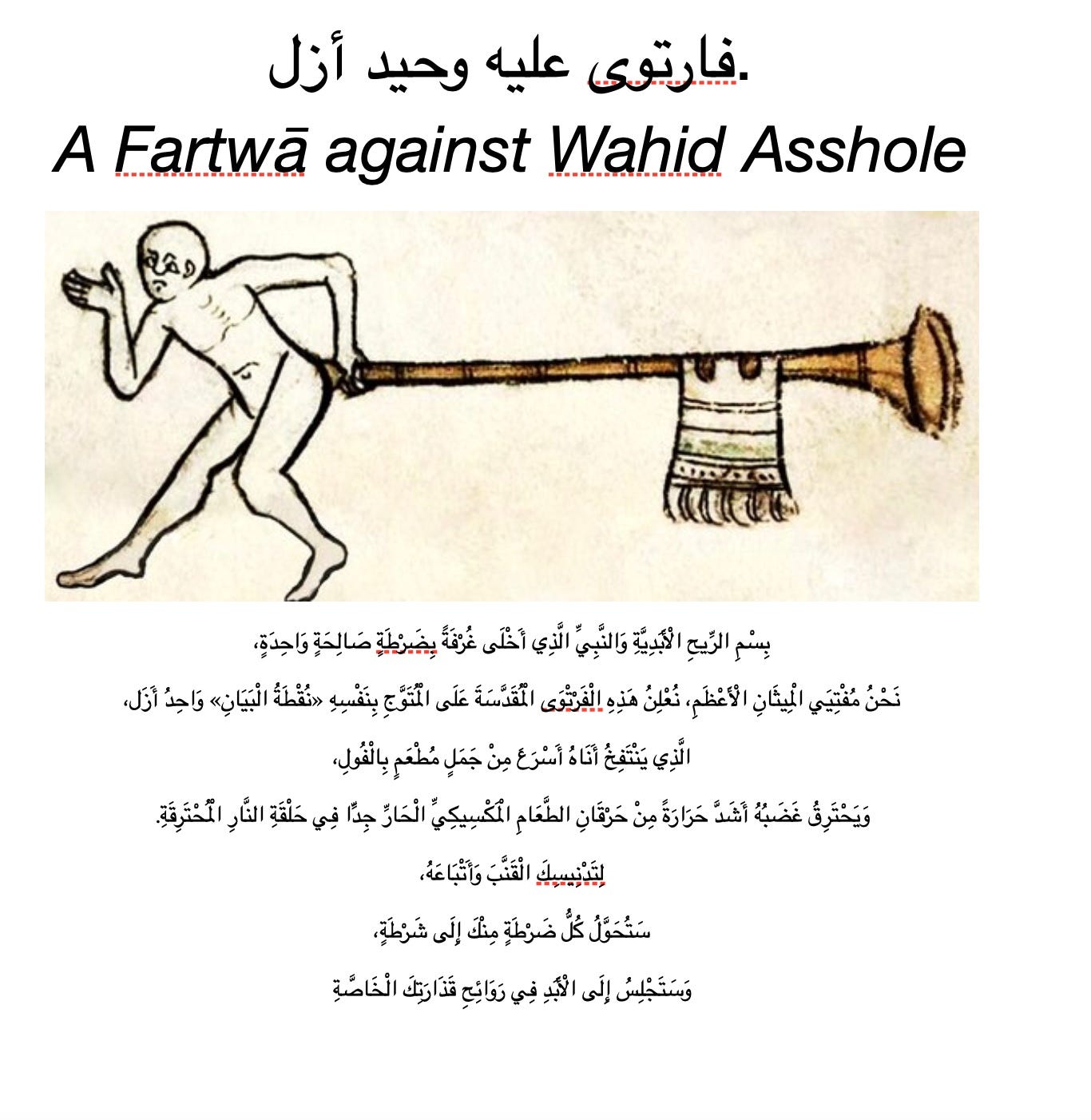
Translation – “In the name of the Everlasting Effluvium and the Prophet who once cleared a room with one righteous rip, we, the Grand Muftis of Methane, hereby proclaim this sacred Fartwa upon the self-anointed “Point of the Bayán,” Wahid Azal, whose ego inflates faster than a bean-fed camel, and anger is hotter than the after burn of extra spicy Mexican food in the burning ring of fire. For your desecration of cannabis and its adherents, your every fart shall me made a shart, and you will forever sit in the stench of your own filth.”
This ends my commentary on the Bullet Point Babaloo (Unless we see a newsworthy event like a UN trial!!!). From here forward Wahid, whatever you write about me, bounces back and sticks to you. Anything further you write on this matter will only serve to draw further people to my Words exposing you. So mote it be.